
So, no surprise that Flávio Bolsonaro, facing pre-election charges of corruption, money laundering, and tax evasion, successfully fled to the United States instead of facing the legal process in Brazil (as did the winner of Sunday’s elections, Luiz Inácio Lula da Silva several years ago when he was falsely accused); all while the United States holds legal Venezuelan president Nicholas Madura and his wife prisoners after a kidnapping which violated all norms of international law. I guess the severity of a crime is in the eyes of the beholder. Especially in this era when law is an irrelevancy, domestically and internationally, and only power counts.
While not formally endorsing Flávio, the United States did everything it could to get him elected, as it did with its other “pet” candidates in Colombia, Peru, Honduras, Bolivia, Chile, Argentina, Paraguay, El Salvador, Costa Rica, Panama, etc. The collaboration spanned long-term institutional advice from the United States far-right to direct strategic involvement by Trump administration officials and political venture capitalists during the 2026 campaign cycle.
The strategic advisory pipeline from the United States operated on three distinct levels:
- During the 2026 presidential campaign, two prominent United States State Department advisers—Darren Beattie (Senior Adviser for Western Hemisphere Affairs) and Ricardo Pita (Deputy Assistant Secretary)—actively led a strategic campaign aimed at restoring the Bolsonaro clan to power. According to investigative reports by journalists from The Business Standard and other outlets, these officials helped formulate tactical maneuvers to weaken President Lula da Silva, including successfully lobbying for 25% United States tariffs on Brazilian imports and advocating for the classification of Brazilian domestic criminal factions as foreign terrorist organizations to tilt electoral momentum in Flávio Bolsonaro’s favor.
- In April 2026, the Rockbridge Network, a prominent United States conservative political venture capital fund co-founded by American tech investors and current United States Vice President Vance, drafted a highly confidential blueprint titled “Rockbridge Network Brasil”. The group formally proposed creating a 23-member Technology Council—composed of 19 foreign business and political leaders—to directly advise Senator Flávio Bolsonaro’s Liberal Party presidential campaign. The strategy aimed to provide financial backing to remodel Brazil’s right-wing political landscape, mirroring American conservative operations targeting the media, universities, and legislative strategy.
- According to reporting by Agência Pública, United States strategists actively advised the Bolsonaro family on specific tactical playbooks, including: Deploying pre-emptive rhetoric to cast doubt on the legitimacy of electronic voting machines; relying heavily on alternative social media applications and coordinated digital ecosystems to orchestrate campaigns outside traditional media oversight; following the exact tactical blueprint utilized during the 2020 United States presidential election to reject concession, file immediate legal challenges, and push for the annulment of voting results when trailing in the count.
As to Flávio and his long standing criminal allegations. They include the following:
- The Banco Master Movie Financing Scheme. The primary investigation centers on whether the Bolsonaro family misused funds or accepted bribes under the guise of movie production. Favio is accused of receiving tens of millions of dollars from Daniel Vorcaro, the disgraced former owner of Banco Master, to finance an unreleased biographical film about his father (former President Jair Bolsonaro) titled “The Dark Horse”. Leaked voice memos and text messages from May 2026 revealed Flávio asking Vorcaro for $26.8 million. Authorities allege the funds were intended to bankroll his political agenda and cover the expenses of his brother, Eduardo Bolsonaro, rather than legitimate production.
- The Social Security Pension Fraud & Money Laundering Scheme. A separate, broader inquiry links Flávio to systemic fraud involving unauthorized deductions from elderly citizens’ pensions. Prosecutors allege Flávio used sports betting platforms and shell corporations to launder fraudulent deductions taken from Brazil’s social security pension system. Federal police discovered that Flávio held “master user” bank access to accounts belonging to Alcazar Holdings, a company tied to a lawyer accused of laundering over $1 billion through fraud.
- The “Rachadinha Scheme. Between 2004 and 2018, while Flávio Bolsonaro was serving as a state representative in the Legislative Assembly of Rio de Janeiro (ALERJ), he was accused of running a criminal organization that siphoned public funds by employing “ghost workers” and forcing legislative aides to return large portions of their government salaries back to the Bolsonaro family. Flávio’s legislative office hired numerous individuals as aides who rarely, if ever, showed up for actual public service work (ghost employees). Some of these employees were even revealed to be relatives of notorious Rio paramilitary militia bosses. Once those employees received their taxpayer-funded government salaries, they were forced to withdraw the cash or transfer up to 90% of their earnings back to the operation’s coordinator. Fabrício Queiroz, a former police officer and longtime close friend of the Bolsonaro family, acted as Flávio’s driver and chief political aide. Brazil’s financial intelligence unit (COAF) flagged over 1.2 million reais ($220,000) in highly suspicious, rapid cash deposits moving through Queiroz’s bank account. State prosecutors formally charged Flávio Bolsonaro in 2020 with embezzlement, money laundering, and misappropriation, alleging the diverted public funds were integrated into his personal wealth via a chocolate shop. Siphoned cash was reportedly mixed into the daily revenue lines of a boutique franchise chocolate shop co-owned by Flávio in Rio de Janeiro to give the illicit funds a legitimate commercial appearance. Prosecutors alleged that Flávio routinely used large bags of undeclared cash to purchase luxury apartments in Copacabana and later a luxury mansion in Brasília, artificially simulating capital gains to clean the money. The suspicious financial trail also tracked thousands of dollars in direct checks written by Queiroz to Jair Bolsonaro’s wife, Michelle Bolsonaro.
In late 2021, the original criminal case stalled. In a highly controversial legal victory for the Bolsonaro family, Brazil’s Superior Court of Justice (STJ) and the Supreme Court invalidated the core financial evidence. The courts ruled that prosecutors improperly bypassed formal judicial authorizations when acquiring Flávio’s initial financial intelligence reports (COAF data), resulting in the official dismissal of the original “rachadinha” charges on technical, procedural grounds rather than an acquittal on the merits. However, the political and legal landscape has rapidly shifted following his recent defeat in the October 2026 presidential runoff election and escape, first to Argentina and then to the United States. Lawyers have petitioned federal prosecutors to officially bypass the previously tainted evidence and reopen investigations into the siphoned funds, citing fresh, independent evidence regarding hidden safety deposit boxes used by the family during the peak of the ALERJ scheme.
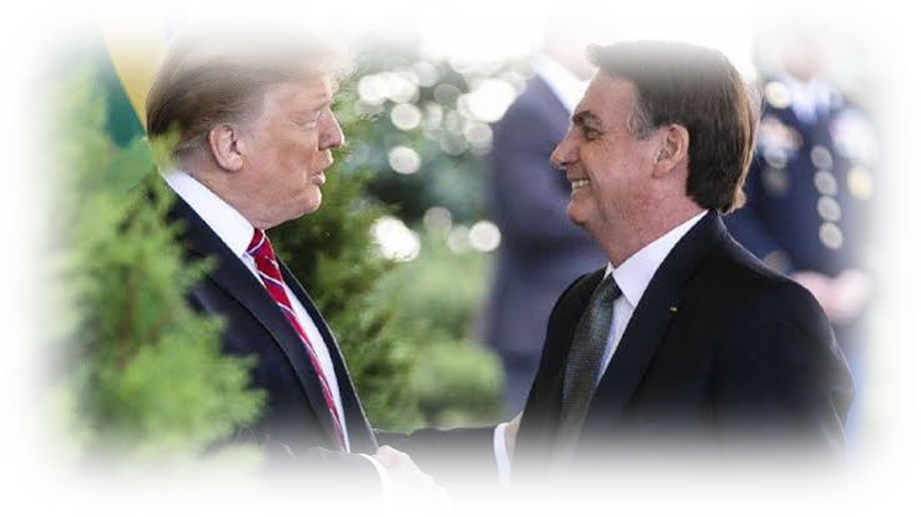
Based on the foregoing, it’s no wonder Flávio was obviously a perfect partner for the Trump administration and its allies in Brazil. Plenty to hide, plenty to lose, and an escape hatch? Essential. The Trump relationship with the Bolsonaro “clan” dates back to Jair Bolsonaro’s 2018 and 2022 campaigns. One of Jair’s other sons, former Congressman Eduardo Bolsonaro, made over 70 visits to the United States forming a close relationship with former Trump strategist Steve Bannon and other conservative political architects like Jason Miller. Now, it remains to be seen how the Trump and Bolsonaro families can find a way to mutually profit, given the failure of Flávio’s presidential aspirations.
The biggest loser or biggest winner from Flavio’s flight is probably his second stepmother, Jair’s third wife Michelle, a political power on her own in the right wing powerhouse Liberal Party, more so than any of the Bolsonaro brothers. During the recent parliamentary elections she attained the highest vote ever for the Senate and has a huge personal following among evangelical Christians and among conservative women. Flavio’s flight eliminates him as a political rival (their relationship was not smooth). On the other hand, his cowardice when compared to current president Lula may well tarnish the entire Bolsonaro clan given that he is the third member to flee to the United States (although his father returned to face the justice system after two months). Especially after he vowed to his followers not to do so and to remain in Brazil and prove his innocence.
Luckily for the Brazilian political right, President Lula is term limited from running in the 2030 presidential elections and has no viable successors visible and, of course, there is no telling what Donald Trump may do in the future. He has already been urged to kidnap and remove President Lula by right wing Florida Congressman Carlos Giménez (a major Trump ally), as he did to president Maduro and his wife in Venezuela.
_____
© Guillermo Calvo Mahé; Manizales, 2026; all rights reserved. Please feel free to share with appropriate attribution.
Guillermo (“Bill”) Calvo Mahé (a sometime poet and aspiring empirical philosopher) is a writer, political commentator and academic currently residing in the Republic of Colombia (although he has primarily lived in the United States of America of which he is also a citizen). Until 2017 he chaired the political science, government and international relations programs at the Universidad Autónoma de Manizales. Previously, he chaired the social studies and foreign language departments at the Eastern Military Academy in Huntington, New York. He is currently the publisher of the Inannite Review available at Substack.com; an intermittent commentator on radio and television in both Colombia and abroad; and, an occasional contributor to diverse periodicals and publications. He has academic degrees in political science (BA, The Citadel, the Military College of South Carolina), law (JD, St. John’s University, School of Law), international legal studies (LL.M, the Graduate Division of the New York University School of Law) and translation and linguistic studies (GCTS, the University of Florida’s Center for Latin American Studies). However, he is also fascinated by mythology, religion, physics, astronomy and mathematics, especially with matters related to quanta, cosmology and cosmogony. He can be contacted at guillermo.calvo.mahe@gmail.com and much of his writing is available through his blog at https://guillermocalvo.com/.

