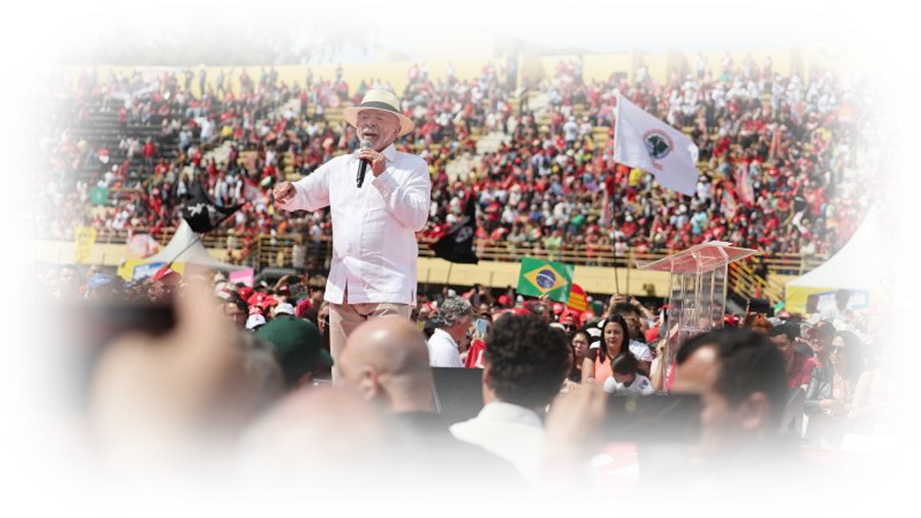
In Brazil, unlike other Latin American countries, the foreign vote was not decidedly right wing. Lula won by over 3.5% of the vote, well over four million votes, a turnaround of over six million votes with a virtually identical voter turnout. In ancient Rome, generals participating in triumphal parades had a man dyed red standing behind them reminding them they were human. At times, in two round presidential elections like Brazil’s, voters do the same, voting against someone in the first round as a warning, but supporting him or her in the second. Nonetheless, the shock of the first round will probably lead to changes in Lula’s governance in areas involving crime and violence, and with respect to more attention to food basket economics.
Because Lula will not be eligible for reelection in four years but many Bolsonaros will be, and because the Brazilian left lacks a viable successor, at least at present, the future does not look as bleak for the Brazilian right as a Bolsonaro victory would have been for the left. Notwithstanding his impressive comeback victory, governing for Lula will prove extremely difficult given the right’s control over Congress. His victory, however, is a serious defeat for President Trump and Prime Minister Netanyahu’s aspirations in Latin America and may bode ill for their own parties in the upcoming elections in their own countries.
Had Bolsonaro won, the United States would have quickly entered into long term agreements for natural resources, especially in the Amazon which would have been freed up for development and Israel would have gained another important foothold in Latin America. There would have been significant deregulation and reduction of public spending, except with respect to police and the armed forces. Integration with other Latin American countries would likely have been abandoned, as would Brazil’s leadership role in the BRICS. The Constitution would likely have been significantly amended in a manner making it easier to reshape the Supreme Court and entrench right wing rule, and, given the right’s control of Congress, it still may be.
Interestingly, the orchestrated transportation delays in Lula oriented districts in Northern Brazil were overcome by the two hour voting extensions while the weather delays in the South were apparently not. However, since both sides asked for the extension, neither side can legitimately challenge it.
Pro-Bolsonaro evangelicals may be wondering why God intervened in that manner. _____
Guillermo (“Bill”) Calvo Mahé (a sometime poet and aspiring empirical philosopher) is a writer, political commentator and academic currently residing in the Republic of Colombia (although he has primarily lived in the United States of America of which he is also a citizen). Until 2017 he chaired the political science, government and international relations programs at the Universidad Autónoma de Manizales. Previously, he chaired the social studies and foreign language departments at the Eastern Military Academy in Huntington, New York. He is currently the publisher of the Inannite Review available at Substack.com; an intermittent commentator on radio and television in both Colombia and abroad; and, an occasional contributor to diverse periodicals and publications. He has academic degrees in political science (BA, The Citadel, the Military College of South Carolina), law (JD, St. John’s University, School of Law), international legal studies (LL.M, the Graduate Division of the New York University School of Law) and translation and linguistic studies (GCTS, the University of Florida’s Center for Latin American Studies). However, he is also fascinated by mythology, religion, physics, astronomy and mathematics, especially with matters related to quanta, cosmology and cosmogony. He can be contacted at guillermo.calvo.mahe@gmail.com and much of his writing is available through his blog at https://guillermocalvo.com/.
Somewhere, perhaps, a man whose proper name is Aléxandros Argead, walks and dreams strange dreams. He is strong, brilliant and ambitious but also very confused. He is an amnesiac. He believes that Aléxandros Argead is his name because it is inscribed on a rectangular metallic tag with rounded edges he wore on a ball chain around his neck but he does not know where he was born or where he was raised, although his dreams seem to provide impossible hints. His oldest memories, all too recent, involve waking, somewhat injured, on a battlefield near the city of Al-Hillah in Iraq along the Euphrates River, approximately 85 kilometers (53 miles) south of Baghdad; the sole survivor of some sort of major military conflict. He was the only survivor and thus had no one he could ask what it was about or on whose side he fought. But he was somehow certain that the “Americans” were not his friends. Fortunately, a certain amount of currency was strewn nearby and he’d collected it, all of it, somehow aware that it would prove important.
It does. Eventually. Although perhaps eventually has not yet made its appearance.
So, what does he look like? Well, his body is athletic and muscular and he is a little less than five feet seven inches tall, with what had once been a fair skin bronzed by prolonged exposure to the outdoors into a naturally ruddy, sun-flushed complexion. His hair is thick, golden and swept upward from his forehead in a distinct, lion-like “anastole” style. His face has sharp features, including a prominent forehead, a short, strong chin, and a slight, characteristic tilt of his head toward his left shoulder. Most striking are his intense, deep-set eyes that carry a sharp, melting gaze which creates an impression of vulnerability but also, of commanding power.
He is, unbeknownst to himself, of a line founded over twenty seven centuries ago, one that over twenty-three centuries ago was thought to have become extinct, one founded by a certain Perdiccas from the ancient Greek city-state of Argos who was, in turn, descended from a certain Temenus, purportedly a great-great-grandson of Heracles. Temenus was at one time king in Argos. Perdicass, however, along with his two older brothers, Gauanes and Aeropus, had a fate further to the north in what was to become known as Macedon. Of course, being aware of nothing, Aléxandros Argead knew nothing concerning the foregoing, and perhaps he never had. Perhaps he never would. According to history, every member of the Argead family had been assassinated by a certain Cassander, son of Antipater, millennia ago. Seemingly as is frequently the case, historians were mistaken.
So, for a bit of context, context for us if not for Aléxandros Argead.
According to the earliest and most widely accepted historical traditions from Herodotus and Thucydides, Perdiccas was the founder of what came to be known as the Argead dynasty, hence Aléxandros’ surname. Purportedly, at least according to legends of which Aléxandros was unaware, perhaps because of his apparent amnesia, or perhaps because his family history had been lost in the mists of time as his ancestors first escaped from their jealous enemies, enemies who had purportedly been faithful followers, and then hid, hid for millennia, but sought to keep their family history somehow alive while hidden, although after several centuries, history had been conflated with myth, and the term myth attributed to actual facts.
Perdiccas had eventually attained power to the north of Argos, to the north of Greece, through a legendary journey of exile, labor, and a prophetic omen as famously recorded in Herodotus’s The Histories. According to what passed for history at the time (and may or may not have been accurate), Perdiccas and his two older brothers, Gauanes and Aeropus, were born and, for a time, lived in the Greek city-state of Argos, claiming descent, however, from the mythical hero Heracles who was born in Thebes. But that was not the most unlikely of the many legends that surround this particular family.
For reasons lost to history, Perdiccas and his brothers, Gauanes and Aeropus, were exiled from Argos, most probably for reasons having to do with disputes concerning royal succession. After being exiled from Argos, the brothers traveled through Illyria to the Macedonian town of Lebaea. There, for a time, they worked as shepherds of sorts for a local king. Not a major king by any means. In those days, almost any independent ruler of a territory, even one the size of a town, tended to proclaim himself a pasireu (petty king). In this case, it involved a pasireu rather than a basileus (more substantial king). Indeed, the king’s own wife baked bread for the royal household including its servants and those who herded livestock. According to an unlikely legend, whenever the queen baked bread, the loaf meant for Perdiccas miraculously doubled in size. Disturbed by the consistent anomaly the queen discussed it with her husband who viewed it as an omen from the gods that Perdiccas was destined for greatness. Fearing this sign, the king ordered the brothers to leave his territory immediately. The brothers agreed, after all, their stay in Lebaea was not meant to be permanent, they were of royal stock and probably meant to somehow or other reclaim their birthrights, so they readily agreed to leave, asking only for the wages they had earned. The king however, for some stupid reason, reneged on his obligation to pay them, supposedly mockingly pointed to a patch of sunlight shining through the chimney and told them that was all they would get. Surprising the king and his wife as well as his brothers, Perdiccas accepted the offer, symbolically scraping the sunlight into the fold of his garment. Abruptly, shortly after the brothers departure, the king, not a total idiot, realized that the acceptance by Perdiccass and his symbolic act of gathering up the sunlight symbolized claiming the land itself and he sent riders to kill them. However, again according to improbable legend, a sacred river flooded to protect the brothers, allowing them to escape. Perdiccas and his brothers settled near Mount Vermion in a fertile area known as the Gardens of Midas. Using this location as a secure base, Perdiccas’ charisma and legendary heritage allowed him to unite the local Macedonian tribes and he led his new people eastward into the plains, conquering the surrounding territories and eventually founding the city of Aigai (modern Vergina in the Northern Greek region still known as Macedonia), which became the first royal capital of the Argead kingdom.
Because of their origin in Argos, the lineage founded by the brothers became known as the Argead dynasty and it ruled the ancient kingdom of Macedon from its founding around 700 before the Common Era until 310 of that epoch. While the house ruled Macedonia for seven centuries, it was only towards the end under Phílippos II and his second son, Aléxandros III, that the Argead dynasty rose from a peripheral northern kingdom to a global superpower unifying Greece, dismantling the Persian Empire and extending as far as Western India. The dynasty seemingly ended shortly after Aléxandros III’s’ death as a result of the power struggles of his generals (the Diadochi), culminating in the murder of his young son, Aléxandros IV, in 310 BC. However, ignored by history was the reality that Aléxandros III was not the only heir of the Argeads, nor, perhaps, was Aléxandros IV the only surviving offspring of Aléxandros III.
Which brings us to Aléxandros Argead, the one who thought that he knew his name but little else. Concerning his personal past or his likely future neither we nor he know anything and, of his present, only the foregoing (as to which he was, at the moment, unaware). But the world needs heroes today, today perhaps more than ever, and perhaps his appearance near the city of Al-Hillah is, like so many other things in his family’s past, an omen.
From deep within the deepest pit in Hades, a furious Cassander looks on. _____
Guillermo (“Bill”) Calvo Mahé (a sometime poet and aspiring empirical philosopher) is a writer, political commentator and academic currently residing in the Republic of Colombia (although he has primarily lived in the United States of America of which he is also a citizen). Until 2017 he chaired the political science, government and international relations programs at the Universidad Autónoma de Manizales. Previously, he chaired the social studies and foreign language departments at the Eastern Military Academy in Huntington, New York. He is currently the publisher of the Inannite Review available at Substack.com; an intermittent commentator on radio and television in both Colombia and abroad; and, an occasional contributor to diverse periodicals and publications. He has academic degrees in political science (BA, The Citadel, the Military College of South Carolina), law (JD, St. John’s University, School of Law), international legal studies (LL.M, the Graduate Division of the New York University School of Law) and translation and linguistic studies (GCTS, the University of Florida’s Center for Latin American Studies). However, he is also fascinated by mythology, religion, physics, astronomy and mathematics, especially with matters related to quanta, cosmology and cosmogony. He can be contacted at guillermo.calvo.mahe@gmail.com and much of his writing is available through his blog at https://guillermocalvo.com/.
So, is hegemonic divinity a curse or punishment rather than a privilege?
Given reality, that seems at least possible and perhaps probable; well, assuming hegemonic divinity involving the five traditional attributes exists. The traditional attributes, at least to hegemonic, monotheistic Abrahamics are: eternal existence, without beginning or end; ubiquity, omnipresence, presence everywhere concurrently and permanently; omniscience, all knowingness; omnipotence, all powerful; and, the trickiest in light of the others, omnibenevolence, all good, perfectly so.
Imagine how incredibly boring eternal existence must be, especially eternal existence without peers or companions.
But perhaps it’s much worse than just boring.
In one postulate, the divine experiences everything that anything and anyone experiences and does so perpetually, over and over again time being inapplicable thus, every single experience is permanent: all the joy and all the pleasure, sure; but also all the pain and all the suffering, all the frustration, all the betrayal, all the injustice, all the blame, whether fair or not.
In a more scientifically sophisticated version, one predicated on string and quantic hypotheses, one where every possibility exists in an infinity of universes, that scenario is multiplied in infinite variations. Would it be possible to remain sane in that context while being omnibenevolent? If divinity were callous and indifferent, or even evil, perhaps. But being omnibenevolent, and eternally so, sanity would seem quantically improbable.
So, what sane omnipotent and omnibenevolent divinity would voluntarily tolerate such eternal punishment? It certainly seems as though the experience would be the ultimate punishment, the ultimate curse but if so, imposed by what?
Might it be that divinity, in addition to the five traditional hegemonic, monotheistic, Abrahamic attributes is a masochist?
That would seem the only answer and sort of explains the crucifixion of Yešu, assuming any of the foregoing is accurate.
I wonder how frustrated the foregoing would make masochists feel. _____
Guillermo (“Bill”) Calvo Mahé (a sometime poet and aspiring empirical philosopher) is a writer, political commentator and academic currently residing in the Republic of Colombia (although he has primarily lived in the United States of America of which he is also a citizen). Until 2017 he chaired the political science, government and international relations programs at the Universidad Autónoma de Manizales. Previously, he chaired the social studies and foreign language departments at the Eastern Military Academy in Huntington, New York. He is currently the publisher of the Inannite Review available at Substack.com; an intermittent commentator on radio and television in both Colombia and abroad; and, an occasional contributor to diverse periodicals and publications. He has academic degrees in political science (BA, The Citadel, the Military College of South Carolina), law (JD, St. John’s University, School of Law), international legal studies (LL.M, the Graduate Division of the New York University School of Law) and translation and linguistic studies (GCTS, the University of Florida’s Center for Latin American Studies). However, he is also fascinated by mythology, religion, physics, astronomy and mathematics, especially with matters related to quanta, cosmology and cosmogony. He can be contacted at guillermo.calvo.mahe@gmail.com and much of his writing is available through his blog at https://guillermocalvo.com/.
Today I’m daring fate by wearing an old green New York Jets football, Jersey. Number 19, the Keyshawn Johnson model. The Jets, as always, well, at least since Super Bowl III, are addicted to tradition, and not in a good sense. So, to take my mind off this past weekend’s disaster against the Patriots, I let my mind soar and speculate on the divine, albeit in a quotidian fashion. After all, during January of 1969 the divine appeared to answer Jets’ fans prayers amidst promises of never asking for anything again. A deal the divine appears to have taken all too seriously.
Anyway ….
So, I asked myself, seeking to change the focus of my grumblings about inept officials and inept coaches and inept players and all too patient fans: “does the divine prefer the green of vegetation and mountains, or the blue of oceans and skies?”
I recall that back in the nineteen-fifties we assumed that our planet, as seen from space, was green. I think Robert Heinlein had something to do with that. Turns out that, as Frank Borman demonstrated, seen from space our planet is mainly a light blue and white, with only slight traces of green. That was quite a change. However, that does not, as a Jet’s fan, mean that the divine prefers blue. Perhaps green, especially the variant sported by Jets fans, is more exclusive. Perhaps that is why photosynthesis is so amazing.
Imagine, living on sunlight.
Of course, that brings brilliant yellow into the equation.
Guillermo (“Bill”) Calvo Mahé (a sometime poet and aspiring empirical philosopher) is a writer, political commentator and academic currently residing in the Republic of Colombia (although he has primarily lived in the United States of America of which he is also a citizen). Until 2017 he chaired the political science, government and international relations programs at the Universidad Autónoma de Manizales. Previously, he chaired the social studies and foreign language departments at the Eastern Military Academy in Huntington, New York. He is currently the publisher of the Inannite Review available at Substack.com; an intermittent commentator on radio and television in both Colombia and abroad; and, an occasional contributor to diverse periodicals and publications. He has academic degrees in political science (BA, The Citadel, the Military College of South Carolina), law (JD, St. John’s University, School of Law), international legal studies (LL.M, the Graduate Division of the New York University School of Law) and translation and linguistic studies (GCTS, the University of Florida’s Center for Latin American Studies). However, he is also fascinated by mythology, religion, physics, astronomy and mathematics, especially with matters related to quanta, cosmology and cosmogony. He can be contacted at guillermo.calvo.mahe@gmail.com and much of his writing is available through his blog at https://guillermocalvo.com/.
Abstract: Reflections on Professor Lisa Hilbink’s critique of Professor Ran Hirschl’s perspective on kritarchy (or kratocracy or dikastocracy, to which he refers as juristocracy; i.e., rule by judges); reflections on the reality that the concepts of democracy and rights are not coherent as currently understood, and that neither judges nor legislators possess the ethics and independence necessary to effectively exercise constitutional control; and, criticism of the misuse of linguistics to confuse issues such as democracy and rights and on the dubious nature of current concepts of constitutional control.
This year I ran across an article published by Professor Lisa Hilbink, PhD, entitled “Beyond Manicheanism: Assessing the New Constitutionalism”. It was published in the Maryland Law Review[1] over two decades ago. The version I ran across was an unfinished draft of the article which she shared on Academia.edu during 2005 and one sentence criticizing the now late professor Ran Hirschl, PhD, set me off in an unexpected direction. Dr. Hilbink wrote, at least in the February 2005 draft, that: “Hirschl’s central argument is based on a stark distinction between courts as insulated,…semi-autonomous, professional policy-making bodies on the one hand, and legislatures as faithful mirrors of popular will, on the other.”
While I tend to side strongly with critiques of what Dr. Hircshl referred to as “Juristocracy” in his lauded 2005 book, Towards Juristocracy: The Origins and Consequences of the New Constitutionalism;[2] the quote made me focus on the reality that if legislatures ever truly reflected the beliefs and goals of their electorates, that is certainly not the case today thus, “faithful mirrors of popular will” they certainly are not. Today, their constituents are not those who “vote” them into office but those who finance their campaigns and the political parties that post them. Of course, that’s also true of heads of state and chief executives. Thus, while unelected judges are all too frequently oligarchical and elitist, so too, for the most part, are legislators and the political heads of executive branches.
That should certainly not be the case but, as long as political campaigns are costly and privately financed by non-voters (as demanded by the United States Supreme Court[3]), then the possibility of elected officials acting in the interests of the voters who elect them rather than in the interest of the billionaires who fund them is, at best, improbable. Especially since so much of the expense of being elected eventually winds up in the coffers of the legacy media, a complex of simplistic organizations owned and controlled by the same billionaires who provide the bulk of the political contributions.
The Relative Positions of Dr. Hirschl and Dr. Hilbink:
Dr. Hirschl’s core argument with respect to kritarchy (or kratocracy or dikastocracy, to which he refers as juristocracy; i.e., rule by judges), is, as I understand it, that the post-World War II global trend of empowering courts and recognizing inviolable constitutionalizing rights as a means to limit “democratic abuse of democracy and social justice” (an ironic turn of phrase), is a ruse, and that the reality is that the expansion of John Marshall’s concept of judicial review and judicial constitutional control[4], which morphed in the twentieth century into the concept of judicial activism and the organic constitution, was instead driven by threatened political elites, economic stakeholders, and judicial leaders engaging in “hegemonic preservation” to protect their policy preferences from majoritarian politics.
Dr. Hilbink’s position, on the other hand, criticizes Dr. Hirschl’s “hegemonic preservation” theory which she describes as positing that the global expansion of judicial power is not a neutral victory for human rights but a strategic move by a tripartite coalition of threatened political elites, economic elites seeking to lock in neoliberal market policies and high-court judiciaries seeking to protect their interests from the “vicissitudes of democratic politics”, something accomplished by shifting decision-making from majoritarian legislatures to insulated courts. She does so although acknowledging the empirical weight of Dr. Hirschl’s case studies, by arguing that Dr. Hirschl fell victim to the exact same Manichean trap as the liberal “enthusiasts” he criticizes. According to her, where the legal scholars Dr. Hirschl criticizes romanticize judges as uniquely noble, principled actors operating entirely above the political fray, Dr. Hirschl swings to the opposite extreme asserting that he views judges and institutional design as uniquely self-interested and collusive. While admitting that a court’s origins may not always (or even usually) be pure, she asserts that that does not necessarily mean that long-term institutional impacts are malevolent. In conjunction with the foregoing she differentiates the mother of judicial activism, the United States Supreme Court, from constitutional courts and courts vested with constitutional authority as well as general oversight of legal systems in other countries, seeming to admit that Dr. Hirschl may be correct with respect to the former, but not necessarily with respect to the latter. In that regard, Dr. Hilbink argues that the judicial role in constitutional control is not monolithic and instead, involves massive structural variations such as how judges are appointed, their legal subcultures, and their professional norms, all of which dictate whether a court acts as an elite shield or a democratically responsive partner. Dr. Hilbink finally notes that Dr. Hirschl relies heavily on a rigid dichotomy between “law” and “politics”, implying that there are questions that are purely moral or political and that transferring them to a courtroom strips them of democratic legitimacy to which she counters by asserting that that judicial review and legislative policy-making can be interactive and mutually supportive rather than inherently adversarial.
Notwithstanding their differing perspectives, however, both challenge the romantic, mainstream view that the global expansion of judicial review is simply a natural, benevolent evolution toward human rights and social justice, both arguing that while constitutional courts are highly effective at handling procedural liberties, collective identity, or negative rights, they rarely advance economic equity or redistributive justice and both view the insulation of policy-making from direct popular democracy as a defining hallmark of modern constitutional frameworks.
An interesting debate and convincing performance by Dr. Hilbink. My perspective is somewhat different and more analytically pessimistic for different reasons. I see both centered on the impact of what purports to be democracy in governance and on which of two competing institutions can best reflect and protect it. But, to a great extent, I believe that democracy is and has always been, at least in its current incarnation, illusory and confusing. If the argument is better defined and more limited so as to involve only the concept of majority rule, then any delegation to a select group, whether unelected judges or elected legislators, in each case, where immunity for ignoring the will of the majority is immune from consequences (other than non-reelection or reappointment), has historically been doomed to failure. And the obverse, direct democracy, as Socrates is reputed to have observed and experienced, is not an answer.
My Observations:
With reference to the foregoing, I have long felt that linguistic abuse as a means of obfuscating reality has, to some extent, been a weapon well-used by lawyers, politicians, journalists and academics to confuse the electorate. I have written concerning that as it applies to the term “democracy” which, rather than reflect the concept of majority rule, has been so loaded down with contradictory concepts and platitudes as to make it, as a concept, unworkable. That is especially true when democracy is defined as a concept melding majority rule with liberty and pluralism, each of which is at odds with the others. As opposed to majority rule, liberty is a purely individualistic concept grounded on individual autonomy and pluralism is grounded on the rights of minorities vis a vis both individual and majority rights. The term “rights” is as incoherent but for different reasons. Rights purport to involve something inherent rather than granted and thus subject to neither conditions nor limitations, no matter how reasonable. How unreasonable is that? Based on that definition, no rights exist, have ever existed and can never exist, as is demonstrated by the reality that rights are respected by governments only when convenient. The purported solution? Keep expanding their scope into even more improbable, albeit worthy areas (like the environment, peace and social welfare). That is not to imply that something aspirationally similar to rights, perhaps involving mandatory government spending priorities, would not be meritorious, but all we have, anywhere, are artfully phrased non-functional “guarantees”. I note that “guarantees” are generally unattainable oxymorons, at best implying reasonable efforts.
Conclusions: So, what was the question???
Well, I think the question relating to my diatribe concerning the nature of democracy and of rights was, or should have been, where does the concept of a constitution fit into the foregoing? Or perhaps, where should it fit in. Not in the organic sense of establishing and regulating the branches and organs of governance but in the more esoteric sense of seeking to create a just and workable balance between majority rule, liberty and pluralism and to create a mechanism to at least approach the concept of rights. And to determine just how calcified related decisions should be, calcified in the sense that a constitution seeks to impose current values on future generations while ignoring important aspects concerning the values of generations that preceded us. That would then bring us to the questions raised by Drs. Hirschl and Hilbink as to what kind of institution could most effectively act as the enforcement mechanism for constitutional goals, dictates and aspirations. At that point, their arguments would acquire significant relevance, although perhaps as starting points for evolution towards a truly efficient, just and objective means of constitutional control, something which may well prove as solely aspirational as the “rights” and respect for “democracy” that most constitutions purport to guarantee. At least so long as the humans involved remain so prone to elitist self-preservation and the cancerous quest for ever increasing control, regardless of their roles.
Calvo Mahé, Guillermo. “Sobre el control y la revisión constitucional: Un análisis comparativo centrado en las repúblicas”; XII Foro de Tendencias Contemporáneas de Derecho, Universidad de Caldas, Nov. 2017, Manizales.
Hilbink, Lisa (2006): “Beyond Manicheanism: Assessing the New Constitutionalism”; 65 Md. L. Rev. 15 (2006); University of Maryland Francis King Carey School of Law, Baltimore.
Hirschl, Ran (2004): Towards Juristocracy: The Origins and Consequences of the New Constitutionalism; Harvard University Press; Cambridge.
Guillermo (“Bill”) Calvo Mahé (a sometime poet and aspiring empirical philosopher) is a writer, political commentator and academic currently residing in the Republic of Colombia (although he has primarily lived in the United States of America of which he is also a citizen). Until 2017 he chaired the political science, government and international relations programs at the Universidad Autónoma de Manizales. Previously, he chaired the social studies and foreign language departments at the Eastern Military Academy in Huntington, New York. He is currently the publisher of the Inannite Review available at Substack.com; an intermittent commentator on radio and television in both Colombia and abroad (e.g., NewsX World in India); and, an occasional contributor to diverse periodicals and publications. He has academic degrees in political science (BA, The Citadel, the Military College of South Carolina), law (JD, St. John’s University, School of Law), international legal studies (LL.M, the Graduate Division of the New York University School of Law) and translation and linguistic studies (GCTS, the University of Florida’s Center for Latin American Studies). However, he is also fascinated by mythology, religion, physics, astronomy and mathematics, especially with matters related to quanta, cosmology and cosmogony. He can be contacted at guillermo.calvo.mahe@gmail.com and much of his writing is available through his blog at https://guillermocalvo.com/.
[1] Hilbink, Lisa (2006): “Beyond Manicheanism: Assessing the New Constitutionalism”, 65 Md. L. Rev. 15 (2006); University of Maryland Francis King Carey School of Law, Baltimore.
[2] Harvard University Press; Cambridge. The book won the American Political Science Association’s Law & Courts Section 2021 Lasting Contribution Award.
[3] See, e.g., Buckley v. Valeo (1976); Citizens United v. Federal Election Commission (2010); McCutcheon v. Federal Election Commission (2014); Federal Election Commission v. Ted Cruz / Senator Ted Cruz Committee v. Federal Election Commission (2022); and Federal Election Commission v. NRSC (2026).
[4] Which I have criticized in diverse articles, some of which are listed at the conclusion of this article.
The following is the transcript for the segment by Guillermo Calvo Mahé in a special report by India’s NewsX World with respect to the Bolsonaro Dynasty in Brazil, a reality regardless of the final results of the 2026 Brazilian Elections. It has been slightly edited to correct grammatical issues and provide context and updating information has been added: _______
On Sunday October 4, the Brazilian electorate followed the path of most recent Latin American elections, at least as far as the Congress is concerned, rejecting the progressive left and embracing the conservative right. In that context, a question arises as to whether Brazil’s turn to the right is a reaction against what the public perceives of as a moribund and corrupt economy (notwithstanding significant progress in minimizing poverty during the current administration) or whether it reflects the crystallization of a Bolsonaro family dynasty (given the fact that so many members of the Bolsonaro family are now in elected positions of power). Jahir Bolsonaro, the family’s patriarch, was 38th president of Brazil, having served in that role from 2019 to 2023 and as a member of the Chamber of Deputies from 1991 to 2019. Previously, he served as a captain in the Brazilian army. However, he has been in prison serving a twenty-seven year sentence for organizing an attempted coup against his successor, the current president of Brazil, Luiz Inácio Lula da Silva, who is currently running for reelection against Jahir Bolsonaro’s son, Flavio.
One answer to the unexpected results of the initial round of the Brazilian elections which involved not only the presidency but the Chamber of Deputies, a significant part of the Senate and the powerful state governors seems to be that, come what may during the final round of presidential voting on October 31, Jahir Bolsonaro has managed to install his family firmly in control of the Congress and in likely control of the presidency. If so, that would quickly lead to his from imprisonment and expand Bolsonaro family control of the federal judiciary as well.
So, who are the members of the evolving Bolsonaro family dynasty? Let’s start with Flavio.
Flavio is not his father’s clone nor a mere figurehead. He has his own 23 year political career including eight years as a senator and, although his father is certainly Flavio’s political mentor, they have differing styles and different focuses, something Flavio emphasizes:
Flavio’s presidential campaign stressed down to earth economic issues and concerns rather than abstract ideological issues and Flavio used a more restrained personal style, reaching out to centrist voters as well as focusing on conservative themes. Still, like his father, he also stressed his relationships with the United States and Israel would be much more positive, his relations with China more limited and that his interests in the BRICS coalition would be secondary at best.
As in all recent elections in Latin America, Flavio’s stressed the problem of allegedly rampant crime and a decline in morals urging a return to traditional Christian values and was highly critical of the threats of an emerging socialist state.
Flavio’s campaign focused on sophisticated use of targeted and tightly focused social media rather than on the mass, amateur WhatsApp forwarding networks used by his father and, perhaps thanks to his brother Eduardo’s US contacts, his use of the Internet was extremely well financed by, among others, the Rockbridge Network, a group co-founded by U.S. Vice President JD Vance and backed by prominent right-wing donors and Silicon Valley investors such as Peter Thiel and Rebekah Mercer, and supporters of Israel.
Of course, a political dynasty such as that established in India by the Nehru–Gandhi family, in the United States by the Kennedy and Bush families or as is common in many Latin American countries, is a complex concept, but it is one that the family’s patriarch, Jahir Bolsonaro, has apparently mastered.
The second round of the presidential election is not clear cut as most believe given that 40 million voters either did not participate (notwithstanding Brazil’s mandatory voting requirements) or cast null or none of the above ballots in the first round of voting and, as October 25 approaches, polls indicated that it is tightening, although Flavio remains in the lead, but, even if enough voters who failed to participate in the initial round were pulled into the Lula camp to overcome Flavio’s initial two million plus lead and a Lula comeback took place, a Bolsonaro political dynastic structure seems firmly in place, one that, given the age of its diverse members, could last for decades.
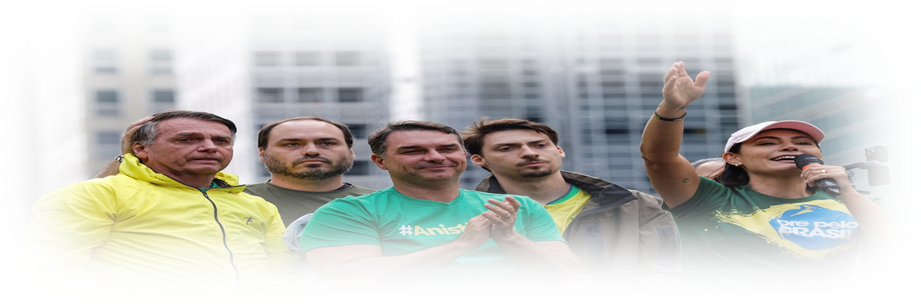
For example, in addition to Flavio, Jahir Bolsonaro’s current wife, Michelle, Jahir’s third wife and Flavio’s second step mother, is virtually the same age as Flavio and an ambitious political power on her own, especially among evangelical Christians and among conservative women, two constituencies largely responsible for Flavio’s success in the first round. She is also extremely powerful in the Liberal Party, the political party that sponsors the Bolsonaro family, even more so than Flavio. In the recent elections she attained the highest vote ever for the Brazilian Senate. But Flavio and his brothers have had serious conflicts with Michelle and their goals and ambitions are not always compatible.
In addition to Michelle, the Bolsonaro clan now boasts a number of other members of Congress with current and future electoral aspirations. Flavio’s brother Carlos (age 43), the family’s social media and digital genius, is now in the Senate; 28 year old Jair Renan, Flavio’s half-brother, is now a deputy in the Chamber of Deputies; Flavio’s brother Eduardo, age 43, is a former Deputy who fled to the United States when threatened with possible prosecution for lobbying foreign powers to intervene in his father’s trial (he was convicted in absentia) but used his exile very successfully to cultivate strong ties with members of the Trump administration and is likely to return and resume his political career; and, Jahir’s brother, the uncle of the clan, Renato Bolsonaro, age 62, also won a seat in the incoming Congress. There are also Michelle’s two daughters waiting on the sidelines (one in her teens and the other in her twenties), the eldest from a previous relationship.
So yes, Flavio Bolsonaro successfully used economic discontent to pull ahead of Luiz Inácio Lula da Silva in the initial round of voting but a Bolsonaro political dynasty definitely seems to be coalescing in Brazil although perhaps, who will lead it, is not always clear. _____
As an update with respect to the election itself, it appears that foreign interference in the second round of Brazil’s presidential elections has significantly intensified, including alleged intervention by Meta in favor of Flavio Bolsonaro. The Lula campaign has formally accused Meta’s platforms (Instagram, Facebook, and WhatsApp) of having utilized biased algorithms, restricted content distribution, and disabled advertising capabilities to systematically disadvantage Lula and favor Flavio.
The core allegations against Meta have involved accusations that the Meta AI engine is intrinsically biased. For instance, the AI system reportedly refused to generate campaign images or content when using the prompt “Lula 13” but readily generated them for “Flávio 22”. The Lula campaign specifically claimed that Instagram restricted Lula’s official profile from promoting feed posts, froze or interrupted video view counts and temporarily caused his profile and other left-wing leaders to disappear from search results prior to the first round of voting. The allegations have neutral support; for example, the non-profit group Ekō alleged that Meta broke Brazilian electoral laws by approving foreign-funded, AI-generated ads that spread disinformation and hate speech. A separate study from the Federal University of Rio de Janeiro found over 1,600 irregular political advertisements on Meta platforms funded primarily from the United States and Israel which violates Brazil’s ban on foreign electoral spending.
In mid-October 2026, Justice Marco Aurélio Bellizze of Brazil’s Superior Electoral Court ordered Meta to take immediate action to guarantee equal treatment for both candidates. The court mandated that Meta apply identical criteria for its AI tools and barred the company from suppressing political content or search results to cause a campaign imbalance. Meta was also issued a tight deadline to submit granular, profile-by-profile explanations of any restrictions applied to Lula’s accounts.
As expected, Meta denied any political bias rejecting all claims of “deliberate” bias or political engineering, stating that its systems do not distribute content based on ideology and are applied equally worldwide. In its defense, Meta cited widespread, unrelated global technical issues. The company stated that a freeze on Instagram Reels view counts impacted creators across more than 100 countries and was not isolated to Lula’s account. Similarly, a brief disruption to ad-creation tools affected users globally rather than targeting specific campaigns.
Notwithstanding the abovementioned, given time constraints, none of the foregoing is anticipated to have a significant impact on the highly polarized electorate. Indeed electoral violence and threats of violence, primarily from supporters of the Bolsonaro which have sought to intimidate the electorate may be more important. For example, on October 7, 2026, a major fire devastated UFPE’s Innovation Directorate building in Recife, destroying pharmaceutical, computer science, and genetics laboratories. This incident followed two other fires at the institution within an eight-day span, causing an estimated R$100 million in damages and obliterating two decades of scientific research. The fires broke out immediately after students held protests on campus supporting President Luiz Inácio Lula da Silva and opposing Flavio Bolsonaro ahead of the October 25 presidential runoff election. Because the fires occurred hours after students received explicit bomb threats attributed to Bolsonaro supporters, Brazil’s Federal Police and the Federal Prosecutor’s Office opened a criminal investigation into the matter. _______
Guillermo (“Bill”) Calvo Mahé (a sometime poet and aspiring empirical philosopher) is a writer, political commentator and academic currently residing in the Republic of Colombia (although he has primarily lived in the United States of America of which he is also a citizen). Until 2017 he chaired the political science, government and international relations programs at the Universidad Autónoma de Manizales. Previously, he chaired the social studies and foreign language departments at the Eastern Military Academy in Huntington, New York. He is currently the publisher of the Inannite Review available at Substack.com; an intermittent commentator on radio and television in both Colombia and abroad; and, an occasional contributor to diverse periodicals and publications. He has academic degrees in political science (BA, The Citadel, the Military College of South Carolina), law (JD, St. John’s University, School of Law), international legal studies (LL.M, the Graduate Division of the New York University School of Law) and translation and linguistic studies (GCTS, the University of Florida’s Center for Latin American Studies). However, he is also fascinated by mythology, religion, physics, astronomy and mathematics, especially with matters related to quanta, cosmology and cosmogony. He can be contacted at guillermo.calvo.mahe@gmail.com and much of his writing is available through his blog at https://guillermocalvo.com/.
Kritarchy (or kritocracy) is the term for rule by judges or the judiciary. It seems the inevitable consequence of vesting the judiciary with the power to “interpret” constitutions and, when constitutions are deemed supreme, to effectively control government in the form once exercised by dictatorial political bureaus (politburos) and the central committees in one party states. Unless the “judges” charged with constitutional control (control being the end result of purported review) are democratically elected for fixed terms, something which only occurs in Mexico and Bolivia (but even there, the nomination process is controlled by traditional branches of government and, in Mexico, the term is long, 12 years) they are obviously antidemocratic elites. Kritarchy is thus a specialized form of antidemocratic oligarchy rather than an aspect of democracy which sort of makes sense, given that constitutions, by their nature, are inherently antidemocratic, in the sense that democracy requires majority rule. However, given the reality that in purported democracies popular apathy is more the rule than popular participation, democracy as such is more a fable than a reality. A majority is more than a plurality and when large segments of a population do not participate in democratic elections, real majorities (50% of the eligible electorate plus one) are rarely if ever attainable.
Kritarchy is defended as essential to protect human and minority rights from democratic abuse, an obvious fallacy as that assumes judges who prioritize such concepts and that is no more likely in a judicial tribunal than it is in a popularly elected legislature or even, in a popularly elected autocracy. Since the Biden administration’s 2013 destruction of the selection of federal judges in the United States through political consensus via the filibuster (Murphy is still chuckling about that), federal judges in the United States have been more politically biased in their decisions than ever, making it clear, in the cradle of judicial review, just how wrong the infamous decision in Marbury versus Madison (really John Marshall versus his despised cousin, Thomas Jefferson) was. And an incoherent Kritarchy such as that which runs rampant in the United States today is, procedurally, as bad a form of government as currently exists.
Thus we find ourselves, politically and economically, where we do, rule by judges bought and paid for by plutocratic kleptocracies with merit a sort of pejorative, except in the Hobbesian sense of merit, i.e., merit being equated with brute power. It’s as ironic as is the reality that many, perhaps most, perhaps virtually all evangelical pastors are politically tied to Zionism which, when it involves religion at all, insists that the purported Christ, about whom such evangelical pastors incessantly preach, is deemed by their Zionist overseers as, at best, condemned to an eternity in Hell drowning in a pool of molten excrement. Seemingly, the blind leading the blind would be quite an improvement over the deaf, dumb and blind simians who “guide” us today.
We humans are a strange, incoherent and evolutionally counterintuitive species. _____
Guillermo (“Bill”) Calvo Mahé (a sometime poet and aspiring empirical philosopher) is a writer, political commentator and academic currently residing in the Republic of Colombia (although he has primarily lived in the United States of America of which he is also a citizen). Until 2017 he chaired the political science, government and international relations programs at the Universidad Autónoma de Manizales. Previously, he chaired the social studies and foreign language departments at the Eastern Military Academy in Huntington, New York. He is currently the publisher of the Inannite Review available at Substack.com; an intermittent commentator on radio and television in both Colombia and abroad; and, an occasional contributor to diverse periodicals and publications. He has academic degrees in political science (BA, The Citadel, the Military College of South Carolina), law (JD, St. John’s University, School of Law), international legal studies (LL.M, the Graduate Division of the New York University School of Law) and translation and linguistic studies (GCTS, the University of Florida’s Center for Latin American Studies). However, he is also fascinated by mythology, religion, physics, astronomy and mathematics, especially with matters related to quanta, cosmology and cosmogony. He can be contacted at guillermo.calvo.mahe@gmail.com and much of his writing is available through his blog at https://guillermocalvo.com/.
The 1970’s: Eastern Military Academy, the faculty and Susan, they say you can never go back but I did, and it’s never left me, except for Susan. Or did I leave her? St. John’s University, the School of Law and Joan Aceste and Joyce Raskin and June Callwood, fantasies and friends, Mario Cuomo and hard work, success, and regrets. Always regrets as time marches on. The Graduate Division of the New York University School of Law, awakening and Helene Alba; the world opening up to teach me how wrong I’d too often been and would be again. The New York State Assembly and then, Kaufmann and Feit and Vickie Forest. All things I should have kept but let go.
What an awesome decade, perhaps the most challenging and happiest of my life; until the eighties and my three sons, Billy, Alex and Edward.
What a full life it’s been, and what a full life it is, even if it’s consistently taken a turn towards the dark side.
But the seventies were special, full of optimism and certainty, even if it was misplaced. _____
Guillermo (“Bill”) Calvo Mahé (a sometime poet and aspiring empirical philosopher) is a writer, political commentator and academic currently residing in the Republic of Colombia (although he has primarily lived in the United States of America of which he is also a citizen). Until 2017 he chaired the political science, government and international relations programs at the Universidad Autónoma de Manizales. Previously, he chaired the social studies and foreign language departments at the Eastern Military Academy in Huntington, New York. He is currently the publisher of the Inannite Review available at Substack.com; an intermittent commentator on radio and television in both Colombia and abroad; and, an occasional contributor to diverse periodicals and publications. He has academic degrees in political science (BA, The Citadel, the Military College of South Carolina), law (JD, St. John’s University, School of Law), international legal studies (LL.M, the Graduate Division of the New York University School of Law) and translation and linguistic studies (GCTS, the University of Florida’s Center for Latin American Studies). However, he is also fascinated by mythology, religion, physics, astronomy and mathematics, especially with matters related to quanta, cosmology and cosmogony. He can be contacted at guillermo.calvo.mahe@gmail.com and much of his writing is available through his blog at https://guillermocalvo.com/.
«Ve’betarayin yehon qadmayin ve’qadmayin betarayin» («הָרִאשׁוֹנִים יִהְיוּ אַחֲרוֹנִים וְהָאַחֲרוֹנִים – רִאשׁוֹנִים» en hebreo); la primera frase estaba en arameo. «Los primeros serán los últimos y los últimos serán los primeros», según se dice, eso proclamó Jesús —o más exactamente, Yešu—. Pero ¿qué hay de los que están entre esos dos polos? ¿Existirá una relación inversa en toda la escala? ¿Y qué decir de los que ocupan el centro: los insípidos, los tibios o casi fríos, aquellos que, buscando mantener abiertas todas las opciones, se niegan a tomar partido? ¿Dónde se situarán y cuándo?
Por supuesto, están los hipócritas, los mentirosos, los manipuladores; aquellos que adoptan una postura sin intención alguna de actuar en consecuencia y que, de hecho, a menudo actúan de manera totalmente opuesta a lo que dicen defender. Suelen congregarse en la política, el derecho, el periodismo y entre el clero.
Hay quienes consideran que los que están en el medio son los peores de todos: los cobardes, los cómplices. Claro que en ese punto intermedio hay diversas variantes, y tal vez distintos olores. La ambivalencia. ¿En qué se diferencia de la indecisión? ¿O de la apatía? ¿Y cuál podría ser la relación entre la apatía y lo patético?
Hay quienes afirman que «es mejor haber amado y perdido que no nunca haber amado». ¿Cómo se traduce esto conceptualmente en el caso de quienes expresan su opinión y resultan estar equivocados, frente a aquellos que, por miedo a equivocarse, nunca opinan?
¿Dónde te situarías tú?
Es solo una pregunta.
Se atribuye a Albert Einstein la siguiente frase: «El mundo es un lugar peligroso para vivir, no por causa de los malvados, sino por aquellos que no hacen nada al respecto».
Guillermo Calvo Mahé es escritor, comentarista, analista político y académico residente en la República de Colombia. Aspira ser poeta y filósofo empírico y a veces se lo cree. Hasta el 2017 coordinaba los programas de Ciencia Política, Gobierno y Relaciones Internacionales de la Universidad Autónoma de Manizales. En la actualidad, participa en entrevistas radiales y televisadas, foros, seminarios y congresos cívicos tabto en Colombia como en el exterior y edita y publica la revista virtual, The Inannite Review disponible en Substack.com/. Tiene títulos académicos en ciencias políticas (del Citadel, la universidad militar de la Carolina del Sur), derecho (de la St. John’s University en la ciudad de Nueva York), estudios jurídicos internacionales (de la facultad posgrado de derecho de la New York University) y estudios posgrado de lingüística y traducción (del Centro de Estudios Latinoamericanos de la Universidad de la Florida). Sin embargo, también es fascinado por la mitología, la religión, la física, la astronomía y las matemáticas, especialmente en lo relacionado con lo cuántico y la cosmogonía. Puede ser contactado en guillermo.calvo.mahe@gmail.com y gran parte de su escritura está disponible a través de su blog en https://guillermocalvo.com/.
“Ve’betarayin yehon qadmayin ve’qadmayin betarayin” (“הָרִאשׁוֹנִים יִהְיוּ אַחֲרוֹנִים וְהָאַחֲרוֹנִים – רִאשׁוֹנִים” in Hebrew), the first was in Aramaic.
“The first shall be last and the last shall be first” Jesus, more accurately Yešu, is reported to have declaimed. But, what about those in between? Will there be an inverse relationship all the way through? And what of those in the middle, the bland, the lukewarm or almost cool, those who, seeking to keep all options open, refuse to take a stand. Where will they stand and when?
Of course, there are the hypocrites, the liars, the manipulators, those who take a stand with no intention of acting on it, indeed, who frequently act in a manner totally opposed to that they claim to espouse. They tend to congregate in politics, and law, and journalism, and among the clergy.
There are those who feel that those in the middle are the worst of all, the cowardly, the enablers. Of course, there are a number of flavors in the middle, and perhaps odors. Ambivalence. How different is it than indecision? Or apathy? And what might the relationship between apathy and pathetic be?
There are those who assert that “it is better to have loved and lost than never to have loved at all”. How does that translate in the context of those who opine and turn out to have been wrong versus those, who, fearing to be wrong, never opine at all?
Where would you place yourself?
Just asking.
Albert Einstein is credited with saying: “The world is a dangerous place to live, not because of the people who are evil, but because of the people who don’t do anything about it.”
Guillermo (“Bill”) Calvo Mahé (a sometime poet and aspiring empirical philosopher) is a writer, political commentator and academic currently residing in the Republic of Colombia (although he has primarily lived in the United States of America of which he is also a citizen). Until 2017 he chaired the political science, government and international relations programs at the Universidad Autónoma de Manizales. Previously, he chaired the social studies and foreign language departments at the Eastern Military Academy in Huntington, New York. He is currently the publisher of the Inannite Review available at Substack.com; an intermittent commentator on radio and television in both Colombia and abroad; and, an occasional contributor to diverse periodicals and publications. He has academic degrees in political science (BA, The Citadel, the Military College of South Carolina), law (JD, St. John’s University, School of Law), international legal studies (LL.M, the Graduate Division of the New York University School of Law) and translation and linguistic studies (GCTS, the University of Florida’s Center for Latin American Studies). However, he is also fascinated by mythology, religion, physics, astronomy and mathematics, especially with matters related to quanta, cosmology and cosmogony. He can be contacted at guillermo.calvo.mahe@gmail.com and much of his writing is available through his blog at https://guillermocalvo.com/.