
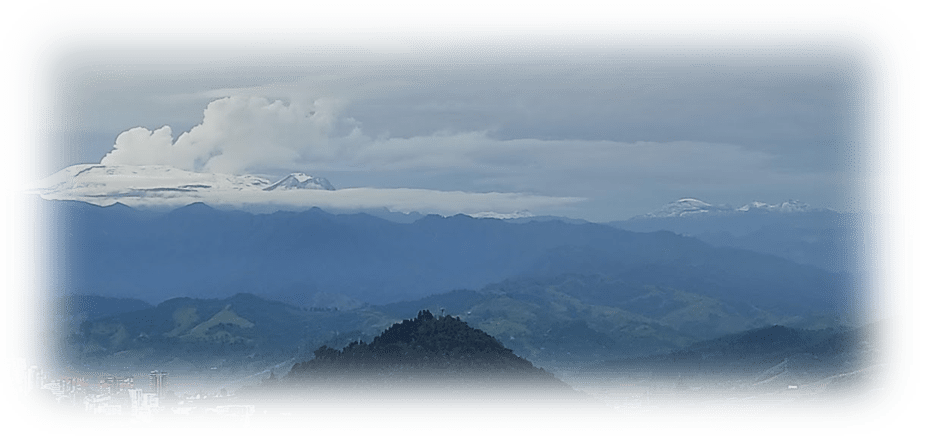
It’s a beautiful, sunny Saturday in the city in the sky. The one set among snow clad peaks and thermal springs near an adjacent volcano or two and the remnants of several glaciers. The one set atop the central range of the Colombian Andes in the midst of a sea of mountains dressed in diverse verdant shades. It seems summery although in the Northern Hemisphere, the part of our planet in which this part of Colombia is set, it is late autumn, just short of winter. But then, this close to the equator, seasons tend to meld and shift and be measured in hours rather than months.
The world seems as bad as it’s been since the second war to end all wars a bit over three quarters of a century ago, all the lessons it purportedly taught at best unlearned but more they were probably just fictitious attempts at justifying unjustifiable terminal follies. Again. After all, the second war to end all wars took place less than two decades after the first war to end all wars ended. And wars? Well, they’re just fine, in fact, perhaps healthier than ever.
Still, … as individuals here and there, life plows on, life: full of interpersonal challenges and triumphs, its own interpersonal beauty and mystique artfully masking our own errors and mistakes.
The Global South (which ironically includes Russia and China and Iran but definitely not the Ukraine) seems to be making headway in its quest for liberation from the constant abuse, humiliation and looting that flows from the North. But not without severe challenges as the Global North has no intention of brooking what it considers insolence by lesser species. By people almost but not quite human.
Notwithstanding the hypocritical “woke”, condescension still rules.
Still, … there is a scent of a different sort of future and lingering echoes seem to wonder whether such future will be better or just filled with shadows from the past, and whether the images we’ll see in our future mirrors will reflect who we’ve been, or we claim to have been, or who we wish we had been, or who we’d like to be, or who we’ve been forced to become. Hopefully the images that stare back at us will not be too much like those of those who for so long have oppressed so many. Wishful thinking, I know, but “if our reach does not exceed our grasp, then what’s a heaven for”, as Robert Browning wrote. But then, he was a poet, not a politician, a journalist or a historian (the illusory professions).
Omnipresent, dystopia seems to rule. We seem to be a people in transition, greedily tearing down the past without any agreement on what will replace the corrupt social institutions that have been decaying, putrefied for millennia. Decaying but refusing to die. That confuses and polarizes us as we’re manipulated by the worst among us, the Northern hegemonic wannabe leaders who refuse to let go and definitely decline to share, but who still exercise almost total control. Yet, “almost” is an optimistic harbinger, a qualifier that hints at possible changes, perhaps even beneficent changes.
Who can tell?
But we can hope.
Especially on a beautiful sunny Saturday in early December, one in which at least some of us are safely ensconced among some of those we most love, … at least for the day.
The carnage, genocide and ethnic cleansing underway in Palestine by the worst cultural descendants of the tribe which, after looting Egypt, went on to plunder and murder every man woman and child in ancient Jericho, continues unabated despite popular condemnation in the Global South and even, among an enlightened minority in Europe, the United States and even Israel, although, from here in the heights of the Andes, as in the United States and Europe, to some, that all seems very far away. Far enough away so that the screams of pain and dying gasps and mourning and lamentations are barely audible and thus, perhaps, at least for them, can be sanitized and washed away.
Or at least shouted down and obfuscated through carefully crafted rhetoric, with reckoning postponed, if not for ever, at least for another day.
After all, who mourns for ancient Jericho today?
_______
© Guillermo Calvo Mahé; Manizales, 2023; all rights reserved. Please feel free to share with appropriate attribution.
Guillermo (“Bill”) Calvo Mahé (a sometime poet) is a writer, political commentator and academic currently residing in the Republic of Colombia (although he has primarily lived in the United States of America of which he is also a citizen). Until 2017 he chaired the political science, government and international relations programs at the Universidad Autónoma de Manizales. He is currently the publisher of the Inannite Review, available at Substack.com, a commentator on Radio Guasca FM, and an occasional contributor to the regional magazine, el Observador. He has academic degrees in political science (the Citadel), law (St. John’s University), international legal studies (New York University) and translation and linguistic studies (the University of Florida’s Center for Latin American Studies). However, he is also fascinated by mythology, religion, physics, astronomy and mathematics, especially with matters related to quanta and cosmogony. He can be contacted at guillermo.calvo.mahe@gmail.com and much of his writing is available through his blog at https://guillermocalvo.com/.
 Guillermo Calvo Mahé