
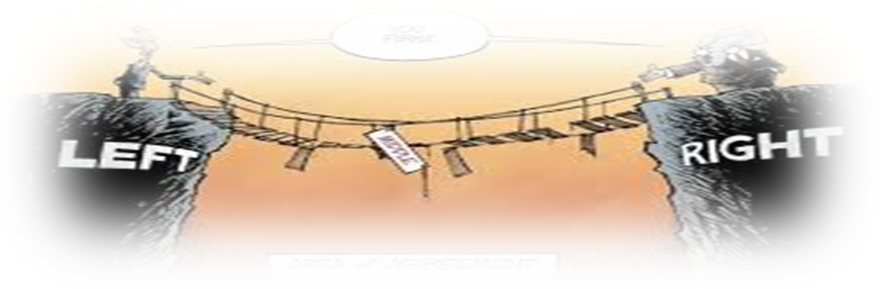
Political ideologies are not policy specific, rather, they are based on how the decision making process should function:
- Conservatism in the context of democracy is based on the premise that democracy is not temporally static but has three components, past, present and future, all of which must be considered when engaging in fundamental decisions thus change has to be considered from all three perspectives, respect for tradition, dealing with current needs but considering impact on future generations.
- Liberalism is more present oriented, problems should be promptly addressed and resolved, notwithstanding tradition, but taking impact on future generations into account.
- Socialism is based on the realization that we have two distinct and sometimes incompatible natures, the individual and the collective, and that tensions between them should be resolved taking both into account, when possible, but when the conflict cannot be resolved, the interests of the collective should prevail. A concept illustrated by the fictional Star Trek Vulcan, Spock when he would proclaim that the goof of the many outweighed the good of the few, and as a corollary, of the one.
- Libertarianism has components similar to socialism but the primacy when conflict is irreconcilable is in favor of the individual rather than the collective, thus, the needs of the one outweigh the needs of the many. It is the foundational pillar for the antidemocratic concept of “individual rights” such as were championed in the United States’ Bill of Rights.
“Left” and “Right” are incoherently variable terms with reference to the foregoing, as are the concepts of statist (in favor of power vested in the state) and anti-statists, as they tend to change based on what political group controls the state and at what level or the goals of political policies being considered.
These four aspects of decision making need not always be in conflict and wise policy makers should take all three into account. Unfortunately, most current policy makers are not wise and are dedicated primarily to the perspective that the many exist to serve the few and must be controlled by any means possible, while making it seem that the many, rather than the few, are the decision makers, when the truth is the obverse, and that generalized individual liberty is an impediment to such control.
_____
© Guillermo Calvo Mahé; Manizales, 2026; all rights reserved. Please feel free to share with appropriate attribution.
Guillermo (“Bill”) Calvo Mahé (a sometime poet and aspiring empirical philosopher) is a writer, political commentator and academic currently residing in the Republic of Colombia (although he has primarily lived in the United States of America of which he is also a citizen). Until 2017 he chaired the political science, government and international relations programs at the Universidad Autónoma de Manizales. Previously, he chaired the social studies and foreign language departments at the Eastern Military Academy in Huntington, New York. He is currently the publisher of the Inannite Review available at Substack.com; an intermittent commentator on radio and television; and, an occasional contributor to diverse periodicals and publications. He has academic degrees in political science (BA, The Citadel, the Military College of South Carolina), law (JD, St. John’s University, School of Law), international legal studies (LL.M, the Graduate Division of the New York University School of Law) and translation and linguistic studies (GCTS, the University of Florida’s Center for Latin American Studies). However, he is also fascinated by mythology, religion, physics, astronomy and mathematics, especially with matters related to quanta, cosmology and cosmogony. He can be contacted at guillermo.calvo.mahe@gmail.com and much of his writing is available through his blog at https://guillermocalvo.com/.
 Guillermo Calvo Mahé