Lugubriously lethargic lassitude is the art form the legacy media has perfected on behalf of its masters to keep us from realizing what has happened to the world we hoped to leave as a legacy for our descendants, the world we thought we’d be able to glimpse and, at times enjoy, the world we were promised if we would just work hard and behave.
It is the hopeless state that assails us when we seek to exercise our political duties and go to the polls with no real choice at all, all the available candidates having already been bought and paid for with our money but certainly not for our benefit.
It is the residue we’re left with when those who own and control us abuse us, and we’re left without recourse in the face of their immune impunity.
It is our reaction when we are forced to realize that Jeffrey Epsteins rule our world through their bought and paid for proxies and that we can, at best, sit and watch as children are abused and Palestinians are slaughtered for fun and profit, hoping that the vision of German Lutheran pastor Martin Niemöller’s “First They Came” will not apply to us, at least not in the near future.
It is what being inside a societal black hole’s event horizon feels like for those not among the Chosen. It is what being aware feels like in the Dystopia we live in, one where we sometimes envy those blissfully unaware among us, those who make it possible. It is what we feel when we’ve come to realize that the metaphorical sign atop the gates of mythic Hell joyfully proclaiming the death of hope already apply to us. _____
Guillermo (“Bill”) Calvo Mahé (a sometime poet and aspiring empirical philosopher) is a writer, political commentator and academic currently residing in the Republic of Colombia (although he has primarily lived in the United States of America of which he is also a citizen). Until 2017 he chaired the political science, government and international relations programs at the Universidad Autónoma de Manizales. Previously, he chaired the social studies and foreign language departments at the Eastern Military Academy in Huntington, New York. He is currently the publisher of the Inannite Review available at Substack.com; an intermittent commentator on radio and television; and, an occasional contributor to diverse periodicals and publications. He has academic degrees in political science (BA, The Citadel, the Military College of South Carolina), law (JD, St. John’s University, School of Law), international legal studies (LL.M, the Graduate Division of the New York University School of Law) and translation and linguistic studies (GCTS, the University of Florida’s Center for Latin American Studies). However, he is also fascinated by mythology, religion, physics, astronomy and mathematics, especially with matters related to quanta, cosmology and cosmogony. He can be contacted at guillermo.calvo.mahe@gmail.com and much of his writing is available through his blog at https://guillermocalvo.com/.
The last part of my education, long after I’d attained degrees in political science, law and international legal studies, involved, in part, linguistics and, to my surprise, it vastly enhanced my grasp of the other disciplines I’d studied, as well as of communication in general, as though I’d previously been intellectually two dimensional but after grasping essential aspects of linguistics, I’d attained the ability to perceive and to express myself in three or four. That led me to understand how Noam Chomsky had managed to attain such profound wisdom concerning both society and human nature although, perhaps, not with respect to all of his associates.
Something similar had occurred to me many decades earlier when, towards the end of my initial degree in law, I’d taken an elective course in jurisprudence, a course which should really have been a mandatory first semester course. Especially meaningful in that course was the section on Hohfeldian Terminology, a system of eight fundamental legal concepts created by American jurist Wesley Newcomb Hohfeld in 1913 to clarify ambiguous legal language, obviously an aspect of linguistics applied to law[2]. It is probably not very familiar to practicing attorneys today, although it should be.
Earlier in life I’d regretted not having studied higher mathematics as the little exposure I’d had in college to the field had led me to believe that most of us were largely blind, deaf and dumb with respect to the reality surrounding us. For some reason, however, philosophy did not impacted me in the same manner, probably because it is so premise driven; i.e., given a premise accepted as accurate, logic leads to conclusions that seem brilliant but which usually have little to do with reality. Indeed, the most important thing I learned of practical value while studying philosophy was that when predicted conclusions did not reflect reality, the premises were usually at fault.
I am now the sum of diverse currents having made many, many mistakes and learned from some of them, perhaps having gained at least a trace of wisdom in the process, especially, a willingness to accept that there is a great deal I don’t know and the ability to sometimes discern what it is that I don’t know. Perhaps the most important thing I’ve learned is that an open mind is a wonderful thing but ought never to be confused with an absence of opinions and beliefs, all of which should be continuously put to the test; perhaps the test I learned from philosophy: if the expected results prove inaccurate, the drawing board needs to be revisited rather than ignored through a plethora of excuses.
Interestingly, the latter concept seems anathema in politics were an open mind is considered an indicia of the absence of principles, a trait popularly referred to as “waffling”. Hence, a politician willing to reconsider his or her positions in light of experience is looked down upon as untrustworthy, something which does a lot to explain where we find ourselves: easily manipulated and unwilling to accept reality, even when it smacks us in the face.
As opposed to politicians, great mathematicians and physicists are constantly testing their premises, something that seems a corollary to David Hume’s belief that absolute truth may be impossible to prove but that what he referred to as “conventions”, tools we use in lieu of truth for practical purposes, i.e., because they seem to work (until they cease to be reliable, at which point they are discarded), were good enough in the short term[3].
Socrates taught by feigning ignorance and pretending to seek knowledge from those he taught, among them Aristocles, who we know by his nickname, Plato. Or perhaps, Socrates really did have an open mind and was misinterpreted, kind of like the character Chauncey Gardiner so well played by the late, great, Peter Sellers in the film, Being There.
Guillermo (“Bill”) Calvo Mahé (a sometime poet and aspiring empirical philosopher) is a writer, political commentator and academic currently residing in the Republic of Colombia (although he has primarily lived in the United States of America of which he is also a citizen). Until 2017 he chaired the political science, government and international relations programs at the Universidad Autónoma de Manizales. Previously, he chaired the social studies and foreign language departments at the Eastern Military Academy in Huntington, New York. He is currently the publisher of the Inannite Review available at Substack.com; an intermittent commentator on radio and television; and, an occasional contributor to diverse periodicals and publications. He has academic degrees in political science (BA, The Citadel, the Military College of South Carolina), law (JD, St. John’s University, School of Law), international legal studies (LL.M, the Graduate Division of the New York University School of Law) and translation and linguistic studies (GCTS, the University of Florida’s Center for Latin American Studies). However, he is also fascinated by mythology, religion, physics, astronomy and mathematics, especially with matters related to quanta, cosmology and cosmogony. He can be contacted at guillermo.calvo.mahe@gmail.com and much of his writing is available through his blog at https://guillermocalvo.com/.
[1] Plato. (1997): Apology (H. Tarrant, Trans.) in J. M. Cooper (Ed.), Plato: Complete Works (Stephanus p. 21d). Hackett Publishing.
If he or she or it or even they exist, the divine, they and I are, I think, friends. Mainly because I dare to interact with them as a sort of equal. Not in terms of power of course, but in sensitivities and concerns and perceptions, seeing in divinity those same traits, albeit not easily admitted, especially to “believers” who insist that divinity is perfect: eternal, omniscient, ubiquitous, omnipotent and omnibenevolent, when the divine has or have, in all probability (assuming probability is relevant), doubts of his, her, its’ or their own, and perhaps quite a bit of guilt and remorse.
The divine, if the concept exists, desperately need someone with whom to communicate and not in prayer (which probably generates divine migraines) or devotion, but openly and honestly, without fear of being judged, but rather, hoping for empathy, in much the same way as humans should hope to relate with whatever concept of divinity they individually have.
Of course, the likelihood that divinity exists is rather slight but, all the same, even if imagined, it can be comforting.
Or, terrifying.
Terrifying if he, she, it or they are really, to any extent, omniscient, ubiquitous, and omnipotent but not omnibenevolent (eternal is irrelevant). Given the world as it is and as it has seemingly always been, omnibenevolence obviously cannot coexist with the other attributes traditionally associated with divinity by purportedly modern humans. The ancients, even the purported descendants of Abraham, knew that. Their divinities were selfish, self-centered, prone to outbursts and as frequently wrong as they were right, regardless of what their sycophants wrote. Which explains why they were terrified of their divinities and sought to appease them, rather than to understand them. Interestingly, similar fear seems to infest most Abrahamic religions, despite the love on which they are purportedly premised.
But I like my concept much more. Ours is a hubris free relationship involving imperfect, perhaps insecure divinities that need us as much as we need them. It is more comforting, more reflective of the best in us as humans (or is it we?). Thus, I cater to the divine generously, open to whatever they need to get off of their metaphorical shoulders without expecting all that much in return, other than a bit of reciprocity.
Hmm, reciprocity.
Isn’t that the essence of the so called “Golden Rule”? _____
Guillermo (“Bill”) Calvo Mahé (a sometime poet and aspiring empirical philosopher) is a writer, political commentator and academic currently residing in the Republic of Colombia (although he has primarily lived in the United States of America of which he is also a citizen). Until 2017 he chaired the political science, government and international relations programs at the Universidad Autónoma de Manizales. Previously, he chaired the social studies and foreign language departments at the Eastern Military Academy in Huntington, New York. He is currently the publisher of the Inannite Review available at Substack.com; an intermittent commentator on radio and television; and, an occasional contributor to diverse periodicals and publications. He has academic degrees in political science (BA, The Citadel, the Military College of South Carolina), law (JD, St. John’s University, School of Law), international legal studies (LL.M, the Graduate Division of the New York University School of Law) and translation and linguistic studies (GCTS, the University of Florida’s Center for Latin American Studies). However, he is also fascinated by mythology, religion, physics, astronomy and mathematics, especially with matters related to quanta, cosmology and cosmogony. He can be contacted at guillermo.calvo.mahe@gmail.com and much of his writing is available through his blog at https://guillermocalvo.com/.
Nature and nature’s god, if there is one, and if there is a difference between the two concepts, cares nothing at all about the human concepts of good and evil, or good and evil at all, caring only for efficiency and its maximization but, lacking omniscience, seeks to find efficiency through trial and error, through experimentation which is frequently not only unsuccessful, but results in devastating failures, that is where infinity and eternity create the ideal laboratory.
We humans refer to the foregoing as evolution, which may well not be a bio-centric concept but rather, applicable to every process in the cosmos, or better yet, the multiverse or best of all, the omniverse, at least for now. That concept expands as the concept (or fiction) of time is filtered in.
Of course, evolution in a cosmic sense was probably most prominent during the early stages of cosmic evolution, during the first zeptoseconds after whatever first occurred, but continued experimenting with energy and with the smallest possible particulate units which we currently believe to involve quarks and leptons but probably involved a series of predecessors, most of them failed.
I wonder what it was like before the first zeptosecond. A concept, at least in human terms, that needs light and hydrogen atoms but which obviously had precursors, smaller and shorter until they sought to merge with a time before infinity or eternity had been posited as divine hypotheses, assuming, of course, the improbable existence of divinity.
It must be incredibly comforting to be unconcerned with good or evil, merely enjoying the creative frustrations of the quest for efficiency, a road like, the road to Hell, littered with positive intentions but unconcerned with damnation.
We humans, of course, believe that we know better. We have concepts of good and evil contradictory to nature’s quest for efficiency and contrary to the dictates of cruel evolution. We believe ourselves more enlightened, which more than anything confuses us as we have, to date, been utterly unable to abide by the morality and ethics we invent to discredited nature’s cruel quest for efficiency. But then, comforting hypocrisy is our hall mark. One with which we imbue the verisimilitudes of divinity we create in hopes that those illusions will provide us with answers to unfathomable and hence unanswerable queries, and the most foul among us use the myths we create, to maximize control and power and wealth and hubris. And they find that efficient, at least in the short term, and hence divine.
We humans, and perhaps all forms of life, are apparently aberrations nature has yet to categorize as failed experiments, failures which, or perhaps who, like Mordred, aspire to supplement their parentage, or progenitor, nature itself, and force it into our own image, one where good and evil exist as relative concepts, useful tools as long as they’re ignored whenever inconvenient.
Observations which my deistic friends of Abrahamic persuasions will find heretical and anathema, at best, but which Elphaba apparently grasped as, exposed to water, she slowly started to melt and in her personal, last instant epiphany, exclaimed: “What a world, what a world!” _____
Guillermo (“Bill”) Calvo Mahé (a sometime poet and aspiring empirical philosopher) is a writer, political commentator and academic currently residing in the Republic of Colombia (although he has primarily lived in the United States of America of which he is also a citizen). Until 2017 he chaired the political science, government and international relations programs at the Universidad Autónoma de Manizales. Previously, he chaired the social studies and foreign language departments at the Eastern Military Academy in Huntington, New York. He is currently the publisher of the Inannite Review available at Substack.com; an intermittent commentator on radio and television; and, an occasional contributor to diverse periodicals and publications. He has academic degrees in political science (BA, The Citadel, the Military College of South Carolina), law (JD, St. John’s University, School of Law), international legal studies (LL.M, the Graduate Division of the New York University School of Law) and translation and linguistic studies (GCTS, the University of Florida’s Center for Latin American Studies). However, he is also fascinated by mythology, religion, physics, astronomy and mathematics, especially with matters related to quanta, cosmology and cosmogony. He can be contacted at guillermo.calvo.mahe@gmail.com and much of his writing is available through his blog at https://guillermocalvo.com/.
The concept that rejecting the political posture of an individual or political movement or party can constitute “treason” in a pluralistic democracy is oxymoronic.
The allegiance of a citizen in a democracy is to the corporate concept of the “People”, not to any person or political party, and certainly not to any serving government. Perhaps not even to the “State”.
The principal political duty of individuals in a democracy is to maintain their civic responsibilities by informing and educating themselves, exercising their reason and common sense, and sharing their opinions with other citizens without fear of reprisals, calumnies or ridicule.
The foregoing is something almost entirely absent from current discourse in purported Western democracies. Perhaps the “adjective “Western” now changes the nature of the noun modified making it synonymous instead with oligarchical autocracy and dictatorship. _____
Guillermo (“Bill”) Calvo Mahé (a sometime poet and aspiring empirical philosopher) is a writer, political commentator and academic currently residing in the Republic of Colombia (although he has primarily lived in the United States of America of which he is also a citizen). Until 2017 he chaired the political science, government and international relations programs at the Universidad Autónoma de Manizales. Previously, he chaired the social studies and foreign language departments at the Eastern Military Academy in Huntington, New York. He is currently the publisher of the Inannite Review available at Substack.com; an intermittent commentator on radio and television; and, an occasional contributor to diverse periodicals and publications. He has academic degrees in political science (BA, The Citadel, the Military College of South Carolina), law (JD, St. John’s University, School of Law), international legal studies (LL.M, the Graduate Division of the New York University School of Law) and translation and linguistic studies (GCTS, the University of Florida’s Center for Latin American Studies). However, he is also fascinated by mythology, religion, physics, astronomy and mathematics, especially with matters related to quanta, cosmology and cosmogony. He can be contacted at guillermo.calvo.mahe@gmail.com and much of his writing is available through his blog at https://guillermocalvo.com/.
“Even the most foolish among us may be capable, deliberately or inadvertently, of transcendental wisdom thus, there may be hope for me yet.” Guillermo Calvo Mahé, July 30, 2026.
A quote inspired by recollections of one phrase uttered by Howard Dean, a failed Democratic Party candidate, decades ago: “…we have to change minds and change hearts—one heart at a time.”
Something that has always remained with me and inspires me to keep writing and publishing during times such as ours. Times such as those that Sigmund Freud must have been thinking of while in Vienna during 1938 when, in his preface to Moses and Monotheism, he wrote: “in darker times there lived a man who thought as you do”.
We all know what followed: the Second World War, the Holocaust, the atomic bombing of Hiroshima and Nagasaki, the colonization of Palestine by Zionist invaders and the ensuing Nakba, and then, …. well things have become even worse. _____
Guillermo (“Bill”) Calvo Mahé (a sometime poet and aspiring empirical philosopher) is a writer, political commentator and academic currently residing in the Republic of Colombia (although he has primarily lived in the United States of America of which he is also a citizen). Until 2017 he chaired the political science, government and international relations programs at the Universidad Autónoma de Manizales. Previously, he chaired the social studies and foreign language departments at the Eastern Military Academy in Huntington, New York. He is currently the publisher of the Inannite Review available at Substack.com; an intermittent commentator on radio and television; and, an occasional contributor to diverse periodicals and publications. He has academic degrees in political science (BA, The Citadel, the Military College of South Carolina), law (JD, St. John’s University, School of Law), international legal studies (LL.M, the Graduate Division of the New York University School of Law) and translation and linguistic studies (GCTS, the University of Florida’s Center for Latin American Studies). However, he is also fascinated by mythology, religion, physics, astronomy and mathematics, especially with matters related to quanta, cosmology and cosmogony. He can be contacted at guillermo.calvo.mahe@gmail.com and much of his writing is available through his blog at https://guillermocalvo.com/.
It’s interesting and indeed important in this age where verity is an anachronism to reflect on the intellectual pillars on which seventeenth and eighteenth century political philosophers ruminated as they wove the fundaments on which they hoped “western” society might to be based. They were not concerned with democracy at all. Indeed, most disdained it as mob rule, but they were very concerned with avoidance of tyranny. Not “tyranny” in the classical Greek sense of attainment of power by nontraditional means, Greek tyrants were among the most effective and populist leaders, but in the sense of abuse of power by an oligarch. They realized, I believe, that rule of one man (a subject) by another (a sovereign) inevitably involves the appropriation, for benign or malign purposes, of the subject’s sovereignty (i.e., his or her autonomy) and they were most concerned with at least limiting the extent to which such bequeathed, stolen or otherwise acquired individual sovereignty would be subjugated. In this, Thomas Hobbes was more sanguine than was the kinder and more idealistic John Locke but as history has demonstrated, Hobbes was more perceptive.
In the opinion of John Locke and perhaps also Thomas Hobbes, in a primordial, perhaps metaphorical past, individuals, theretofore fully vested of their individual sovereignty, surrendered it in exchange for a social system that provided some semblance of security and predictability because in a world where everyone was sovereign, no one was secure, the concept of private property could not exist, and though the strongest might rule, the weak, collectively or while the strong slumbered, could dispose of them. Hobbes believed that individuals surrendered the totality of their individual sovereignty to a single individual, an autocrat, or to a group of individuals, an oligarchy, in exchange for promised personal safety and for “boons” from the sovereign which resembled rights, but could be modified, suspended or eliminated at the sovereign’s whim, so long as the sovereign provided security.
John Locke’s perspective was very different in that not all aspects of individual sovereignty were surrendered and the aspects retained were inviolable “rights”. Further, that the surrender of the portion of individual sovereignty not retained was based on a social contract and thus, the surrender was conditioned on the sovereign’s compliance with the terms pursuant to which it had attained its authority, which included guarantees of security, but much more, especially respect for the aspects of sovereignty not surrendered.
Because “rights” were the purported residue of individual sovereignty, not granted but retained, they could not be conditioned, even when the conditions were benign, made sense and were necessary. Consequently, if what seems a right is subject to any condition, it is no longer a right but a boon granted by one who has attained sovereignty over another or others, and the best that might be hoped for is a quasicontractual arrangement where the sovereign agrees to be bound by rules giving the subject limited means to enforce the boon granted. Limited means because, as we see today in the United States, sovereigns tend to avoid or ignore the promises made to their subjects whenever the whim strikes them. Thomas Hobbes did not believe in the concept of rights (other than as a primordial myth). Because he believed that the totality of individual sovereignty had been surrendered to a central authority in exchange for security and for the grant of boons that sort of smelled like rights, he believed that mankind’s hope lay in enlightened sovereigns.
Today, “rights” appear everywhere, enumerated in countless constitutions and referenced constantly in treaties, legislation and political debates, indeed, they have morphed into diverse purported generations each expanding their purported scope. But no so-called-right is unconditional and despite constant references to guarantees, no such right is consistently enforced. Given that rights are purportedly self-enforcing, not having been granted but retained, it seems clear, at least to the author, that in reality, no rights, as understood by John Locke exist. Rather, there are aspirational concepts towards which decent governments should seek to evolve, and what exists currently is solely the conception described by David Hume in his criticism of Locke as conventional, utility-based, and established human conditional agreements meant to maintain social order and property, essential, artificial rules that allow people to coexist peacefully, which may or may not be honored..
John Locke naively believed in rights and argued articulately in their favor albeit, as David Hume eventually pointed out, his logic was premise free, i.e., rather than articulated, his premises were purportedly self-evident. However, clever politicians including those who betrayed their oaths of loyalty to the British monarchy in the latter half of the eighteenth century in order to appropriate the British monarch’s sovereignty for themselves, found Locke’s arguments useful, if perhaps not quite credible. They were, after all, pragmatically practical men interested in practical results rather than the idealists that history portrays. Indeed, their actions (think of Thomas Jefferson, the Declaration of Independence and slavery) with respect to their purported reformulation of John Locke’s conclusions were laced with hypocrisy. That always has been the case and not just among the so-called Founding Fathers nor limited to the republic they founded.
Still, the Founding Fathers, like the political philosophers who preceded and followed them, were concerned with the issue of tyranny, at least with tyranny that impacted them directly and, in order to minimize tyranny, the founders of the United Colonies’ eventual republic sought to constitutionally disperse sovereignty in two ways: first by placing temporal limits on the human beings who might be charged with its employment and second, by fragmenting sovereignty into separate groupings of political power, thus avoiding “dictatorship” [1]. In this regard it is worth noting that the concept of dictatorship ought not to be considered a pejorative but rather, merely the result of un-fragmented sovereignty, i.e., when all political power was concentrated in one person or institution (the traditional segmentation of political power being, legislative, executive and judicial, to which should have been added a fourth, supervision and control over the other three to avoid usurpation[2]).
That democracy was not important at to the Founding Fathers seems obvious in the institutional structures they established through the Constitution promulgated in 1787 and set into full force in 1788:
The Senate was selected, not by the People but by the States.
The membership of the House of Representatives was not based on population but on a complex system comprised in part of population, in another part based on equal numerical representation of the states, and in a third part by treating persons locked into involuntary servitude (slavery) as 3/5ths of a person, however, the right to vote was restricted in such manner as the states might determine so that, as in ancient Athens, less than ten percent of the population originally enjoyed the “franchise” (right to vote).
The President was to be elected by designees of the states selected as they saw fit to serve in an organization that never actually met, the Electoral College. And the federal Judiciary was to be selected for life by agreement between the president and the Senate.
No trace of democracy anywhere.
That system has somewhat morphed into a semblance of democracy by expansion of the right to vote, usurping functions originally assigned to the states, but not on a one person one vote basis as residents in smaller states exercise disproportional electoral power in the Senate, the House of Representatives and the Electoral College.
Democracy should however be a majoritarian concept and that requires popular participation. Unfortunately, unlike the ancient Athenians and Romans where political participation (at least by those eligible to participate) was deemed a duty, in the United States participation in the political process is deemed a sort of right and, consequently, rarely if ever do enough eligible voters participate in the electoral process to make attainment of a real majority (more than 50% of the eligible electorate) possible. Hence electoral decisions are made by relatively small pluralities, usually less than 30% of the eligible electorate and that 30% is comprised of or controlled by elites with little or no interest in the common welfare (as opposed to their own privileges).
Perhaps more relevant is the reality that while the illusion of democracy seems to have evolved over time, the reality has not. Elected officials for the most part (with fairly are exceptions) answer not to their constituents but to those who fund their political campaigns. Institutionally, political power is purportedly concentrated in two privileged political parties supposedly in a relationship of collaborative opposition but today and for the past half century at least, both of those groupings are economically dominated by a purportedly private organization dedicated to imposing the will of a foreign country on the citizenry[3]. As a result, the residents of that foreign country, well, at least the residents who are members of that country’s official religion, obtain, at the expense of United States tax payers, massive social programs unavailable in the United States (e.g., subsidized housing, free healthcare and education, etc.), massive funding for its armed forces, the use of the armed forces of the United States for its own quest for lebensraum and, use of the veto power of the United States in the United Nations (as directed by that foreign government). In addition to the foregoing, the purported rights constitutionally guaranteed to the citizens of the United States are quickly becoming inapplicable if they are detrimental to the goals, aspirations or interests of that foreign state. Consequently, a foreign state, without temporal limitations such as are involved in terms of political office or limitations based on fragmentation of sovereignty has imposed a de facto tyrannical dictatorship over the United States, which it uses to impose its will over the Middle East. Its ambitions however may well spread to other regions in the not too distant future.
Ironic but perhaps, something that was predictable as far back as 1787. Indeed, George Washington, the first president of the United States under the Constitution of 1787 seems to have foreseen the possibility now existent in his farewell address. The address was in the form of a letter entitled “The Address of General Washington to the People of America on His Declining the Presidency of the United States” published in Claypoole’s American Daily Advertiser on September 19, 1796, about ten weeks before the newly appointed members of the Electoral College were to cast their votes in 1796. In that address he sternly warned against the situation which the country finds itself in today, one that has been continually evolving since at least 1916. Wikipedia, not the most reliable source but a useful one from time to time, describes the segment of George Washington’s Farewell Address dedicated to foreign sovereigns as follows (footnotes omitted)[4]:
Washington dedicates a large part of his farewell address to discussing foreign relations and the dangers of permanent alliances between the United States and foreign nations, which he views as foreign entanglements. He advocates a policy of good faith and justice towards all nations, again making reference to proper behavior based upon religious doctrine and morality. He urges the American people to avoid long-term friendly relations or rivalries with any nation, arguing that attachments with or animosity toward other nations will only cloud the government’s judgment in its foreign policy. He argues that longstanding poor relations will only lead to unnecessary wars due to a tendency to blow minor offenses out of proportion when committed by nations viewed as enemies of the United States. He continues this argument by claiming that alliances are likely to draw the United States into wars that have no justification and no benefit to the country beyond simply defending the favored nation. Alliances, he warns, often lead to poor relations with nations who feel that they are not being treated as well as America’s allies, and threaten to influence the American government into making decisions based upon the will of their allies instead of the will of the American people.
….
Washington makes an extended reference to the dangers of foreign nations who will seek to influence the American people and government; nations who may be considered friendly as well as nations considered enemies will equally try to influence the government to do their will. “Real patriots”, he warns, who “resist the intrigues” of foreign nations may find themselves “suspected and odious” in the eyes of others, yet he urges the people to stand firm against such influences all the same. He portrays those who attempt to further such foreign interests as becoming the “tools and dupes” of those nations, stealing the applause and praise of their country away from the “real patriots” while actually working to “surrender” American interests to foreign nations.
Washington goes on to urge the American people to take advantage of their isolated position in the world, and to avoid attachments and entanglements in foreign affairs, especially those of Europe, which he argues have little or nothing to do with the interests of America. He argues that it makes no sense for the American people to become embroiled in European affairs when their isolated position and unity allow them to remain neutral and focus on their own affairs. He argues that the country should avoid permanent alliances with all foreign nations, although temporary alliances during times of extreme danger may be necessary. He states that current treaties should be honored but not extended.
Washington wraps up his foreign policy stance by advocating free trade with all nations, arguing that trade links should be established naturally and the role of the government should be limited to ensuring stable trade, defending the rights of American merchants and any provisions necessary to ensure the conventional rules of trade.
Obviously, as in the case of President Dwight David Eisenhower’s farewell address, President Washington’s foresight has been utterly ignored. Thus, while the postulations of the sixteenth and seventeenth century philosophers who sought to provide future generations with guidance with respect to the avoidance of tyranny to some extent impacted the Founding Fathers in the formulation of the Constitution of 1787, the results have proven singularly unsuccessful and have instead, resulted in the domination of three hundred and fifty million residents of the United States by ten million European Immigrants to the Middle East who have managed to leverage widespread control over economics, communication, entertainment and finance into total control over the … well, … seemingly everything. Pretty much the definition of tyranny.
So, … In retrospect, reflecting on tyranny, democracy, rights and sovereignty, we have never had democracy or rights although for a while, to an extent, we managed to minimize tyranny, but whatever sovereignty we once had, or though we had, is now illusory as well. Ironically, the efforts of the Founding Fathers to sunder Britain’s American colonies from British sovereignty in a manner minimizing the risks of tyranny have only resulted in subjugation to the tyranny of another foreign sovereign.
Guillermo (“Bill”) Calvo Mahé (a sometime poet and aspiring empirical philosopher) is a writer, political commentator and academic currently residing in the Republic of Colombia (although he has primarily lived in the United States of America of which he is also a citizen). Until 2017 he chaired the political science, government and international relations programs at the Universidad Autónoma de Manizales. Previously, he chaired the social studies and foreign language departments at the Eastern Military Academy in Huntington, New York. He is currently the publisher of the Inannite Review available at Substack.com; an intermittent commentator on radio and television; and, an occasional contributor to diverse periodicals and publications. He has academic degrees in political science (BA, The Citadel, the Military College of South Carolina), law (JD, St. John’s University, School of Law), international legal studies (LL.M, the Graduate Division of the New York University School of Law) and translation and linguistic studies (GCTS, the University of Florida’s Center for Latin American Studies). However, he is also fascinated by mythology, religion, physics, astronomy and mathematics, especially with matters related to quanta, cosmology and cosmogony. He can be contacted at guillermo.calvo.mahe@gmail.com and much of his writing is available through his blog at https://guillermocalvo.com/
[1] A dictatorship is the most efficient form of government but more likely to lead to tyranny than fragmented sovereignty although, as can be seen today, the scheme of governance the Founding Fathers established on their second attempt, in 1787, can fairly easily be converted into a dictatorship when all elements of such fragmentation are reunited under one person, or one political group, as frequently occurs and as is the case in the United States today.
[2] Unfortunately, the Founding Fathers did not provide for an arbiter between the three traditional powers, although the concept was considered at the Constitutional Convention, and several proposed solutions rejected. Instead, they appeared to assume that such function could be attained through granting the executive a power to veto legislation, for whatever reason, subject to override, and also the power to pardon. They were, unfortunately mistaken as that power was quickly usurped by the Judiciary in a decision worthy of Machiavelli, the case of Marbury v. Madison (1803) where John Marshall, the recently appointed n Chief Justice of the United States provided his detested cousin, President Thomas Jefferson with a pyrrhic victory by deciding in his favor, but based on the dubious theory that the Judiciary was the arbiter of constitutional authority. Theretofore, that function had been assumed to lie in the legislative branch (as it did in the United Kingdom) or in the executive as implied at the Constitutional Convention, although a number of colonies in their own systems of governance had been drifting towards the concept of judicial review under their own constitutions. See generally, Calvo Mahé, Guillermo et. al. (Jiménez Ramírez, Milton Cesar, editor, 2020): “Capítulo I. Evolución del control de constitucionalidad en los estados unidos.”; El control de la constitucionalidad en episodios: acerca del control constitucional como límite al poder; Universidad de Caldas, Facultad de ciencias jurídicas y sociales; Bogotá.
[3] The American Israeli Public Affairs Committee (AIPAC).
Political ideologies are not policy specific, rather, they are based on how the decision making process should function:
Conservatism in the context of democracy is based on the premise that democracy is not temporally static but has three components, past, present and future, all of which must be considered when engaging in fundamental decisions thus change has to be considered from all three perspectives, respect for tradition, dealing with current needs but considering impact on future generations.
Liberalism is more present oriented, problems should be promptly addressed and resolved, notwithstanding tradition, but taking impact on future generations into account.
Socialism is based on the realization that we have two distinct and sometimes incompatible natures, the individual and the collective, and that tensions between them should be resolved taking both into account, when possible, but when the conflict cannot be resolved, the interests of the collective should prevail. A concept illustrated by the fictional Star Trek Vulcan, Spock when he would proclaim that the goof of the many outweighed the good of the few, and as a corollary, of the one.
Libertarianism has components similar to socialism but the primacy when conflict is irreconcilable is in favor of the individual rather than the collective, thus, the needs of the one outweigh the needs of the many. It is the foundational pillar for the antidemocratic concept of “individual rights” such as were championed in the United States’ Bill of Rights.
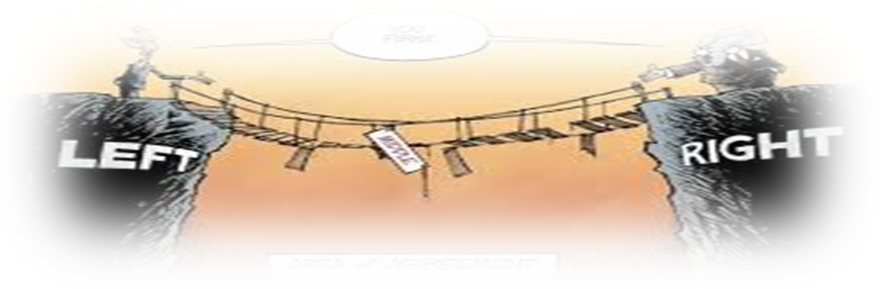
“Left” and “Right” are incoherently variable terms with reference to the foregoing, as are the concepts of statist (in favor of power vested in the state) and anti-statists, as they tend to change based on what political group controls the state and at what level or the goals of political policies being considered.
These four aspects of decision making need not always be in conflict and wise policy makers should take all three into account. Unfortunately, most current policy makers are not wise and are dedicated primarily to the perspective that the many exist to serve the few and must be controlled by any means possible, while making it seem that the many, rather than the few, are the decision makers, when the truth is the obverse, and that generalized individual liberty is an impediment to such control. _____
Guillermo (“Bill”) Calvo Mahé (a sometime poet and aspiring empirical philosopher) is a writer, political commentator and academic currently residing in the Republic of Colombia (although he has primarily lived in the United States of America of which he is also a citizen). Until 2017 he chaired the political science, government and international relations programs at the Universidad Autónoma de Manizales. Previously, he chaired the social studies and foreign language departments at the Eastern Military Academy in Huntington, New York. He is currently the publisher of the Inannite Review available at Substack.com; an intermittent commentator on radio and television; and, an occasional contributor to diverse periodicals and publications. He has academic degrees in political science (BA, The Citadel, the Military College of South Carolina), law (JD, St. John’s University, School of Law), international legal studies (LL.M, the Graduate Division of the New York University School of Law) and translation and linguistic studies (GCTS, the University of Florida’s Center for Latin American Studies). However, he is also fascinated by mythology, religion, physics, astronomy and mathematics, especially with matters related to quanta, cosmology and cosmogony. He can be contacted at guillermo.calvo.mahe@gmail.com and much of his writing is available through his blog at https://guillermocalvo.com/.
Divinity, at least according to followers of Abrahamic religions, involves five essential attributes: eternal existence, the divinity must have always existed and will always exist; omnipresence, i.e., the divinity must be ubiquitous, concurrently everywhere; omniscience, the divinity must have permanent and eternal knowledge concerning absolutely everything not only with respect to the past and the present, but also the future; omnipotence, the divinity must necessarily be all powerful, capable of anything and everything without reservation; and, the divinity must be omnibenevolent, all good without a trace of evil or negativity.
Other religions, more ancient religions as well as contemporary religions have been more realistic. Deities, where they existed, were just more powerful than humans albeit not omnipotent, especially when they were plural. If not ubiquitously omnipresent, they were perhaps not bound by the rules concerning time and space that apply to us and could show up when least expected. Omniscient? Not at all, although perhaps they, or some of them, were more cognitively gifted, at least sometimes. Eternal? Nope, they somehow came into being, usually sequentially, and in most cases, eventually expired, although the expiration was sometimes temporary. And omnibenevolent? Hell no! They were willful and selfish and prone to emotional outburst. Hmmm, that all sounds a great deal like the Abrahamic YHWH.
Still, to be fair, omniscience and ubiquitous omnipresence would seem possible if one eliminates time and space, treating them as illusions. If time did not exist, then eternity would be either irrelevant or merely a natural state. Perhaps in that context, since nothing would really exist, omnipotence might also be possible although not all that potent. But omnibenevolence is subjective although, in the absence of time and space and anything at all (other than perhaps, a sentient singularity), it might well be either irrelevant or natural, there being no choices to make. In the foregoing context, an idealized divinity such as that imagined in Abrahamic religions might be possible, but only until time and space arrived, only until decisions became, not only possible, but necessary, even if any such decisions were merely illusions.
So, where does that leave us?
Perhaps pondering on the nature of quantic phenomena and how they might impact the foregoing. As I understand it, everything and anything is possible at a quantic level, sort of like the concept of chaos where, rather than consider it a negative, chaos is merely the confluence of every possibility; however, quantic activation would require an observer which would create a sort of bootstrap cosmogony. Kind of like the ones were it is the worshippers who create the worshipped.
Guillermo (“Bill”) Calvo Mahé (a sometime poet and aspiring empirical philosopher) is a writer, political commentator and academic currently residing in the Republic of Colombia (although he has primarily lived in the United States of America of which he is also a citizen). Until 2017 he chaired the political science, government and international relations programs at the Universidad Autónoma de Manizales. Previously, he chaired the social studies and foreign language departments at the Eastern Military Academy in Huntington, New York. He is currently the publisher of the Inannite Review available at Substack.com; an intermittent commentator on radio and television; and, an occasional contributor to diverse periodicals and publications. He has academic degrees in political science (BA, The Citadel, the Military College of South Carolina), law (JD, St. John’s University, School of Law), international legal studies (LL.M, the Graduate Division of the New York University School of Law) and translation and linguistic studies (GCTS, the University of Florida’s Center for Latin American Studies). However, he is also fascinated by mythology, religion, physics, astronomy and mathematics, especially with matters related to quanta, cosmology and cosmogony. He can be contacted at guillermo.calvo.mahe@gmail.com and much of his writing is available through his blog at https://guillermocalvo.com/.
According to one system used to measure the passage of “time” (whatever that is) and to identify events that occurred during that particular stream, one among many events once stood out. Well in truth almost an infinity of events stood out at least with respect to the entities with which this reflection deals but, for the nonce (another sort of vaguely defined unit of “time”) we intend to deal with some specific events that they somehow deemed crystalized. The author uses the plural first person pronoun, not in the royal sense, but rather, as a means of including both the author and the readers in the assertion. Anyway, we will attempt to reflect on an undefined, perhaps undefinable specific series of related events, albeit only after we engage in an effort to place them in a somewhat coherent temporal context (again, a concept related to “time”) albeit using the limited form of communication available to our protagonists.
Diverse series of somewhat related events have seemed interesting to the strange carbon based biological composites which, at the “time” about which we are reflecting, inhabited a satellite revolving around another satellite and with a satellite of its own (as will be explained below) who considered themselves the pinnacle of natural evolution as well as the beneficiaries of particular attention from beings ironically superior to themselves, or at least of one such being which some among them believe to be a deity. They believe themselves to be sentient and, not just sentient, but special, although, to be honest, they subdivide themselves into a myriad of subgroups and each subgroup considers that only it is special and that all the other virtually identical subgroups, at least with respect to their biological composition, are inferior. Incoherent, we agree, but we are just doing our best to describe related contextualizing phenomena.
One of the units of “time” (a concept they cannot quite define but which they use all of the, well, time), is a period they refer to as a year; i.e., the “time” it takes the satellite of a “star” (a “star” being a very large spherical continuous nuclear explosion) inhabited by them (the satellite), the “star being known to them as “Sol”, among other names, and the satellite they inhabit being referred to by many of them as “Terra”, among other names, “among other names” because they have apparently (despite ancient legends concerning a time prior to the destruction of a great tower) never been quite been able to agree on appropriate nomenclature ….
Oh my, we’ve digressed so much in an effort at contextualization that we’ve assuredly confused the reader’s train of thought, so, we’ll sort of “reboot”: … “a year” is the term they use to refer to the approximate amount of “time” it takes their Terra to complete one circumnavigation of their Sol.
These peculiar and extremely conceited beings further subdivide the “year” into days, the time it took Terra, the satellite they inhabit, to complete one revolution around its axis, and then further subdivide their perception of times into units smaller than days known to them as hours and seconds and milliseconds and nanoseconds, etc., as well as into units larger than days which they refer to as weeks and months and seasons. Months and seasons are related to the orbits of a satellite of Terra, which these entities, who believe themselves to be sentient, sometimes refer to as Luna (among other names). Weeks? Well, they really have no logical basis (but they could if the “year” were divided into thirteen, rather than twelve months, and each month further divided into four, seven day weeks instead of into a variable number of days ranging from twenty-eight to thirty-one). In that case, a day or two would be left over and would be deemed outside of the normal calendar designations of months and weeks, perhaps being designated holidays, for example, New Year’s Day and, every four years, Leap Day. Why months are arranged as they currently are is difficult to say which is not the same as saying that such somewhat irrational albeit purportedly sentient beings do not have myriads of rationalizations to explain their incoherence. Oh my, a double negative, … confusing.
At this point, it probably makes sense to identify the author of this reflection. Not exactly an easy thing to do but essential if we’re ever to get to the point.
The author is a confused member of the protagonists in this reflection but knows that “he” is confused. What, the reader may now wonder is a “he”? Well, these entities subdivide themselves into two major biological categories, male and female, although lately (another concept related to time involving proximity, “proximity” being a concept related to something referred to as “space” but which could, by analogy, also refer to “time”), a number of these entities have been refusing to acknowledge such categories and refer to themselves as, among other things, non-binary, or else, just somewhat arbitrarily switch their biological characterization to a variant of the other category to which they refer as “their culturally perceived gender”.
Perhaps the foregoing will lead the reader to understand why the author perceives of himself as confused. So confused in fact that he has completely lost track of the nature of this reflection and as to why he has been writing it and as to just what series of events he had hoped to memorialize when he started writing this reflection.
Contextualization can be so confusing! It seems that the author has lost himself amidst shifting eddies of time and space flowing somewhere hidden deep within what passes for his mind.
Ahhh, fortunately, perhaps, or perhaps not, clarity, or something akin to clarity seems to engulf him and he recalls that when he started writing this reflection he had been speculating on the nature of what some among his contemporaries referred to as divinity, and on how different perspectives were with respect to that strange but seemingly transcendental concept, and then, that he had been wondering about the nature of “surety”, not in the sense of one who stands for the obligations of another, but in the sense of certainty, acknowledging that his interpretation of that term was based on linguistic analysis rather than custom and that language was utterly inefficient in that respect, as opposed, perhaps, to numbers. And that as he started writing, he had started to reflect on the nature of “knowledge” which, in terms of absolute accuracy, seemed as unattainable as infinity, and he considered the probability that all we had, really, were opinions, some of which we held very strongly, and then he had recalled a philosopher, David Hume, who had wrestled with related speculations and had concluded that absolute truths might or might not exist, and that as humans we could at best approximate the practical semblance of truths by developing what he called “conventions”, useful vehicles which we could, for a time, treat as “truths” but knowing that at some point, their seeming verity might well prove an illusion but how, over time, “conventions” became calcified so that, to most people, they became unassailable truths for which they were prepared to fight and to kill and to die, although “to kill for” was certainly favored over “to die over”. And then, he had become distracted with the concept of prepositions, wondering how a “convention” had evolved in the English language, really a hodgepodge combination of diverse linguistic traditions, to the effect that it was improper to end a sentence with a preposition. Certainly a much safer “convention” than the diverse religious “conventions” among the fratricidal Abrahamic religions which declared any failure to firmly consider related “conventions” absolute truths were what they referred to as “heresies”, and that heretics had to be eliminated, justifying genocide regardless of commandments that abjured homicide. And then he recalled how, as a very young teacher, he had taught a course on comparative religions which he had expanded to include comparative mythologies as neither he nor his students could establish clear boundaries between the two concepts and how, after decades of research, he had come to perceive all organized religions, especially the Abrahamic variants, as more mythic than those belief systems that he and his students had once considered ancient superstitions. Not a comforting thought, so he had returned to speculating on the nature of time and space which had doubled back to the concept of “conventions” and thence, to this strange reflection.
And the author wonders, first, whether anyone will ever read this reflection and, if so, what the reader or readers will make of it. And what they will make of him. And whether or not he will be embarrassed if anyone who knows him will attribute it to him.
Then he decides that perhaps it’s “time” to end this strange reflection.
“Time” he wonders, just what is it? Not just how it’s measured. And then he speculates on whether time can exist without motion and then, finally (another concept related to time), while wondering whether syllogisms had anything to do with silliness, he seemingly stops writing ….
Guillermo (“Bill”) Calvo Mahé (a sometime poet and aspiring empirical philosopher) is a writer, political commentator and academic currently residing in the Republic of Colombia (although he has primarily lived in the United States of America of which he is also a citizen). Until 2017 he chaired the political science, government and international relations programs at the Universidad Autónoma de Manizales. Previously, he chaired the social studies and foreign language departments at the Eastern Military Academy in Huntington, New York. He is currently the publisher of the Inannite Review available at Substack.com; an intermittent commentator on radio and television; and, an occasional contributor to diverse periodicals and publications. He has academic degrees in political science (BA, The Citadel, the Military College of South Carolina), law (JD, St. John’s University, School of Law), international legal studies (LL.M, the Graduate Division of the New York University School of Law) and translation and linguistic studies (GCTS, the University of Florida’s Center for Latin American Studies). However, he is also fascinated by mythology, religion, physics, astronomy and mathematics, especially with matters related to quanta, cosmology and cosmogony. He can be contacted at guillermo.calvo.mahe@gmail.com and much of his writing is available through his blog at https://guillermocalvo.com/.