Kritarchy (or kritocracy) is the term for rule by judges or the judiciary. It seems the inevitable consequence of vesting the judiciary with the power to “interpret” constitutions and, when constitutions are deemed supreme, to effectively control government in the form once exercised by dictatorial political bureaus (politburos) and the central committees in one party states. Unless the “judges” charged with constitutional control (control being the end result of purported review) are democratically elected for fixed terms, something which only occurs in Mexico and Bolivia (but even there, the nomination process is controlled by traditional branches of government and, in Mexico, the term is long, 12 years) they are obviously antidemocratic elites. Kritarchy is thus a specialized form of antidemocratic oligarchy rather than an aspect of democracy which sort of makes sense, given that constitutions, by their nature, are inherently antidemocratic, in the sense that democracy requires majority rule. However, given the reality that in purported democracies popular apathy is more the rule than popular participation, democracy as such is more a fable than a reality. A majority is more than a plurality and when large segments of a population do not participate in democratic elections, real majorities (50% of the eligible electorate plus one) are rarely if ever attainable.
Kritarchy is defended as essential to protect human and minority rights from democratic abuse, an obvious fallacy as that assumes judges who prioritize such concepts and that is no more likely in a judicial tribunal than it is in a popularly elected legislature or even, in a popularly elected autocracy. Since the Biden administration’s 2013 destruction of the selection of federal judges in the United States through political consensus via the filibuster (Murphy is still chuckling about that), federal judges in the United States have been more politically biased in their decisions than ever, making it clear, in the cradle of judicial review, just how wrong the infamous decision in Marbury versus Madison (really John Marshall versus his despised cousin, Thomas Jefferson) was. And an incoherent Kritarchy such as that which runs rampant in the United States today is, procedurally, as bad a form of government as currently exists.
Thus we find ourselves, politically and economically, where we do, rule by judges bought and paid for by plutocratic kleptocracies with merit a sort of pejorative, except in the Hobbesian sense of merit, i.e., merit being equated with brute power. It’s as ironic as is the reality that many, perhaps most, perhaps virtually all evangelical pastors are politically tied to Zionism which, when it involves religion at all, insists that the purported Christ, about whom such evangelical pastors incessantly preach, is deemed by their Zionist overseers as, at best, condemned to an eternity in Hell drowning in a pool of molten excrement. Seemingly, the blind leading the blind would be quite an improvement over the deaf, dumb and blind simians who “guide” us today.
We humans are a strange, incoherent and evolutionally counterintuitive species. _____
Guillermo (“Bill”) Calvo Mahé (a sometime poet and aspiring empirical philosopher) is a writer, political commentator and academic currently residing in the Republic of Colombia (although he has primarily lived in the United States of America of which he is also a citizen). Until 2017 he chaired the political science, government and international relations programs at the Universidad Autónoma de Manizales. Previously, he chaired the social studies and foreign language departments at the Eastern Military Academy in Huntington, New York. He is currently the publisher of the Inannite Review available at Substack.com; an intermittent commentator on radio and television in both Colombia and abroad; and, an occasional contributor to diverse periodicals and publications. He has academic degrees in political science (BA, The Citadel, the Military College of South Carolina), law (JD, St. John’s University, School of Law), international legal studies (LL.M, the Graduate Division of the New York University School of Law) and translation and linguistic studies (GCTS, the University of Florida’s Center for Latin American Studies). However, he is also fascinated by mythology, religion, physics, astronomy and mathematics, especially with matters related to quanta, cosmology and cosmogony. He can be contacted at guillermo.calvo.mahe@gmail.com and much of his writing is available through his blog at https://guillermocalvo.com/.
Lugubriously lethargic lassitude is the art form the legacy media has perfected on behalf of its masters to keep us from realizing what has happened to the world we hoped to leave as a legacy for our descendants, the world we thought we’d be able to glimpse and, at times enjoy, the world we were promised if we would just work hard and behave.
It is the hopeless state that assails us when we seek to exercise our political duties and go to the polls with no real choice at all, all the available candidates having already been bought and paid for with our money but certainly not for our benefit.
It is the residue we’re left with when those who own and control us abuse us, and we’re left without recourse in the face of their immune impunity.
It is our reaction when we are forced to realize that Jeffrey Epsteins rule our world through their bought and paid for proxies and that we can, at best, sit and watch as children are abused and Palestinians are slaughtered for fun and profit, hoping that the vision of German Lutheran pastor Martin Niemöller’s “First They Came” will not apply to us, at least not in the near future.
It is what being inside a societal black hole’s event horizon feels like for those not among the Chosen. It is what being aware feels like in the Dystopia we live in, one where we sometimes envy those blissfully unaware among us, those who make it possible. It is what we feel when we’ve come to realize that the metaphorical sign atop the gates of mythic Hell joyfully proclaiming the death of hope already apply to us. _____
Guillermo (“Bill”) Calvo Mahé (a sometime poet and aspiring empirical philosopher) is a writer, political commentator and academic currently residing in the Republic of Colombia (although he has primarily lived in the United States of America of which he is also a citizen). Until 2017 he chaired the political science, government and international relations programs at the Universidad Autónoma de Manizales. Previously, he chaired the social studies and foreign language departments at the Eastern Military Academy in Huntington, New York. He is currently the publisher of the Inannite Review available at Substack.com; an intermittent commentator on radio and television; and, an occasional contributor to diverse periodicals and publications. He has academic degrees in political science (BA, The Citadel, the Military College of South Carolina), law (JD, St. John’s University, School of Law), international legal studies (LL.M, the Graduate Division of the New York University School of Law) and translation and linguistic studies (GCTS, the University of Florida’s Center for Latin American Studies). However, he is also fascinated by mythology, religion, physics, astronomy and mathematics, especially with matters related to quanta, cosmology and cosmogony. He can be contacted at guillermo.calvo.mahe@gmail.com and much of his writing is available through his blog at https://guillermocalvo.com/.
The last part of my education, long after I’d attained degrees in political science, law and international legal studies, involved, in part, linguistics and, to my surprise, it vastly enhanced my grasp of the other disciplines I’d studied, as well as of communication in general, as though I’d previously been intellectually two dimensional but after grasping essential aspects of linguistics, I’d attained the ability to perceive and to express myself in three or four. That led me to understand how Noam Chomsky had managed to attain such profound wisdom concerning both society and human nature although, perhaps, not with respect to all of his associates.
Something similar had occurred to me many decades earlier when, towards the end of my initial degree in law, I’d taken an elective course in jurisprudence, a course which should really have been a mandatory first semester course. Especially meaningful in that course was the section on Hohfeldian Terminology, a system of eight fundamental legal concepts created by American jurist Wesley Newcomb Hohfeld in 1913 to clarify ambiguous legal language, obviously an aspect of linguistics applied to law[2]. It is probably not very familiar to practicing attorneys today, although it should be.
Earlier in life I’d regretted not having studied higher mathematics as the little exposure I’d had in college to the field had led me to believe that most of us were largely blind, deaf and dumb with respect to the reality surrounding us. For some reason, however, philosophy did not impacted me in the same manner, probably because it is so premise driven; i.e., given a premise accepted as accurate, logic leads to conclusions that seem brilliant but which usually have little to do with reality. Indeed, the most important thing I learned of practical value while studying philosophy was that when predicted conclusions did not reflect reality, the premises were usually at fault.
I am now the sum of diverse currents having made many, many mistakes and learned from some of them, perhaps having gained at least a trace of wisdom in the process, especially, a willingness to accept that there is a great deal I don’t know and the ability to sometimes discern what it is that I don’t know. Perhaps the most important thing I’ve learned is that an open mind is a wonderful thing but ought never to be confused with an absence of opinions and beliefs, all of which should be continuously put to the test; perhaps the test I learned from philosophy: if the expected results prove inaccurate, the drawing board needs to be revisited rather than ignored through a plethora of excuses.
Interestingly, the latter concept seems anathema in politics were an open mind is considered an indicia of the absence of principles, a trait popularly referred to as “waffling”. Hence, a politician willing to reconsider his or her positions in light of experience is looked down upon as untrustworthy, something which does a lot to explain where we find ourselves: easily manipulated and unwilling to accept reality, even when it smacks us in the face.
As opposed to politicians, great mathematicians and physicists are constantly testing their premises, something that seems a corollary to David Hume’s belief that absolute truth may be impossible to prove but that what he referred to as “conventions”, tools we use in lieu of truth for practical purposes, i.e., because they seem to work (until they cease to be reliable, at which point they are discarded), were good enough in the short term[3].
Socrates taught by feigning ignorance and pretending to seek knowledge from those he taught, among them Aristocles, who we know by his nickname, Plato. Or perhaps, Socrates really did have an open mind and was misinterpreted, kind of like the character Chauncey Gardiner so well played by the late, great, Peter Sellers in the film, Being There.
Guillermo (“Bill”) Calvo Mahé (a sometime poet and aspiring empirical philosopher) is a writer, political commentator and academic currently residing in the Republic of Colombia (although he has primarily lived in the United States of America of which he is also a citizen). Until 2017 he chaired the political science, government and international relations programs at the Universidad Autónoma de Manizales. Previously, he chaired the social studies and foreign language departments at the Eastern Military Academy in Huntington, New York. He is currently the publisher of the Inannite Review available at Substack.com; an intermittent commentator on radio and television; and, an occasional contributor to diverse periodicals and publications. He has academic degrees in political science (BA, The Citadel, the Military College of South Carolina), law (JD, St. John’s University, School of Law), international legal studies (LL.M, the Graduate Division of the New York University School of Law) and translation and linguistic studies (GCTS, the University of Florida’s Center for Latin American Studies). However, he is also fascinated by mythology, religion, physics, astronomy and mathematics, especially with matters related to quanta, cosmology and cosmogony. He can be contacted at guillermo.calvo.mahe@gmail.com and much of his writing is available through his blog at https://guillermocalvo.com/.
[1] Plato. (1997): Apology (H. Tarrant, Trans.) in J. M. Cooper (Ed.), Plato: Complete Works (Stephanus p. 21d). Hackett Publishing.
On August 13 of this year (2026), Sue Seboda published an article on Substack entitled “Will the SAVE Act Save America or is it just more spitballs and sledgehammers…”. It follows a multipart series of articles Sue has written and published on Substack dealing with the history of immigration and immigration legislation in the United States, a decent fairly objective effort worth reading, as is her latest article which can be accessed at https://sueseboda.substack.com/p/will-the-save-act-save-america?r=lwzkv&utm_campaign=post&utm_medium=web. Sue strikes me as being on the conservative side of the political spectrum but objective and open minded. I like her work. I, on the other hand, am and have long been a democratic socialist along the lines of Noam Chomsky, Nelson Mandela, Pepe Mujica, Martin Luther King, Jr., etc. (not to be confused with Vladimir Lenin, Joseph Stalin or even Leon Trotsky).
Sue’s article deals with very significant issues, issues that also impact other critical issues not dealt with in the article such as the nature of the federal decennial census used to apportion Congressional representation and distribute federal funds and the issue of birthright citizenship, all of which should probably be dealt with concurrently via a federal constitutional clarifying amendment after robust debate that results in legal requirements that deal with real problems in a manner avoiding discrimination based on race, gender, religious beliefs or national origins but definitely limits the roles of non-citizens in United States institutions. The article focuses on the pros and cons of the Safeguard American Voter Eligibility Act (SAVE Act), a proposed Congressional bill that would requires individuals to provide documentary proof of United States citizenship (such as a passport or certified birth certificate) when registering to vote in federal elections.
If formal participation in the political process by undocumented migrants is an important issue, an even more critical issue has been ignored and is generally ignored, the role of foreign governments and their agents, advocates and representative in the United States electoral and political system and the role of campaign contributions from sources ineligible to vote in the elections impacted, including political action committees, corporations, labor unions, chambers of commerce and individuals. That is a real clear and present danger. The two great villains in the foregoing, albeit not the only ones, are the Israeli American Public Affairs Committee (AIPAC) and the United States Supreme Court, especially in its Citizens United decision, Citizens United v. FEC; 558 U.S. 310 (2010) and its June 30, 2026 decision in National Republican Senatorial Committee v. Federal Election Commission, 609 U.S. ____ (2026). Of course, the legacy media focuses primarily on imaginary roles by Russia and China, ignoring the reality of United States interference in foreign elections, most recently, along with Israel, throughout Latin America.
For the most part (in the author’s opinion), the least rational political posture with respect to securing the electoral process has been that adopted by the Democratic Party and its activist base which vehemently oppose action to require picture identification and proof of citizenship to vote. That specifically includes vehement opposition to the SAVE Act which includes concepts that enjoy overwhelming support among the citizenry, opposition to which is likely to cost the Democratic Party a significant number of votes among the independent voter community in upcoming Congressional elections. The SAVE Act is far from perfect and could certainly use a bit of constitutional and pragmatic polish though its premises seem sound. However, a rising swell of Republicans, apparently political descendants of the nineteenth century “American Party”[1], are seeking clearly inappropriate actions designed to minimize the rights and even citizenship status of United States citizens, especially naturalized citizens and Islamic Americans, or indeed any United States citizens opposed to Zionist and Israeli control over United States officials, both elected and appointed. Republican advocates have gone as far as to demand that certain United States citizens be stripped of their citizenship and expelled from the United States for opposing policies such as undeclared wars and support for genocide and ethnic cleansing, or that they at least be imprisoned and deprived of their political rights. The foregoing is even more ludicrous than Democratic Party and Democratic Party activist opposition to limiting the right to vote and receipt of federal benefits, as a right, to United States citizens.
The reality is that the positions of both the Democratic and Republican parties are based on few moral, ethical, legal or constitutional factors but rather, only on how they benefit their ability to dominate government at all levels: federal, state and local. That is something that should disgust all decent citizens regardless of their favored political ideologies but, unfortunately, the communications and entertainment industries in the United States, rather than educate and enlighten, manipulate, obfuscate, confuse and deceive, making functional democracy at best highly improbable, inefficient and dysfunctional, i.e., the ludicrous system we have today led by the ludicrous national leaders proffered by both major political parties for the past half century: i.e., William Jefferson Clinton, George W. Bush, Barack H. Obama, Joseph Robinette Biden and Donald J. Trump (with their supporting casts in Congress, the Judiciary and the Bureaucracy, led by their noses by the Military Industrial Complex against which President Dwight David Eisenhower warned as he left office).
It may be that at some level things are changing, ironically, based on dissidents within the Republican Party (such as Tucker Carlson, Marjorie Taylor Green, Thomas Massie, Joe Kent and Candace Owens) seeking a real “Make America First” alternative, and on an evolving democratic socialist wing in the Democratic Party led by recently elected New York City Mayor Zohran Mamdani. I confess to admiring them all, though I’m not always in full agreement with them. If they could somehow unite and develop a platform based on issues with which they agree, and there are many, many of the worst problems engrained for over a century in United States politics might be minimized. However, that is a posture their respective followers appear to consider anathema and thus, such a scenario is only a bit more probable than Hell freezing over or the United States electorate finally coming to grips with the Declaration of Independence they claim to revere.
Guillermo (“Bill”) Calvo Mahé (a sometime poet and aspiring empirical philosopher) is a writer, political commentator and academic currently residing in the Republic of Colombia (although he has primarily lived in the United States of America of which he is also a citizen). Until 2017 he chaired the political science, government and international relations programs at the Universidad Autónoma de Manizales. Previously, he chaired the social studies and foreign language departments at the Eastern Military Academy in Huntington, New York. He is currently the publisher of the Inannite Review available at Substack.com; an intermittent commentator on radio and television; and, an occasional contributor to diverse periodicals and publications. He has academic degrees in political science (BA, The Citadel, the Military College of South Carolina), law (JD, St. John’s University, School of Law), international legal studies (LL.M, the Graduate Division of the New York University School of Law) and translation and linguistic studies (GCTS, the University of Florida’s Center for Latin American Studies). However, he is also fascinated by mythology, religion, physics, astronomy and mathematics, especially with matters related to quanta, cosmology and cosmogony. He can be contacted at guillermo.calvo.mahe@gmail.com and much of his writing is available through his blog at https://guillermocalvo.com/.
The concept that rejecting the political posture of an individual or political movement or party can constitute “treason” in a pluralistic democracy is oxymoronic.
The allegiance of a citizen in a democracy is to the corporate concept of the “People”, not to any person or political party, and certainly not to any serving government. Perhaps not even to the “State”.
The principal political duty of individuals in a democracy is to maintain their civic responsibilities by informing and educating themselves, exercising their reason and common sense, and sharing their opinions with other citizens without fear of reprisals, calumnies or ridicule.
The foregoing is something almost entirely absent from current discourse in purported Western democracies. Perhaps the “adjective “Western” now changes the nature of the noun modified making it synonymous instead with oligarchical autocracy and dictatorship. _____
Guillermo (“Bill”) Calvo Mahé (a sometime poet and aspiring empirical philosopher) is a writer, political commentator and academic currently residing in the Republic of Colombia (although he has primarily lived in the United States of America of which he is also a citizen). Until 2017 he chaired the political science, government and international relations programs at the Universidad Autónoma de Manizales. Previously, he chaired the social studies and foreign language departments at the Eastern Military Academy in Huntington, New York. He is currently the publisher of the Inannite Review available at Substack.com; an intermittent commentator on radio and television; and, an occasional contributor to diverse periodicals and publications. He has academic degrees in political science (BA, The Citadel, the Military College of South Carolina), law (JD, St. John’s University, School of Law), international legal studies (LL.M, the Graduate Division of the New York University School of Law) and translation and linguistic studies (GCTS, the University of Florida’s Center for Latin American Studies). However, he is also fascinated by mythology, religion, physics, astronomy and mathematics, especially with matters related to quanta, cosmology and cosmogony. He can be contacted at guillermo.calvo.mahe@gmail.com and much of his writing is available through his blog at https://guillermocalvo.com/.
“Even the most foolish among us may be capable, deliberately or inadvertently, of transcendental wisdom thus, there may be hope for me yet.” Guillermo Calvo Mahé, July 30, 2026.
A quote inspired by recollections of one phrase uttered by Howard Dean, a failed Democratic Party candidate, decades ago: “…we have to change minds and change hearts—one heart at a time.”
Something that has always remained with me and inspires me to keep writing and publishing during times such as ours. Times such as those that Sigmund Freud must have been thinking of while in Vienna during 1938 when, in his preface to Moses and Monotheism, he wrote: “in darker times there lived a man who thought as you do”.
We all know what followed: the Second World War, the Holocaust, the atomic bombing of Hiroshima and Nagasaki, the colonization of Palestine by Zionist invaders and the ensuing Nakba, and then, …. well things have become even worse. _____
Guillermo (“Bill”) Calvo Mahé (a sometime poet and aspiring empirical philosopher) is a writer, political commentator and academic currently residing in the Republic of Colombia (although he has primarily lived in the United States of America of which he is also a citizen). Until 2017 he chaired the political science, government and international relations programs at the Universidad Autónoma de Manizales. Previously, he chaired the social studies and foreign language departments at the Eastern Military Academy in Huntington, New York. He is currently the publisher of the Inannite Review available at Substack.com; an intermittent commentator on radio and television; and, an occasional contributor to diverse periodicals and publications. He has academic degrees in political science (BA, The Citadel, the Military College of South Carolina), law (JD, St. John’s University, School of Law), international legal studies (LL.M, the Graduate Division of the New York University School of Law) and translation and linguistic studies (GCTS, the University of Florida’s Center for Latin American Studies). However, he is also fascinated by mythology, religion, physics, astronomy and mathematics, especially with matters related to quanta, cosmology and cosmogony. He can be contacted at guillermo.calvo.mahe@gmail.com and much of his writing is available through his blog at https://guillermocalvo.com/.
The following is a short primer on Palestinian religious evolution during the past two millennia dedicated to my unfortunately uneducated Christian Zionist friends who buy into the myth that God gave Palestine to Zionists. All of this material was obtained in a quick, AI assisted search on the Internet and thus is easily verifiable.
Contrary to the claims of Zionists that “they” were promised Palestine, Jewish groups over a millennia following the purported time of Abraham and Moses, at the beginning of the Common Era, were highly varied and fragmented, lacking any single centralized religious authority. Instead, much like modern Christian sects, of which thousands of competing variants exist, many condemning their competitors as heretics, the “Jewish” population was divided into competing sects, political factions, and diaspora communities.
The primary ideological and social groups in first-century Judea included:
Pharisees: A group of scholars and laymen who emphasized rigorous adherence to both the written Torah and an extensive oral tradition. They believed in the resurrection of the dead and angels, and their teachings laid the groundwork for modern Rabbinic Judaism.
Sadducees: The wealthy, conservative elite, largely comprised of priests, who controlled the Jerusalem Temple and the Sanhedrin. They rejected the oral law, believed only in the literal written Torah, and did not believe in an afterlife or resurrection.
Essenes: Ascetic, separatist communities (such as those associated with the Dead Sea Scrolls at Qumran) who withdrew from mainstream society. They practiced strict purity rituals and communal ownership, believing the Temple establishment in Jerusalem had become corrupt.
Zealots and Revolutionaries: Militant, nationalistic factions that fiercely opposed Roman taxation and rule. Groups like the Sicarii (daggermen) resorted to violence and guerrilla warfare against both the Romans and Jewish elites they viewed as collaborators.
Herodians: A small, politically motivated group of Jews who supported the royal dynasty of Herod the Great and, by extension, Roman authority.
The “Common” Jews: The vast majority of the population who did not officially belong to any sect. They sought to maintain basic Jewish practices like observing Shabbat, keeping kosher, and practicing circumcision while living their daily lives.
Diaspora Jews: Communities living outside the Land of Israel in major Hellenistic centers like Alexandria (Egypt) and Rome. These groups adapted significantly to Greco-Roman culture while maintaining their religious and ethnic identity.
Beyond the major factions, the beginning of the Common Era featured numerous minor, highly specialized, and localized Jewish groups. Historians like Josephus and early textual records identify several smaller groups that emerged from specific theological, geographical, or political pressures:
1. Ascetic and Mystical Offshoots
Therapeutae: Based in Egypt (especially near Alexandria), this was a communal group of Jewish ascetics described by the Jewish philosopher Philo. Similar to the Essenes, they abandoned their property, lived in isolation, and dedicated their lives to intense prayer, fasting, and the allegorical study of scripture. Notably, unlike the Qumran Essenes, their community included women.
Bana’im (The Builders): Mentioned briefly in rabbinic literature, they were an Essene-like group in Palestine. They were obsessively preoccupied with ritual purity, particularly ensuring their clothes remained entirely free of mud stains or contaminants.
Hemerobaptists: A minor group whose defining characteristic was daily morning baptism. They believed that immersing themselves in water every single morning was necessary to wash away sins and maintain absolute ritual purity before prayer.
2. Radical and Political Factions
The Fourth Philosophy: This is the term Josephus used to describe an ideological movement started by Judas the Galilean. While they agreed with the Pharisees on religious matters, their defining political belief was a radical refusal to call any human “lord” or king, viewing Roman taxation as direct blasphemy against God. This philosophy birthed the later Zealot and Sicarii movements.
The Sicarii (Daggermen): A radical, covert splinter group of revolutionaries. They hid small daggers (sicae) under their cloaks to assassinate high-ranking Jewish elites and priests whom they accused of collaborating with the Roman occupiers.
3. Early Messianic and Borderline Groups
The Nazarenes / Early Christ-Followers: In the first decades of the Common Era, the followers of Jesus of Nazareth existed strictly as a minor sect within the broader Jewish framework. They continued to worship at the Temple, keep kosher, and follow the Torah, but they held the distinct conviction that the Messiah had already arrived.
The Samaritans: Though distinct from mainstream Jews, they shared a common Israelite heritage. They rejected the Jerusalem Temple entirely, holding that Mount Gerizim was the only divinely chosen place of worship, and accepted only their own version of the Torah (the Samaritan Pentateuch).
The reality is that Christianity also emerged as a Jewish group, expanded by Saul of Tarsus to include non-inhabitants of the Levant, and later, Islam emerged as a fusion of Judaism and Christianity with the remnants of inhabitants of the Levant, the ancient “Jews”, converting to Christianity or Islam, or, in some cases, coalescing into an evolving form of orthodox Judaism, albeit unlike modern Reform Liberal or Conservative Judaism and certainly unlike Zionism, founded by European converts to Judaism who rejected its religious aspects in favor of atheism with cultural Jewish trappings.
Modern “Judaism”
Modern Judaism evolved from Rabbinic Judaism which coalesced out of catastrophic historical crises. Practically all major forms of Judaism practiced today, including Orthodox, Conservative, and Reform, share a similar foundational lineage. The transition from a fractured, temple-based religion to the diverse structures of non-monolithic modern Judaism occurred across two monumental phases:
Phase 1: The Cataclysm and the Blueprint (70 CE – 600 CE)
Before 70 CE, most but not all of Jewish life revolved around the Jerusalem Temple, animal sacrifices, and the priesthood. A major division had already occurred when Samaritan Jews had rejected the centralization of Judaism in Jerusalem with the Temple there as the purported focal point of Judaism. When the Roman Empire destroyed the Temple in 70 CE, the economic and spiritual heart of Jerusalem centered Judaism was obliterated. But Judaism survived and coalesced due to a series of radical transformations:
The Shift to Yavneh: According to tradition, a Pharisaic leader named Rabbi Yochanan ben Zakkai was smuggled out of the Roman siege of Jerusalem. He negotiated a deal with the Roman general Vespasian to establish an academy in the coastal town of Yavneh.
Ritual Substitution: At Yavneh, the surviving sages detached Judaism from a physical building. They decreed that communal prayer would replace animal sacrifice, the synagogue would replace the Temple, and rabbis (teachers) would replace priests.
The Compilation of the Talmud: Over the next several centuries, Jewish scholars debated and codified these laws into written texts: the Mishnah (c. 200 CE) and the Talmud (c. 600 CE). This created a portable, text-centered religion that could survive in the global diaspora.
Phase 2: The Enlightenment and the Modern Denominations (1700s – 1800s)
For over a thousand years, the rabbinic system was the undisputed norm. However, the European Enlightenment and Jewish Emancipation in the 18th and 19th centuries granted Jews civil rights, shattering the walls of the traditional Jewish ghetto and forcing a new question: How do you remain Jewish while integrating into modern Western society? This crisis split Rabbinic Judaism into the modern movements we recognize today:
Reform Judaism: Emerging in Germany, this movement aimed to modernize the religion. They translated prayers into local languages, introduced organs into synagogues, and viewed Jewish law (Halakha) as an evolving ethical guide rather than a binding set of divine mandates.
Orthodox Judaism: This arose as a direct counter-reaction to Reform Judaism. Leaders like Samson Raphael Hirsch argued that traditional Jewish law was immutable and fully divine. “Modern Orthodoxy” emerged to show that one could strictly observe the Torah while engaging with secular culture and education.
Conservative Judaism: Formed as a middle ground, this movement argued that Jewish law is dynamic and must adapt to the times, but its core traditions and historical practices must be conserved and respected.
None of the foregoing have direct links to any form of primitive Judaism with direct interaction with Moses, or Abram or YHWH, any more than do any Christian or Islamic sects, nor, of course, does Zionism.
Guillermo (“Bill”) Calvo Mahé (a sometime poet and aspiring empirical philosopher) is a writer, political commentator and academic currently residing in the Republic of Colombia (although he has primarily lived in the United States of America of which he is also a citizen). Until 2017 he chaired the political science, government and international relations programs at the Universidad Autónoma de Manizales. Previously, he chaired the social studies and foreign language departments at the Eastern Military Academy in Huntington, New York. He is currently the publisher of the Inannite Review available at Substack.com; an intermittent commentator on radio and television; and, an occasional contributor to diverse periodicals and publications. He has academic degrees in political science (BA, The Citadel, the Military College of South Carolina), law (JD, St. John’s University, School of Law), international legal studies (LL.M, the Graduate Division of the New York University School of Law) and translation and linguistic studies (GCTS, the University of Florida’s Center for Latin American Studies). However, he is also fascinated by mythology, religion, physics, astronomy and mathematics, especially with matters related to quanta, cosmology and cosmogony. He can be contacted at guillermo.calvo.mahe@gmail.com and much of his writing is available through his blog at https://guillermocalvo.com/.
In the United States there are sacrosanct symbols, especially the Constitution and the Flag, perhaps also the armed forces. All public officers are required to take a solemn oath to protect and defend the Constitution; the citizenry at large is, at one time or another, required to do so in the form of the “Pledge of Allegiance” but I believe all of the foregoing are a mistake. I believe it is a mistake because oaths are, or should be, not only solemn but sacred with consequences, serious consequences for their violation[1]. And the reality is that, as in the case of “sacred scriptures”, most people honor their oaths superficially, very visibly and audibly, but not profoundly. Exceptions are the rule.
Take the Constitution. The version promulgated in 1787 has been officially amended twenty-seven times, although amendments have sometimes cancelled each other out, for example, the 21st amendment repealed the 18th, and the 20th, 22nd, 23rd, and 25th amendments all redefined the election and succession processes. However, unofficially, via purported “interpretation”, the Constitution has been amended thousands of times and each of the latter involves a violation of related sacred oaths. The decision by John Marshall in the case of Marbury versus Madison where the concept of constitutional review was usurped by the Supreme Court[2] is a prime example but so was the Civil War (more accurately perhaps, the War Between the States). The 16th and 17th amendments fundamentally altered the federal nature of the republic created by the Constitution as did, in a sense, the 13th, 14th, 15th, 18th and 19th each of which, in one sense or another, shifted power from the states to the federal government[3].
That violations of the sacred oaths involved may have been morally justified only emphasizes that the oaths to defend, preserve and uphold the Constitution should never have been required in the first place, especially given that the United States of America was founded on the principle of the propriety of oath breaking when circumstances deemed such violations of sacred honor justified. All of the “Founding Father” broke their sacred oaths of allegiance to the British Crown. In that respect, the case of Benedict Arnold is particularly meaningful raising the issue of which was worse, his initial violation of his oath to King George III or his violation of his subsequent oath to the Continental Congress? And what of Robert E. Lee, placed in the impossible situation of either violating his oath to the federal government (which had, in effect, suspended the Constitution to which the oath had been made) or his oath to the State of Virginia? Or what about Abraham Lincoln who clearly violated his oath to the Constitution in existence at the time he first took his oath of office and, of course, his pervious oaths as a Congressman and military officer which have been justified, properly perhaps, as required in order to fulfill his aspirations for a more just and powerful Union?
In my opinion, the only oath we should take is not to intangible symbols, usually too complex to comprehend and usually contradictory as well, but to “We the People”, a noble sociological and civic complex of interrelationships to which the symbols we revere should be inextricably bound. But “We the People” is also a complex and frequently incoherent concept that seeks to meld contradictory beliefs such as “democracy” (the will of the majority), “liberty” (the autonomy of the individual, no matter what a majority believes) and pluralism (the protection of minorities in a quest for equality and equity) as well as to the amorphous, frequently contradictory concepts of legality versus justice; to due process and equal protection, to freedom of conscience, of expression and of assembly. And what of the human tendency towards evolution? Not only biologically but morally and ethically. That which a society in one instant seeks to crystalize soon becomes calcified and obsolete. Should a society be entitled to bind a future society through oaths to values that may become anachronistic?
Some of the concepts referenced above are reflected in the United States Constitution and, before that, in the Declaration of Independence, and many are embodied in the Charter of the United Nations[4]. But none of them encompass the totality of “We the People” although perhaps some guidance is provided in the Preamble[5] to the Constitution of the United States as to the role for which the concept of “We the People” was created; i.e., “We the People of the United States, in order to form a more perfect Union, establish justice, insure domestic tranquility, provide for the common defense, promote the general welfare, and secure the blessings of liberty to ourselves and our posterity, do ordain and establish this Constitution for the United States of America.”
Based on the foregoing, perhaps, at least in the United States of America, the Preamble to the Constitution should be the crux of the only oath we should be asked to take. One to the effect that, on our sacred honor we would each swear that we would do all we can to “establish justice, insure domestic tranquility, provide for the common defense, promote the general welfare, and secure the blessings of liberty to ourselves and our posterity”, understanding that “We the People” are not only those of us alive today but our ancestors and our descendants and that our actions and decisions need to take into account our traditions, our current needs and aspirations and the welfare and aspirations of our progeny.
Wouldn’t it be great if that was an oath not limited to citizens of the United States of America but to everyone, everywhere? If we took such an oath seriously, as all oaths should be taken, then perhaps justice and equity and equality and the common welfare might indeed someday prevail in a world at peace.
Something that at least deserves our consideration. _____
Guillermo (“Bill”) Calvo Mahé (a sometime poet and aspiring empirical philosopher) is a writer, political commentator and academic currently residing in the Republic of Colombia (although he has primarily lived in the United States of America of which he is also a citizen). Until 2017 he chaired the political science, government and international relations programs at the Universidad Autónoma de Manizales. Previously, he chaired the social studies and foreign language departments at the Eastern Military Academy in Huntington, New York. He is currently the publisher of the Inannite Review available at Substack.com; an intermittent commentator on radio and television; and, an occasional contributor to diverse periodicals and publications. He has academic degrees in political science (BA, The Citadel, the Military College of South Carolina), law (JD, St. John’s University, School of Law), international legal studies (LL.M, the Graduate Division of the New York University School of Law) and translation and linguistic studies (GCTS, the University of Florida’s Center for Latin American Studies). However, he is also fascinated by mythology, religion, physics, astronomy and mathematics, especially with matters related to quanta, cosmology and cosmogony. He can be contacted at guillermo.calvo.mahe@gmail.com and much of his writing is available through his blog at https://guillermocalvo.com/.
[1] In this regard, perhaps the 3rd commandment of the Decalogue should be taken into account: “You shall not take the name of the Lord your God in vain, for the Lord will not hold him guiltless who takes his name in vain”, which refers to oaths using the “Lord’s” name as an enforcement mechanism. Formal oaths in the United States are normally taken on the Christian Bible and in the name of the Abrahamic divinity (“So help me God”), notwithstanding the 1st Amendment to the Constitution’s secular requirements.
[2] See, e.g., Calvo Mahé, Guillermo et. al. (Jiménez Ramírez, Milton Cesar, editor, 2020): “Capítulo I. Evolución del control de constitucionalidad en los estados unidos.”; El control de la constitucionalidad en episodios: acerca del control constitucional como límite al poder; Universidad de Caldas, Facultad de ciencias jurídicas y sociales; Bogotá.
[4] Some aspects are also reflected in the Preamble to the Charter of the United Nations, i.e.:
We the peoples of the united nations, determined to save succeeding generations from the scourge of war, which twice in our lifetime has brought untold sorrow to mankind, and to reaffirm faith in fundamental human rights, in the dignity and worth of the human person, in the equal rights of men and women and of nations large and small, and to establish conditions under which justice and respect for the obligations arising from treaties and other sources of international law can be maintained, and to promote social progress and better standards of life in larger freedom, … to practice tolerance and live together in peace with one another as good neighbors, and to unite our strength to maintain international peace and security, and to ensure, by the acceptance of principles and the institution of methods, that armed force shall not be used, save in the common interest, and to employ international machinery for the promotion of the economic and social advancement of all peoples, have resolved to combine our efforts to accomplish these aims ….
[5] There are two very different perspectives with respect to preambles. One is that they are merely aspirational without any binding effect. The other, the one to which I ascribe, is that they embody the fundamental premises on which the promises and agreements which follow are based and to which they must conform, in the absence of which, the covenants embodied will have been extinguished. In a constitutional sense, that would mean that no amendments could impact the concepts embodied in a preamble without destroying the constitution, and perhaps, at best, replacing it. Something which occurred when the United States Constitution of 1787 unconstitutionally extinguished the Articles of Confederation, or, in the Republic of Colombia, when the Constitution of 1991 unconstitutionally replaced the Constitution of 1886.
Another “assassination” attempt in the United States. The third one in two years. All three directed at Donald J. Trump. Several while he was a presidential candidate and now one as president. Predictably, the president and his supporters blame Democratic criticism of Mr. Trump and the media’s reaction to the Epstein scandals while refusing to acknowledge that they themselves engage in similar rhetoric when given the chance, both branches of the AIPAC controlled uniparty doing everything possible to increase polarization within the United States electorate[1].
To me, the issue is more serious and more strategic. What to me is very different this time is that the Trump administration no longer treats assassinations or murders of heads of state or of their families or of their cabinets and their families as crimes, at least when the United States and Israel engage in such activities. The generality of such crimes which constitute violations of the most fundamental principal of international law, jus cogens, no longer seems applicable in the context of the United States and if assassination of political leaders is no longer a crime when engaged in by the United States, how would it then be a crime when engaged in against its own leaders? Legal logic, possibly an oxymoron, would dictate that political assassination is either always or never legal. In the pure legal sense, there is no room for self-serving hybrids.
Cole Tomas Allen, a 31 year old engineer, a purportedly highly intelligent and well educated individual, apparently believed that it was his duty to target Trump administration officials because of their connection to Jeffrey Epstein’s heinous crimes involving rape, pederasty, sexual abuse of minors, murder and satanic rituals, crimes which Mr. Allen’s targets refused to investigate, at least that’s what he claimed according to a note he sent family members minutes before the attack. There are also allegations that he was a pro-Ukraine fanatic furious because of declining United States support for the Volodymyr Oleksandrovych Zelenskyy regime and even a photograph briefly posted on Instagram of Mr. Allen in an Israeli Defense Forces sweatshirt[2]. Indeed, “Never Trumpers” have little trouble believing that all three purported attempts on Mr. Trump’s life were orchestrated, something to which Mr. Trump’s reactions sometimes add credibility. For example, immediately following the latest incident Mr. Trump and members of his cabinet went on the air to indicate how the incident proved the need for the “Big, Beautiful White House Ballroom” currently tied up in litigation. Furthermore, Mr. Trump and his supporters used the incident to justify renewal of authority for warrantless spying on United States citizens. Based on the prevalence of artificial intelligence, it’s impossible verify any of the allegations involving Mr. Allen’s motivation, ludicrous though they may be. If they are.
So, based on the foregoing, how is Mr. Allen to be judged based on the current state of the law? Or is he to be judged at all? After all, conviction without trial is hardly unusual now, at least when the United States is involved. Or Israel.
Many people I know, men who I trust admire and respect and who share a similar educational background with me, at least through undergraduate studies, see no problem with what the United States and Israel have done to leaders in Iran, and in Gaza and in Lebanon and in Syria and in Libya and in Iraq. The list goes on. But they’re horrified when assassination is “attempted”, even unsuccessfully, in the United States, whether the attempts are successful or not and whether against United States political leadership or against civic leaders like Charlie Kirk (unless, of course, it involved an Israeli project, the assassination Charley Kirk and of United States president John F. Kennedy in 1963 comes to mind, or the attack on the USS Liberty). Paranoia, apparently, is catching and I may have a touch, which brings to mind a probable urban myth concerning President Richard M. Nixon who, purportedly once exclaimed: “just because I may be paranoid does not mean there are not people out to get me. In Mr. Nixon’s case he was obviously right (no pun intended).
So, is “the do as I say and not as I do” refrain some parents used in the past (perhaps some still do) applicable when it comes to legal concepts such as crimes? In legal systems the concept of “comity”, a concept related to reciprocity, would seem applicable. But do legal systems still exist? Did they ever? Or are they as much of an illusion as are the concepts of democracy or of liberty or of accountability for one’s actions regardless of who one is (i.e., that purportedly no one is above the las)?
It’s entirely possible that neither international nor constitutional law (at least United States constitutional law) now exist. Perhaps only the “state of nature” posited in the seventeenth century by political philosopher Thomas Hobbes exists, one where only power matters (as Donald Trump has expressly stated). The demise of law and of legal systems in an international context seems like a cancer metastasizing but one which may soon spread to domestic law. Remember when, starting with the Obama administration, it became acceptable, if perhaps not really legal, for United States agents to kill United States citizens using drones and other means without a trial or even an indictment and without the excuse of self-defense? I do. It sickened me then, it sickens me now. It especially sickens me when its probity among our citizenry depends on the political party in power at the time. Especially in light of the reality that, in the United States, both major political parties are AIPAC owned, AIPAC bought and paid for.
My friends who find the extrajudicial execution of United States citizens and foreign leaders acceptable are, to the best of my knowledge, Christians, and religious Christians at that, and they claim to live in accordance with the Decalogue (the formal term for the Ten Commandments), or at least to try to do so. Most insist that the Decalogue should be posted in classroom and courthouses and in public buildings and public spaces. One of the commandments, not the least important, forbids murder. But, then again, it’s never really been taken seriously as a universal proscription, after all, we have abortion and capital punishment and war and “collateral damage” and lately, much to the surprise of many of us but not to many of my friends, the perception that genocide itself is not really wrong, or that deliberate mass murder of hundreds of thousands of civilians, most women, children and the elderly, is not “technically” genocide. Not any more anyway. Most of my conservative friends also claim to believe in a “strict interpretation” of the United States Constitution adopted in 1787 and of the first ten amendments thereto (adopted shortly thereafter), the ones contained in what we refer to as the Bill of Rights. However, their attitude towards both the Constitution and especially the Bill of Rights has undergone a gradual metamorphosis and strict construction is no longer as strict as it once was. That is especially true with respect to the first, fourth and fifth amendments to the Constitution and with respect to the fourteenth amendment adopted following the War Between the States (also referred to as the Civil War, although there was nothing “civil” about it).
I wonder what my friends would feel “duty bound to do” if, as Mr. Allen purportedly believed, they believed that Mr. Trump and members of his administration were in fact involved in rape, pederasty, pedophilia, murder and satanic rituals and that it seemed that their actions would never be prosecuted? Would it matter? Would they dare to take the law into their own hands as Mr. Allen purportedly attempted to do? Should they? I was once pretty sure they would, after all, they were heroes many times over under circumstances involving life and death, their own and those of men and women they commanded. Now, I’m pretty sure they would not. But also, that they should not. John Wilkes Booth firmly believed that Abraham Lincoln was a tyrant responsible for hundreds of thousands of deaths. Brutus believed the same with respect to Julius Caesar. Indeed, most political assassins are firmly convinced of the justice of their respective causes. And they are frequently not wrong. But as a society, until very recently, political assassination was anathema. Or at least purportedly anathema.[3] Is that still the perspective we should adopt? Pragmatically it is and should be despite the resulting impunity, otherwise political violence would be even more prevalent than it currently is. But the lid to the amphora in which Pandora purportedly kept the ills of the world safely locked has been smashed to smithereens.
I’m not a believer in the divinity of the person my friends refer to as Jesus (his real name was the Aramaic rendering of Yešu), nor am I any longer a believer in the god Yešu is said to have worshipped, YHWH, and whose son Yešu purportedly was[4]. But I am a believer in many of the proscriptions contained in the Decalogue and specifically the proscription against killing, and I am a believer in many of the teachings concerning interpersonal relations attributed directly to Yešu. And I am a believer in the United States Constitution although I think it is long overdue for a massive revamping[5]. Consequently, to me, any assassination is anathema, any murder is anathema and all genocide is anathema. But the greatest crime of all may be the corruption of the bravest and best among us, those we believed would protect us from the evil and corruption that surrounds us, those who, seeing it all, now accept it as right and proper and patriotic. Something certainly not unique to United States society. It obviously occurred as the Weimer Republic came to an end.
That people who share backgrounds so similar to mine have such divergent perspectives so passionately held is problematic. For all of us I suppose. As is the profound general demise of empathy and tolerance which has been replaced with intolerant polarization and the rejection of the philosophies reflected in United States Bill of Rights, philosophies that the world seemed to admire so much and which many societies sought to emulate. But today’s world seems more like one in which the most fervent fascists defeated in the Second World War would feel comfortable. Assassination of political leaders and their families and extermination through genocide and ethnic cleansing has somehow become reasonable, at least to many, and the imbalance of wealth between the wealthiest and the poorest now seems an unbreachable chasm. As in preludes to civil wars, we see each other, even within families, as not just mistaken but evil, and we seem unable to even consider the reasons others hold opposing views. The apparent human instinct to vilify is availed of by tiny minorities comprised of the worst among us in order to keep us divided and easily controlled, fighting each other while we’re slowly bled, morally, ethically, economically and physically. We react based on our fears rather than our hopes, fears that are induced rather than prudent, casting aside the values of tolerance that we had seemingly been developing over the past several centuries. The values which echoed those the gentle Nazarene from Palestine tried to teach us millennia ago. Values largely predicated on a single concept: empathy.
How is it that so many Christians, that so many military officers (both serving and retired) who have willingly put their lives at risk to uphold a noble system of values, now so cavalierly reject them? How is that those who so cavalierly wasted the lives and welfare of so many of my fellow alumni[6] now rule unfettered and without sacrifice over us? People like the current president of the United States and his predecessor Joseph Robinette Biden, or Barrack Obama, or George W. Bush, etc., people who have no “skin in the game”, either theirs or their families. People who continue to send the best of us to waste their lives, taking the lives of other young men and women, other sons and daughters, other mothers and fathers, other siblings and friends as though they were irrelevancies because they were born elsewhere and feel as strongly about their values as we purport to feel about ours?
How sick is that? How sick are we? Where have our values gone? Where has our humanity gone? For what have we exchanged it? Would our planet be a better place without us? If Yešu in fact lived, whether as a divinity or merely as an ethical human being, what would he think of us, especially of those who promote assassination and murder and genocide and ethnic cleansing and inequity and inequality and injustice, in his name?
So, back to more current events, should we be surprised that political assassination attempts and that mass killings in our schools are seemingly becoming so normal when the organized mass murder of so many millions abroad has become praiseworthy and when the armaments industry has become the prime beneficiary of a major portion of our earnings?
Are we really as stupid and manipulable and lacking in decency as the worst among us hope? It’s hard to imagine that we are when we think of those we love and respect but, when we listen to them now, when we read their posts and their opinions, the decency inherent within them seems to have vanished. It seems to have been stolen in a manner identical to the way the virtue of children is stolen when they’re raped and abused. Something sickeningly more common than until recently, until after Epstein and friends were brought into the light of day (sort of), we thought possible. But our hypocrisy and lack of empathy and ability to rationalize makes it possible, heaven or something like heaven, help us. _____
Guillermo (“Bill”) Calvo Mahé (a sometime poet and aspiring empirical philosopher) is a writer, political commentator and academic currently residing in the Republic of Colombia (although he has primarily lived in the United States of America of which he is also a citizen). Until 2017 he chaired the political science, government and international relations programs at the Universidad Autónoma de Manizales. Previously, he chaired the social studies and foreign language departments at the Eastern Military Academy in Huntington, New York. He is currently the publisher of the Inannite Review available at Substack.com; an intermittent commentator on radio and television; and, an occasional contributor to diverse periodicals and publications. He has academic degrees in political science (BA, The Citadel, the Military College of South Carolina), law (JD, St. John’s University, School of Law), international legal studies (LL.M, the Graduate Division of the New York University School of Law) and translation and linguistic studies (GCTS, the University of Florida’s Center for Latin American Studies). However, he is also fascinated by mythology, religion, physics, astronomy and mathematics, especially with matters related to quanta, cosmology and cosmogony. He can be contacted at guillermo.calvo.mahe@gmail.com and much of his writing is available through his blog at https://guillermocalvo.com/.
[3] The Central Intelligence Agency, the Mossad, Britain’s MI6, etc., clearly not only believed otherwise but acted otherwise. Do you perhaps remember Ngô Đình Diệm and the havoc that ensued? Or president Kennedy?
[4] Jews, of course, reject those assertions as discussed in the Toledot Yeshu (See Calvo Mahé (2024): “The Life of Yešu According to Diverse Jewish Sources”; Academia.edu.). Muslims take an equivocal position between the two, respecting Yešu as the second most important man who ever lived, and as their savior, but not as divine.
[6]E.g., of graduates from the Citadel, the Military College of South Carolina and from the Eastern Military Academy, and from institutions like those that to me seem so noble, institutions like the Virginia Military Institute, the United States Military Academy at West Point, the United States Naval Academy at Annapolis, the United States Air Force Academy at Colorado Springs, Norwich University, Texas A&M, etc., and, of course, of the men they led.
Abstract: A Gaelic-style satire speculating on whether President Donald J. Trump is more likely to be a reincarnation of Gaius Julius Caesar Augustus Germanicus or the Pauline antichrist or possibly both or neither, and whether quantum theories provide other possibilities. [1], [2]
There are people today who claim to believe that Donald John Trump, the current president of the United States is the antichrist[3], the one predicted by Saul of Tarsus in his guise as Paulus, the Roman Jew who created the religions today grouped together as Christianity[4]. Only a few of those who make that claim, however, are really religious. Nonetheless, their message has resonated, albeit primarily among political opponents. I believe there may be a more likely, less supernatural possibility (or perhaps metaphor): one involving the possibility of “reincarnation”. That concept is usually relegated to metaphysics and oriental religions but it’s actually a pretty widely held, although perhaps not a firmly held, belief[5]. However, there is a tempting hypothesis that makes it sound reasonable, one involving “evolutionary monist panentheism[6]” premised on a belief that the omniverse may be sentient and that it evolves by learning through experience, experience acquired using reincarnation of its biological components as a tool. Waste not want not.
The reincarnation hypothesis is as difficult to prove as it is impossible to disprove and with reference to the scientific method the question always is, is it “testable”? It is not, not yet, perhaps never. No hypotheses concerning the “after life” are but yet, they are widely held and by some pretty smart people (as well, of course, by many people of questionable sanity). Still, the reincarnation hypothesis seems at least as possible as Paul’s beliefs concerning the antichrist. Until, of course, the antichrist shows up. If he or she does. That would tend to render the hypothesis tested.
So, let’s examine both of the foregoing hypotheses. First we’ll look at reincarnative possibilities and then we’ll delve into antichristic possibilities and finally, we’ll very briefly consider other alternatives.
Cheers!!! A nice goblet of brandy may go very well with the following.
On the Possibility that the Current President of the United States is a Reincarnation of a Late Roman Princeps[7]:
We initiate this analysis by recalling an event that occurred during October of the 37th year of the Common Era (although the timeline had yet to be designated as such). It involved a young fellow by the name of Gaius Julius Caesar Augustus Germanicus (formerly just Gaius Julius Caesar, a name he shared with his great grandfather) but better known to history as “Caligula[8]” (“little boot”, a nickname he hated)[9]. That year Caligula (I’ll use that name given that I’m not all that fond of him) came to believe that he’d undergone an apotheotic metamorphosis and had been transformed, while alive, from a mortal into a divinity. Such transformations, at that time, were not unusual but they generally occurred postmortem. Today, well, it’s been a while, but ….
At the time of his apotheotic metamorphosis, Caligula was the anointed “princeps” (first citizen) of the Roman people, a title akin to that of Führer among twentieth century Germans (which raises another possible reincarnation scenario). Caligula had many other titles though. Titles which included but were not limited to Pater Patriae, Pontifex Maximus and consul (several time). But for purposes of this speculation I especially like his title as “Optimus Maximus Caesar” (the Greatest and Best Caesar), one that would certainly appeal to Mr. Trump who would probably have added the term “Ever”. Moderns seem to believe that Caligula was referred to as “emperor” but they’re mistaken, they frequently are.
History has not treated Caligula kindly but then, history not infrequently[10] records events in a manner very different from that which an objective observer would consider accurate. History is, after all, a sort of calcified version of journalism and we know just how unreliable journalism can be. It always has been[11]. All too frequently, as is the case of journalism and journalists, historical verities are completely obfuscated and, in the case of Caligula, or Gaius Julius Caesar Augustus Germanicus if you prefer, that might well have been the case (Barrett, 2015).
Now to the crux of our speculation: i.e., events in the United States of America that took place on the weekend of April 11 through 12 of 2026 when a “president” of the United States (not quite the same as a “princeps”, at least not yet, at least not that we know of although some suspect) apparently had an experience analogous to that of young Caligula after a dispute with the now current Roman Pontiff, Robert Francis Prevost (whose papal name is Leo XIV). Interestingly, like Caligula, Pope Leo is a man of many titles, one of which is shared with Caligula, that of Pontifex Maximus. But Leo is not the object of our speculation.
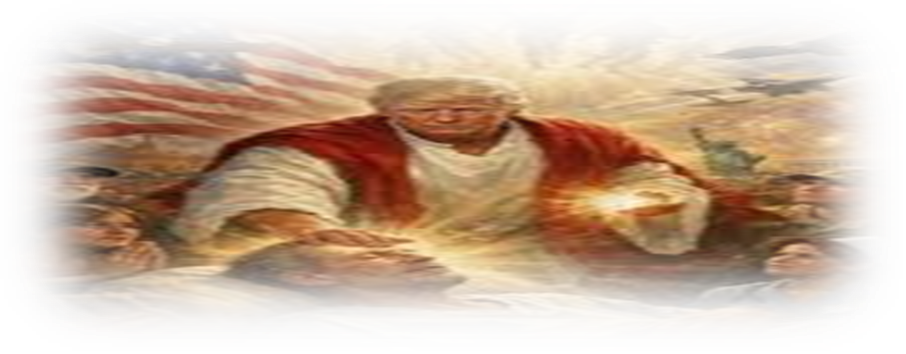
For some reason hard to decipher other than perhaps a belief that he had been, was being or would be deified while alive, Mr. Trump publicly shared artificial intelligence assisted artwork on a self-serving (some would assert, self-aggrandizing) Internet platform which he founded and ironically named “Truth Social”. The “artwork” portrayed Mr. Trump as a divinity, apparently as Yešu the Nazarene[12], the itinerant Palestinian Hebrew civic activist and healer who may have lived several millennia ago[13]. After due reflection, well after due reflection following massive public outrage, Mr. Trump removed the offending post claiming that he’d been misunderstood, as usual, and that the “artwork” merely depicted him as a “physician” curing a patient through non-traditional means. An interesting reaction.
Many people throughout the world found Mr. Trump’s post reminiscent of the ancient Roman princeps Caligula and speculation concerning similarities between Mr. Trump and Caligula became rife, although such speculation was not new[14]. In Mr. Trump’s defense, he might have referenced the fact that, unlike Caligula, he has yet to seek a seat in the Senate for a horse of which he is fond although, while Mr. Trump does not currently own horses, he famously owned a thoroughbred originally named Alibi which he renamed “D. J. Trump”, one he purchased for $500,000 in 1988, but the horse never raced due to health issues and was later retired to stud[15] before dying in 1991[16]. Hmmm, “stud”, that’s purportedly how Mr. Trump perceives of himself but, given J.D.’s demise in 1991, no equine senatorial candidate is likely to be nominated by Mr. Trump, at least for now. Still, his critics would likely have pointed out that like young Caligula, Mr. Trump also fancies himself a great artist (perhaps the greatest artist ever), or at least a great interior decorator (ditto). And a great exterior decorator as well (with ballrooms and arches of triumph a new specialty). Previously it had been hotels and golf courses. And beauty pageants! Both Caligula and the president were fond of beauty pageants although Caligula’s involved involuntary participation in erotic activities in the style of Mr. Trump’s former friend, Jeffrey Epstein, by the wives of members of the Roman Senate. That possibility has yet to occur to Mr. Trump. At least as far as we know. If ever released, the Epstein files might indicate otherwise[17].
But, superficial anecdotes and similarities aside, … About reincarnation? Is it possible that Caligula, whose career was cut short by his own Praetorians, is revisiting us?
Well, “possible” is a very open ended concept. It’s possible that the world we perceive doesn’t exist[18] and that we’re just players in a nightmare being experienced by the earliest life form, perhaps the primal prokaryote, so perhaps reincarnation is possible and, if so, perhaps an angry and vengeful Caligula has returned to correct erroneous impressions or, perhaps, to confirm them. Let’s assemble evidence so that we can make an informed guess, comparing young Gaius Julius Caesar Augustus Germanicus with the current avatar of Donald John Trump (sometimes referred to, at his suggestion, as “the Donald”). And let’s assemble it using the artificial intelligence of which the Donald seems so fond when creating images some might interpret as divine.
According to a query concerning Caligula on the Internet platform known as Chrome and a response, apparently employing artificial intelligence, here is what is popularly known about Caligula’s attributes, with my own responsive observations concerning similarities with the Donald:
“Divine Self-Image: Caligula frequently appeared in public dressed as various gods and demigods, such as Hercules, Mercury and Venus. He was known to have the heads removed from famous statues of gods and replaced with his own, treating himself as the supreme artistic masterpiece.” Hmmm, to my knowledge, the Donald has yet to engage “publicly” in activities comparable to the foregoing (well, except with respect to planned changes in currency) but there is a sense that he just might, given time. To date, he only does that in artificially enhanced artwork that he posts on his personal social media platform, “Truth Social”. That’s something young Caligula could not match. But similarities, hmmm. Yep!
“Oratory and Performance: Caligula was regarded as a “renowned declaimer” and enjoyed showing off his oratorical skills. He reportedly engaged in public performances and acted in various capacities, showcasing an ego that required public validation of his talents.” While cognizanti concerning rhetoric and grammar ridicule Mr. Trump’s “eloquence”, he himself revels in displaying his oratorical antics and he certainly showcases an ego that requires public validation of his talents. To his admirers and followers, he certainly seems to be a “renowned declaimer”. So, once again, yep!
“Emulating Hellenistic Kings: Caligula admired the style of Hellenistic rulers, who were often treated as living gods and viewed themselves as patrons or creators of high art.” Hmmm, this raises interesting questions, especially in light of his latest antics. It seems clear that Mr. Trump views himself, especially with respect to real estate construction, as a “creator of high art”, witness his decoration of the Oval Office and the White House, his planned White House Ballroom and his proposed Arch of Triumph (as well as his plans for Gaza). And he also seems to see himself as a monarch (something he’s also portrayed on Truth Social with the help of artificial intelligence). So, not a perfect match but then perfection is an elusive goal. But similarities? Yep! Again.
“Dismissal of Rivals: He was known to act with extreme arrogance, with accounts noting that “no one was allowed to outrank Caligula” in any regard”. Well, in this regard Mr. Trump clearly outdoes young Caligula and that is even without regard to his recent denigration of Catholic Pope Leo XIV. So; … absolutely!
“Removal of Obstructions to Personal Power:During his brief reign, Caligula worked to increase the unconstrained personal power of the princeps as opposed to countervailing powers within the Principate”. That pretty definitely sounds like the Donald. Separation of powers is certainly something he ignores as he ignores concepts such as the sovereignty of independent countries, the rules of international law and anything and everything that does not coincide with his personal morality of the moment (see, e.g., Yang, 2026).
“Military Experience”; Caligula did not lead Roman troops in a conventional battle. In the year 40 of the Common Era but he marched an army to the English Channel for a planned invasion of Britain. However, instead of fighting, he ordered the legionnaires to attack the waves with weapons and to collect seashells as “spoils of the sea” to celebrate an imagined victory over the sea god Neptune.” While Mr. Trump attended a military high school in New York, he “declined” to serve in the military given that the conflict in Vietnam was not healthy for his feet[19]. He did however order the kidnapping of the president of Venezuela and a joint attack (along with Israel) on Iran, in both cases, hoping that their oil would qualify as a trophy, and he provided Israel with all the funds and armaments necessary to engage in genocidal ethnic cleansing throughout the Middle East. That should count for something.
“Impoverishing his subjects”: Caligula impoverished the Roman treasury by squandering 2.7 billion sesterces left by his predecessor, Tiberius, in less than a year. His lavish spending on spectacles, personal luxury and extravagant building projects led him to seize private property, raise taxes and resort to extortion to fund his reign.” Hmmm, well, Mr. Trump also spends lavishly, largely at the behest of his buddy, Benjamin Netanyahu, and, together, they increased the United States national debt from less than twenty trillion dollars at the beginning of Mr. Trump’s initial term as president to almost forty trillion by the end of his fifth year in the presidency, albeit with a little help from his friend Joey Robinette Biden. Well, not so much a friend as a bitter enemy but with shared values and goals (they both enjoyed plundering). But Joey was the friend of a friend (Bibi) and it’s the thought that counts. And Mr. Trump did raid and steal assets to help fund his extravagant ideas, especially from Venezuela. Like Caligula (and Eric Cartman of South Park fame), the Donald’s motto has been “I can do whatever I want”! And of course there’s the White House ballroom and the proposed Arc de Triomphe, etc., so, one more time, a hearty yep!
Hmm, it seems there may be disturbing trends echoing in from the past. And they continue:
A Wikipedia entry with respect to Caligula[20] asserts that he was initially perceived as a “good, generous, fair and community-spirited” sort of guy but that he promptly became “increasingly self-indulgent, cruel, sadistic, extravagant and sexually perverted”, eventually evolving into “an insane, murderous tyrant who demanded and received worship as a living god, humiliated the Senate and planned to make his horse a consul”. However, the Wikipedia article notes that, on reflection, given the fact that his history was written by Senatorial detractors long after his assassination, modern historians “dismiss many of the allegations against him as misunderstandings, exaggerations, mockery or malicious fantasies”. Well, the media, other than that controlled by pro-Israeli Zionists such as Fox News, has given Mr. Trump a pretty hard time up to now but, as a result, pro-Israeli Zionists have gone on a buying spree buying-up numerous media sources[21], especially those that have been critical of Mr. Trump, like CNN. Sounds like the future may hold further similarities. Here again echoes seem to ring loudly with reference both to the “unflattering” written conclusions concerning Mr. Trump and his defense by those inclined to view him more favorably. Sycophants I think they’re called[22].
Continuing:
With reference to the observations of more prurient similarities between Mr. Trump and the Princeps, Caligula, for many decades Mr. Trump has been viewed as a sexual addict, a sexual predator and perhaps even a sexual pervert[23] (as was Caligula), especially given his close relationship with Jeffrey Epstein but, during his first term as president it can be argued that his intentions at least were “good, generous, fair and community-spirited”. It is also clear that during that time his opponents engaged in a vicious and unfair campaign to discredit him[24]. However, apparently at least in part due to the abuse he suffered during his first term and even more, to the abuse he suffered during the Joseph Robinette Biden presidency, his second term has been very different from the positive aspects that seemed possible during his first term thus, all of the pejorative descriptions of Caligula seem to be have become germane with respect to Mr. Trump[25], except, of course, the references to equestrian matters. At least for the nonce. It seems unlikely that equines will soon obtain representation in the United States Senate; golf clubs however, may be a different matter.
Anyway:
Partially as a result of the Biden administration’s abuse of power and its own corruption following Mr. Trump’s initial term, a supportive reaction occurred among the electorate and he was elected to a non-consecutive second term, a rarity in United States political history. He was elected amid expectations that he would reverse the Biden administration’s support for Israeli military adventures, genocide and ethnic cleansing and the foreign interventionism that had characterized four of the previous United States presidencies (the Clinton, Bush, Obama and Biden presidencies), after all, that’s what he’d promised (among a plethora of other things).
So, another similarity crops up, predecessors!! Caligula’s predecessor, Tiberius Claudius Nero (then Tiberius Julius Caesar, then Tiberius Julius Caesar Augustus) had been very unpopular towards the end of his reign and it was hoped, even expected, that the abuses of Tiberius would be curbed when Caligula came to power. No such luck. Pretty much the same can be said with respect to the Donald. Almost immediately following his second inaugural however, all restraints were cast aside and delusions of grandeur comparable to those of young Caligula were made manifest. Well, at least more manifest than theretofore. Indeed, Mr. Trump specifically insisted, in response to critics, that neither the United States Constitution nor international law nor the opinions of non-aligned religious leaders nor public opinion restricted his activities in any manner, only his own “morals of the moment” being relevant[26]. As a result, Mr. Trump has quickly become (as was the case with Caligula) the least popular president in recorded United States history[27], a perception shared throughout the world with the exception of genocidal Israel and the few world leaders who find both Mr. Trump and his apparent political master, Benjamin Netanyahu, men to be admired, a view however not shared by most of their subjugated populations.
The term “least popular” is complex though, at least among the United States electorate. Mr. Trump’s most fervent followers profess to devout Christianity and continue to support him, no matter what, completely ignoring all vestiges of reality, even as his conduct becomes more and more deranged and at odds with the Christianity they claim to profess[28]. Thus this speculation (intended as a “satire” in the ancient Gaelic sense) is, in part, a reaction to the reactions of many people for whom the author cares and who he respects respects (having shared similar educational backgrounds) but whose ability to grasp reality now seems impossible for the author to understand. Well, unless he takes into account the impact of B. F. Skinner’s behaviorist psychology and modern communications theory[29] and the apparent reality that facts not only do not impact strongly-held opinions but that contradictory facts seem to reinforce them[30]. The author is specifically alluding to attitudes by Mr. Trump supporting and enabling genocidal events in the Middle East by Israel, the Pearl Harbor-like attack on Iran by the United States and Israel and ignoring the Zionist attitude towards Christians in the Middle East where spitting on Christians and desecrating Christian artifacts and destroying churches is considered a Jewish tradition[31] (something with which non-Zionist Jews do not agree). Facts with reference to the foregoing are plentiful and readily available but, as in the case of the “say no evil, see no evil and hear no evil simians”, such facts are blissfully ignored by United States citizens, many of them military veterans and religious Christians who one would think, based on heretofore shared values and shared educational experiences, would know better. But they don’t, and they don’t aggressively. They view those who believe as the author[32] does to be historically ignorant, deluded and lacking patriotism. Fair enough. Thus this “satire”.
So, enough about Mr. Trump as the incarnation of Caligula (for the moment). The evidence is strong but not conclusive. And we still have no definitive evidence that reincarnation exists at all, although it may be a possibility. But what about Mr. Trump’s potential role as the antichrist?[33]
On the Possibility that the president of the United States is the Antichrist Envisioned by Saul of Tarsus (and others):
Some of Mr. Trump’s followers, perhaps many, assert that he is the catalyst for the second coming of Yešu and that his seemingly deranged current activities in the Middle East in support of the quest for Israeli hegemony should be seen as the precursors for the great battle they anticipate at Armageddon, the herald for Yešu’s return. Of course, that would tend to support the hypotheses that Mr. Trump really is the antichrist[34] rather than merely the reincarnation of Caligula as the role of catalyst for Armageddon is usually ascribed to that entity. But what are the purported attributes of the antichrist and how do they relate to Mr. Trump? Again I’ll seek the assistance of a version of artificial intelligence as superficially provided by the Chrome Internet browser for assistance: Based on Pauline prophecies the antichrist is depicted as a charismatic, deceitful global leader and dictator who appears during the end times[35]. Among his principal characteristics are the following, which I will compare with characteristics attributable to Mr. Trump:
“The Man of Lawlessness/Sin: He is marked by total rebellion aiming to change established times and laws”. Hmmm, pretty much on point as he has stated that he is bound neither by the Constitution or International law but only by his own “morality” of the moment (see, e.g., Yang, 2026), a morality that quickly changes as convenient.
“Blasphemous Ruler: He speaks arrogant words, blasphemes God.” Hmm, I think Catholic Pope Leo XIV might have strong opinions on this point but, in a contrary fashion, so do his followers who equate his pronouncements with those of their god.
“Charismatic Deceiver: He initially appears as a peaceful savior, using flattery and brilliant deception to gain power, often compared to a ‘little horn’ that grows in influence.” Hmm, well, “ain’t that the truth!
“Global Dictator: He will gain worldwide authority over nations and religions.” Well, he certainly perceives himself in that light and is doing everything he can to make it a reality.
“Economic Controller: He controls the global economy, forcing a mark on the right hand or forehead, forbidding anyone to buy or sell without it.” Once again, hmmmm: Donald Trump owns hundreds of trademarks and service marks globally, managed primarily through his company, DTTM Operations LLC. His portfolio includes over 800 trademarks in more than 80 countries, covering real estate, hotels, hospitality, apparel and merchandise, alongside political campaign slogans like “Make America Great Again”. Aha!!! MAGA.
“Persecutor of Believers: He is a blood-thirsty dictator who wars against and destroys those who refuse to follow him.” Wow!!!! That pretty much describes the Donald, just ask former followers Tucker Carlson or Megyn Kelly or Candace Owens or Alex Jones or Clint Russell or Nick Fuentes, etc., and, of course, anyone who opposes him in any form. Ask Pope Leo.
Observations & Contextualization
Although I usually refrain from using pejoratives such as “ignorant” and “stupid” (this speculation notwithstanding) because I feel they would be counterproductive if I am seeking to persuade, I have to admit that such thoughts do cross my mind. And they sadden me with respect to the people who hold those beliefs who I personally know, men with whom I’ve studied or who’ve graduated from educational institutions I also attended. And they are many. Probably a majority. Which leads me to ask myself how and why my perceptions and perspectives are so different from theirs. That I may be wrong and they may be right is an essential postulate with respect to an open mind. Empathy calls and only empathy can someday resolve our differences, assuming that empathy somehow survives. Well then, a bit of personal revelation (a sort of pun) is probably in order, revelation that seems relevant in light of the nature of most current Trump supporters (other than Israelis) who believe themselves to be devout Christians (or else devout Zionists). Revelation that may help to explain the differences in our perceptions, as well as similarities that may someday provide resolution.
I’ve explored religions since I was seven years old[36] and as a young adult, taught courses on comparative religions and comparative mythologies. Based on my research and on profound reflections I’ve come to rejected most, perhaps all the religions I’ve studied, at least as postulated, although I’ve not rejected their fundamental premises[37]. I’ve studied religions primarily from historical and philosophical perspectives using historical and philosophical sources accompanied by deep personal introspection, frequently introspection facilitated as I wrote and puzzled over, … well, the myriad puzzles[38] religions present, puzzles where questions multiply as answers become more and more evasive, although answers are not required where “faith” can substitute for facts and logic. In doing so I encountered doctrines that were purportedly espoused[39] by Yešu and I found the precepts attributed directly to him with respect to interpersonal relationships both worthy and generous, with a sweet undertone, as opposed to those ascribed to the Pharisee, Saul of Tarsus so beloved of Trump supporters, whose doctrines seemed mean spirited and callous to me, all too frequently aligned with fund raising and control, almost the opposite of those attributed directly to Yešu. And, of course, Saul is the primary originator of the antichrist mythos.
The association of Pauline Christianity with Mr. Trump is certainly a point of departure from Caligula who reigned during the birth of the movement that sprung up around Yešu during his lifetime. But it’s a point of contact with respect to speculation involving the antichrist. Caligula probably reigned shortly after Yešu’s demise, his demise either through crucifixion by the Romans, as related in what has come to be referred to as the New Testament, or torture, stoning and hanging by the Jerusalem Sanhedrin, as related in diverse versions of the Jewish Toledot Yeshu[40]. Muslims reject the notion that he was put to death and insist that Yešu (Isa to them) survived and eventually ascended directly into Heaven without a sojourn in Hell. Caligula reigned from the years 37 through 41 of the Common Era and likely had no direct contact with or knowledge of early followers of Yešu (not yet Christians), who were still a small, emerging Jewish sect. Of course, Mr. Trump’s Christian followers are more correctly followers of one of the many Pauline religions premised mainly on the death of Yešu rather than on the precepts he sought to imbue. So, in matters of religion, the nexus between Mr. Trump and Caligula suffers from a temporal vacuum when it comes to how we might compare them other than the seeming fact that both appear to consider themselves divinities and that neither particularly respected religion, except in so far as it served to aggrandize them. But the differences between Yešu’s ethical and moral teachings with respect to interpersonal relations and the divergent Pauline doctrines do a lot to explain the differing perceptions among those of us who otherwise share such similarities in education and values. After all, Yešu never mentioned a “Christ” or an “antichrist”.
Far Off Hypotheses and Conclusions:
Wow, Caligula reincarnated versus the Pauline antichrist, it seems like a tie.
In neither case is there demonstrably definitive probative evidence that either concept is valid which, however, is not the same as indicating that no supporting evidence exists. “Demonstrably definitive probative evidence” is a much harder standard of proof than the “beyond a reasonable doubt standard” required for criminal conviction. But there is definitely adequate proof that a Donald J. Trump exists (unfortunately) and it is very likely that there was a Gaius Julius Caesar Augustus Germanicus and a Saul of Tarsus and even a Yešu as well.
So, where are we in this comparative speculation in the guise of a Gaelic satire? Are there any other possible conclusions we might want to consider?
Well, to be honest, farfetched though they may be, there are other alternative hypotheses concerning the possible apotheoses of Caligula and or Mr. Trump or others? Indeed, there are several to the effect that fictional characters can incarnate. One is posited by Daniil Andreev and taken seriously by some fairly intelligent people[41]. And supposedly “quantum” theories have confused everything while they have made everything possible. So let’s speculate a bit on that hypothesis as a final element worthy of a Gaelic satire. How about a presidential version of Yosemite Sam? Yosemite Sam first came to public awareness during 1945, the year prior to the Donald’s birth. While I personally don’t believe it’s likely that cartoon characters can reincarnate but the similarity is also, in some respects, uncanny. My apologies to Sam. The same holds true for Eric Cartman of South Park fame, another Donald Trump act-alike.
So, in light of the foregoing, what might we conclude, recalling that this is a speculation in the form of a Gaelic satire?
Well, it’s theoretically possible that both primary speculations concerning Mr. Trump are accurate and that he is Gaius Julius Caesar Augustus Germanicus reincarnated and that both are the antichrist anticipated by Paulus, formerly Saul of Tarsus. A sort of ribbon on this satiric package. One seemingly more reasonable than the Yosemite Sam or Eric Cartman hypotheses. Or, of course, none may be accurate and Mr. Trump may be sui generis, as he believes, although the nature of his uniqueness is certainly up for debate and may well be debated for centuries (as is the case with Caligula), assuming that the world survives Mr. Trump’s presidency. At any rate, in closing, a traditional Gaelic “aspiration” may well be appropriate with reference to Mr. Trump:
“Imeacht gan teacht ort!”
Interested readers may want to look it up. It is certainly not the worst malediction one might contrive.
I wonder if this speculation qualifies as a syllogism, albeit a sarcastic and satirical syllogism.
Bibliography & Sources
Andreev, Daniil (1957, published in English 1997): The Rose of the World (translated by Jordan Roberts); Lindisfarne Books, London.
Barrett, Anthony A. (2015): Caligula: The Abuse of Power. 2nd ed. Routledge, London.
McGinn, Bernard (1994): Antichrist: Two Thousand Years of the Human Fascination with Evil; HarperSanFrancisco, San Francisco.
McLaughlin, Roisin (2008): “Early Irish Satire”; Journal of the Galway Archaeological and Historical Society, Volume 62, January 2010; School of Celtic Studies, Dublin Institute for Advanced Studies. Dublin.
Stevenson, I. (1997). Reincarnation and Biology: A Contribution to the Etiology of Birthmarks and Birth Defects (Vols. 1–2). Praeger Publishers, Westport, CT.
Tabor, James D. (2013): Paul and Jesus: How the Apostle Transformed Christianity; Simon & Schuster, New York City.
Whitehead, Andrew L. and Samuel L. Perry. 2020. Taking America Back for God: Christian Nationalism in the United States. Oxford University Press, New York City.
Guillermo (“Bill”) Calvo Mahé (a sometime poet and aspiring empirical philosopher) is a writer, political commentator and academic currently residing in the Republic of Colombia (although he has primarily lived in the United States of America of which he is also a citizen). Until 2017 he chaired the political science, government and international relations programs at the Universidad Autónoma de Manizales. Previously, he chaired the social studies and foreign language departments at the Eastern Military Academy in Huntington, New York. He is currently the publisher of the Inannite Review available at Substack.com; an intermittent commentator on radio and television; and, an occasional contributor to diverse periodicals and publications. He has academic degrees in political science (BA, The Citadel, the Military College of South Carolina), law (JD, St. John’s University, School of Law), international legal studies (LL.M, the Graduate Division of the New York University School of Law) and translation and linguistic studies (GCTS, the University of Florida’s Center for Latin American Studies). However, he is also fascinated by mythology, religion, physics, astronomy and mathematics, especially with matters related to quanta, cosmology and cosmogony. He can be contacted at guillermo.calvo.mahe@gmail.com and much of his writing is available through his blog at https://guillermocalvo.com/.
[1] This piece is way too long, even as a Gaelic satire, but I just couldn’t help myself and for those with the patience to read it, I think you’ll find it at least entertaining and possibly informative. Give it a try!! I double down dare you! It’ll piss Donald Trump off no end.
Apologies: I hereby formally and sincerely apologize, beforehand and as an afterword, to Pope Leo XIV, to Yešu, to all my friends who will be offended by a Gaelic satire directed at someone they love, to fundamentalist Zionist Christians in general, to Yosemite Sam, to Eric Cartman and to Gaius Julius Caesar Augustus Germanicus. Better late than never. Finally, last but not least, should it turn out that Saul of Tarsus (a/k/a Paulus) was indeed the antichrist, my apologies for having attributed that possibility to Mr. Trump and to Mr. Germanicus (assuming that is the proper modern manner of addressing Caligula).
[2] For Gaelic satire, see generally McLaughlin, Roisin (2008): “Early Irish Satire”; Journal of the Galway Archaeological and Historical Society, Volume 62, January 2010; School of Celtic Studies, Dublin Institute for Advanced Studies. Dublin.
[3] For an academic discussion of the antichrist, see McGinn, Bernard (1994): Antichrist: Two Thousand Years of the Human Fascination with Evil; HarperSanFrancisco, San Francisco.
[4] See, e.g., Tabor, James D. (2013): Paul and Jesus: How the Apostle Transformed Christianity; Simon & Schuster, New York City.
[5] For an academic study delving into the possibility of reincarnation, see generally Stevenson, I. (1997). Reincarnation and Biology: A Contribution to the Etiology of Birthmarks and Birth Defects (Vols. 1–2). Praeger Publishers, Westport.
[6] “Evolutionary monist panentheism” is a philosophical and theological worldview that posits that all reality exists within a single, interconnected divine being that is both beyond the universe (transcendent) and immanent within it. This divine reality is not static; rather, it is constantly evolving alongside the universe, with all constituent parts striving toward greater complexity and “perfection”. See generally Clayton, P. (2004): Mind and emergence: From quantum to consciousness. Oxford University Press, New York City; see also Calvo Mahé, Guillermo (2025): “Panentheistic Reflections on Evolutionary Structure”; The Inannite Review, Substack, September 28, 2025 available at https://open.substack.com/pub/guillermocalvomah/p/panentheistic-reflections-on-evolutionary?r=lwzkv&utm_campaign=post&utm_medium=web.
[8] A sort of strange confession impacting my probable lack of objectivity concerning Caligula is in order. The paternal line of my family (the Calvi) has long clung to what to me appears to be a historical delusion (a variant on an urban myth so, a family myth). Some among them claim ancestry from a certain Gaius Calvisius Sabinus who was a Roman consul in the year 26 of the Common Era. A prior Calvisius Sabinus from whom they also claim descent was co-consul with Octavian during the 4th year prior to the Common Era, the purported year of Yešu’s birth, at least according to some. The former Calvisius Sabinus (although later in time) was a Roman senator who fell out of favor during Caligula’s reign, long after he’d served as consul, because he and his wife Cornelia had been accused of conspiring against the Princeps (a point of pride among those old members of my family who cling to the myth). To avoid a certain conviction Calvisius and Cornelia both committed suicide during the year 39 of the Common Era thus avoiding the trial. Notwithstanding my certainty that the familial relationship is mythical, it did impact my earliest perceptions with respect to Caligula. On the other hand, given evolutional biological probabilities, most people with southern European roots may well be descended indirectly from most people who bore children in that region during antiquity. Just not in a direct line as my own ancestors seem to believe.
[9] For a detailed academic discussion relating to Caligula, see generally Barrett, Anthony A. (2015): Caligula: The Abuse of Power. 2nd ed. Routledge, London.
[10] A double negative, I know, I know, I claim poetic license, after all, Gaelic satires are poetic in nature.
[11] “Yellow Journalism” preceded the Pulitzer – Hearst battles of the 19th century, see for example, the vicious journalistic battles involving Founding Fathers Thomas Jefferson (with the assistance of James Madison) versus Alexander Hamilton and even Aaron Burr [see, e.g., Sheehan, Colleen A. (2004): “Madison v. Hamilton: The Battle Over Republicanism and the Role of Public Opinion”; American Political Science Review, Volume 98, Issue 3, August 2004 pp. 405–424, available at https://www.jstor.org/stable/4145337] and, even before Caligula, Marcus Tullius Cicero and Gaius Julius Caesar engaged in written rhetorical battles were truth was not infrequently victimized, see, e.g., Pauli, Adolf F. (1958): “Letters of Caesar and Cicero to Each Other”; The Classical World, Vol. 51, No. 5 (Feb., 1958), pp. 128-132. The Johns Hopkins University, Baltimore available at https://www.jstor.org/stable/4344010.
[12] Known primarily under Greek variants of the name such as Jesus (English), Jesús (Spanish), Jésus (French), Gesù (Italian), and Yesu (Swahili/Hindi).
[20] Not that Wikipedia is always a reliable source, especially as to things about which exuberant contributors feel strongly. Caligula, however, for now, seems a safe topic. See Wikipedia contributors. (2026, April 12). Caligula. In Wikipedia, the Free Encyclopedia. Retrieved 00:42, April 20, 2026, from https://en.wikipedia.org/w/index.php?title=Caligula&oldid=1348470896.
[21]E.g., Paramount Global, Warner Brothers Discovery, HBO/HBO Max, CNN, DC Comics and Warner Bros. Pictures and TikTok USA, etc.
[24] Indeed, this author frequently defended Mr. Trump in diverse published articles as well as on radio and television from a number of the unfair attacks levelled against him although always stressing that such defense did not indicate positive support for Mr. Trump or for Mr. Trump’s conduct, beliefs or proposed policies. While I profoundly regret the fact that Mr. Trump has been elected president of the United States and, as in the case of his predecessor, has been a facilitator directly responsible for genocide, ethnic cleansing and Israel’s campaign of lebensraum in the Middle East, I do not regret having defended him from unfair accusations and attacks which in fact made him more popular than ever. Such defense, I feel, provides my critiques of Mr. Trump with more credibility, at least I hope so.
[25] Hmm, that brings up another possibility, one unrelated to the antichrist or reincarnation, spiritual possession. But that’s beyond the scope of this already far too long “speculation”.
[27] See, e.g., Rottinghaus, B., & Vaughn, J. S. (2024): Presidential Greatness Project Expert Survey 2024. University of Houston; Coastal Carolina University.
[28] See, e.g., Whitehead, Andrew L. and Samuel L. Perry. 2020. Taking America Back for God: Christian Nationalism in the United States. Oxford University Press, New York City.
[32] Okay, I’ll confess, “I” am the author referenced above. I was just briefly trying to maintain a more academic attitude which for some reason eschews use of the first person. But that has quickly become tedious. I will therefor return to using I, or me, or myself, etc., from here on out. I can almost sense the grammatical first person smiling while the third person frowns.
[33] As a disclaimer or better yet, an admission, I’ve always believed that if an antichrist ever existed it was the man who invented the concept, Saul of Tarsus but, for purposes of this speculation, I’ll pretend to keep an open mind. Sort of the way a journalist would.
[36] Hence my familiarity with reincarnation in the evolutional monist panentheistic sense.
[37] I confess however to being drawn to the concept of evolutional monist panentheism in an agnostic sense.
[38] As a barely relevant (perhaps irrelevant) aside, I’ve taught comparative religions in conjunction with which I’ve studied all three branches of the Abrahamic faiths as well as the Indian religions (all Indian religions revolve around a mixture of Hindu concepts sometimes mixed somehow with Islam), Buddhism, Zoroastrianism, Theosophy, primitive mythologies (which my students wisely referred to as “other peoples’ religions), etc. In trying to understand current world politics, a study of the Abrahamic religions and their interrelationship seems essential and my friends, those who were catalysts for this speculation, clearly have a poor and superficial understanding of that topic which may help explain our divergent perspectives. The Three Abrahamic religions, Judaism, Christianity and Islam are a complex mix of contradictions and their interrelationship is incoherent. Islam is the bridge between the toe polar opposites, Judaism and Christianity. It shares a very positive view of Yešu with Christianity but shares the strict monotheism of Judaism thus Islam respects both of its two related religious branches. Indeed, were it not for Islamic tolerance, Judaism might well have been successfully expunged by intolerant Christians but, as has occurred with the Persians who saved the Hebrews from their Babylonian exile, Islam is facing existentially genocidal attacks as Israel, with United States assistance, picks off one group of Muslims after another while wealthy Muslim countries watch, perhaps not realizing their turn is coming (reminiscent of the situation criticized by German pastor Martin Niemöller with reference to the cowardice and inaction of spectators during the Nazis’ rise to power, see United States Holocaust Memorial Museum. [2023, April 11] Martin Niemöller: “First they came for the Socialists…”. Holocaust Encyclopedia. Retrieved April 21, 2026, from https://encyclopedia.ushmm.org/content/en/article/martin-niemoeller-first-they-came-for-the-socialists).
[39] A sort of a digression (again), a sort of silly one this time, I’ve also studied linguistics and words tend to fascinate me. As I wrote the word “espoused” above it occurred to me to reflect on its etymology and how it is related to both marriage on the one hand (spouse) and to support for a cause. I guess both concepts involve “support” albeit in very different senses. According to Chrome, the link involves a “commitment”. Rats! Now I’ve become interested in the etymology of the term “commit” and its use with respect to dedication as opposed to a sort of imprisonment.
[41] Strange as it may seem, the concept of fictitious characters incarnating or “reincarnating” into reality has been explored in both esoteric writing and speculative fiction. See, e.g., Andreev, Daniil (1957, published in English 1997): The Rose of the World (translated by Jordan Roberts); Lindisfarne Books, London. In The Rose of the World (Roza Mira) Mr. Andreev posits that fictional characters are not merely products of the imagination but rather entities that exist in other planes of reality and are channeled by poets and artists. Consequently, he proposed a complex meta-geography where fictional characters can be seen as manifestations or indeed, as beings, either demonic or enlightened, that enter the human consciousness through creative inspiration. Hmmm!!! Pretty interesting.