Reflections on the Bolsonaro Dynasty and the 2026 Brazilian Elections

The following is the transcript for the segment by Guillermo Calvo Mahé in a special report by India’s NewsX World with respect to the Bolsonaro Dynasty in Brazil, a reality regardless of the final results of the 2026 Brazilian Elections.  It has been slightly edited to correct grammatical issues and provide context and updating information has been added:
_______

On Sunday October 4, the Brazilian electorate followed the path of most recent Latin American elections, at least as far as the Congress is concerned, rejecting the progressive left and embracing the conservative right.  In that context, a question arises as to whether Brazil’s turn to the right is a reaction against what the public perceives of as a moribund and corrupt economy (notwithstanding significant progress in minimizing poverty during the current administration) or whether it reflects the crystallization of a Bolsonaro family dynasty (given the fact that so many members of the Bolsonaro family are now in elected positions of power).  Jahir Bolsonaro, the family’s patriarch, was 38th president of Brazil, having served in that role from 2019 to 2023 and as a member of the Chamber of Deputies from 1991 to 2019.  Previously, he served as a captain in the Brazilian army.  However, he has been in prison serving a twenty-seven year sentence for organizing an attempted coup against his successor, the current president of Brazil, Luiz Inácio Lula da Silva, who is currently running for reelection against Jahir Bolsonaro’s son, Flavio.

One answer to the unexpected results of the initial round of the Brazilian elections which involved not only the presidency but the Chamber of Deputies, a significant part of the Senate and the powerful state governors seems to be that, come what may during the final round of presidential voting on October 31, Jahir Bolsonaro has managed to install his family firmly in control of the Congress and in likely control of the presidency.  If so, that would quickly lead to his from imprisonment and expand Bolsonaro family control of the federal judiciary as well.

So, who are the members of the evolving Bolsonaro family dynasty?  Let’s start with Flavio.

Flavio is not his father’s clone nor a mere figurehead.  He has his own 23 year political career including eight years as a senator and, although his father is certainly Flavio’s political mentor, they have differing styles and different focuses, something Flavio emphasizes: 

  • Flavio’s presidential campaign stressed down to earth economic issues and concerns rather than abstract ideological issues and Flavio used a more restrained personal style, reaching out to centrist voters as well as focusing on conservative themes.  Still, like his father, he also stressed his relationships with the United States and Israel would be much more positive, his relations with China more limited and that his interests in the BRICS coalition would be secondary at best.
  • As in all recent elections in Latin America, Flavio’s stressed the problem of allegedly rampant crime and a decline in morals urging a return to traditional Christian values and was highly critical of the threats of an emerging socialist state.
  • Flavio’s campaign focused on sophisticated use of targeted and tightly focused social media rather than on the mass, amateur WhatsApp forwarding networks used by his father and, perhaps thanks to his brother Eduardo’s US contacts, his use of the Internet was extremely well financed by, among others, the Rockbridge Network, a group co-founded by U.S. Vice President JD Vance and backed by prominent right-wing donors and Silicon Valley investors such as Peter Thiel and Rebekah Mercer, and supporters of Israel.

Of course, a political dynasty such as that established in India by the Nehru–Gandhi family, in the United States by the Kennedy and Bush families or as is common in many Latin American countries, is a complex concept, but it is one that the family’s patriarch, Jahir Bolsonaro, has apparently mastered. 

The second round of the presidential election is not clear cut as most believe given that 40 million voters either did not participate (notwithstanding Brazil’s mandatory voting requirements) or cast null or none of the above ballots in the first round of voting and, as October 25 approaches, polls indicated that it is tightening, although Flavio remains in the lead, but, even if enough voters who failed to participate in the initial round were pulled into the Lula camp to overcome Flavio’s initial two million plus lead and a Lula comeback took place, a Bolsonaro political dynastic structure seems firmly in place, one that, given the age of its diverse members, could last for decades. 

For example, in addition to Flavio, Jahir Bolsonaro’s current wife, Michelle, Jahir’s third wife and Flavio’s second step mother, is virtually the same age as Flavio and an ambitious political power on her own, especially among evangelical Christians and among conservative women, two constituencies largely responsible for Flavio’s success in the first round.  She is also extremely powerful in the Liberal Party, the political party that sponsors the Bolsonaro family, even more so than Flavio.  In the recent elections she attained the highest vote ever for the Brazilian Senate.  But Flavio and his brothers have had serious conflicts with Michelle and their goals and ambitions are not always compatible.

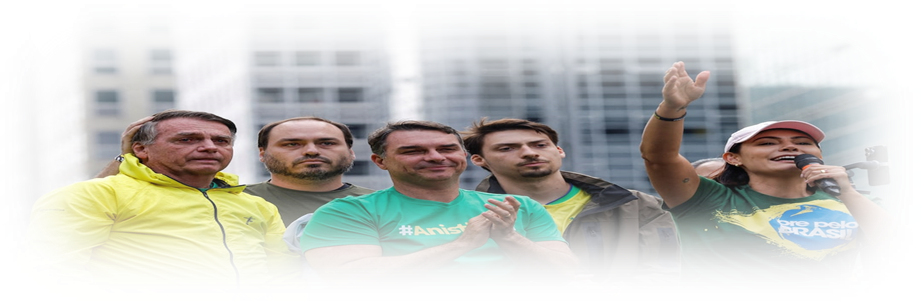
In addition to Michelle, the Bolsonaro clan now boasts a number of other members of Congress with current and future electoral aspirations.  Flavio’s brother Carlos (age 43), the family’s social media and digital genius, is now in the Senate; 28 year old Jair Renan, Flavio’s half-brother, is now a deputy in the Chamber of Deputies; Flavio’s brother Eduardo, age 43, is a former Deputy who fled to the United States when threatened with possible prosecution for lobbying foreign powers to intervene in his father’s trial (he was convicted in absentia) but used his exile very successfully to cultivate strong ties with members of the Trump administration and is likely to return and resume his political career; and, Jahir’s brother, the uncle of the clan, Renato Bolsonaro, age 62, also won a seat in the incoming Congress. There are also Michelle’s two daughters waiting on the sidelines (one in her teens and the other in her twenties), the eldest from a previous relationship. 

So yes, Flavio Bolsonaro successfully used economic discontent to pull ahead of Luiz Inácio Lula da Silva in the initial round of voting but a Bolsonaro political dynasty definitely seems to be coalescing in Brazil although perhaps, who will lead it, is not always clear.
_____

As an update with respect to the election itself, it appears that foreign interference in the second round of Brazil’s presidential elections has significantly intensified, including alleged intervention by Meta in favor of Flavio Bolsonaro. The Lula campaign has formally accused Meta’s platforms (Instagram, Facebook, and WhatsApp) of having utilized biased algorithms, restricted content distribution, and disabled advertising capabilities to systematically disadvantage Lula and favor Flavio.

The core allegations against Meta have involved accusations that the Meta AI engine is intrinsically biased. For instance, the AI system reportedly refused to generate campaign images or content when using the prompt “Lula 13” but readily generated them for “Flávio 22”.  The Lula campaign specifically claimed that Instagram restricted Lula’s official profile from promoting feed posts, froze or interrupted video view counts and temporarily caused his profile and other left-wing leaders to disappear from search results prior to the first round of voting.  The allegations have neutral support; for example, the non-profit group Ekō alleged that Meta broke Brazilian electoral laws by approving foreign-funded, AI-generated ads that spread disinformation and hate speech. A separate study from the Federal University of Rio de Janeiro found over 1,600 irregular political advertisements on Meta platforms funded primarily from the United States and Israel which violates Brazil’s ban on foreign electoral spending.

In mid-October 2026, Justice Marco Aurélio Bellizze of Brazil’s Superior Electoral Court ordered Meta to take immediate action to guarantee equal treatment for both candidates. The court mandated that Meta apply identical criteria for its AI tools and barred the company from suppressing political content or search results to cause a campaign imbalance. Meta was also issued a tight deadline to submit granular, profile-by-profile explanations of any restrictions applied to Lula’s accounts.

As expected, Meta denied any political bias rejecting all claims of “deliberate” bias or political engineering, stating that its systems do not distribute content based on ideology and are applied equally worldwide.  In its defense, Meta cited widespread, unrelated global technical issues. The company stated that a freeze on Instagram Reels view counts impacted creators across more than 100 countries and was not isolated to Lula’s account. Similarly, a brief disruption to ad-creation tools affected users globally rather than targeting specific campaigns.

Notwithstanding the abovementioned, given time constraints, none of the foregoing is anticipated to have a significant impact on the highly polarized electorate.  Indeed electoral violence and threats of violence, primarily from supporters of the Bolsonaro which have sought to intimidate the electorate may be more important.  For example, on October 7, 2026, a major fire devastated UFPE’s Innovation Directorate building in Recife, destroying pharmaceutical, computer science, and genetics laboratories. This incident followed two other fires at the institution within an eight-day span, causing an estimated R$100 million in damages and obliterating two decades of scientific research.  The fires broke out immediately after students held protests on campus supporting President Luiz Inácio Lula da Silva and opposing Flavio Bolsonaro ahead of the October 25 presidential runoff election. Because the fires occurred hours after students received explicit bomb threats attributed to Bolsonaro supporters, Brazil’s Federal Police and the Federal Prosecutor’s Office opened a criminal investigation into the matter.
_______

© NewsX World and Guillermo Calvo Mahé; Manizales, 2026; all rights reserved.  Please feel free to share with appropriate attribution.

Guillermo (“Bill”) Calvo Mahé (a sometime poet and aspiring empirical philosopher) is a writer, political commentator and academic currently residing in the Republic of Colombia (although he has primarily lived in the United States of America of which he is also a citizen). Until 2017 he chaired the political science, government and international relations programs at the Universidad Autónoma de Manizales. Previously, he chaired the social studies and foreign language departments at the Eastern Military Academy in Huntington, New York. He is currently the publisher of the Inannite Review available at Substack.com; an intermittent commentator on radio and television in both Colombia and abroad; and, an occasional contributor to diverse periodicals and publications. He has academic degrees in political science (BA, The Citadel, the Military College of South Carolina), law (JD, St. John’s University, School of Law), international legal studies (LL.M, the Graduate Division of the New York University School of Law) and translation and linguistic studies (GCTS, the University of Florida’s Center for Latin American Studies). However, he is also fascinated by mythology, religion, physics, astronomy and mathematics, especially with matters related to quanta, cosmology and cosmogony. He can be contacted at guillermo.calvo.mahe@gmail.com and much of his writing is available through his blog at https://guillermocalvo.com/.

Of Counterintuitive Courts, Constitutions and Bibles

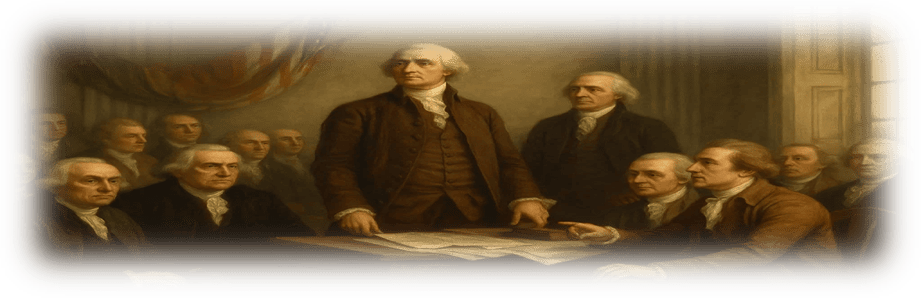
Kritarchy (or kritocracy) is the term for rule by judges or the judiciary.  It seems the inevitable consequence of vesting the judiciary with the power to “interpret” constitutions and, when constitutions are deemed supreme, to effectively control government in the form once exercised by dictatorial political bureaus (politburos) and the central committees in one party states.  Unless the “judges” charged with constitutional control (control being the end result of purported review) are democratically elected for fixed terms, something which only occurs in Mexico and Bolivia (but even there, the nomination process is controlled by traditional branches of government and, in Mexico, the term is long, 12 years) they are obviously antidemocratic elites.  Kritarchy is thus a specialized form of antidemocratic oligarchy rather than an aspect of democracy which sort of makes sense, given that constitutions, by their nature, are inherently antidemocratic, in the sense that democracy requires majority rule.  However, given the reality that in purported democracies popular apathy is more the rule than popular participation, democracy as such is more a fable than a reality.  A majority is more than a plurality and when large segments of a population do not participate in democratic elections, real majorities (50% of the eligible electorate plus one) are rarely if ever attainable.

Kritarchy is defended as essential to protect human and minority rights from democratic abuse, an obvious fallacy as that assumes judges who prioritize such concepts and that is no more likely in a judicial tribunal than it is in a popularly elected legislature or even, in a popularly elected autocracy.  Since the Biden administration’s 2013 destruction of the selection of federal judges in the United States through political consensus via the filibuster (Murphy is still chuckling about that), federal judges in the United States have been more politically biased in their decisions than ever, making it clear, in the cradle of judicial review, just how wrong the infamous decision in Marbury versus Madison (really John Marshall versus his despised cousin, Thomas Jefferson) was.  And an incoherent Kritarchy such as that which runs rampant in the United States today is, procedurally, as bad a form of government as currently exists.

Thus we find ourselves, politically and economically, where we do, rule by judges bought and paid for by plutocratic kleptocracies with merit a sort of pejorative, except in the Hobbesian sense of merit, i.e., merit being equated with brute power.  It’s as ironic as is the reality that many, perhaps most, perhaps virtually all evangelical pastors are politically tied to Zionism which, when it involves religion at all, insists that the purported Christ, about whom such evangelical pastors incessantly preach, is deemed by their Zionist overseers as, at best, condemned to an eternity in Hell drowning in a pool of molten excrement.  Seemingly, the blind leading the blind would be quite an improvement over the deaf, dumb and blind simians who “guide” us today.

We humans are a strange, incoherent and evolutionally counterintuitive species.
_____

© Guillermo Calvo Mahé; Manizales, 2026; all rights reserved.  Please feel free to share with appropriate attribution.

Guillermo (“Bill”) Calvo Mahé (a sometime poet and aspiring empirical philosopher) is a writer, political commentator and academic currently residing in the Republic of Colombia (although he has primarily lived in the United States of America of which he is also a citizen). Until 2017 he chaired the political science, government and international relations programs at the Universidad Autónoma de Manizales. Previously, he chaired the social studies and foreign language departments at the Eastern Military Academy in Huntington, New York. He is currently the publisher of the Inannite Review available at Substack.com; an intermittent commentator on radio and television in both Colombia and abroad; and, an occasional contributor to diverse periodicals and publications. He has academic degrees in political science (BA, The Citadel, the Military College of South Carolina), law (JD, St. John’s University, School of Law), international legal studies (LL.M, the Graduate Division of the New York University School of Law) and translation and linguistic studies (GCTS, the University of Florida’s Center for Latin American Studies). However, he is also fascinated by mythology, religion, physics, astronomy and mathematics, especially with matters related to quanta, cosmology and cosmogony. He can be contacted at guillermo.calvo.mahe@gmail.com and much of his writing is available through his blog at https://guillermocalvo.com/.

Nihilistic Pessimism

Lugubriously lethargic lassitude is the art form the legacy media has perfected on behalf of its masters to keep us from realizing what has happened to the world we hoped to leave as a legacy for our descendants, the world we thought we’d be able to glimpse and, at times enjoy, the world we were promised if we would just work hard and behave.

It is the hopeless state that assails us when we seek to exercise our political duties and go to the polls with no real choice at all, all the available candidates having already been bought and paid for with our money but certainly not for our benefit.

It is the residue we’re left with when those who own and control us abuse us, and we’re left without recourse in the face of their immune impunity.

It is our reaction when we are forced to realize that Jeffrey Epsteins rule our world through their bought and paid for proxies and that we can, at best, sit and watch as children are abused and Palestinians are slaughtered for fun and profit, hoping that the vision of German Lutheran pastor Martin Niemöller’s “First They Came” will not apply to us, at least not in the near future.

It is what being inside a societal black hole’s event horizon feels like for those not among the Chosen.  It is what being aware feels like in the Dystopia we live in, one where we sometimes envy those blissfully unaware among us, those who make it possible.  It is what we feel when we’ve come to realize that the metaphorical sign atop the gates of mythic Hell joyfully proclaiming the death of hope already apply to us.
_____

© Guillermo Calvo Mahé; Manizales, 2026; all rights reserved.  Please feel free to share with appropriate attribution.

Guillermo (“Bill”) Calvo Mahé (a sometime poet and aspiring empirical philosopher) is a writer, political commentator and academic currently residing in the Republic of Colombia (although he has primarily lived in the United States of America of which he is also a citizen). Until 2017 he chaired the political science, government and international relations programs at the Universidad Autónoma de Manizales. Previously, he chaired the social studies and foreign language departments at the Eastern Military Academy in Huntington, New York. He is currently the publisher of the Inannite Review available at Substack.com; an intermittent commentator on radio and television; and, an occasional contributor to diverse periodicals and publications. He has academic degrees in political science (BA, The Citadel, the Military College of South Carolina), law (JD, St. John’s University, School of Law), international legal studies (LL.M, the Graduate Division of the New York University School of Law) and translation and linguistic studies (GCTS, the University of Florida’s Center for Latin American Studies). However, he is also fascinated by mythology, religion, physics, astronomy and mathematics, especially with matters related to quanta, cosmology and cosmogony. He can be contacted at guillermo.calvo.mahe@gmail.com and much of his writing is available through his blog at https://guillermocalvo.com/.

On An Ethics for Non-State Popular Responsive Violence

I apparently wrote the following in 2012, revisited it on June 1, 2017 for some reason, and am again revisiting it.  Today is the 27th day of August, 2026.  The time spanned is interesting but, perhaps even more, so is the relevance.  The protagonists are, I assume, Citadel classmates, some of whose names have been changed to protect the guilty:

We were supposed to play softball against a group of local VMI alumni but the day which had started out under a bright golden sun set in a field of robin’s egg blue had made a drastic turn about ten minutes before game time and we’d retired to a local Irish pub where we’d had a dart tournament of sorts instead.  After we’d split a few pitchers, a few of us wound up, a bit tipsy in the basement bar at Mike’s house.

We’d shot the shit for quite a while, getting a bit more buzzed as we watched Sunday afternoon football, then finding ourselves in that twilight waiting for the Sunday night game, buzzed enough to take on the world’s problems, … again.  We’d all been political science or history majors but most of us had gravitated towards the business world after a sojourn exploring rice paddies of Southeast Asia.

I hadn’t been paying all that much attention, truth be told, I might have been snoozing, until a bit of acrimony crept into our discussions.

Bill had once explained his theory of legitimized violence to me in the context of what he referred to as our reverse Robin Hood socioeconomic system.  “Since impunity is rampant”, he’d said, “new mechanisms need to evolve to create and police social justice and that, at least in a state of transition, must involve successful challenges to the state monopoly on legitimate use of violence.  The bad guys now own all major states and most if not all minor states so the conditions that led to the implicit decision to surrender personalized use of violence no longer exist.  But unlimited violence won’t work either.”

He was off on a similar vein again, this time, trying to put terrorism into some kind of ethical context.  I think most of us acknowledged the problem but few saw terrorism as the answer.  So Woody, I think, asked Bill if he had any kind of workable solution.

“Terrorism has no boundaries so while in the short term, it provides a kind of superficially reactive sense of justice, it in fact adds to injustice” Bill explained.  “There is no accepted terrorist ethic, if there were, then it wouldn’t really be ‘terrorism’, it would be something else.

“Like what” Woody had asked?  He and Bill, for the time being, seemingly engaged in a somewhat too serious albeit hypothetical soliloquy.  Bill’s vocabulary was a bit too sophisticated for a lot of people but you get used to it after a few decades.

“We’d need to invent a new term I guess” Bill had replied, “but first we’d need to carefully consider what applicable parameters could maximize effectiveness while minimizing harm to the innocent, and in the context of the kind of class-based abuse that we have, determining who is innocent is a fundamental problem.” 

“Suppose”, he’d continued “a financier manipulates the law to cheat a million people of their retirement savings but because he then has so much money, he buys protection, not only from prosecution or even civil legal claims, but buys enough security to assure his personal welfare can’t be threatened.  Then suppose a victim, in order to exact some kind of compensation, kills the man’s brother; an innocent person who did not benefit directly from the financier’s wrongdoing.  Does that involve terrorism?  Does that involve justice?  Or suppose the victims hire someone to bomb a facility owned by the financier, one undoubtedly insured, and a number of employees and customers are injured there.  Does that involve terrorism?  Does that involve justice?  Probably not, in either case.  But what else can victims do?  How can they make the costs of wrongful conduct so high that despite the unwillingness of the state to see justice done, such conduct will be made too risky?”

“That’s the million dollar question” Chuck chimed in (so he wasn’t asleep after all).  Woody poked him, laughing. “Remember when questions were cheaper?  Groucho Marx and the $64,000 question?”

“You mean Karl Marx don’t you” grumbled Frank.  Frank was a completely honest guy but a dyed in the wool Republican for whom the state could do no wrong.

Bill glanced at his friends, worried that perhaps he was being a bit too open.  They’d all studied political science together decades before but the others had wandered into different fields.  He had too but after his divorce he’d returned to academia and a very different world view.  Still, while they frequently disagreed, there was a lot of respect shared so he opened up.  “Cute, guys, if only this wasn’t so serious.  Desperate people take desperate actions, and way too much of the world is full of desperate people.  A bit of ethical guidance could save a lot of lives.

“Ethics?  Terrorist ethics, you’ve got to be kidding” chided Frank.

“Well financiers’ ethics sure aren’t about to make a surprise appearance” responded Bill.  “The fact is, an analogy to ethical and legal norms involving the concept of self-defense might alleviate the collateral damage.  Maybe there is a basis for resort to violence that can at least be tied to standards so that suffering by the innocent can be minimized, but it’s a tough call.  One argument I’ve heard involves concentric zones of responsibility-benefit with the victimizers in the middle, kind of like bulls’ eyes, and the purely innocent on the outside.

Huh (from several of the people present)?

“Well” answered Bill, the innermost circle has those most directly responsible with each next circle including a proximate prioritization of blame or responsibility. It’s a nexus based chain.  Let me give you an example.  The person responsible is in the central circle, following circles might include that person’s accomplices, then that person’s guards, then people who benefit directly from that persons improper actions, then persons who benefit indirectly.  After a series of circles like that you arrive at the mass of people who have no links.  Only action involving the latter would be pure terrorism while only action against the person responsible would be fully justified.  As one gets further away from the center, justification decreases while the label of terrorism becomes more apt.  Of course, defining who merits occupying the center is the rub.

Woody thought for a bit and then asked, “Well; how does that affect tax payers?  Many of us support activities that might be considered culpable while others don’t, but we all have to pay them.

Bill seemed prepared for the question and replied fairly quickly “The problem there involves the ability to implement the ethical paradigm.  How to tell which taxpayers are more blameworthy and which are more innocent, and even harder, how to act separately in such a general context.  Obviously the supporters of the policies that are blameworthy are less innocent than the opponents, but the group is too homogenous to differentiate.”

“Tom, you’re the lawyer” said Chuck.  “I know law and ethics have all too little in common, but what do you think of Bill’s observations?”

Tom kind of grinned.  “That depends on whether he can pay the legal fees.  I’m pretty sure he’ll be needing a lawyer, soon.”

“Fuck all of you” shouted Frank, apparently a bit more buzzed than the rest.  “And God bless America.”

Realizing he may have talked a bit more openly than was healthy in the current climate, Bill glanced at his watch and exclaimed “Where the Hell has the time gone, we need to do this again sometime but as for me, I’m out ‘a here.”

Most of the others agreed, called for their tabs and got up, all except for Frank and Tom, who decided they needed to talk a bit more.

“Shit” Bill whispered to Woody as he left, “I forgot just what Frank has been doing during the past few years”.

“You can’t be serious Bill” Woody whispered back.

“Then why are we whispering” observed Bill?  “Why are we whispering?”
_______

© Guillermo Calvo Mahé; Manizales, 2012; all rights reserved.  Please feel free to share with appropriate attribution.

Guillermo (“Bill”) Calvo Mahé (a sometime poet and aspiring empirical philosopher) is a writer, political commentator and academic currently residing in the Republic of Colombia (although he has primarily lived in the United States of America of which he is also a citizen). Until 2017 he chaired the political science, government and international relations programs at the Universidad Autónoma de Manizales. Previously, he chaired the social studies and foreign language departments at the Eastern Military Academy in Huntington, New York. He is currently the publisher of the Inannite Review available at Substack.com; an intermittent commentator on radio and television; and, an occasional contributor to diverse periodicals and publications. He has academic degrees in political science (BA, The Citadel, the Military College of South Carolina), law (JD, St. John’s University, School of Law), international legal studies (LL.M, the Graduate Division of the New York University School of Law) and translation and linguistic studies (GCTS, the University of Florida’s Center for Latin American Studies). However, he is also fascinated by mythology, religion, physics, astronomy and mathematics, especially with matters related to quanta, cosmology and cosmogony. He can be contacted at guillermo.calvo.mahe@gmail.com and much of his writing is available through his blog at https://guillermocalvo.com/.

A Very Brief Observation Concerning the Concept of Treason in a Pluralistic Democracy

The concept that rejecting the political posture of an individual or political movement or party can constitute “treason” in a pluralistic democracy is oxymoronic.  

The allegiance of a citizen in a democracy is to the corporate concept of the “People”, not to any person or political party, and certainly not to any serving government.  Perhaps not even to the “State”.

The principal political duty of individuals in a democracy is to maintain their civic responsibilities by informing and educating themselves, exercising their reason and common sense, and sharing their opinions with other citizens without fear of reprisals, calumnies or ridicule. 

The foregoing is something almost entirely absent from current discourse in purported Western democracies.  Perhaps the “adjective “Western” now changes the nature of the noun modified making it synonymous instead with oligarchical autocracy and dictatorship.
_____

© Guillermo Calvo Mahé; Manizales, 2026; all rights reserved.  Please feel free to share with appropriate attribution.

Guillermo (“Bill”) Calvo Mahé (a sometime poet and aspiring empirical philosopher) is a writer, political commentator and academic currently residing in the Republic of Colombia (although he has primarily lived in the United States of America of which he is also a citizen). Until 2017 he chaired the political science, government and international relations programs at the Universidad Autónoma de Manizales. Previously, he chaired the social studies and foreign language departments at the Eastern Military Academy in Huntington, New York. He is currently the publisher of the Inannite Review available at Substack.com; an intermittent commentator on radio and television; and, an occasional contributor to diverse periodicals and publications. He has academic degrees in political science (BA, The Citadel, the Military College of South Carolina), law (JD, St. John’s University, School of Law), international legal studies (LL.M, the Graduate Division of the New York University School of Law) and translation and linguistic studies (GCTS, the University of Florida’s Center for Latin American Studies). However, he is also fascinated by mythology, religion, physics, astronomy and mathematics, especially with matters related to quanta, cosmology and cosmogony. He can be contacted at guillermo.calvo.mahe@gmail.com and much of his writing is available through his blog at https://guillermocalvo.com/.

Introspective, Self-Deprecating Quote of the Day, July 30, 2026

“Even the most foolish among us may be capable, deliberately or inadvertently, of transcendental wisdom thus, there may be hope for me yet.”  Guillermo Calvo Mahé, July 30, 2026.

A quote inspired by recollections of one phrase uttered by Howard Dean, a failed Democratic Party candidate, decades ago: “…we have to change minds and change hearts—one heart at a time.” 

Something that has always remained with me and inspires me to keep writing and publishing during times such as ours.  Times such as those that Sigmund Freud must have been thinking of while in Vienna during 1938 when, in his preface to Moses and Monotheism, he wrote: “in darker times there lived a man who thought as you do”. 

We all know what followed: the Second World War, the Holocaust, the atomic bombing of Hiroshima and Nagasaki, the colonization of Palestine by Zionist invaders and the ensuing Nakba, and then, ….  well things have become even worse.
_____

© Guillermo Calvo Mahé; Manizales, 2026; all rights reserved.  Please feel free to share with appropriate attribution.

Guillermo (“Bill”) Calvo Mahé (a sometime poet and aspiring empirical philosopher) is a writer, political commentator and academic currently residing in the Republic of Colombia (although he has primarily lived in the United States of America of which he is also a citizen). Until 2017 he chaired the political science, government and international relations programs at the Universidad Autónoma de Manizales. Previously, he chaired the social studies and foreign language departments at the Eastern Military Academy in Huntington, New York. He is currently the publisher of the Inannite Review available at Substack.com; an intermittent commentator on radio and television; and, an occasional contributor to diverse periodicals and publications. He has academic degrees in political science (BA, The Citadel, the Military College of South Carolina), law (JD, St. John’s University, School of Law), international legal studies (LL.M, the Graduate Division of the New York University School of Law) and translation and linguistic studies (GCTS, the University of Florida’s Center for Latin American Studies). However, he is also fascinated by mythology, religion, physics, astronomy and mathematics, especially with matters related to quanta, cosmology and cosmogony. He can be contacted at guillermo.calvo.mahe@gmail.com and much of his writing is available through his blog at https://guillermocalvo.com/.

Serious Reflections on Mr. Trumps Soliloquy Concerning Electoral Fraud

Mr. Trump may be vile and corrupt but he is not always wrong or wrong about everything although he certainly tends to distort reality viciously, even when he has a scintilla of a point. 

For example, his allegations about electoral fraud are not without foundation.  There are clearly ineligible voters registered to vote in the United States and elsewhere, although how many is not clear.  And many of the suggestions in the Safeguard American Voter Eligibility (SAVE) Act have merit, indeed, many of the safeguards are staples of electoral systems all over the world although the United States federal system, coupled with the antipathy in the United States to a uniform form of national identity card, makes implementation problematic.

However, a much more serious related problem, one apparently being exploited by Israel and perhaps others (including diverse intelligence agencies all over the world), involves an insidious form of identity theft, i.e., where eligible voters who do not normally vote but whose votes are sometimes cast nonetheless, without their knowledge or consent, drastically impact electoral results.  There is purportedly evidence that companies with access to electoral data trace such non-voters and make related information available to diverse governments and entrepreneurial enterprises, facilitating electoral fraud.

The indicia is a large and anomalous increase in voting volume in favor of the victorious candidate, one that then wins by small margins as recently occurred all over Latin America and may have occurred in the 2020 United States elections.  Given the political disinterest of those whose “votes” are cast without their knowledge or authority, such tactic is almost impossible to prove or even detect other than on a macro level, and the law generally does not accept that kind of proof.  And when those charged with electoral integrity are involved, no investigations take place, complaints being dismissed on technical grounds. 

That seems to be the new electoral norm everywhere.  Of course, the foregoing observation is labelled, at best, as a “conspiracy theory” although it is clear that it is really more than just a working hypothesis.   When added to the reality that abuse of social media to circulate massive amounts of false information, scientifically timed for optimal electoral results is rampant, it seems obvious that “democracy” has become even more of a non sequitur than usual.
_____

© Guillermo Calvo Mahé; Manizales, 2026; all rights reserved.  Please feel free to share with appropriate attribution.  Image copyright New York Times.

Guillermo (“Bill”) Calvo Mahé (a sometime poet and aspiring empirical philosopher) is a writer, political commentator and academic currently residing in the Republic of Colombia (although he has primarily lived in the United States of America of which he is also a citizen). Until 2017 he chaired the political science, government and international relations programs at the Universidad Autónoma de Manizales. Previously, he chaired the social studies and foreign language departments at the Eastern Military Academy in Huntington, New York. He is currently the publisher of the Inannite Review available at Substack.com; an intermittent commentator on radio and television; and, an occasional contributor to diverse periodicals and publications. He has academic degrees in political science (BA, The Citadel, the Military College of South Carolina), law (JD, St. John’s University, School of Law), international legal studies (LL.M, the Graduate Division of the New York University School of Law) and translation and linguistic studies (GCTS, the University of Florida’s Center for Latin American Studies). However, he is also fascinated by mythology, religion, physics, astronomy and mathematics, especially with matters related to quanta, cosmology and cosmogony. He can be contacted at guillermo.calvo.mahe@gmail.com and much of his writing is available through his blog at https://guillermocalvo.com/.

Political Echoes from Southern Climes

On Sunday May 31, 2026, a week from the day on which I write this introspection, Colombians will head to the polls for a presidential election.  In Colombia as in much of the world, the electoral process is less controversial than in the United States, with participatory rights carefully monitored through required identification through official, state issued identification documents.  Also, in Colombia, if a candidate receives more than 50% of the vote, he or she will be the victor, if not, the top two vote recipients will face off in a runoff on the 21st of June.  In Colombian the candidate with less votes never wins, as happens from time to time in the United States, although how votes are counted may impact that observation, as it did with respect to the manipulated, well, perhaps stolen is a more honest term, election that took place in Colombia on the 19th of April in 1970.  However, notwithstanding precautions, as in much of the world the electorate’s confidence in electoral integrity may be at a low point and that because, as in the United States, information manipulation is rampant.

In that regard, the primary election for the selection of a Republican candidate for the House of Representatives from the State of Kentucky’s 4th Congressional District is illustrative as to how massive infusions of cash can distort the vote through massive albeit temporary increases in questionable participation.  To be fair, the same was probably the case in recent senatorial elections in the State of Georgia so it’s a bipartisan phenomenon.  It may also have been the case in the United States’ presidential election of 2020 (which reflected massive but subsequently not duplicated electoral participation).  So, what does Mr. Massie’s improbable defeat in Kentucky have to do with Colombian presidential elections about to take place?

Well, Mr. Massie was defeated by massive infusions of cash orchestrated by groups aligned with a foreign government, the State of Israel to be specific, and the State of Israel is very interested in the results of the presidential election in Colombia, as it was in the last presidential election in Argentina, and in Honduras and in El Salvador and in Bolivia and throughout Latin America, especially in those countries that have proven to be critics of Israeli genocide and ethnic cleansing.  In those countries, money illegally provided by Israel or Israeli supporters made the difference between the election of a progressive popular government and the victors, all governments led by admirers of current United States president Donald Trump and Israeli Prime Minister, Benjamin Netanyahu.  Two of the three leading candidates for the Colombian presidency are also admirers of Messrs. Trump and Netanyahu and, as in the case of the aforementioned Latin American countries, have been able to spend massive amounts of money on their campaigns, albeit not necessarily directly.  Somehow, social media has proven extremely kind to them, even beyond the posts admittedly paid for by them and their supporters (as was the case in Mr. Massie’s Kentucky primary election).  Indeed, attribution to the sponsors of the most outlandish Colombian posts is almost impossible to ascertain.…  Almost as though they involved intelligence agency professionals.

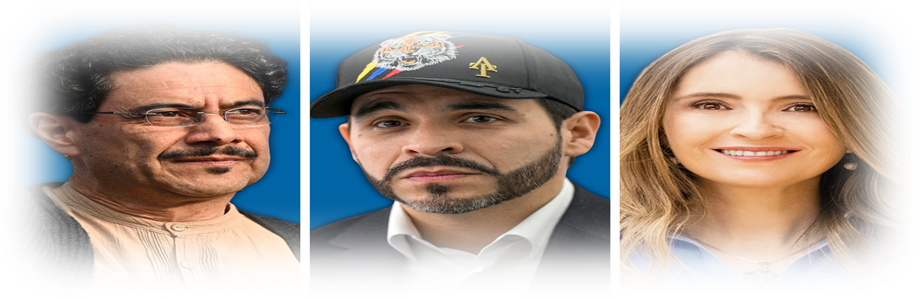
Notwithstanding the foregoing, neither of the pro-Zionist Colombian candidates currently leads the electoral pack.  That position is held by Senator Iván Cepeda Castro, a progressive follower of current Colombian president Gustavo Francisco Petro Urrego, a vocal critic of genocide and ethnic cleansing.  He has comfortably led throughout the electoral campaign in all reliable polls (although the term “reliable” with reference to polls may be an oxymoron).  His two chief competitors are Abelardo Gabriel de la Espriella Otero and Paloma Susana Valencia Laserna, both right wing politicians although Ms. Valencia has tried to capture some of the political center by ironically selecting as her running mate a gay male, Juan Daniel Oviedo Arango.  Ironic because Ms. Valencia has always been opposed to most LGBT+ issues but, as the ubiquitous “they” say “politics makes strange bedfellows”.  Mr. de la Espriella is a successful albeit unsavory lawyer having represented the worst elements of Colombian society including paramilitary death squad leaders and corrupt politicians.  He refers to himself as “el Tigre”, employs a sharp military salute whenever possible (despite, like Mr. Trump, having “legally” avoided compulsory military service) and is bereft of any government experience, running as an “outsider”.  Ms. Valencia on the other hand is from a prominent Colombian political family, has been a member of Congress for a long time and was personally selected as a candidate by former Colombian president Alvaro Uribe Velez.  She enjoys the support of most traditional political parties and politicians although party members in some cases, especially with respect to the Liberal Party, have refused to accept the decision of their party’s leaders.  In addition to the three front runners there are numerous other candidates, some of whom are well known, but none has more than a 3% following in recent polls.

Currently Mr. Cepeda, whose father was a Colombian senator assassinated by paramilitaries (such as those represented by Mr. de la Espriella) leads Mr. de La Espriella by more than 10% and Ms. Valencia by well over 20% but the sum of Mr. de la Espriella’s numbers and those of Ms. Valencia roughly equal those of Mr. Cepeda thus, while Mr. Cepeda is close to the 50% threshold for victory in the first round of elections, he is not there.  That makes a potential second round competitive, given the ideological compatibility of Mr. de la Espriella and Ms. Valencia and their mutual dedication to former president Uribe.  That creates an ideal scenario for foreign electoral interference in which both the State of Israel and the United States are clearly participants and rather well experienced.

The question then is, as it was in Kentucky, whether enough voters are willing sell out their country’s interests to foreign states, as voters in other Latin American countries have recently done (and, honestly, as has so often happened in the past) or whether given the disasters that the recently elected Trump and Netanyahu aligned right wing governments have proven to be (contrasted with the success on most fronts of Colombia’s current progressive government), Colombians will prove wiser and more patriotic than their continental counterparts (and also, wiser and more patriotic that the majority of United States’ voters in the State of Kentucky’s 4th Congressional District).

The reaction in the United States to Mr. Massie’s defeat has ranged from smug arrogance on the part of the Israeli-First component of Donald Trump’s MAGA coalition to dismay among those Trump voters who believed that he would prove different than the American Israel Public Affairs Committee (AIPAC) owned presidents of the past half century, something that might lead to a huge electoral reversal for the Republican Party in the United States this November, although the reality is that AIPAC controls both the United States’ Republican and Democratic parties, at least at the leadership levels.  The decision in Colombia is likely to impact not only Colombia’s future but also elections in other countries, not least of which might be this autumn’s United States congressional elections, and it might also impact the future of the Middle East, realities of which Colombian voters, for the most part, are blissfully unaware.  In the meantime, as has apparently become the norm … everywhere, false news and rabid calumnies fill Colombian airwaves and social media.

So, Sunday, May 31, 2026, perhaps a day to be long remembered; …

Hopefully not in infamy.
_____

© Guillermo Calvo Mahé; Manizales, 2026; all rights reserved.  Please feel free to share with appropriate attribution.

Guillermo (“Bill”) Calvo Mahé (a sometime poet and aspiring empirical philosopher) is a writer, political commentator and academic currently residing in the Republic of Colombia (although he has primarily lived in the United States of America of which he is also a citizen). Until 2017 he chaired the political science, government and international relations programs at the Universidad Autónoma de Manizales. Previously, he chaired the social studies and foreign language departments at the Eastern Military Academy in Huntington, New York. He is currently the publisher of the Inannite Review available at Substack.com; an intermittent commentator on radio and television; and, an occasional contributor to diverse periodicals and publications. He has academic degrees in political science (BA, The Citadel, the Military College of South Carolina), law (JD, St. John’s University, School of Law), international legal studies (LL.M, the Graduate Division of the New York University School of Law) and translation and linguistic studies (GCTS, the University of Florida’s Center for Latin American Studies). However, he is also fascinated by mythology, religion, physics, astronomy and mathematics, especially with matters related to quanta, cosmology and cosmogony. He can be contacted at guillermo.calvo.mahe@gmail.com and much of his writing is available through his blog at https://guillermocalvo.com/.

A Brief Reflection on Gerrymandering and How to Minimize It

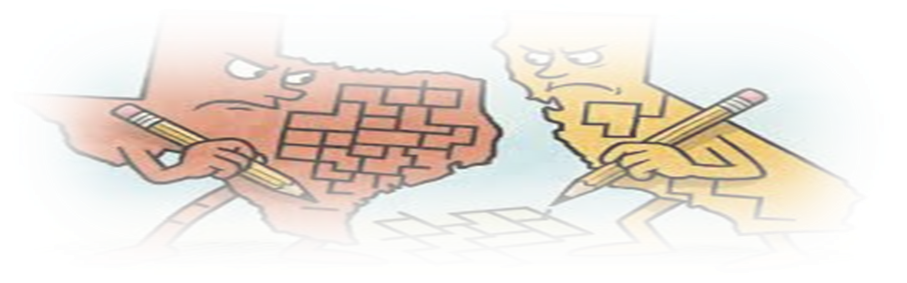
Gerrymandering is now completely out of control thanks to the GOP, the Democrats and the politicized judiciary.  The only practical solution is one adopted by most countries in the world and that is multi-legislator districts, preferably on a state wide basis, with proportional representation.  How would that work?  Or better yet, how does it work successfully in so many places. 

Well, take California with, I believe, 55 representatives elected to the House of Representatives.  Each California voter would have 55 votes which he or she could allocate to a single candidate (55) or divide among a number of candidates.  As an illustration, if a voter wanted to allocate his or her votes equally among eleven candidates, each would receive five votes, or the 55 votes could be distributed among the eleven candidates in any manner the voter deemed appropriate.  Or the voter could provide one vote each to 55 candidates.  California, with the largest representation in the House is the most complex example, states with less representation would be inversely simpler.  It is, in essence, what happens in the states that only elect one member to the House, it is a statewide contest with no gerrymandering possible. 

To make things easier, California and other states with large House membership could be divided into smaller voting districts.  In the California case for example, it could be divided into five voting districts, each electing eleven legislators,  While that would still permit efforts to distort the vote through gerrymandering, it would be more difficult to do so and less efficient, but in any case, much better that the single member system we have now.  And it can be implemented on a state by state basis through local legislation rather than on a federal level which would, in my opinion, require a constitutional amendment.  The latter might be the best solution for the long term but harder to implement. 

Something to consider for those who really care about electoral integrity rather than merely about maximizing the power of the political party to which they have become subservient.
_____

© Guillermo Calvo Mahé; Manizales, 2026; all rights reserved.  Please feel free to share with appropriate attribution.

Guillermo (“Bill”) Calvo Mahé (a sometime poet and aspiring empirical philosopher) is a writer, political commentator and academic currently residing in the Republic of Colombia (although he has primarily lived in the United States of America of which he is also a citizen). Until 2017 he chaired the political science, government and international relations programs at the Universidad Autónoma de Manizales. Previously, he chaired the social studies and foreign language departments at the Eastern Military Academy in Huntington, New York. He is currently the publisher of the Inannite Review available at Substack.com; an intermittent commentator on radio and television; and, an occasional contributor to diverse periodicals and publications. He has academic degrees in political science (BA, The Citadel, the Military College of South Carolina), law (JD, St. John’s University, School of Law), international legal studies (LL.M, the Graduate Division of the New York University School of Law) and translation and linguistic studies (GCTS, the University of Florida’s Center for Latin American Studies). However, he is also fascinated by mythology, religion, physics, astronomy and mathematics, especially with matters related to quanta, cosmology and cosmogony. He can be contacted at guillermo.calvo.mahe@gmail.com and much of his writing is available through his blog at https://guillermocalvo.com/.

“We the People” on the Concept of Oaths

In the United States there are sacrosanct symbols, especially the Constitution and the Flag, perhaps also the armed forces.  All public officers are required to take a solemn oath to protect and defend the Constitution; the citizenry at large is, at one time or another, required to do so in the form of the “Pledge of Allegiance” but I believe all of the foregoing are a mistake.  I believe it is a mistake because oaths are, or should be, not only solemn but sacred with consequences, serious consequences for their violation[1].  And the reality is that, as in the case of “sacred scriptures”, most people honor their oaths superficially, very visibly and audibly, but not profoundly.  Exceptions are the rule.

Take the Constitution.  The version promulgated in 1787 has been officially amended twenty-seven times, although amendments have sometimes cancelled each other out, for example, the 21st amendment repealed the 18th, and the 20th, 22nd, 23rd, and 25th amendments all redefined the election and succession processes.  However, unofficially, via purported “interpretation”, the Constitution has been amended thousands of times and each of the latter involves a violation of related sacred oaths.  The decision by John Marshall in the case of Marbury versus Madison where the concept of constitutional review was usurped by the Supreme Court[2] is a prime example but so was the Civil War (more accurately perhaps, the War Between the States).  The 16th and 17th amendments fundamentally altered the federal nature of the republic created by the Constitution as did, in a sense, the 13th, 14th, 15th, 18th and 19th each of which, in one sense or another, shifted power from the states to the federal government[3].

That violations of the sacred oaths involved may have been morally justified only emphasizes that the oaths to defend, preserve and uphold the Constitution should never have been required in the first place, especially given that the United States of America was founded on the principle of the propriety of oath breaking when circumstances deemed such violations of sacred honor justified.  All of the “Founding Father” broke their sacred oaths of allegiance to the British Crown.  In that respect, the case of Benedict Arnold is particularly meaningful raising the issue of which was worse, his initial violation of his oath to King George III or his violation of his subsequent oath to the Continental Congress?  And what of Robert E. Lee, placed in the impossible situation of either violating his oath to the federal government (which had, in effect, suspended the Constitution to which the oath had been made) or his oath to the State of Virginia?  Or what about Abraham Lincoln who clearly violated his oath to the Constitution in existence at the time he first took his oath of office and, of course, his pervious oaths as a Congressman and military officer which have been justified, properly perhaps, as required in order to fulfill his aspirations for a more just and powerful Union?

In my opinion, the only oath we should take is not to intangible symbols, usually too complex to comprehend and usually contradictory as well, but to “We the People”, a noble sociological and civic complex of interrelationships to which the symbols we revere should be inextricably bound.  But “We the People” is also a complex and frequently incoherent concept that seeks to meld contradictory beliefs such as “democracy” (the will of the majority), “liberty” (the autonomy of the individual, no matter what a majority believes) and pluralism (the protection of minorities in a quest for equality and equity) as well as to the amorphous, frequently contradictory concepts of legality versus justice; to due process and equal protection, to freedom of conscience, of expression and of assembly.  And what of the human tendency towards evolution?  Not only biologically but morally and ethically.  That which a society in one instant seeks to crystalize soon becomes calcified and obsolete.  Should a society be entitled to bind a future society through oaths to values that may become anachronistic?

Some of the concepts referenced above are reflected in the United States Constitution and, before that, in the Declaration of Independence, and many are embodied in the Charter of the United Nations[4].  But none of them encompass the totality of “We the People” although perhaps some guidance is provided in the Preamble[5] to the Constitution of the United States as to the role for which the concept of “We the People” was created; i.e., “We the People of the United States, in order to form a more perfect Union, establish justice, insure domestic tranquility, provide for the common defense, promote the general welfare, and secure the blessings of liberty to ourselves and our posterity, do ordain and establish this Constitution for the United States of America.”

Based on the foregoing, perhaps, at least in the United States of America, the Preamble to the Constitution should be the crux of the only oath we should be asked to take.  One to the effect that, on our sacred honor we would each swear that we would  do all we can to “establish justice, insure domestic tranquility, provide for the common defense, promote the general welfare, and secure the blessings of liberty to ourselves and our posterity”, understanding that “We the People” are not only those of us alive today but our ancestors and our descendants and that our actions and decisions need to take into account our traditions, our current needs and aspirations and the welfare and aspirations of our progeny.

Wouldn’t it be great if that was an oath not limited to citizens of the United States of America but to everyone, everywhere?  If we took such an oath seriously, as all oaths should be taken, then perhaps justice and equity and equality and the common welfare might indeed someday prevail in a world at peace.

Something that at least deserves our consideration.
_____

© Guillermo Calvo Mahé; Manizales, 2026; all rights reserved.  Please feel free to share with appropriate attribution.

Guillermo (“Bill”) Calvo Mahé (a sometime poet and aspiring empirical philosopher) is a writer, political commentator and academic currently residing in the Republic of Colombia (although he has primarily lived in the United States of America of which he is also a citizen). Until 2017 he chaired the political science, government and international relations programs at the Universidad Autónoma de Manizales. Previously, he chaired the social studies and foreign language departments at the Eastern Military Academy in Huntington, New York. He is currently the publisher of the Inannite Review available at Substack.com; an intermittent commentator on radio and television; and, an occasional contributor to diverse periodicals and publications. He has academic degrees in political science (BA, The Citadel, the Military College of South Carolina), law (JD, St. John’s University, School of Law), international legal studies (LL.M, the Graduate Division of the New York University School of Law) and translation and linguistic studies (GCTS, the University of Florida’s Center for Latin American Studies). However, he is also fascinated by mythology, religion, physics, astronomy and mathematics, especially with matters related to quanta, cosmology and cosmogony. He can be contacted at guillermo.calvo.mahe@gmail.com and much of his writing is available through his blog at https://guillermocalvo.com/.



[1] In this regard, perhaps the 3rd commandment of the Decalogue should be taken into account: “You shall not take the name of the Lord your God in vain, for the Lord will not hold him guiltless who takes his name in vain”, which refers to oaths using the “Lord’s” name as an enforcement mechanism.  Formal oaths in the United States are normally taken on the Christian Bible and in the name of the Abrahamic divinity (“So help me God”), notwithstanding the 1st Amendment to the Constitution’s secular requirements.

[2] See, e.g., Calvo Mahé, Guillermo et. al. (Jiménez Ramírez, Milton Cesar, editor, 2020): “Capítulo I. Evolución del control de constitucionalidad en los estados unidos.”; El control de la constitucionalidad en episodios: acerca del control constitucional como límite al poder; Universidad de Caldas, Facultad de ciencias jurídicas y sociales; Bogotá.

[3] See, e.g., Calvo Mahé (2023): “Motley Constitutionalism: a labyrinthine aphorism”; The Medium; July 30, 2023 available at https://guillermo-calvo-mahe.medium.com/motley-constitutionalism-a-labyrinthine-aphorism-9270c689f12d.

[4] Some aspects are also reflected in the Preamble to the Charter of the United Nations, i.e.:

We the peoples of the united nations, determined to save succeeding generations from the scourge of war, which twice in our lifetime has brought untold sorrow to mankind, and to reaffirm faith in fundamental human rights, in the dignity and worth of the human person, in the equal rights of men and women and of nations large and small, and to establish conditions under which justice and respect for the obligations arising from treaties and other sources of international law can be maintained, and to promote social progress and better standards of life in larger freedom, … to practice tolerance and live together in peace with one another as good neighbors, and to unite our strength to maintain international peace and security, and to ensure, by the acceptance of principles and the institution of methods, that armed force shall not be used, save in the common interest, and to employ international machinery for the promotion of the economic and social advancement of all peoples, have resolved to combine our efforts to accomplish these aims ….

[5] There are two very different perspectives with respect to preambles.  One is that they are merely aspirational without any binding effect.  The other, the one to which I ascribe, is that they embody the fundamental premises on which the promises and agreements which follow are based and to which they must conform, in the absence of which, the covenants embodied will have been extinguished.  In a constitutional sense, that would mean that no amendments could impact the concepts embodied in a preamble without destroying the constitution, and perhaps, at best, replacing it.  Something which occurred when the United States Constitution of 1787 unconstitutionally extinguished the Articles of Confederation, or, in the Republic of Colombia, when the Constitution of 1991 unconstitutionally replaced the Constitution of 1886.