
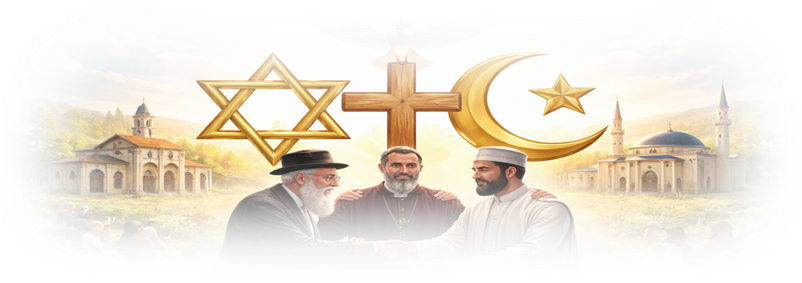
The three principal roots of the Abrahamic religions, Judaism, Christianity and Islam (there are hundreds of branches and thousands of twigs, metaphorically speaking) are profoundly incoherent in their relationship, inter se, having for the most parts, profound similarities, e.g., they all worship the same god, and minimal differences, mainly involving the role and nature of one person, the one variously referred to as Yešu, Yeshu, Yeshua, Jesus, Isa and variants thereof.
Ironically, the Abrahamic variant that most honors the most ancient Abrahamic strictures (as reflected in the Tanakh) is probably Islam. Indeed, almost all of the much maligned Sharia Law is premised on ancient Jewish Law (absent requirements for animal sacrifice). Islam is also the bridge between Judaism and Christianity, affording the Christian Jesus a major role in its religious traditions, second only to that ascribed to the prophet Mohamed, while Judaism, in its non-atheistic variants (e.g., Zionism), recognizes the existence of Jesus and his purported miracles but ascribes them to demonic practices, and claims that rather than reigning from heaven, he is consigned to eternal damnation in a molten pool of feces in some version of Hell (Calvo Mahé, 2025). Zionism on the other hand (a fourth hand so to speak), was founded in the late nineteenth century by Jews who had embraced atheism and were interested primarily in colonization of the middle east and global political and economic dominance, and has virtually nothing in common with religious Judaism or any religion at all (Calvo Mahé, 2026).
This reflection has a catalyst and that is an article published in 2021 in Academia.edu (in the Academic Letters section) by Gregory B. Kaplan entitled “The psychology of converso humor” (Kaplan, 2021), the term “converso” referring to forced converts from Judaism to Christianity and their descendants. Conversely, conversions to Judaism came from diverse sources including paganism, Greco-Roman polytheism, and traditional Middle Eastern/African religions and, of course, the massive Turko-Slavic conversions at the end of the ninth century by the Khazars. These included the Arabian, pre Islamic Himyarite Kingdom in around 380 CE; the Kingdom of Adiabene in Northern Iraq during the first century CE; the Idumeans and Ituraeans in the Levant in the second century BCE (like the convertos, a forced conversion); North African Berber tribes after the rise of Islam. Significant details concerning the foregoing are provided by Luis H. Feldman (1993, 2003) and Rabbi Pinvhas Landis (2022).
The catalytic aspect is specifically, based on this sentence: “During the 1400s, a dichotomy developed between New and Old Christians (those with no Jewish ancestors) according to which all conversos were perceived as heretical Christians. In consequence, conversos became subject to discrimination and persecution.”[1]
I found the reality reflected therein particularly ironic given that all original followers of Yešu, although they did not consider themselves “Christians”, were religious Jews. Christianity was a perversion of their beliefs orchestrated by Saul of Tarsus who Christians consider a “saint”, but who historically cognizant Jews consider a Jewish infiltrator into the newly evolving variant of Judaism represented by Yešu and his purported apostles and followers. Saul was, according to Jewish sources, including the Toledot Yeshu, purportedly an agent of the Jerusalem Sanhedrin who deliberately perverted Judaic principles within the evolving movement in order to make it different enough from Judaism to stem the adoption of Yešu’s principles by Jews and hence, Saul of Tarsus, Judas (the purported betrayer of Yešu) and in some cases, even Simon Peter (St. Peter) are revered by historically knowledgeable Jews as Jewish heroes (Calvo Mahé, 2024). Thus, in a sense, original followers of Yešu were conversos as well and deprecated by subsequent Pauline “Christians”.
As ironic as any of the foregoing is the relationship of Christian Zionists to Judaism. Christian Zionists in large part emerged from devout antisemites who saw the Zionist project as essential to the purported Second Coming (i.e., the return of Jesus Christ to judge the living and the dead and reign for a thousand years in an earthly kingdom), and they supported and support the Zionist project in the expectation that their version of Jesus will return and consign all but 144,000 of history’s Jewish population to perdition. Mainly evangelical Protestants, Christian Zionists also tend to believe that most Christians whose beliefs do not align with theirs will also be consigned to perdition in Hell for eternity when Jesus returns.
It is interesting to reflect that, during the so called dark ages and even into the renaissance and enlightenment, Muslim scholars and leaders were the intellectual savors of Western Civilization and indeed, of Judaism, in much the same way that conversos became important, indeed critical leaders of Christian science, culture, politics and economics. Thus, today’s globalist world, purportedly led by Zionists and Christians, in fact largely owes its foundations to conversos and Muslims.
The most positive meld of Abrahamic religions probably occurred in the Palestinian portion of the Ottoman Empire prior to its demise and the subsequent British Protectorate (which was supposed to assist in the evolution of an independent Palestinian state based on the concept of popular self-determination), the declaration of the State of Israel and the related Nakba. There, for at least a time, Muslims, Christians and Jews lived together as Palestinian brethren. Unfortunately, Zionists have destroyed that community in ongoing campaigns of genocide and ethnic cleansing, campaigns directed not only against Muslims but against Christians as well.
Ironic Abrahamic incoherencies all.
Sources:
Calvo Mahé, Guillermo (2024): The Life of Yešu According to Diverse Jewish Sources“; Noah’s Ark Research papers, Academia.edu, available at https://www.academia.edu/124579552/The_Life_of_Ye%C5%A1u_According_to_Diverse_Jewish_Sources.
Calvo Mahé, G. (2026): “On the Origen of the ‘Hebrews’“; Noah’s Ark Research papers, Academia.edu, available at ttps://www.academia.edu/165112048/On_the_Origen_of_the_Hebrews_.
Calvo Mahé, Guillermo (2026): “Zionism, Antisemitism, Jeffrey Epstein and the Purported Protocols of the Elders of Zion”; Medium, February 21, 2026 available at https://medium.com/@guillermo-calvo-mahe/zionism-antisemitism-jeffrey-epstein-and-the-purported-protocols-of-the-elders-of-zion-e95f278ae193.
Feldman, L. H. (1993): “Proselytism by Jews in the Third, Fourth, and Fifth Centuries“; Journal for the Study of Judaism in the Persian, Hellenistic, and Roman Period. 24 (1). Brill: 1–58. Available at https://brill.com/view/journals/jsj/24/1/article-p1_1.xml?srsltid=AfmBOoqUGwgSYGRlA–6-SB6u07HaVTsLvFeUjP9oBc2Ced3HxeHBFXl.
Feldman, Louis H. (2003): “Conversion to Judaism in Classical Antiquity“; Hebrew Union College Annual. 74 Hebrew Union College – Jewish Institute of Religion 115-156: available at https://www.jstor.org/stable/i23503557.
Kaplan, G. B. (2021): “The psychology of converso humor”; Academia Letters, Article 674 available at https://doi.org/10.20935/AL674
Landis, Pinchas (2022): “The Surge of Converts to Judaism in Ancient Rome”; Aish.com, May 29, 2022 available at https://aish.com/the-surge-of-converts-to-judaism-in-ancient-rome/.
_____
© Guillermo Calvo Mahé; Manizales, 2026; all rights reserved. Please feel free to share with appropriate attribution.
Guillermo (“Bill”) Calvo Mahé (a sometime poet and aspiring empirical philosopher) is a writer, political commentator and academic currently residing in the Republic of Colombia (although he has primarily lived in the United States of America of which he is also a citizen). Until 2017 he chaired the political science, government and international relations programs at the Universidad Autónoma de Manizales. Previously, he chaired the social studies and foreign language departments at the Eastern Military Academy in Huntington, New York. He is currently the publisher of the Inannite Review available at Substack.com; an intermittent commentator on radio and television; and, an occasional contributor to diverse periodicals and publications. He has academic degrees in political science (BA, The Citadel, the Military College of South Carolina), law (JD, St. John’s University, School of Law), international legal studies (LL.M, the Graduate Division of the New York University School of Law) and translation and linguistic studies (GCTS, the University of Florida’s Center for Latin American Studies). However, he is also fascinated by mythology, religion, physics, astronomy and mathematics, especially with matters related to quanta, cosmology and cosmogony. He can be contacted at guillermo.calvo.mahe@gmail.com and much of his writing is available through his blog at https://guillermocalvo.com/.
[1] In the interests of objectivity, the author discloses that he is not personally a believer in any of the Abrahamic faiths but is an admirer of the social, civic and economic postulates attributed to Yešu as reflected in democratic socialism.

