
Today, March 8, 2026 is an interesting day because of the confluence of diverse factors. It is “Women’s Day” in many places, originally “Working Women’s Day” but the concept has been expanded internationally as it has become recognized that unpaid domestic labor is as worthy of recognition as any other kind of labor. But today is also Daylight Savings Time Day, at least in the United States of America where millions of people woke to find that they’re bodies believe that it is an hour later than everything around them seems to be occurring. Finally, it is the first in a series of election days in the Republic of Colombia this year. Today the members of Congress are elected and primaries are held for contested presidential candidacies. Which brings me, admittedly in a roundabout way, to the continuing debate in the United States concerning who should be permitted to vote and how.
In Colombia, voting requires photo identification via a national identity card updated constantly to electronically indicate not only citizenship, but voting residency. At the designated polls (voting is in person), one is also fingerprinted and required to provide a signature. The individual voting locations are maintained electronically in the National Registry and one can find one’s polling place and room through the Internet. The identity cards, denominated “cedulas”, are easily available to everyone, in fact, they’re required and used for commercial transactions, transport, etc. They are issued by the National Registry which verifies citizenship as well as basic personal data including height and blood type. Elections are easy, quick, and with results posted the same day. All of the foregoing is very different than the incoherently complex, inefficient and insecure system in the United States where the concept of a national identification card has been anathema to conservatives and libertarians in the past but, ironically, at present, it is liberals who seem to oppose required voting identification while conservatives insist on photo identification that includes proof of citizenship and support federal legislation denominated the “Save Act” to make such requirements applicable nationally.
The Save Act sounds logical but has a major problem. Because the United States is a federation, elections occur at the state, county and special district rather than national level, even in elections for Congress and the Presidential Electoral College (there are no real presidential elections) thus, appropriate identification would require supplemental systems that verify not only national citizenship, but state and local domicile. No current form of identification meets those requirements which would require a constantly updated national citizen database similar to what exists in Colombia and most other countries, a database heretofore opposed by the conservatives who now insist on what, without it, would be a dysfunctional Save Act. So, unlike most of the world, the United States is engaged in an easily resolvable but transcendentally important ludicrous political debate, politicized in order to polarize the electorate. Perhaps instead of Make America Great Again, the United States electorate needs to concentrate on just Make America Functional.
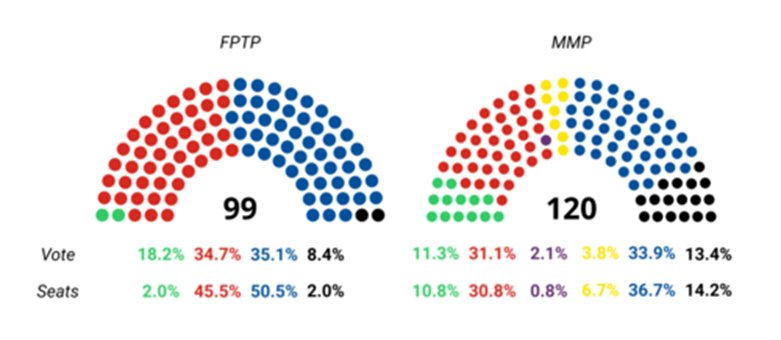
While the electoral process in the Republic of Colombia is fair, efficient and relatively secure, there are significant issues that render it deficient in terms of democracy, a universal problem. Most of all, the electoral system is geared to empower political parties instead of voters, hence, it is political parties rather than the citizenry that is the subject of political rights and related political power. As in most of the non-English speaking world, Colombian legislative elections are proportional so that the legislature more or less represents most of the political forces in the country. If, for example, a political party only receives ten percent of the vote, it still receives ten percent of the membership in the legislature, unlike the English speaking world (the United States, the United Kingdom, Canada, Australia and New Zealand) where it would be completely frozen out. This is accomplished in Colombia and elsewhere because instead of using individual electoral districts where only one legislator is chosen, a system of multi-legislator districts is used. The most efficient such system is the one used in the Republic of Ireland for elections to the lower house of Parliament where the voter places all of the candidates in the district in order of preference allocating to each a voting value. Thus, the individual voter’s personal list can be comprised of candidates from diverse political parties. For example, if the district were to have ten candidates, the one listed first would receive a voting value of ten and the one listed tenth would receive a voting value of one. If a candidate is not listed, the voting value would be zero. The candidates elected in that ten legislator district would be the ten who accumulated the most voting value points and might well include candidates who received no first or second place votes.
In Colombia and other places, the list system is perverted because the lists are predetermined by the political parties and in many instances, the order of candidates, which determines who will be elected, is frozen. In other hybrid systems voters get to either vote for the whole list or to indicate a preference for a single candidate, with the order of candidates in the list reprioritized based on the number of votes received by individual candidates. In the Republic of Colombia, the political parties determine whether the lists will be closed, the former option, or open, the latter. Closed lists are sometimes justified as necessary in order to assure gender balance in the results with candidates listed in alternating gender.
The principal practical problem with the legislative electoral system in the Republic of Colombia in the open system is that the names of candidates do not appear on the ballot, rather, only the names of the political parties or movements sponsoring the list and a series of numbers representing the individual candidates, thus, voters have to arrive at the polls with the number of the candidate they favor memorized. Because voters frequently forget the specific numbers, they instead opt to vote only for the party. This issue is easily resolvable by either placing the names of candidates on the ballot or providing a guide at the polling station that voters can consult to find the number allocated to their preferred candidate but as usually occurs, solutions are plentiful but the will to implement them, for manipulative reasons, is absent. The other major problem is that although the electoral districts are multi legislator districts, voters can only vote for one candidate thus, for example, the Department of Caldas is entitled to five members in the House of Representatives, voters can only vote for one and in doing so, automatically vote for that candidates sponsoring political party or political movement.
Another practical problem in Colombia is that the political party system is in great incoherent ideologically. With political parties forming local electoral alliances of convenience. Thus, in one Department a list may be jointly sponsored by the Liberal Party, Conservative Party, the Party of National Unity and the Radical Change Party, in another Department the party configuration may be very different, excluding some of the members or replacing or supplementing them with others, or even, presenting a unique list without alliances with other parties. The consequence is that the policies advocated by different parties can be inconsistent in different parts of the country but, since promised policies are, as in most parts of the world, rarely honored, the impact is more theoretical than practical.
Legislative electoral systems in the English speaking world, the first past the post systems as they are commonly known, are the least democratic, i.e., candidates receiving less than half of the vote are elected based on a plurality, and a plurality means that the candidate was opposed by most of the voters who fragmented their votes. Such issue could be tempered, if not resolved, through required runoff systems, but that would still disenfranchise a majority of the electorate. Smaller political parties have no legislative representation at all, and hence, are not likely to ever evolve into major parties, especially as voters are urged by the media not to waste their votes on smaller political parties.
The proportional list systems have their own problems except, perhaps, in systems such as exist in the Republic of Ireland, but given the political power provided to political parties by systemic deficiencies, the likelihood of change to improve the functionality of legislative democracy, other than through constitutional reform directly through the electorate, is unlikely. Democracy is thus, unfortunately, more of a useful illusion than a realistic system of governance, almost everywhere. Of course, that leaves open for future analysis the value of an effective democratic electoral system given the laziness, ignorance, emotionality, prejudices and naiveté of so many voters.
Further exponent sayeth naught other than: Happy Women’s Day and Happy Daylight Savings Day!
_____
© Guillermo Calvo Mahé; Manizales, 2026; all rights reserved. Please feel free to share with appropriate attribution.
Guillermo (“Bill”) Calvo Mahé (a sometime poet and aspiring empirical philosopher) is a writer, political commentator and academic currently residing in the Republic of Colombia (although he has primarily lived in the United States of America of which he is also a citizen). Until 2017 he chaired the political science, government and international relations programs at the Universidad Autónoma de Manizales. Previously, he chaired the social studies and foreign language departments at the Eastern Military Academy in Huntington, New York. He is currently the publisher of the Inannite Review available at Substack.com; an intermittent commentator on radio and television; and, an occasional contributor to diverse periodicals and publications. He has academic degrees in political science (BA, The Citadel, the Military College of South Carolina), law (JD, St. John’s University, School of Law), international legal studies (LL.M, the Graduate Division of the New York University School of Law) and translation and linguistic studies (GCTS, the University of Florida’s Center for Latin American Studies). However, he is also fascinated by mythology, religion, physics, astronomy and mathematics, especially with matters related to quanta, cosmology and cosmogony. He can be contacted at guillermo.calvo.mahe@gmail.com and much of his writing is available through his blog at https://guillermocalvo.com/.
 Guillermo Calvo Mahé