An Intriguing Possibility for 2028

The 2026 elections were surprising, primarily because of the willingness of Republican voters to break ranks with their party in the national interest, to break their traditional voting allegiance seeking instead to attain the broken pledges of Trump’s successful 2024 campaign.  No more wars, concentration on the needs of United States citizens, minimizing corruption.  By contrast, the majority of the Democrats currently serving in Congress and those that will assume office early next January seem inclined to ignore the demands of those who just gave them a majority and to continue along the path set for them by their AIPAC masters.  That was clear in the recent vote to impeach Secretary of War Peter Hegseth.  There, eleven members of the Democratic Party’s contingent in the House of Representatives (all but one beneficiaries of AIPAC largesse) failed for one reason or another to make it to the vote thus saving Mr. Hegseth job; a sort of “the dog ate my homework moment” they expect their electorate to swallow.

The proposed leadership of the Democrats in the next Congress, Hakeem Jeffries as Speaker in the House of Representatives and Chuck Schumer as majority leader in the Senate, Israeli Firsters both, promise more of the same.  Plenty of noise with hearings involving the president, his family and allies but only superficial inquiry into the Epstein scandals and especially continued allegiance to Israel and its perpetual wars and to its perpetual draining of United States’ taxpayers’ pockets leaving little for education, healthcare or the social safety net (although Israel enjoys them all).

Ironically, the foregoing may open an avenue for a return to power by Republicans in 2028, but only if Democratic voters are as willing to put their country ahead of their party as were Republican voters in 2026.  And if, learning from this year’s massive defeat, the GOP selects its presidential candidate from among the current group of Republican America First rebels, e.g., people like Thomas Massie, Marjorie Taylor Greene, Joe Kent, Candace Owens, Tucker Carlson, Nick Fuentes, Jackson Hinkle or Rand Paul.  The amazing thing would be if the new group of democratic socialists in the Democratic Party, both elected officials and voters, joined with those Republicans in seeking a real answer to the clamor for change by NOT selecting their presidential candidate from the current list of favorites, all AIPAC toadies, but instead, by helping form a real bipartisan, America First movement.  Perhaps Democrats like New York Mayor Zohran Mamdani, newly minted senator James Talarico, Cori Bush, Jamaal Bowman, Julia Salazar and Brandon Johnson might bolt their party and join Republican rebels in a national unity ticket.  Wouldn’t that be something?

Notwithstanding how likely the betrayal of their voters (if not their funders) by the Democratic Party’s current and prospective leaders and the bulk of its elected officials is, the likelyhood of a unity movement seems improbable.  But improbable is not the same as impossible and perhaps the awakening of GOP voters’ consciences and common sense can somehow or other, notwithstanding the duplicitous legacy press, infect enough honest, intelligent and sensible Democrats to make a unity ticket that places the interests of the United States first a reality.

Unlikely, I know, but where there’s life there’s hope, and the 2026 midterm elections demonstrated that at least among the voters (if not among the Democratic Party’s current and prospective leadership), there was a trace of decency (instead of polarizing partisanship). 

Perhaps even a trace of life.
_____

© Guillermo Calvo Mahé; Manizales, 2026; all rights reserved.  Please feel free to share with appropriate attribution.

Guillermo (“Bill”) Calvo Mahé (a sometime poet and aspiring empirical philosopher) is a writer, geopolitical commentator and academic currently residing in the Republic of Colombia (although he has primarily lived in the United States of America of which he is also a citizen). Until 2017 he chaired the political science, government and international relations programs at the Universidad Autónoma de Manizales. Previously, he chaired the social studies and foreign language departments at the Eastern Military Academy in Huntington, New York. He is currently the publisher of the Inannite Review available at Substack.com; an intermittent commentator on radio and television in both Colombia and abroad; and, an occasional contributor to diverse periodicals and publications. He has academic degrees in political science (BA, The Citadel, the Military College of South Carolina), law (JD, St. John’s University, School of Law), international legal studies (LL.M, the Graduate Division of the New York University School of Law) and translation and linguistic studies (GCTS, the University of Florida’s Center for Latin American Studies). However, he is also fascinated by mythology, religion, physics, astronomy and mathematics, especially with matters related to quanta, cosmology and cosmogony. He can be contacted at guillermo.calvo.mahe@gmail.com and much of his writing is available through his blog at https://guillermocalvo.com/.


The Yokes on Us

The recent United States midterm elections were not an endorsement of the corrupt Democratic Party and its Israeli First leadership but of the corrupt Republican Party and its Israeli First leadership, something which leading GOP dissidents had been warning about for years; dissident leaders like media personalities Tucker Carlson, Candace Owens, Nick Fuentes and Jackson Hinkle, like former director of the National Counterterrorism Center Joe Kent, like members of Congress Marjorie Taylor Greens and Thomas Massie and current Senator Rand Paul.  The election in numerous aspects was a mirror image of the 2024 elections when the electorate rejected the Israel First leadership of the Biden administration thinking that in Donald Trump, the United States public would finally come first.  The “yoke” was on us.  It may well be again.

Instead of reacting to the recent electoral revolt in a sensible, self-preservatory fashion, the Trump administration has instead doubled down on Israeli control of the United States government by appointing Stephen Miller as White House chief of staff.  However, the reality is that even in the Congress that will take office on January 4, 2027 (the 3rd is a Sunday), AIPAC will remain firmly in control having bought and paid for virtually the entire Congressional membership, both Republican and Democratic (518 of the 535 members, 247 Democrats and 268 Republicans[1]).  That is especially true under the current leadership of the Democratic Party, i.e., Hakeem Jeffries, Chuck Schumer and somehow, Nancy Pelosi, Hillary Clinton and Kamala Harris, and that, notwithstanding the rejection of AIPAC by the electorate and by an interesting group of democratic socialist elected as Democrats. 

As with the dissident Republicans, there are great dissident Democrats, especially among the emerging democratic socialist coterie, e.g., Zohran Mamdani, newly minted senator James Talarico, Cori Bush, Jamaal Bowman, Julia Salazar and Brandon Johnson, among others.  Unfortunately, the legacy media will do all it can to obfuscate the dissidents in both parties and preserve Zionist political hegemony.  And the legacy media will warn us of impending disasters as we are purportedly threatened by Muslim hoards seeking to impose Sharia law throughout the United States, or hordes of immigrants seeking to change the nature of United States society, or communists who hate us because of our purported freedoms, or crazed liberals (or reactionary conservatives, take your pick).  Or of imminent Russian or Chinese domination.  Or perhaps soon, of space aliens seeking to steal the natural resources we’ve plundered from others.

So, what might the future hold? 

Well, most likely, the highly polarized “same old same old” as the legacy media, following the orders of the billionaire class and its very own Deep State (i.e., the military industrial complex against which Ike warned us so many decades ago, now joined by the intelligence community), keep us at one another’s’ throats instead of permitting us to wake and go after those who pillage us constantly through the only form of socialism that is deemed tolerable, the corporate welfare state[2].  And the rich will continue to get richer, much richer, much, much richer (if somewhat fewer), the poor will continue to get, well not poorer, that’s hardly possible, but much more numerous. And too many of the best and brightest among us will be sent off to give their lives and health, both physical and mental, in perpetual wars, watched from afar by the rich and powerful and their families; and when they return (if they do), maimed and psychotic, asked what they’ve done for their masters recently.

Unless, of course, we “the huddled masses yearning to breathe free”, somehow wake up and cast off the yokes that keep us enthralled. 

But how likely is that?
_____

© Guillermo Calvo Mahé; Manizales, 2026; all rights reserved.  Please feel free to share with appropriate attribution.

Guillermo (“Bill”) Calvo Mahé (a sometime poet and aspiring empirical philosopher) is a writer, political commentator and academic currently residing in the Republic of Colombia (although he has primarily lived in the United States of America of which he is also a citizen). Until 2017 he chaired the political science, government and international relations programs at the Universidad Autónoma de Manizales. Previously, he chaired the social studies and foreign language departments at the Eastern Military Academy in Huntington, New York. He is currently the publisher of the Inannite Review available at Substack.com; an intermittent commentator on radio and television in both Colombia and abroad; and, an occasional contributor to diverse periodicals and publications. He has academic degrees in political science (BA, The Citadel, the Military College of South Carolina), law (JD, St. John’s University, School of Law), international legal studies (LL.M, the Graduate Division of the New York University School of Law) and translation and linguistic studies (GCTS, the University of Florida’s Center for Latin American Studies). However, he is also fascinated by mythology, religion, physics, astronomy and mathematics, especially with matters related to quanta, cosmology and cosmogony. He can be contacted at guillermo.calvo.mahe@gmail.com and much of his writing is available through his blog at https://guillermocalvo.com/.



[1] Specific, per member details available, see “AIPAC Recipients List 2026”, Who Funds My Rep?, available at https://whofundsmyrep.com/rankings.

[2] Well, or else United States funded Israeli welfare such as free health care, free education, subsidized housing and alimentation, etc.

Realistic Reflections on the Blue Tsunami of November 3, 2026

Hey guys, Cassandra calling.  From Troy, three thousand two hundred years ago.  I’m a prophetess after all.  I hate to stomp on your euphoria but ….

On Tuesday, November 3, 2026, the United States political system experienced a “Blue Tsunami” but, while voters elected more Democratic Party candidates than Republicans, they did not endorse that political party’s leadership.  Instead, they rejected the brutal corruption, deception and immorality in office of “the Donald”, Donald John Trump, which is a very different thing.  In doing so, they joined important Republicans who had already done so, appalled by his the betrayal of his 2024 campaign promises involving putting an end to perpetual war and focusing on economic bread and butter issues, on minimizing polarization and putting America first, they joined people like media personalities Tucker Carlson, Candace Owens, Nick Fuentes and Jackson Hinkle, like former director of the National Counterterrorism Center Joe Kent, like former members of Congress Marjorie Taylor Greens and Thomas Massie and current Senator Rand Paul.  Unlike those honest protestors, the current Congressional leaders of the Democratic Party, Hakeem Jeffries in the House and Chuck Schumer in the Senate, both from New York, are bought and paid for representatives of the American Israel Public Affairs Committee (AIPAC) and Israel firsters, as are a major portion of the Democratic Party’s Congressional Representatives and Senators, those who will control the new Congress that will assume its role on either January 3rd or 4th, 2027 (the 3rd is on a Sunday).  While some progressives and democratic socialists won, and that was amazing and heartening, the vast majority of the victors were the same old crowd just waiting for their turn at the trough. So, notwithstanding the wishes of the electorate as clearly indicated in the recent elections, the more things change, the more too many are likely to stay the same.  That President Trump responded to his electoral defeat by optimistically stating the he looks forward to “working” with the new Congressional majority may well tell us more than we want to know.  I was pleasantly surprised that the election took place at all, and that its results were accepted, but in large part that was due to the Supreme Court’s unusual decision not to become involved in support of Trumpian aspirations-

There were superficially positive developments but they are probably largely illusory in the greater scheme of things.  Or they will be without further action on our part.  Real action, not just gripes and complaints.  While AIPAC, which has long controlled both major United States political parties, is facing an apparently unprecedented structural crisis of faith within the United States’ citizenry, its control and Israel’s influence over the Congress and both major political parties is only superficially diminished.  It’s true that for the first time in modern political history we saw marquee progressive candidates win major statewide races, not only in spite of AIPAC’s opposition but by actively campaigning against it, AIPAC still commands hundreds of millions of dollars, owns (or leases) the majority of the Congress and has hundreds of allies in positions of political, economic and military power.  Thus United States foreign policy, where traditionalist Democratic Party legislators are at least as anxious as President Trump to do Israel’s bidding, is unlikely to change in any material manner.  The new Democratic Congressional majority is unlikely to insist that the kidnapped Venezuelan president be released and returned to office, or that the oil plundered from Venezuela be returned.  Or that the rightwing mini-Trumps installed by United States and Israeli intelligence agencies in most of Latin America be replaced in honest democratic elections.  Instead of a quest for peace, they are likely to insist on enlargement of the proxy war against Russia through the puppet regime in the Ukraine and in renewed antagonism against China, especially with respect to its province of Taiwan.  The reality is that now, after the election, the goal of the Democratic leadership, just like that of their Republican counterparts, involves, not the “common welfare” but securing a victory in the 2028 elections.  But perhaps that will require more than just embarrassing Republicans in the executive branch and the Trump family “syndicate” in particular.  Perhaps, for a change, it will require more than just instilling fear in the hearts of potential voters.  Perhaps it will require meeting the demands of the electorate for peace, economic prosperity and an emphasis on the welfare of the United States population, whether citizens or not, rather than filling the coffers of the military industrial complex (now fused with the intelligence agencies into the Deep State) against which Ike warned us so long ago.  But that is not a likely scenario.

At any rate, don’t expect all that much in kept promises.  A thorough investigation into the sickly putrid Jeffrey Epstein saga would embarrass too many Democrats and too many very powerful political donors, and it would provide devastating evidence of the immorality of United States, European and Israeli intelligence agencies for whom pedophilia and murder were and continue to be useful tools.  That is an inquiry which the Deep State will guide into a maze of obfuscation from which, as in the case of the assassination of President John F. Kennedy or the downing of New York’s Twin Towers, verity is very unlikely to emerge.  And as to the quest for peace?  That would eliminate the greatest profit generation enterprise on the planet, perpetual war, which in turn would stem the redistribution of wealth from the populace to the billionaire caste, the only form of socialism Americans are taught to respect.  Thus that too will be deflected through manufactured threats designed to maintain us all in a state of perpetual anxiety and insecurity (beware the Muslim hordes trying to steal our democracy, and the communists and the socialists, and the foreigners yearning to breathe free).  Support by leaders of both major parties for the Zionist quest for a Greater Israel may be obfuscated but it will probably not be diminished, with efforts made to humanize genocide and ethnic cleansing paid for by United States taxpayers.  Those crimes against humanity are, as far as both Democrats and Republicans are concerned, immoral only when our interests are negatively impacted.

There will be plenty of subpoenaing to embarrass Republicans but not enough to effect meaningful change other than, perhaps, electorally, and the response will be plenty of vetoing, resulting in more government gridlock and polarization and the federal judiciary will become more politicized than ever.  Explanations blaming others will bloom and befuddle us all, as usual.  And it is all too likely that we will revert to our instinctive emotional shells, backing the political leaders who got and get us into the messes we and the rest of the world (other than the privileged few) inhabit.

Still, not everything is depressingly pessimistic.  There may be a few rays of hope.  After all, America First Republicans and progressive democratic socialists have somehow germinated out of the political compost that surrounds us.  Thus, notwithstanding the foregoing, there may be an out, but that is not a likely scenario.  It would require us to embrace the democratic socialist rebels in the Democratic Party and the America First rebels in the Republican Party and to select from among them, candidates for the presidency in 2028 rather than from among traditional politicians, politicians like JD Vance or Marco Rubio on the Republican side or Kamala Harris, Gavin Newsom, Pete Buttigieg, Josh Shapiro, Andy Beshear and Gretchen Whitmer on the Democratic side, all of whom are imposed on us by AIPAC and the billionaire caste (interesting name for a band).  Perhaps the electorate will gravitate to people who have rejected AIPAC and its bribes (errr, donations, now to be disguised through a third party maze), people like Joe Kent, Tucker Carlson, Nick Fuentes, Jackson Hinkle, Marjorie Taylor Greens, Thomas Massie or Rand Paul on the Republican side or the newly minted senator James Talarico, or Cori Bush, or Jamaal Bowman, or Julia Salazar or Brandon Johnson in the Democratic Party.  Unfortunately, Zohran Mamdani is not eligible having been born abroad.  But they would have to survive the calumnious brutality of the legacy media and that is a feat rarely accomplished.

So, for now, perhaps all week long, let’s enjoy the sort of defeat of the disgusting, corrupt and hypocritical Trumpian MAGA political parody and its AIPAC masters, but let’s not hold our breath awaiting better times at the hands of their Democratic Party opponents.  Only we, acting together, ignoring fear and focusing on our hope and decency can make a difference; a difference whose goal is not the accumulation of wealth and power or world hegemony but the common attainment of equity, justice and opportunity, of the “common welfare” promised by the United States Constitution. 

The recent election will not take us there but perhaps a door has been forced opened and we can stick a leg in to keep it that way.

At least for a while.
_____

© Guillermo Calvo Mahé; Manizales, 2026; all rights reserved.  Please feel free to share with appropriate attribution.

Guillermo (“Bill”) Calvo Mahé (a sometime poet and aspiring empirical philosopher) is a writer, political commentator and academic currently residing in the Republic of Colombia (although he has primarily lived in the United States of America of which he is also a citizen). Until 2017 he chaired the political science, government and international relations programs at the Universidad Autónoma de Manizales. Previously, he chaired the social studies and foreign language departments at the Eastern Military Academy in Huntington, New York. He is currently the publisher of the Inannite Review available at Substack.com; an intermittent commentator on radio and television in both Colombia and abroad; and, an occasional contributor to diverse periodicals and publications. He has academic degrees in political science (BA, The Citadel, the Military College of South Carolina), law (JD, St. John’s University, School of Law), international legal studies (LL.M, the Graduate Division of the New York University School of Law) and translation and linguistic studies (GCTS, the University of Florida’s Center for Latin American Studies). However, he is also fascinated by mythology, religion, physics, astronomy and mathematics, especially with matters related to quanta, cosmology and cosmogony. He can be contacted at guillermo.calvo.mahe@gmail.com and much of his writing is available through his blog at https://guillermocalvo.com/.

Political Echoes from Southern Climes

On Sunday May 31, 2026, a week from the day on which I write this introspection, Colombians will head to the polls for a presidential election.  In Colombia as in much of the world, the electoral process is less controversial than in the United States, with participatory rights carefully monitored through required identification through official, state issued identification documents.  Also, in Colombia, if a candidate receives more than 50% of the vote, he or she will be the victor, if not, the top two vote recipients will face off in a runoff on the 21st of June.  In Colombian the candidate with less votes never wins, as happens from time to time in the United States, although how votes are counted may impact that observation, as it did with respect to the manipulated, well, perhaps stolen is a more honest term, election that took place in Colombia on the 19th of April in 1970.  However, notwithstanding precautions, as in much of the world the electorate’s confidence in electoral integrity may be at a low point and that because, as in the United States, information manipulation is rampant.

In that regard, the primary election for the selection of a Republican candidate for the House of Representatives from the State of Kentucky’s 4th Congressional District is illustrative as to how massive infusions of cash can distort the vote through massive albeit temporary increases in questionable participation.  To be fair, the same was probably the case in recent senatorial elections in the State of Georgia so it’s a bipartisan phenomenon.  It may also have been the case in the United States’ presidential election of 2020 (which reflected massive but subsequently not duplicated electoral participation).  So, what does Mr. Massie’s improbable defeat in Kentucky have to do with Colombian presidential elections about to take place?

Well, Mr. Massie was defeated by massive infusions of cash orchestrated by groups aligned with a foreign government, the State of Israel to be specific, and the State of Israel is very interested in the results of the presidential election in Colombia, as it was in the last presidential election in Argentina, and in Honduras and in El Salvador and in Bolivia and throughout Latin America, especially in those countries that have proven to be critics of Israeli genocide and ethnic cleansing.  In those countries, money illegally provided by Israel or Israeli supporters made the difference between the election of a progressive popular government and the victors, all governments led by admirers of current United States president Donald Trump and Israeli Prime Minister, Benjamin Netanyahu.  Two of the three leading candidates for the Colombian presidency are also admirers of Messrs. Trump and Netanyahu and, as in the case of the aforementioned Latin American countries, have been able to spend massive amounts of money on their campaigns, albeit not necessarily directly.  Somehow, social media has proven extremely kind to them, even beyond the posts admittedly paid for by them and their supporters (as was the case in Mr. Massie’s Kentucky primary election).  Indeed, attribution to the sponsors of the most outlandish Colombian posts is almost impossible to ascertain.…  Almost as though they involved intelligence agency professionals.

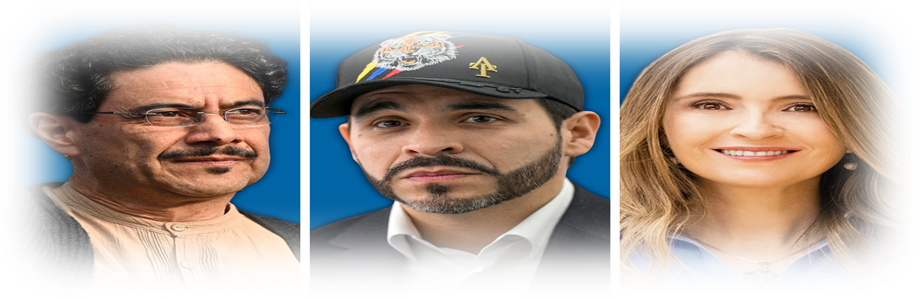
Notwithstanding the foregoing, neither of the pro-Zionist Colombian candidates currently leads the electoral pack.  That position is held by Senator Iván Cepeda Castro, a progressive follower of current Colombian president Gustavo Francisco Petro Urrego, a vocal critic of genocide and ethnic cleansing.  He has comfortably led throughout the electoral campaign in all reliable polls (although the term “reliable” with reference to polls may be an oxymoron).  His two chief competitors are Abelardo Gabriel de la Espriella Otero and Paloma Susana Valencia Laserna, both right wing politicians although Ms. Valencia has tried to capture some of the political center by ironically selecting as her running mate a gay male, Juan Daniel Oviedo Arango.  Ironic because Ms. Valencia has always been opposed to most LGBT+ issues but, as the ubiquitous “they” say “politics makes strange bedfellows”.  Mr. de la Espriella is a successful albeit unsavory lawyer having represented the worst elements of Colombian society including paramilitary death squad leaders and corrupt politicians.  He refers to himself as “el Tigre”, employs a sharp military salute whenever possible (despite, like Mr. Trump, having “legally” avoided compulsory military service) and is bereft of any government experience, running as an “outsider”.  Ms. Valencia on the other hand is from a prominent Colombian political family, has been a member of Congress for a long time and was personally selected as a candidate by former Colombian president Alvaro Uribe Velez.  She enjoys the support of most traditional political parties and politicians although party members in some cases, especially with respect to the Liberal Party, have refused to accept the decision of their party’s leaders.  In addition to the three front runners there are numerous other candidates, some of whom are well known, but none has more than a 3% following in recent polls.

Currently Mr. Cepeda, whose father was a Colombian senator assassinated by paramilitaries (such as those represented by Mr. de la Espriella) leads Mr. de La Espriella by more than 10% and Ms. Valencia by well over 20% but the sum of Mr. de la Espriella’s numbers and those of Ms. Valencia roughly equal those of Mr. Cepeda thus, while Mr. Cepeda is close to the 50% threshold for victory in the first round of elections, he is not there.  That makes a potential second round competitive, given the ideological compatibility of Mr. de la Espriella and Ms. Valencia and their mutual dedication to former president Uribe.  That creates an ideal scenario for foreign electoral interference in which both the State of Israel and the United States are clearly participants and rather well experienced.

The question then is, as it was in Kentucky, whether enough voters are willing sell out their country’s interests to foreign states, as voters in other Latin American countries have recently done (and, honestly, as has so often happened in the past) or whether given the disasters that the recently elected Trump and Netanyahu aligned right wing governments have proven to be (contrasted with the success on most fronts of Colombia’s current progressive government), Colombians will prove wiser and more patriotic than their continental counterparts (and also, wiser and more patriotic that the majority of United States’ voters in the State of Kentucky’s 4th Congressional District).

The reaction in the United States to Mr. Massie’s defeat has ranged from smug arrogance on the part of the Israeli-First component of Donald Trump’s MAGA coalition to dismay among those Trump voters who believed that he would prove different than the American Israel Public Affairs Committee (AIPAC) owned presidents of the past half century, something that might lead to a huge electoral reversal for the Republican Party in the United States this November, although the reality is that AIPAC controls both the United States’ Republican and Democratic parties, at least at the leadership levels.  The decision in Colombia is likely to impact not only Colombia’s future but also elections in other countries, not least of which might be this autumn’s United States congressional elections, and it might also impact the future of the Middle East, realities of which Colombian voters, for the most part, are blissfully unaware.  In the meantime, as has apparently become the norm … everywhere, false news and rabid calumnies fill Colombian airwaves and social media.

So, Sunday, May 31, 2026, perhaps a day to be long remembered; …

Hopefully not in infamy.
_____

© Guillermo Calvo Mahé; Manizales, 2026; all rights reserved.  Please feel free to share with appropriate attribution.

Guillermo (“Bill”) Calvo Mahé (a sometime poet and aspiring empirical philosopher) is a writer, political commentator and academic currently residing in the Republic of Colombia (although he has primarily lived in the United States of America of which he is also a citizen). Until 2017 he chaired the political science, government and international relations programs at the Universidad Autónoma de Manizales. Previously, he chaired the social studies and foreign language departments at the Eastern Military Academy in Huntington, New York. He is currently the publisher of the Inannite Review available at Substack.com; an intermittent commentator on radio and television; and, an occasional contributor to diverse periodicals and publications. He has academic degrees in political science (BA, The Citadel, the Military College of South Carolina), law (JD, St. John’s University, School of Law), international legal studies (LL.M, the Graduate Division of the New York University School of Law) and translation and linguistic studies (GCTS, the University of Florida’s Center for Latin American Studies). However, he is also fascinated by mythology, religion, physics, astronomy and mathematics, especially with matters related to quanta, cosmology and cosmogony. He can be contacted at guillermo.calvo.mahe@gmail.com and much of his writing is available through his blog at https://guillermocalvo.com/.
A Brief Reflection on Gerrymandering and How to Minimize It

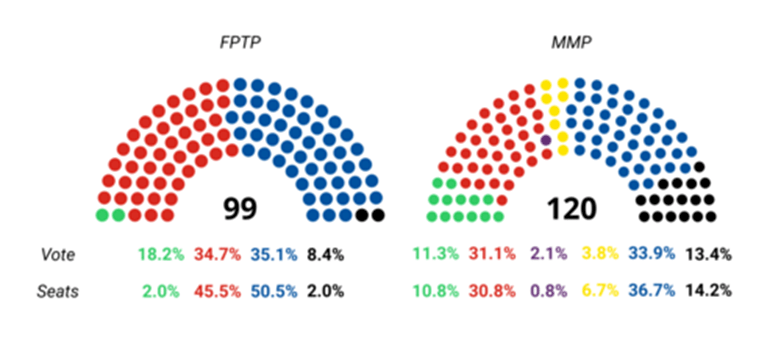
Gerrymandering is now completely out of control thanks to the GOP, the Democrats and the politicized judiciary.  The only practical solution is one adopted by most countries in the world and that is multi-legislator districts, preferably on a state wide basis, with proportional representation.  How would that work?  Or better yet, how does it work successfully in so many places. 

Well, take California with, I believe, 55 representatives elected to the House of Representatives.  Each California voter would have 55 votes which he or she could allocate to a single candidate (55) or divide among a number of candidates.  As an illustration, if a voter wanted to allocate his or her votes equally among eleven candidates, each would receive five votes, or the 55 votes could be distributed among the eleven candidates in any manner the voter deemed appropriate.  Or the voter could provide one vote each to 55 candidates.  California, with the largest representation in the House is the most complex example, states with less representation would be inversely simpler.  It is, in essence, what happens in the states that only elect one member to the House, it is a statewide contest with no gerrymandering possible. 

To make things easier, California and other states with large House membership could be divided into smaller voting districts.  In the California case for example, it could be divided into five voting districts, each electing eleven legislators,  While that would still permit efforts to distort the vote through gerrymandering, it would be more difficult to do so and less efficient, but in any case, much better that the single member system we have now.  And it can be implemented on a state by state basis through local legislation rather than on a federal level which would, in my opinion, require a constitutional amendment.  The latter might be the best solution for the long term but harder to implement. 

Something to consider for those who really care about electoral integrity rather than merely about maximizing the power of the political party to which they have become subservient.
_____

© Guillermo Calvo Mahé; Manizales, 2026; all rights reserved.  Please feel free to share with appropriate attribution.

Guillermo (“Bill”) Calvo Mahé (a sometime poet and aspiring empirical philosopher) is a writer, political commentator and academic currently residing in the Republic of Colombia (although he has primarily lived in the United States of America of which he is also a citizen). Until 2017 he chaired the political science, government and international relations programs at the Universidad Autónoma de Manizales. Previously, he chaired the social studies and foreign language departments at the Eastern Military Academy in Huntington, New York. He is currently the publisher of the Inannite Review available at Substack.com; an intermittent commentator on radio and television; and, an occasional contributor to diverse periodicals and publications. He has academic degrees in political science (BA, The Citadel, the Military College of South Carolina), law (JD, St. John’s University, School of Law), international legal studies (LL.M, the Graduate Division of the New York University School of Law) and translation and linguistic studies (GCTS, the University of Florida’s Center for Latin American Studies). However, he is also fascinated by mythology, religion, physics, astronomy and mathematics, especially with matters related to quanta, cosmology and cosmogony. He can be contacted at guillermo.calvo.mahe@gmail.com and much of his writing is available through his blog at https://guillermocalvo.com/.

Some Brief but Important Reflections on Pending Decisions Concerning Electoral Processes

Two issues seem very relevant to me as another hyperbolically intense and polarized electoral cycle approaches, both, to some extent, being currently considered by the United States’ utterly politicized Supreme Court (Michael Watson, Mississippi Secretary of State, Petitioner v. Republican National Committee, et al., Docket Number: No. 24-1260, U.S. Supreme Court), much more a politburo than an impartial arbiter of legal disputes.  They involve the electoral cycle and mail-in-ballots.

Election days are by necessity arbitrary.  Electoral periods, what we have today, involve a temporal range culminating in an end date and they are also arbitrary, but more complex.  To me, an “informed” electorate may be the most essential factor for a functional democracy, excluding aspects related to electoral corruption (which has always been present).  An informed electorate requires that the voters have access to all relevant information before making their decisions.  That argues against a temporal range with early voting, especially when the temporal range is broad because political parties and advocacy groups are desperate to have votes frozen in time at the earliest possible moment so that voters do not continue to receive information that might impact their vote in manners adverse to the interests of such groups although, of course, such impact would not always impact them negatively.  To me, therefore, early voting is more democratically counterproductive than is receipt of mail-in-ballots postmarked on the final “end date” but received a reasonably short period thereafter.

Mail-in-ballots involve a different, albeit related issue, and that is that they facilitate electoral corruption, and not limited to the casting of ballots by ineligible voters or the casting of ballots by a voter in multiple jurisdictions.  They facilitate the creation of a market for purchased votes, for example, by facilitating the purchase of a signed ballot, filled in or vacant, from a voter who either needs the cash or sees voting as a profit making opportunity, a world-wide phenomenon probably as old as the first election, and not limited to mail-in-ballots, but certainly facilitated by them.  On the other hand, there is certainly justification for use of mail-in-ballots where nearby polling stations are not available, for example, where voters reside abroad, or for use by voters whose mobility is restricted because they are incapacitated.

The foregoing issues merit serious reflection and better solutions than those available today (or as proposed in the hyperbolically denominated “Save Act”[1]), understanding that neither electoral ignorance nor electoral corruption are likely to ever be eliminated but that they can certainly be minimized.  Unfortunately, such solutions would require non-politicized arbiters without personal interests in the results and that mechanism is non-existent in the good old USA.  Or actually, anywhere else.  Less disinterested arbiters than the United States’ major political parties, the Democrats and the GOP, however, are difficult to imagine.  Consider for example their oscillating positions on the gerrymandering issue.  And they are the ones on whom, along with the nine political appointees to the Supreme Court, we are left to rely.
_____

© Guillermo Calvo Mahé; Manizales, 2026; all rights reserved.  Please feel free to share with appropriate attribution.

Guillermo (“Bill”) Calvo Mahé (a sometime poet and aspiring empirical philosopher) is a writer, political commentator and academic currently residing in the Republic of Colombia (although he has primarily lived in the United States of America of which he is also a citizen). Until 2017 he chaired the political science, government and international relations programs at the Universidad Autónoma de Manizales. Previously, he chaired the social studies and foreign language departments at the Eastern Military Academy in Huntington, New York. He is currently the publisher of the Inannite Review available at Substack.com; an intermittent commentator on radio and television; and, an occasional contributor to diverse periodicals and publications. He has academic degrees in political science (BA, The Citadel, the Military College of South Carolina), law (JD, St. John’s University, School of Law), international legal studies (LL.M, the Graduate Division of the New York University School of Law) and translation and linguistic studies (GCTS, the University of Florida’s Center for Latin American Studies). However, he is also fascinated by mythology, religion, physics, astronomy and mathematics, especially with matters related to quanta, cosmology and cosmogony. He can be contacted at guillermo.calvo.mahe@gmail.com and much of his writing is available through his blog at https://guillermocalvo.com/.


[1] The Safeguard American Voter Eligibility (SAVE) Act (H.R. 8281/H.R. 22).

Democracy and Comparative Electoral Systems

Today, March 8, 2026 is an interesting day because of the confluence of diverse factors.  It is “Women’s Day” in many places, originally “Working Women’s Day” but the concept has been expanded internationally as it has become recognized that unpaid domestic labor is as worthy of recognition as any other kind of labor.  But today is also Daylight Savings Time Day, at least in the United States of America where millions of people woke to find that they’re bodies believe that it is an hour later than everything around them seems to be occurring.  Finally, it is the first in a series of election days in the Republic of Colombia this year.  Today the members of Congress are elected and primaries are held for contested presidential candidacies.  Which brings me, admittedly in a roundabout way, to the continuing debate in the United States concerning who should be permitted to vote and how.

In Colombia, voting requires photo identification via a national identity card updated constantly to electronically indicate not only citizenship, but voting residency.  At the designated polls (voting is in person), one is also fingerprinted and required to provide a signature.  The individual voting locations are maintained electronically in the National Registry and one can find one’s polling place and room through the Internet.  The identity cards, denominated “cedulas”, are easily available to everyone, in fact, they’re required and used for commercial transactions, transport, etc.  They are issued by the National Registry which verifies citizenship as well as basic personal data including height and blood type.  Elections are easy, quick, and with results posted the same day.  All of the foregoing is very different than the incoherently complex, inefficient and insecure system in the United States where the concept of a national identification card has been anathema to conservatives and libertarians in the past but, ironically, at present, it is liberals who seem to oppose required voting identification while conservatives insist on photo identification that includes proof of citizenship and support federal legislation denominated the “Save Act” to make such requirements applicable nationally. 

The Save Act sounds logical but has a major problem.  Because the United States is a federation, elections occur at the state, county and special district rather than national level, even in elections for Congress and the Presidential Electoral College (there are no real presidential elections) thus, appropriate identification would require supplemental systems that verify not only national citizenship, but state and local domicile.  No current form of identification meets those requirements which would require a constantly updated national citizen database similar to what exists in Colombia and most other countries, a database heretofore opposed by the conservatives who now insist on what, without it, would be a dysfunctional Save Act.  So, unlike most of the world, the United States is engaged in an easily resolvable but transcendentally important ludicrous political debate, politicized in order to polarize the electorate.  Perhaps instead of Make America Great Again, the United States electorate needs to concentrate on just Make America Functional.

While the electoral process in the Republic of Colombia is fair, efficient and relatively secure, there are significant issues that render it deficient in terms of democracy, a universal problem.  Most of all, the electoral system is geared to empower political parties instead of voters, hence, it is political parties rather than the citizenry that is the subject of political rights and related political power.  As in most of the non-English speaking world, Colombian legislative elections are proportional so that the legislature more or less represents most of the political forces in the country.  If, for example, a political party only receives ten percent of the vote, it still receives ten percent of the membership in the legislature, unlike the English speaking world (the United States, the United Kingdom, Canada, Australia and New Zealand) where it would be completely frozen out.  This is accomplished in Colombia and elsewhere because instead of using individual electoral districts where only one legislator is chosen, a system of multi-legislator districts is used.  The most efficient such system is the one used in the Republic of Ireland for elections to the lower house of Parliament where the voter places all of the candidates in the district in order of preference allocating to each a voting value.  Thus, the individual voter’s personal list can be comprised of candidates from diverse political parties.  For example, if the district were to have ten candidates, the one listed first would receive a voting value of ten and the one listed tenth would receive a voting value of one.  If a candidate is not listed, the voting value would be zero.  The candidates elected in that ten legislator district would be the ten who accumulated the most voting value points and might well include candidates who received no first or second place votes.

In Colombia and other places, the list system is perverted because the lists are predetermined by the political parties and in many instances, the order of candidates, which determines who will be elected, is frozen.  In other hybrid systems voters get to either vote for the whole list or to indicate a preference for a single candidate, with the order of candidates in the list reprioritized based on the number of votes received by individual candidates.  In the Republic of Colombia, the political parties determine whether the lists will be closed, the former option, or open, the latter.  Closed lists are sometimes justified as necessary in order to assure gender balance in the results with candidates listed in alternating gender.

The principal practical problem with the legislative electoral system in the Republic of Colombia in the open system is that the names of candidates do not appear on the ballot, rather, only the names of the political parties or movements sponsoring the list and a series of numbers representing the individual candidates, thus, voters have to arrive at the polls with the number of the candidate they favor memorized.  Because voters frequently forget the specific numbers, they instead opt to vote only for the party.  This issue is easily resolvable by either placing the names of candidates on the ballot or providing a guide at the polling station that voters can consult to find the number allocated to their preferred candidate but as usually occurs, solutions are plentiful but the will to implement them, for manipulative reasons, is absent.  The other major problem is that although the electoral districts are multi legislator districts, voters can only vote for one candidate thus, for example, the Department of Caldas is entitled to five members in the House of Representatives, voters can only vote for one and in doing so, automatically vote for that candidates sponsoring political party or political movement.

Another practical problem in Colombia is that the political party system is in great incoherent ideologically. With political parties forming local electoral alliances of convenience.  Thus, in one Department a list may be jointly sponsored by the Liberal Party, Conservative Party, the Party of National Unity and the Radical Change Party, in another Department the party configuration may be very different, excluding some of the members or replacing or supplementing them with others, or even, presenting a unique list without alliances with other parties.  The consequence is that the policies advocated by different parties can be inconsistent in different parts of the country but, since promised policies are, as in most parts of the world, rarely honored, the impact is more theoretical than practical.

Legislative electoral systems in the English speaking world, the first past the post systems as they are commonly known, are the least democratic, i.e., candidates receiving less than half of the vote are elected based on a plurality, and a plurality means that the candidate was opposed by most of the voters who fragmented their votes.  Such issue could be tempered, if not resolved, through required runoff systems, but that would still disenfranchise a majority of the electorate.  Smaller political parties have no legislative representation at all, and hence, are not likely to ever evolve into major parties, especially as voters are urged by the media not to waste their votes on smaller political parties.

The proportional list systems have their own problems except, perhaps, in systems such as exist in the Republic of Ireland, but given the political power provided to political parties by systemic deficiencies, the likelihood of change to improve the functionality of legislative democracy, other than through constitutional reform directly through the electorate, is unlikely.  Democracy is thus, unfortunately, more of a useful illusion than a realistic system of governance, almost everywhere.  Of course, that leaves open for future analysis the value of an effective democratic electoral system given the laziness, ignorance, emotionality, prejudices and naiveté of so many voters.

Further exponent sayeth naught other than: Happy Women’s Day and Happy Daylight Savings Day!

_____

© Guillermo Calvo Mahé; Manizales, 2026; all rights reserved.  Please feel free to share with appropriate attribution.

Guillermo (“Bill”) Calvo Mahé (a sometime poet and aspiring empirical philosopher) is a writer, political commentator and academic currently residing in the Republic of Colombia (although he has primarily lived in the United States of America of which he is also a citizen). Until 2017 he chaired the political science, government and international relations programs at the Universidad Autónoma de Manizales. Previously, he chaired the social studies and foreign language departments at the Eastern Military Academy in Huntington, New York. He is currently the publisher of the Inannite Review available at Substack.com; an intermittent commentator on radio and television; and, an occasional contributor to diverse periodicals and publications. He has academic degrees in political science (BA, The Citadel, the Military College of South Carolina), law (JD, St. John’s University, School of Law), international legal studies (LL.M, the Graduate Division of the New York University School of Law) and translation and linguistic studies (GCTS, the University of Florida’s Center for Latin American Studies). However, he is also fascinated by mythology, religion, physics, astronomy and mathematics, especially with matters related to quanta, cosmology and cosmogony. He can be contacted at guillermo.calvo.mahe@gmail.com and much of his writing is available through his blog at https://guillermocalvo.com/.

On the GOP’s Save Act and Critical Related Issues

Opposition to the so called Save Act (H.R.22 – 119th Congress, 2025-2026) by Democrats based on their current arguments concerning threats to democracy seems stupid, nonsensical and counterproductive (to the glee of the GOP).  The requirement for photo identification verifying citizenship and right to vote as a prerequisite to voting is something common all over the world, something usually accompanied by required signature and fingerprint verification.  In the United States the issue is a bit more complicated because of states’ rights under our federal system and the historical aversion to a national identification card and because of the transient nature of United States society with voting at federal, state and local levels predicated not only on citizenship but on residency.  Thus it would seem that appropriately reliable verification documentation would be required at each such level depending on the election involved.  A problem, true, but not an irresolvable problem given available technology.  However, it could well require implementation of a national identification smart card, centrally updated; not an insurmountable obstacle as credit card companies make clear on a quotidian basis.  Mail in voting, the other serious wedge issue, clearly facilitates electoral fraud and just as clearly, makes voting easier.  But safeguards can be added to minimize its deficiencies.  In addition to the danger of facilitating electoral fraud, mail in voting has been abused in order to “lock in” votes before relevant issues come to light by providing for early voting, but that too can be regulated in order to minimize its abuse, rather than eliminated.  Wise Democrats would be much better off electorally by resolving the deficiencies noted rather than by focusing on hyperbolic platitudes.

Still, constitutional arguments based on federalism and states’ rights do have merit.  The Constitution vests decisions concerning electoral qualifications and related issues in the states but provides Congress a role should it elect to exercise it, something which Congress has done from time to time albeit not coherently, that is because Congress has limited its role to issues involving “federal elections” and the only real federal election is that “virtual” election taken when state departments of state submit the results of state level elections for electors to the Electoral College (which never, in fact, meets) to the United States Congress for tabulation and consideration.  All other elections involving the national government are taken at the state level.  The House of Representatives is elected through state district elections in districts established and supervised by the states, the same being true with respect to the Electoral College and, of course, despite the ill-considered and antidemocratic 17th Amendment to the Constitution, election of Senators is also done on a state basis.  The members of the Supreme Court are not elected at all but rather appointed through agreement between the Senate and the president.  The issue however is, or ought to be, more complex.  The truth is that a constitutional amendment related to a number of electoral issues is desperately required. 

Issues that need to be dealt with constitutionally include:

  • Financing of electoral campaigns which should, in all probability, be limited to eligible voters in the electoral districts involved, excluding thereby corporate and related entities (e.g., unions, political action committees, etc.).  The Supreme Court’s abhorrent Citizens United decision also needs to be obliterated.
  • The use of the national census for purposes of determining state representation in the House of Representatives and the Electoral College needs to be clarified so that for those purposes, only citizens are counted.  Not even permanent residents should be counted although for other purposes the census should include everyone resident in a state, regardless of their nationality or electoral status.
  • The issue of birthright citizenship, poorly dealt with in the 14th amendment, should be clarified.  As interpreted by the Supreme Court, it has been seriously abused and is a goad to illegal immigration.  Mr. Trump is not always wrong.
  • The status of undocumented immigrants for diverse purposes should also be dealt with, perhaps creating national standards in order to avoid forum shopping.

Those issues each require serious consideration involving a much more fundamental issue as well.  The United States Constitution adopted in 1789 and implemented in 1791 envisioned a federal state comprised of purportedly sovereign states.  Really, a fragmentation of sovereignty predicated on the concept of enumerated powers dealt with both in Article I, Section 8 of the Constitution and in its 9th and 10th amendments.  However, as I noted quite a while ago in an article entitled Motley Constitutionalism: a Labyrinthine Aphorism, the concept of federalism has been drastically and negatively impacted since shortly after adoption of the Constitution; first, by John Marshall’s usurpation of constitutional control in the case of Marbury v. Madison, then by the usurpation of issues involving secession, supremacy of legislation and related factors by the federal government as a result of the Civil War of 1861-65 and through the 13th, 14th and 15th amendments imposed following the Civil War (justifiable though they were), then, in the series of Wilson administration constitutional amendments that shattered state power, especially the 16th (taxation), 17th (representation through the Senate), 18th (state police power) and 19th (state control of the right to vote) and finally, by Supreme Court decisions ostensibly based on the Commerce Clause of the Constitution during the middle of the 20th century.  The foregoing constitutional proposals would further the trend away from federalism and towards a unitary state, as would consistent proposals to do away with the Electoral College in favor of direct, popular election of the president.

Those damned two sides to every issue can be utterly frustrating.  However, there is also a third side.  The truth is that a broad and serious discussion concerning the federal nature of the Republic is very much past due, a nature that has become largely illusory as chip by chip its federal foundation has become eroded.  The reality is that the original concept, first of a confederation of independent states, sort of like the United Nations, and then of a hybrid between a confederation and a unitary state (a federation) has in practice perhaps become obsolete as the United States has “sort of” become one nation rather than a conglomeration of regions, although, politically, it has become divided between urban and rural areas with totally different voting perspectives and an utterly polarized citizenry.  That discussion should have been undertaken before each and every decision impacting federalism but apparently the topic and its strategic aspects were ignored in favor of the interests of the moment, pretty much in the same manner as the Save Act is being currently considered: ironically, a legislative act proposed by traditional proponents of states’ rights and opposed by traditional proponents of a powerful central government.

Perhaps it’s way past time for a profound discussion concerning the nature and deficiencies of the Constitution adopted in 1789, two-hundred-and-thirty-seven years ago, and so patched up that it resembles the “motley of ill-matched patches” worn by ancient court jesters.  Like the Bible and other sacred treatises, the current Constitution is honored and revered, oaths taken to preserve and defend it, but not really followed.

Perhaps it’s time for a new constitutional convention, one led by serious technocrats and academics rather than politicians, a constitution to then be presented directly for approval or rejection, in whole or in part, by the citizenry it will be meant to govern.  A constitution to effectively, efficiently and equitable harmonize our society in order to really attain the common welfare.  But the sad truth is that neither major political party is interested in the foregoing as it would eliminate too many of the useful wedge issues through which we are each manipulated, divided and controlled.
_____

© Guillermo Calvo Mahé; Manizales, 2026; all rights reserved.  Please feel free to share with appropriate attribution.

Guillermo (“Bill”) Calvo Mahé (a sometime poet and aspiring empirical philosopher) is a writer, political commentator and academic currently residing in the Republic of Colombia (although he has primarily lived in the United States of America of which he is also a citizen). Until 2017 he chaired the political science, government and international relations programs at the Universidad Autónoma de Manizales. Previously, he chaired the social studies and foreign language departments at the Eastern Military Academy in Huntington, New York. He is currently the publisher of the Inannite Review available at Substack.com; an intermittent commentator on radio and television; and, an occasional contributor to diverse periodicals and publications. He has academic degrees in political science (BA, The Citadel, the Military College of South Carolina), law (JD, St. John’s University, School of Law), international legal studies (LL.M, the Graduate Division of the New York University School of Law) and translation and linguistic studies (GCTS, the University of Florida’s Center for Latin American Studies). However, he is also fascinated by mythology, religion, physics, astronomy and mathematics, especially with matters related to quanta, cosmology and cosmogony. He can be contacted at guillermo.calvo.mahe@gmail.com and much of his writing is available through his blog at https://guillermocalvo.com/.
Reflections on the New York City Electorate and, Secondarily, on the Mayoral Candidacy of Zohran Mamdani

Like Zohran Mamdani, but more like Albert Einstein, Noam Chomsky, Martin Luther King, Jr., Nelson Mandela, Pepe Mujica and many others, I define myself as a democratic socialist.  That is very different from authoritarian socialists, “social democrats” and very, very different from a supporters of the ill-named Democratic Party or of the GOP although, with respect to the latter two, I find the Democratic Party much more hypocritical, despicable and dangerous.  I am not a Trump or MAGA supporter, far from it, but nor am I afflicted with Trump Derangement Syndrome.  Trump has many faults but all are shared by the most prominent Democrats, Democrats like war mongers Hillary Clinton, Barack Obama and Joe Biden to name just a few, especially with respect to their primary allegiance to Israel, allegiance bought and paid for by AIPAC.  My primary regret with reference to Mr. Mamdani’s candidacy is that it is Messrs. Cuomo and Adams who are running as independents and Mr. Mamdani will be the candidate of the utterly corrupt Democratic Party, although its leadership has not only rejected him but is actively opposing him.  More than anything, New York City, New York State and the United States need new political alternatives whose loyalty is to the United States and its citizenry rather than to a foreign government (Israel) or to the billionaire caste (it’s more a caste than a class).  But no such luck.  At least not yet.

I find the article entitled “Debunking the Myths about Mamdani’s Candidacy” written by Stewart Lawrence and published on August 13, 2025 in Counterpunch (available at https://www.counterpunch.org/2025/08/13/debunking-the-myths-about-mamdanis-candidacy/) not only interesting, but reflective of a hopeful sign, i.e.,  that the young may prove significantly less naïve and less subject to media manipulation and much more cognitively competent and ethical than most of their elders, a bit strange given that my generation, the Baby Boomers, shared many of their values when we were their age. When purportedly, “the Times they were a ‘Changing”.  That is a double edged sword, though, as my generation permitted its idealism to be corrupted in a quest for financial security as soon as we became parents.  One wonders if that same affliction will also contaminate the best of Generation X and Generation Z, etc.

While I share some, perhaps many, perhaps even most of Mr. Mamdani’s values and beliefs, there are postures I feel are simplistically addressed by him.  For example, those dealing with issues like immigration and law enforcement which, while very important, are more complex than what he perceives.  And, I’m concerned that beneath it all, he’s a partisan Democrat who suffers from the obligatory Trump Derangement Syndrome and who, like Bernie Sanders and Alexandria Ocasio-Cortez (“AOC”, a moniker I find presumptive) will, if he is elected (a near certainty, sell out his values in exchange for acceptance by the same old power brokers who have always controlled everything and that he will all too soon permit himself to serve as little more than a deceptive token.  A cynical view, I know, but one well earned.

Still, for now, Mr. Mamdani is a breath of fresh air and much more importantly, those who are drawn to him, especially those among the young and among most of New York City’s Jewish population seem to have had the cobwebs removed from their eyes and their ears and their mouths reflecting a political awakening that may help lead us away from the Deep State’s perpetual wars and thus from the edge of the apocalyptic abyss. It may center us on the importance of spending our hard earned tax revenue on positive things, items like free universal health care, like free education for all at all levels, like affordable housing for all, like adequate nutrition for all, like all of the things, including the foregoing, available to Israeli and European citizens, who our government subsidizes. 

Wouldn’t that be something? 

Especially if the New York City electorate has really woken to the realities facing us, especially if they reflect not just a New York City phenomenon.  Especially if they can reject “woke” triumphalism and virtue shaming which, rather than draw others to their idealistic goals, just turns them off.
_____

© Guillermo Calvo Mahé; Manizales, 2025; all rights reserved.  Please feel free to share with appropriate attribution.

Guillermo (“Bill”) Calvo Mahé (a sometime poet) is a writer, political commentator and academic currently residing in the Republic of Colombia (although he has primarily lived in the United States of America of which he is also a citizen). Until 2017 he chaired the political science, government and international relations programs at the Universidad Autónoma de Manizales. Previously, he chaired the social studies and foreign language departments at the Eastern Military Academy in Huntington, New York. He is currently the publisher of the Inannite Review available at Substack.com; an intermittent commentator on radio and television; and, an occasional contributor to diverse periodicals and publications. He has academic degrees in political science (BA, The Citadel, The Military College of South Carolina), law (JD, St. John’s University, School of Law), international legal studies (LL.M, the Graduate Division of the New York University School of Law) and translation and linguistic studies (GCTS, the University of Florida’s Center for Latin American Studies). However, he is also fascinated by mythology, religion, physics, astronomy and mathematics, especially with matters related to quanta, cosmology and cosmogony. He can be contacted at guillermo.calvo.mahe@gmail.com and much of his writing is available through his blog at https://guillermocalvo.com/.
Reflections and Prognostications with respect to a First Tuesday Following a First Monday in November

Dateline: October 3, 2024

Faith in electoral processes all over the world seems to be at all-time lows, largely because, for so long, elections in most places have been manipulated, either through distortion of information presenting false scenarios and expectations or, because of threats of economic or military castigation should voters fail to follow electoral scripts designed by their self-perceived “betters”.  As last resorts, until fairly recently, orchestrated coups d’état and even direct military intervention from abroad were popular; however, new technologies, especially with respect to communications and hackable electronic voting have reintroduced a strain of subtlety.  The British and the French were the past masters of such manipulation but for a century at least, it has been the United States that has taken over that function, initially through the State Department but now through intelligence agencies; and intelligence agencies acting more and more on their own.  Power, of course, is the ultimate prize, economic power derived through theft of natural resources but more and more, through organized war profiteering of the kind Ike warned against as he left office. 

Until recently, the foregoing did not bother United States citizens very much, even when it involved domestic electoral fraud.  We were aware that domestic electoral fraud was not unusual.  Bribery was a tradition as was vote buying and, when all else failed, destruction of ballots with replacements stuffed into ballot boxes.  Nor unusual were the super patriotic voting dead.  In any case, electoral promises were always illusory, few felt they would be kept and fewer seemed to care that they’d been deceived.  Elections were a sort of game, like baseball perhaps, but of the Black Sox variant.  Now, however, chickens seem to have come home to roost.  Of a sudden, the United States electorate really seems to care about the results, albeit futilely so. 

One cannot tell if the United States federal elections of 2020 (both presidential and for the Senate, i.e., in Georgia) were “stolen”, something a substantial portion of the United States electorate believes.  We will probably never find out.  But groundwork for electoral fraud in 2020 was facilitated by the orchestrated response to the Covid 19 pandemic, with electoral safeguards demolished both bureaucratically and judicially, purportedly in the name of democracy.  During the past decade electoral safeguards have been minimized in the United States in a manner not seen anywhere else in the world.  Almost everywhere else, at least the illusion of ballot security is maintained with voters required to establish who they are through picture identification, signatures and finger prints before being permitted to exercise their so-called “sacred franchise”.  Additionally, ballots are strictly restricted to voting booths, with their collection strictly controlled.  Those are the norms except in a number of states in the purportedly United States. 

Electoral manipulation in the United States would seem difficult on a national scale given the nature of federalism, with important electoral functions vested at the county level, but in a society so polarized, electoral fraud need not be widespread but rather, concentrated at the points most equally divided in the states with the most electoral votes, and with efforts coordinated at the national level through sources of logistical and legal support. 

Electoral orchestration has evolved from an art form to a science.  Of course, implementing the groundwork for successful electoral manipulation is not enough, it must at least be flavored with plausible deniability.  Thus, the same bureaucracy and judiciary that facilitates electoral creativity shields electoral fraud from being proven by refusing to seriously investigate allegations of electoral improprieties, usually dismissing most such allegations on technicalities after which, the corporate media that supported the electoral misconduct in the first place, loudly proclaims that the allegations were bogus and that those alleging the existence of electoral fraud are evil, seditious “election deniers”.  That is the world in which the citizenry of the United States now lives, the same world the United States has forced on so many other countries whenever it suited the interests of those who controlled it.

Democracy, in the sense of majority rule, does not exist anywhere and never has, even absent electoral shenanigans.  It doesn’t exist because most people are not interested enough in electoral participation, either because it bores them or because they believe it is futile, thus, because of inadequate participation, majorities are rarely possible.  Instead, the majoritarian concept is replaced by mere plurality, i.e., were usually more votes are collectively cast against a specific candidate or proposal, or not at all, than in favor.  However, for some strange psychosocial reason, both the victims and the victimizers of political fraud feel that a semblance of popular government is essential, something we perhaps inherited from the Greeks and the Romans.

In a few days the people of the United States, both citizens and in all probability a number of non-citizens as well, will again earnestly participate in an electoral charade, a futile exercise by a populace utterly polarized by a corrupt corporate media, a corrupt entertainment industry and a corrupt bureaucracy, all making us relatively easy to manipulate, although we seem to be tottering closer than ever to a breaking point as more and more people have somehow gotten the impression that their votes can make a difference.  Indeed, we may be approaching a possibly violent breaking point such as has not been seen in the United States in over a century and a half, and that, despite the best efforts of the powers-that-be to create the impression that, as the Borg may someday become fond of saying, “resistance is futile”.  During the past four years it has become clear that, under Democratic Party rule, protest will not be tolerated unless it is orchestrated by the right people (e.g., the “woke”), that has been made more than abundantly clear through prosecution and persecution of those who dared to express their refusal to accept what they honestly believed was a stolen election in 2020.  A reality which many, too many, discovered on and after January 6, 2021. It is worth noting how different the attitude towards rejection of electoral results deemed fraudulent is when the protestors are political allies of the United States, as in the recent cases of Venezuela and Georgia (the country, not the state), as opposed to our opponents.  Evidently protest abroad is patriotic when in support of United States puppets but involves terrorism when challenging those the United States places and maintains in power.  At home, it’s even more hypocritical.  Electoral protest in the United States against results orchestrated by those who really rule us is anathema, it is seditious and treasonous, notwithstanding the platitudes redolent in our Declaration of Independence.

As an aside, I wonder what vice president Kamala Harris will do in the unlikely event that her opponent prevails when it comes time for her to exercise her constitutional function and certify the result.  An unlikely situation given my pessimistic analysis of probabilities but, wouldn’t that be interesting?  The Chinese have a curse that sounds a bit like a proverb “may you live in interesting times”.  It certainly seems to apply to us.  To many of us, the results of the proximate elections have already been written and, unlike 2016, that script will, in all likelihood, not be subject to evasion, not even temporarily. And even if it were, as Mr. Trump found out during his term in office, the federal bureaucracy and judiciary are so riddled with moles that governance contrary to the interest of the tiny group of powerful elites who rule us as if they possessed Sauron’s ring of power, is virtually impossible.  The reality is probably that, even if the election were not rigged by misinformation and electoral fraud, our future would remain bleak as we will, in all probability, continue to be led towards the Armageddon too many see as an essential way-stop on the road to paradise.  Tipping points are all but impossible to reverse and we seem to have reached ours as both major presidential campaigns applaud genocide, ethnic cleansing and apartheid and most of the United States electorate, as German citizens once did, looks the other way; and as antagonizing powers that share our capacity to destroy everything has become a bipartisan ideal.

As a supporter of third party and independent candidates for many decades, no candidate likely to win ever enjoys my support, but that is not as negative as it sounds.  Those of us who find ourselves perpetually outside-looking-in tend to attain a clearer vision of political realities, one free of the emotional price associated with passionate advocacy and of a hope to share in the spoils.  Thus, from the sidelines, what most matters to me and others like me is to share perspectives concerning the greatest threats to whatever remnants of liberty remain, not many as during the past four years censorship and castigation of deviation from opinions deemed acceptable has become the norm, and of course, it is important to those of us with strong civic consciousness to share information concerning how electoral processes are safeguarded in diverse parts of the world, contrasting such safeguards with trends in the ever more autocratic United States, a country whose people, if not its governments, I love profoundly.

From the fringes, the more decent among the political class, a tiny group led by aspirants to political power like Jill Stein, Cornell West and Dennis Kucinech, look on horrified, desperately fighting against the fatal entropy that has us firmly in its grasp, while the universe, disinterested, spins on its merry way.  So, don’t be surprised when this November 6, 2024, at the end of a long evening, the elections of 2020 are once more repeated, their format now become the template with which our subjugation will be made ever more clear.  Perhaps, in the future, rather than bother to deceive us, the charade will end and we’ll just assume the posture and accept the inevitable, hoping for the best, knowing that as has almost always been the case: in our own destiny we have little if any say.

So sayeth the realist (that’s what pessimists always call themselves), as from the Global South, where hope still somehow survives, an expat in exile looks North.
_____

© Guillermo Calvo Mahé; Manizales, 2024; all rights reserved.  Please feel free to share with appropriate attribution.

Guillermo (“Bill”) Calvo Mahé (a sometime poet) is a writer, political commentator and academic currently residing in the Republic of Colombia (although he has primarily lived in the United States of America of which he is also a citizen). Until 2017 he chaired the political science, government and international relations programs at the Universidad Autónoma de Manizales. Previously, he chaired the social studies and foreign language departments at the Eastern Military Academy in Huntington, New York. He is currently the publisher of the Inannite Review available at Substack.com; an intermittent commentator on radio and television; and, an occasional contributor to diverse periodicals and publications. He has academic degrees in political science (BA, The Citadel, The Military College of South Carolina), law (JD, St. John’s University, School of Law), international legal studies (LL.M, the Graduate Division of the New York University School of Law) and translation and linguistic studies (GCTS, the University of Florida’s Center for Latin American Studies). However, he is also fascinated by mythology, religion, physics, astronomy and mathematics, especially with matters related to quanta, cosmology and cosmogony. He can be contacted at guillermo.calvo.mahe@gmail.com and much of his writing is available through his blog at https://guillermocalvo.com/.