
Demythifying the Ukrainian Crisis
This is a bit long, and I hate long. I usually give up and read something else, unless, of course, I’m reading a book. But given the circumstances in which we find ourselves, I believe we needed a comprehensive and timely analysis and hope that you read it and agree. And that you share it. The articles cited in the footnotes are by recognized independent media authors and are an integral part of this reflection; essential because real news is almost impossible to find and too many of us are drowning in an ocean of Kool-Aid.
The world is facing an existential crisis as the Euro-Atlantic-centric economic and political elite who have dominated the world since the dawn of the Industrial Revolution are facing a realistic challenge to their power from Chinese led Eurasian upstarts[1]. They have, in the past, successfully turned aside challenges from socialist reformers, fascist corporatists, communist-light experiments and political idealists. Now the threat may prove more serious. The world, as usual, is the battleground, but Europe, again as usual and as usual in traditionalist hands (but showing strains) seems to be the focal point (with Latin America and Africa pretty much, as always, just taken for granted, used and abused). The Middle East burns, as usual, with NATO inspired or supported wars and armed conflicts in Yemen, Libya and Syria while the Palestinians remain imprisoned in Israeli dominated ghettoes where they are frequently hunted like animals by Harkonian-like “settlers” and soldiers[2]. The Sino-Russian Eurasian project, which seeks to shift the fulcrum of politicoeconomic power from the Atlantic towards the East and South, has attained viability because the Atlantic alliances have, for the past half century, been engaged in costly military interventions in diverse areas of the world. Aggressive NATO expansion which seeks to derail the Sino-Russian Eurasian project has included not only most of Eastern Europe but also Latin America where the Republic of Colombia was granted “global partner” status[3] in 2017, perhaps as a means of placing military pressure on neighboring Venezuela and Bolivia as well as on Brazil, should a leftist government regain power there, as seems likely (assuming free and fair elections, no longer a sure thing in many parts of the world). Trump proved a nuisance but was efficiently removed in a political blitzkrieg but his epiphany concerning the anachronistic nature of NATO as a white elephant run amuck needed to be obfuscated, hence, the Ukraine has been converted into a sacrificial goat, and speaking of goats, the Russian Federation has been cast as the scapegoat.
Last month, the new Cold War orchestrated by the United States turned hot as Russia reacted to United States and NATO provocations (accelerated as temporary fixes for domestic political problems faced by administrations in the United States and the United Kingdom) by invading the Ukraine, which had itself earlier invaded the self-proclaimed Donetsk and Luhansk People’s Republics whose populations had apparently bought into the premises of the United States Declaration of Independence[4]. Perhaps they should have known better given the documented hypocrisy of its author, hypocrisy which has echoed throughout the history of the country he helped found.
A Bit of Context
While it finally ignited last month, the current crisis in the Ukraine started on October 3, 1990 when, with the concurrence of the Soviet Union, World War II ended as to Germany. The Soviet Union’s concurrence to German reunification was predicated on a tacit understanding memorialized in internal NATO memoranda to the effect that NATO would not expand. Unfortunately, as with so many other of today’s problems, the Clinton administration, which assumed power in the United States thirty months later, broke that promise in 1999, and in an accelerating fashion, NATO has expanded closer and closer to the Russian border, actually touching it in 2004 when the Baltic States were admitted to membership[5].
The situation was exacerbated drastically when the United States orchestrated a coup d’état against a pro-Russian, democratically elected government in the Ukraine in 2014[6], a violent overthrow resisted by three Ukrainian regions with overwhelming majority Russian populations, the Crimea and the Donetsk and Lugansk regions of the Ukrainian Donbas. All three petitioned to rejoin Russia. After a plebiscite, the Crimea did, but Russia had no interest in incorporating the Donbas, instead suggesting that the Donetsk and Lugansk regions be granted autonomous status within a Ukrainian federation. The Ukraine responded by attacking and partially occupying the Donbass, sparking an armed conflict eerily similar to the American Revolution.
On September 5, 2014 the Ukraine, the Russian Federation, France, Germany and the then-leaders of the self-proclaimed Donetsk People’s Republic and Luhansk People’s Republic signed an agreement, supplemented on February 12, 2015, calling for a ceasefire, withdrawal of heavy weapons from the front lines, release of prisoners of war, and, constitutional reform in the Ukraine granting self-government to the Donbas but restoring control of the state border to the Ukrainian government. However, the Ukraine never implemented the required constitutional reforms and neo-Nazi[7] Ukrainian militias armed by the Ukrainian government, the United States and NATO continued to occupy large portions of the Donetsk and Lugansk regions attempting to forcibly destroy the pro-independence forces, in the process, killing more than 14,000 Donbass residents.
The addition of the Ukraine (and Georgia) to NATO would have resulted in a contiguous NATO border with the Russian Federation and the increased possibility of such adhesion with respect to the Ukraine, the deaths of the more than 14,000 ethnic Russians in the Donbass and the flight of approximately 100,000 Donbass refugees into the Russian Federation in the face of an emerging Ukrainian military advance finally led the Russian Federation to draw a red line. The Russian federation demanded that neither NATO nor the European Union expand into the Ukraine; that NATO withdraw nuclear weapons from countries bordering the Russian Federation; that the Ukraine, as promised in 2015, grant autonomy to the ethnic Russian regions of Donetsk and Luhansk; and finally, that the plebiscite in favor of a return to the Russian Federation by the people of the Ukraine be recognized. However, such proposals were disdainfully rejected by the United States, NATO and the Ukraine. Instead, with a cynicism for the welfare of common people common to the myriad of wars orchestrated by the United States and its allies since the end of World War II, the people of the Ukraine were placed on the sacrificial bloc of “Western Hubris”, but bathed in oceans of crocodile tears. Perhaps as partial revenge for the defeat of American invaders in Afghanistan by the Taliban, the Russian Federation was lured into what the United States hopes will prove to be a comparable quagmire that will lead to the destruction of the Russian economy and hopefully, sabotage the Sino-Russian Eurasian project which threatens economic elites’ domination of the world economy for the benefit of the privileged one percent.
A Bit of Ukrainian and Russian History (often the same thing)
The world seems more insane than usual this year as winter winds down into spring, with truth having become utterly irrelevant and hypocrisy sublime. “Fool us again, please, please!” seems a mass refrain. Censorship in the name of liberty and democracy has become the real pandemic. Still, for those to whom the truth and the future of the human race are important enough to do a bit of research, perhaps there really is a vaccine. A vaccine comprised of a bit of elbow grease mixed in with common sense and seasoned with sanity. Take the current crisis in the Ukraine, perhaps it’s worthwhile understanding what it’s about, even if the story started a long, long time ago. And that requires an acknowledgment of the historical interrelationship of the Russian and Ukrainian people.
The Ukraine, as a polity, can theoretically be considered to have initiated when a legendary Slavic prince by the name of Kyi, along with his brothers Schek and Khoriv, and their sister Lybid, founded the precursor to the city of Kiev (name recently modified in the “West” to Kyiv) in the fifth century. By the middle of the seventh century, the town of Kiev was conquered by the Khazars, an amalgam of Bulgars, Huns, Turks and Caucasians (people from the Caucuses, not a racial group). The Khazars were immensely successful traders who ingeniously played off their Byzantine and Islamic customers’ demand that they select either Islam or orthodox Christianity as their religion by instead, selecting their common denominator, Judaism, to which they converted en masse. Indeed, it’s possible that most Jews today are descendants of the Khazars rather than of the ancient Semitic Hebrews who originated in the Middle East (which may be why so many Jews are fair haired and fair eyed). The Khazar Empire extended from the Volga River and Caspian Sea to the Dnieper and the Black Sea.
During the ninth century, three existential changes occurred. First, Norsemen (Vikings) discovered and conquered much of the area; second, Christian missionaries from Byzantium began to proselytize in the area; and third, in a related manner, two Christian missionaries by the name of Cyril and Methodius facilitated the crystallization of a common Slavic language through the introduction of an alphabet patterned on the Greek alphabet used in the Byzantine Empire. During the second half of the Ninth century, Slavic merchants (probably descended from the Khazars) who controlled a merchant center known as Novgorod sought stability and protection as well as a diminution in political strife from internal political infighting, by inviting[8] one of the invading Viking tribes, the Varangians, to assume governance and made their leader Rurik, a somewhat legendary and mythic figure, their monarch.[9]
Prior to Rurik’s “association” with Novgorod, two other Viking leaders, Askold and Dir, had conquered the small Khazar trading village of Kiev described above and had organized a confederated Viking fleet of 200 ships with which, in 860, they attacked Constantinople. Unsuccessful in their attack but having plundered much of the surrounding countryside, they returned to Kiev which they ruled as vassals to Rurik. Rurik’s brothers, Sineus and Truvor had also engaged in conquests but soon died, leaving Rurik in control their domains. By the time of Rurik’s death in 879, he and other Viking leaders controlled an area that stretched from the Russian steppes to the Black Sea and included large parts of the present day Ukraine, Belarus and Western Russia. In time, however, the indigenous conquered people, the Slavs, subsumed and incorporated the Vikings into their culture.
Rurik was succeeded by a more aggressive Viking ruler, Oleg, regent for Rurik’s son Igor. During his regency, Oleg consolidated numerous theretofore independent Viking conquests, moved the capital of the consolidated domains to Kiev, and successfully attacked the Byzantine Empire. By the time Igor assumed the principate, the domains consolidated by Oleg had been recognized by the Byzantines as equals and Kiev had been transformed from a trading village into the queen city of the “Land of the Rus” (as the Byzantines had christened the consolidated domain).
In short, modern Russia was born in today’s Ukraine, with Kiev as its original capital.
During the second half of the twelfth century, Russia became a fragmented confederation of warring principalities until it was conquered by the Mongols in 1241. In 1362, the Grand Duchy of Lithuania conquered Kiev, followed by a Polish conquest in 1569 but finally, in 1667, Kiev and the Ukraine were reunited with Russia. The Lithuanian and Polish conquests materially impacted the Ukraine as they involved not only Lithuanian and especially Polish immigration, but the introduction of Catholicism as an alternative to the Russian Orthodox Church and to the native Jewish remnant of the Khazar population, an impact that has remained as a divisive historical force.
The Russian Revolution of 1917 impacted major regions of Russia which briefly became independent and then autonomous republics within the Soviet Union. In 1952, the Crimea, a historical part of Russia, was “administratively” transferred to the Ukraine Socialist Republic by Nikita Khrushchev, then the Ukrainian born leader of the Soviet Union. In 1991, when the Soviet Union was dismembered, the Ukraine declared its independence but kept the Crimea (without having obtained the consent of its population), as well as the Donbas, also a predominantly Russian region.
Some Comparisons
Despite the massive sanctions imposed on the Russian Federation by the United States, its allies, and the international organizations they control, such actions seem to have nothing to do with violations of international law or opposition to armed invasions of sovereign states. Indeed, except as a theory and aspiration, the concept of “international law” as a legal system is a failed experiment, primarily because of the historical hubris of the United Kingdom and the United States and their insistence on impunity in the face of their continuous violations of international treaties, refusal to join the principle treaties that seek to implement a framework for international law and de facto repudiation of the Charter of the United Nations.[10] Examples:
- I recall the United States invasion of Grenada which began at dawn on October 25, 1983, and ended when the United States replaced Hudson Austin, the countries provisional leader, with an interim government selected by the United States. The excuse was that the procommunist government of that country had become incoherently deadlocked, threatening possible civil strife. I do not recall any sanctions imposed on the United States by anyone as a result of such action.
- I recall the United States invasion of Panama which started on December 20, 1989 and purportedly ended on January 31, 1990; after the United States forcibly replaced the de facto leader of Panama (and former CIA operative) Manuel Noriega with the Cali Cartel’s purported treasurer, Guillermo Endara. The excuse was purportedly than Mr. Noriega was engaged in drug trafficking and racketeering. I do not recall any sanctions imposed on the United States by anyone as a result of such action.
- I recall the many attacks by Israel on Gaza, the horrible resulting destruction and loss of life, and the daily quotidian assaults by the Israeli State on Palestinians, the indignities and mayhem and murders. But I do not recall any sanctions imposed on Israel by anyone as a result of such action.
- We all, I think recall the unwarranted and horribly costly invasions of Iraq and Afghanistan. But none of us, I think, can recall any sanctions imposed on the United States by anyone as a result of such actions.
- I recall the Saudi led and United States supported ongoing invasion of Yemen. But I do not recall any sanctions imposed on Saudi Arabia or its allies by anyone as a result of such action.
- I recall the French inspired and NATO led invasion and destruction of Libya in which the United States was a leading participant, with its secretary of State, the beastly Hillary Clinton, crowing, “we same, we saw, he died”, referring to the brutal murder of Moammar Gaddafi. But I do not recall any sanctions imposed on them by anyone as a result of such action.
- I am reminded that today, United States, French, English, Turkish and other troops are illegally engaged in military operations inside of Syria. But I do not recall any sanctions imposed on them by anyone as a result of such action.
- I am reminded that the United States and its allies have recognized the pretender Juan Guaido, a self-declared president of Venezuela, have supported more than one coup attempt orchestrated by him, and have turned over to him and his cronies a great deal of the wealth Venezuela requires to care for its population impoverished through their sanctions, as they would impoverish Russia today. But I do not recall any sanctions imposed on them by anyone as a result of such action.
Now the Russians are following in the footsteps of the United States and its allies in NATO and the European Union, in their case, to eliminate a racial supremacist infestation in the Ukraine and to eliminate the threat of NATO expansion to Russian’s borders. In this case, the “Western World” (whatever that is)[11] has decided that sanctions designed to destroy the Russian economy are appropriate, apparently without thought to any consequences. How utterly cavalier. Indeed, the continuing imposition of brutal sanctions on the Russian people seemed designed to goad a nuclear response, incredibly stupid as that would seem to the few sane remaining among us.
International law and the United Nations were to have prevented all such actions, but they haven’t, and they don’t. Hypocrisy and hubris rather than equity and justice reign. And the consequences may well be all too predictable.
A Bit of More Recent Historical Context and Some Personal Observations and Conclusions
Since Dwight David Eisenhower left office during January of 1961, the United States and its allies have been free to engage in military aggression all over the world, invading and overthrowing governments in Latin America, the Middle East, Africa and Asia: governments as small as Haiti and as large as the Soviet Union. Until the dawn of this millennium, it seemed that such tactics had succeeded in attaining hegemonic power, politically, economically and militarily, as well as domestically. With the assistance of a docile and duplicitous corporate media and the tentacles of the wealthiest and most ruthless among us, a Deep State was ensconced in the United States and among its allies, unresponsive to popular needs or popular opinion.
Until 2016, the United States Deep State ruled that country with a hidden almost velvet glove. But in 2016, a two pronged populist rebellion in the United States, echoing earlier populist rebellions elsewhere, shook the “Western” sociopolitical firmament. From the left, a leaderless progressive group sought to induce purportedly native American Senator Elizabeth Warren to challenge Clinton dominance of the Democratic Party, but when that failed, the movement was usurped by opportunist, purported socialist, Senator Bernie Sanders. Unfortunately for the leftist populists, he led their charge waiving a white flag and surrendered to traditionalist Democratic Party leaders who had obviously stolen the 2016 Democratic Party’s presidential nomination from his followers. The GOP faced a similar challenge from the right, from the so called Tea Party, but despite massive resources and well known candidates, the traditionalist among the Republican Party where ambushed by political pragmatist Donald John Trump. Ironically, the apparent right wing populist victory was orchestrated by Clinton Democrats who felt that Mr. Trump, a buffoonish political novice, was the only Republican candidate their idol, Hillary Clinton, could defeat. Indeed, Mr. Trump was urged to run by non-other than Ms. Clinton’s husband, former president Bill Clinton. Unfortunately for them, they’d misjudged the extent of populist discontent and Mr. Trump won a devastatingly shocking victory. Devastating most of all to the Deep State which, until then, had successfully remained a manipulative force behind the scenes, fully in control of both political parties.
While most of Mr. Trump’s economic policies were somewhat in line with the Deep State’s neoliberal economic goals, he seemed averse to the Deep State’s neoconservative interventionist tactics, calling for collaborative relations with both the Russian Federation and the People’s Republic of China and eschewing interventionism except when it benefitted Israel (his beloved daughter Ivanka having converted to orthodox Judaism upon her marriage to Goldman Sacks protégée, Jared Corey Kushner). Mr. Trump’s antimilitarist tendencies even extended to the North Atlantic Treaty Organization (NATO) which he perceived as a dangerous anachronism looking for missions to justify its existence. All of that, of course, was anathema to the military industrial complex against which Eisenhower had warned but which, despite such warnings, had become an integral part of the Deep State.
Mr. Trump, independently wealthy and unbearably arrogant, was not for sale and thus, had to be destroyed, and he was, although he and his followers have put up an unexpectedly spirited fight. No weapon was ignored by the Deep State which, under the leadership of former president Obama, perpetual candidate Clinton and former attorney general Eric Holder (who styles himself AG Holder), as well as the Democratic Party’s congressional leadership, first organized an insurrection denominated “the Resistance” with mass rallies frequently converted to riots, then exacerbated racial tensions by pitting Afro Americans against law enforcement in a manner designed to mobilize the African American vote. The Deep State then had its moles planted throughout the federal bureaucracy, especially the intelligence services, engage in a campaign to constantly undermine the Trump administration through leaks to its wholly owned corporate media. When none of that seemed enough, the Deep State politicized the Covid 19 virus, orchestrating a global economic shutdown justifying extreme electoral measures in sufficient states to assure desired results in the 2020 presidential elections, and with the assistance of billionaires who controlled the Internet, through a combination of algorithms and censorship, deprived the populist right wing, including the president, of access to social media and thus, of any meaningful ability to defend themselves in the electoral arena.
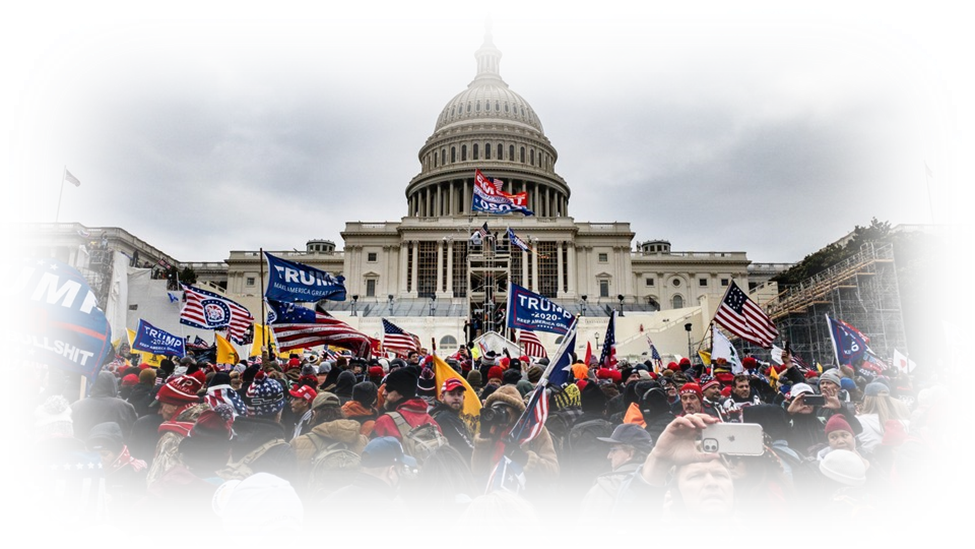
The unusual 2020 elections, characterized by last minute floods of unverified mail-in ballots (facilitated through constitutionally questionable emergency measures justified as necessary to permit voting during the medical “lockdown”), resulted in the election of the Deep State candidate, Joe Biden, results rejected by a sizable segment of the United States electorate which found the refusal to investigate claims of electoral fraud on “technical” grounds unjustifiable. That, in turn, resulted in a war against such nonbelievers by the corporate media and social media platforms which characterized them on a 24/7 basis, as fools and traitors, and imposed even stricter censorship to prevent the spread of their purportedly false, seditious claims, especially after a small minority of people protesting the electoral results in front of the United States Capitol on January 6, 2021, invaded the Capitol itself and engaged in destruction of government property, albeit much less violently than the Democratic Party inspired riots which characterized numerous protests during Mr. Trump’s term in office. In contrast to what occurred during Mr. Trump’s administration where the Congress spent millions of dollars and several years examining Democratic Party complaints of Russian meddling in the 2016 elections (with the alleged collaboration of Mr. Trump and his staff), the Congress and the Justice Department instead opened investigations into the January 6 Capitol protests and ensuing invasion of the Capitol, condemning a number of the participants to prison.
The results of the foregoing were that the Deep State reacquired total power over the federal government in the United States, but that its existence was exposed, as was the reality that the corporate media was entirely under its control. The new president, Mr. Biden, although fully supported by the Deep State and the corporate media and with his political party, the Deep State’s own Democrats in power, quickly proved extremely unpopular. Of course, he had never been popular. Indeed, during the 1988 presidential campaign season, he’d had to withdraw his candidacy when that era’s corporate media, liberal but not yet wholly lacking in objectivity, reported on numerous instances of plagiarism and political corruption where it seemed that rather than representing the State of Delaware in the Senate, he’d represented the credit card companies which had, in turn, provided Mr. Biden’s son Hunter and brother Jimmy with lucrative contracts for questionable or non-existent services. But those episodes were seemingly forgotten by the 2016 version of the corporate media, which instead, covered up numerous instances of questionable conduct by son Hunter, which seemed to also implicate his father, referred to in numerous damaging but obfuscated emails as “the Big Guy”. The concept of the “Emoluments Clause” of the Constitution, so often raised by the corporate media with respect to Mr. Trump and his family had evidently been tacitly repealed when it came to the Biden and Clinton families.
As 2021 dawned, the Biden administration and the Deep State’s Democratic Party, were tanking in all political polls, many of which have been traditionally skewed in favor of Deep State favored candidates and policies, and it seemed probable that right wing populists were likely to take over Congress in 2022, and that Mr. Trump might regain the presidency in 2024, despite intervention against him by Democratic Party controlled prosecutors in both the federal government and a number of States, especially New York State, who seemed determined to prevent him from running for the presidency. Mr. Biden’s problems were mirrored across the pond by the travails of British Prime Minister Boris Johnson, where the European version of the Deep State was determined to destroy him as punishment for his successful efforts to have the United Kingdom withdraw from the European Union.
In both cases, the Deep State had a solution and as has so often happened in the history of our planet, the answer to domestic political problems involved turbulence in international affairs, something always useful and profitable in the extreme for the Deep State’s owners (the billionaire class), albeit at the expense of the tax payers and of reasonably priced medical care, education, welfare benefits and infrastructure. Having put conflict with the Russian Federation in play in 2014 through the overthrow of the pro-Russian government in the neighboring Ukraine in 2014 and its replacement by a virulently anti-Russian, Nazi admiring regime, the Biden administration in the United States and the Johnston administration in the United Kingdom together with NATO began providing the Ukraine with purportedly defensive armaments with which to confront their Russian neighbors and to conquer the parts of the Ukraine that had refused to accept the 2014 coup d’état, while launching a massive propaganda campaign to the effect that the Russian Federation was about to invade and conquer the Ukraine, with the ultimate goal of reconstituting the defunct Soviet Union. A well planned and orchestrated, self-fulfilling prophecy. Goading the bear seemed the most useful means of defusing political problems at home as fueling anti-Russian sentiment would, in all likelihood, at least temporarily, unite the electorate against the manufactured foreign threat. Not novel but tried and true. And successful once again.
The Joe Biden and Boris Johnson administrations seem to have obtained that for which they most hoped, at least in the short term. Their political opponents have joined with them demanding that the Russians be severely punished for their atrocious conduct, be declared war criminals and be subjected to trials like those that took place in the German City of Nuremberg following World War Two. That the intermediate and long term costs may be devastating to most of us is not relevant to them. They needed military confrontation to shore up their plunging ratings and exploding unpopularity although perhaps this time they may have bitten off more than they can chew and certainly more than they can digest, and they’ve pulled their NATO and European Union allies along with them.
As referenced above, the United States, the United Kingdom, the European Union and NATO attempted to preempt Russian reaction to their provision of lethal aggressive military weaponry to Ukrainian groups attacking the Donetsk and Lugansk Peoples’ Republics by hysterically and consistently claiming that Russia was planning to invade the Ukraine, accompanied by a continuous stream of insults and threats (what in the “West” is today referred to as “diplomacy”). They hoped for a win/win situation for them and a lose/lose situation for Vladimir Putin. If Mr. Putin was goaded into a military reaction, they could impose devastating economic sanctions on Russia, as the United States did to Japan in the prelude to World War Two; if he did not react, they could paint themselves as the tough guys who had forced him to back down.
The Ukraine and its people, as they have been during the last eight years, were the expendable pawns. Mired in misery and corruption since the United States orchestrated coup in 2014 (as they’ve almost always been, but seasoned with civil war and resurgent neo-Nazis inclinations), they are now the fodder for neoliberal ambitions and machinations run amuck. Having patiently called for peaceful resolution of the consequences of the 2014 overthrow of the Ukraine’s democratically elected president, the Russians have finally been successfully goaded into reacting. As the Japanese were on December 7, 1941. As the Austrians and the Germans were on July 28, 1914.
The current situation in the Ukraine is the Cuban missile crisis in reverse, except that calmer heads are not prevailing. Instead, brinksmanship is leading to disaster. Except that now, all the players are armed with enough nuclear weaponry to destroy our planet as it now exists. Only the People’s Republic of China among the world’s major powers appears to have maintained its sanity, but the United States is active there as well with arms sales to the estranged Chinese province of Taiwan and encouragement for it to declare independence being actively fomented. Perhaps the situation in the Ukraine can be duplicated there. On the brink of losing the opportunity for hoped for political and economic hegemony, the United States, under a weak president and corrupt, power mad political class, seems intent on courting Armageddon and unfortunately, it is succeeding. We have climbed atop the razor’s edge. The brink on which the world has teetered since Hiroshima and Nagasaki is only one more miscalculation away from realizing the promise of mutual self-assured destruction that dystopian writers have been predicting for so long.[12]
Sometimes there are justifiable reasons for indefensible actions, but perhaps not this time. Sometimes we fight hopeless battles because our culture or our families or our way of life are threatened with destruction and odds are not relevant. But this time the underlying reasons are incredibly petty and short sighted.
And what are they?
Well, the short term reasons, the catalysts, involve the political problems of Messrs. Biden and Johnson, the intermediate term reasons involve the Deep State’s resolve to maintain power, and the long term reasons involve the related United States’ strategic goal, with the collaboration of its NATO puppets, to militarily and economically isolate and surround the Russian Federation and the People’s Republic of China and to the Islamic State of Iran, the Bolivarian Republic of Venezuela, the Republic of Cuba, the Republic of Nicaragua, the Republic of Bolivia and any country that will not bend to the neoliberal policies of the United States and its NATO allies. As in the case of the fictitious Borg, they seek to demonstrate that resistance to hegemonic domination is futile, but perhaps they’ve miscalculated this time. Perhaps they’ve finally gone too far.
Russia is not Iraq or Afghanistan or the Palestinians or Libya or Syria or Yemen or Yugoslavia. It’s not Cuba or Venezuela or Nicaragua or Bolivia. Russia can bite back. And it has. So can the People’s Republic of China. The question is, will Russia limit its reaction or will it permit the so called “West” to goad it into further and more extreme reaction. Reaction that only serves the long term interests of those who wish Russia and its people misery and domination, or a reaction that may lead to the long promised mutually assured destruction. That of course depends on the nature of the unprecedented and hypocritical sanctions which the United States, the European Union and others impose. If they hurt enough, then the Russian Federation must and will retaliate, and we will enter into the kind of cataclysmic measure, counter measure, counter-counter measure spiral which will rid the universe of its human infestation.
Perhaps for the better.
_______
© Guillermo Calvo Mahé; Manizales, 2022; all rights reserved. Please feel free to share with appropriate attribution.
Guillermo (“Bill”) Calvo Mahé (a sometime poet) is a writer, political commentator and academic currently residing in the Republic of Colombia (although he has primarily lived in the United States of America of which he is also a citizen). Until 2017 he chaired the political science, government and international relations programs at the Universidad Autónoma de Manizales. He has academic degrees in political science (the Citadel), law (St. John’s University), international legal studies (New York University) and translation and linguistic studies (the University of Florida’s Center for Latin American Studies). He can be contacted at guillermo.calvo.mahe@gmail.com and much of his writing is available through his blog at http://www.guillermocalvo.com.
[1] See Blinova, Ekaterina (2022). Interview of Jacques Cheminade, “Ex-French Presidential Candidate: West Upended Minsk Agreements, Now Reaps What It Sowed in Ukraine”; Sputnik International, February 24, 2022, found at https://sputniknews.com/20220224/ex-french-presidential-candidate-west-upended-minsk-agreements-now-reaps-what-it-sowed-in-ukraine-1093329336.html, first accessed on February 24, 2022.
[2] See AbuKhalil, As’ad (2022). “The Angry Arab: The Middle East & the War in Ukraine”; Consortium News Volume 27, Number 75 — Wednesday, March 16, 2022, available at https://consortiumnews.com/2022/03/16/the-angry-arab-the-middle-east-the-war-in-ukraine/?unapproved=429977&moderation-hash=7623d2c54762770b523fde22d248e29d#comment-429977, first accessed on March 16, 2022.
[3] See North Atlantic Treaty Organization (2021). “Relations with Colombia”; available at https://www.nato.int/cps/en/natohq/topics_143936.htm.
[4] See Hedges, Chris (2022): “Waltzing to Armageddon”; Consortium News, Volume 27, Number 74 — Tuesday, March 15, 2022; available at https://consortiumnews.com/2022/03/15/chris-hedges-waltzing-to-armageddon/, first accessed on March 15, 2022.
[5] See Johnstone, Diana (2022): “For Washington, War Never Ends”, Consortium News, Volume 27, Number 75 — Wednesday, March 16, 2022, available at https://consortiumnews.com/2022/03/16/diana-johnstone-for-washington-war-never-ends/, first accessed March 16, 2022.
[6] See, “Victoria Nuland, architect of the 2014 coup”, Transcript of intercepted call (“Ukraine crisis: Transcript of leaked Nuland-Pyatt call”; BBC News, February 7, 2014, available at https://www.bbc.com/news/world-europe-26079957).
[7] The term Nazi and neo-Nazi are admittedly hyperbolic and overused but have come to reform to racial supremacist who abhor racial melding and are here used in that context, although, in the Ukraine, actual empathy for the Nazis has always been present.
[8] It is probable that the relationship between the merchants of Novgorod and the Varangians started out as a protective mercenary arrangement which, with or without the consent of the merchants, morphed into a more permanent institutional meld.
[9] Rurik, for those enamored of Netflix fantasies disguised as history, is the protagonist in the Netflix series, “Vikings”.
[10] See Johnstone, Caitlin (2022). “International Law Is a Meaningless Concept When It Only Applies To US Enemies”, March 17, 2022, available at https://caitlinjohnstone.com/2022/03/17/international-law-is-a-meaningless-concept-when-it-only-applies-to-us-enemies/#comment-77044, first accessed on March 17, 2022.
[11] Most of Latin America (with the notable exception of the Republic of Colombia), most of the Middle East, most of Africa and the Peoples’ Republic of China have refrained from joining the anti-Russian crusade.
[12] For an example of how close we are to a terminal miscalculation, see Bedenko, Daria (2022). “India Has Accidentally Fired Missile into Pakistan, Incident to Be Investigated – MoD”, Sputnik News, March 11, 2022, available at https://sputniknews.com/20220311/india-has-accidentally-fired-missile-into-pakistan-incident-to-be-investigated—mod-1093779228.html, first accessed on March 11, 2022.






 Guillermo Calvo Mahé