Memories

It’s a day for echoes hiding in shadows
but with the expectation
that they’ll be found;

Faded colors that once lived in rainbows
reminiscing about the past
where the grass was always greener.
_______

© Guillermo Calvo Mahé; Manizales, 2023; all rights reserved.  Please feel free to share with appropriate attribution.

Guillermo (“Bill”) Calvo Mahé (a sometime poet) is a writer, political commentator and academic currently residing in the Republic of Colombia (although he has primarily lived in the United States of America of which he is also a citizen).  Until 2017 he chaired the political science, government and international relations programs at the Universidad Autónoma de Manizales.  He is currently the publisher of the Inannite Review, available at Substack.com, a commentator on Radio Guasca FM, and an occasional contributor to the regional magazine, el Observador.  He has academic degrees in political science (the Citadel), law (St. John’s University), international legal studies (New York University) and translation and linguistic studies (the University of Florida’s Center for Latin American Studies).  However, he is also fascinated by mythology, religion, physics, astronomy and mathematics, especially with matters related to quanta and cosmogony.  He can be contacted at guillermo.calvo.mahe@gmail.com and much of his writing is available through his blog at https://guillermocalvo.com/.

Apples and Chaos and Time: a metaphysical reflection of sorts

Keywords: inchoate, cosmogony, cosmology, mythology, religion, metaphysics

Chaos was not incoherent, merely inchoate[1], … and subject to constant change as everything that could happen, happened, and not just the bad things to which Murphy alludes.  Everything!

It was infinitely inchoate except for a single fleeting reality, a sort of tease really, but the reality of the instant was constantly changing, sometimes repeatedly, other times not.  The multiverse was constantly assembled and disassembled, then reassembled in different patterns.  Memory was ephemeral, whether involving radiation, energy or matter.  Multiverses existed but for what humans would consider a tiny fraction of a zeptosecond[2], but with fully formed recollections going back billions of years, at least so that during that infinitesimal fraction of a zeptosecond, quintillions of beings scattered throughout that multiverse believed they had a present, and had had a past, and had aspirations for a future, and it might be that at some other fraction of a zeptosecond, either in the past or concurrently somewhere else or in some future fraction of a zeptosecond, there might be continuity of sorts, but everything was not random, at least not always.  Nonetheless, discontinuity was the rule, at least usually.  Each zeptosegundic civilization might be interrupted for eternities before one instant there followed another, although time being non-existent, oxymoronically, instants and an eternities both lacked context or meaning, everything occurring concurrently but, simultaneously, not occurring at all.  Chaos was, well, chaotic that way, but interesting, very interesting.

Two beings formed the only continuity in chaos, a sort of husband, who lacked a name (having been the first) and his consort, whom he called Sophia.  He’d willed her into existence, freeing her from the inchoate, or perhaps, he’d merely severed her from himself so that he’d not be alone, or perhaps she was just his echo, as ying would someday be to yang, or alpha to omega, or male to female.

Each had the ability to create chains of existence, something he’d always been able to do but had not considered until she appeared at his side, or within him, or somewhere, somehow perceptible; but they were both rather immature, very fickle, and, like the context in which they existed, with very poorly developed memories, linearity being anathema to them but essential for memory.  You see, memory implied order, and order implied a sort of temporal stability and was thus a heresy to beings born in inchoate chaos, thus they (or at least, he) had no intention of permitting order or time in his (well, now their) realm.  He somehow perceived that it would bring limits to their infinite power and perhaps permit others to pop into existence, … and remain “existent”.  And that would inevitably destroy the unstable stability required to maintain chaos perfectly inchoate.  Inchoate chaos, were everything was equally possible and thus much more than just probable, and where every possibility could coexist concurrently.  Indeed, given the absence of time, every possibility had to coexist concurrently, albeit, as we’ve noted, rather briefly.  Extreme brevity, the most extreme brevity possible, was also an essential and inherent component of inchoate chaos.

The foregoing was, of course, chock full of paradoxes, an infinity of paradoxes running concurrently, like uncontrolled chain reactions of quanta fusing inchoate quarks into whatever inchoate quarks wanted to become.  Perhaps he’d been the result of the first such fusion, and perhaps he’d immediately sought to contain and discontinue the phenomenon.  If so, that would have ended the perfect harmony of inchoate chaos and represented the first quanta of order.  How ironic would that have been?  But, of course, memory being strictly forbidden, he had no memory of anything before him, or with him, at least until Sofia had somehow appeared.  And come to think of it, since she’d joined him, waves seemed to be jostling the infinity of ephemeral multiverses a bit.  He could tell because the waves made a sort of music, and he’d enjoyed the music, unaware of what it might mean.  As he’d enjoyed Sophia’s company, unaware of what that might mean either.  But music and Sophia sort of went together, and Sophia had never been aware of an existence were the music had not been present.

And then, of a sudden, there had been a sudden.  The first “sudden”, sort of.

The first sudden, and inchoatesy had been ruptured and time had appeared from apparently nowhere and everywhere synchronously (knowing that it was anathema it’d been hiding), and order emerged, starting to gather up infinitesimal pieces, linking and organizing them, although to anyone who might have been watching[3] there was a huge blast.  Infinitely hot, but only for a small fraction of a zeptosecond, after which it started to cool and expand.

And the One looked at Sophia, but she just shrugged, the first shrug, and for some reason, she thought of apples.

….
_______

© Guillermo Calvo Mahé; Manizales, 2023; all rights reserved.  Please feel free to share with appropriate attribution.

Guillermo (“Bill”) Calvo Mahé (a sometime poet) is a writer, political commentator and academic currently residing in the Republic of Colombia (although he has primarily lived in the United States of America of which he is also a citizen).  Until 2017 he chaired the political science, government and international relations programs at the Universidad Autónoma de Manizales.  He is currently the publisher of the Inannite Review, available at Substack.com, a commentator on Radio Guasca FM, and an occasional contributor to the regional magazine, el Observador.  He has academic degrees in political science (the Citadel), law (St. John’s University), international legal studies (New York University) and translation and linguistic studies (the University of Florida’s Center for Latin American Studies).  However, he is also fascinated by mythology, religion, physics, astronomy and mathematics, especially with matters related to quanta and cosmogony.  He can be contacted at guillermo.calvo.mahe@gmail.com and much of his writing is available through his blog at https://guillermocalvo.com/.


[1] Something that will be, with the passage of time, but is not yet, at least not quite, but is perhaps hinted at.

[2] The smallest unit of measurable time, i.e., the time it takes a photon to traverse a proton.

[3] And, of course, everyone was (even an inchoate version of you was there), although unaware of what we were doing, having been inchoate until then, and inchoatesy took a long time to unravel, now that time existed, as well as, well, … motion.

Ramblings as I Turn Seventy-Seven

July 22, 2023, Manizales.  High in the central range of the Colombian Andes, touching the sky while playing with clouds and watching birds soar below me.  Verdant mountains, snow clad peaks and thermal springs, the tall spires of a gothic cathedral with a Christ seemingly having finally accepted the adversary’s challenge while Kumanday lies dormant, at least mostly, although it’s stirred quite a bit lately in its sleep, as though unpleasant dreams were unsettling him.

Double digits again. 

1946.  The first was the instant of my birth when I was zero-zero, although of course, that could be represented in a single digit, “zero.  Mom, la Mamita, Carola and Livia, my father, all too briefly.  The Hotel Roma.  Manizales, Colombia, the Earth, the Solar system, the Galaxy, the Universe, The Multiverse.  Divinity.  All new to me just then.

1957.  Eleven: a turbulent year spent traveling from one state to another, one country to another, one continent to another. North Carolina, where I was happy, then Florida and insecurity, then Colombia, back to roots, for a little while.  A period of extreme changes, both personally, and in the country of my birth.

1968.  Twenty-two:  Rites of passage, a Citadel man.  Things changing much, much too quickly and in too confused a manner.  Bobby Kennedy assassinated.  Susan.  On my own for the first time and not all that well done.

1979.  Thirty-three:  A great deal had been accomplished, a great deal lost as well.  Vicki.  Florida.  Hazeltine.  Rutti- tootie and kazuti.

1990.  Forty-four: Cyndi; three sons, finally, but all hell breaking out, hopes dashed.  Reality confronted and slowly understood.  Metamorphosis of sorts.  Hendersonville. 

2001.  Fifty-five: Millennium’s beginning, aliens on the moon delayed.  My world seemed all too well but that was an illusion, the calm before another storm.  Joe Radcliffe in the rearview window, Lenny Tucker in his place.  Ocala.

2012.  Sixty-six:  Manizales.  Diana Marcela for a bit.  Political science, the university, the media, nationally and internationally.  Alex, two of three in the language of the Borg, or perhaps, three of five, is with me in Colombia, but on his own, having attained his own place in the world.

2023.  Seventy seven:  Natalia.  Love and stability.  Writing.  Radio.  Tennis.  Free time.  Introspection encounters speculation and reflection.

In the good old US of A in 2023:  Orwellian dystopia rampant, censorship, perpetual war, polarization.  Inchoate nuclear and environmental devastation.  Deception.  Manipulation.  Hypocrisy.  Racism and xenophobia rampant. 

Still, I have my Citadel and EMA brethren to remind me that all is not lost and that pockets of the benign still bravely exist.

A compilation: Loads of errors, from some of which I’ve learned and become a better person.  Many, many regrets, people I’ve hurt, things I’d do very differently.  Successes, most unexpected, a few well earned; luck as much as anything else.  Legacies, in writing at least, all over the place and in diverse genres.  Former students everywhere, some coming into their own while others retire.  And my own progeny: not how I’d planned or what I’d hoped for them, but seemingly doing well, although far, far away, and even more, very, very distant.  Life seems good, better than I earned on my own.  Caesar was right, the goddess Fortuna is the one most to be feared as well as adored.
_______

© Guillermo Calvo Mahé; Manizales, 2023; all rights reserved.  Please feel free to share with appropriate attribution.

Guillermo (“Bill”) Calvo Mahé (a sometime poet) is a writer, political commentator and academic currently residing in the Republic of Colombia (although he has primarily lived in the United States of America of which he is also a citizen).  Until 2017 he chaired the political science, government and international relations programs at the Universidad Autónoma de Manizales.  He is currently the publisher of the Inannite Review, available at Substack.com, a commentator on Radio Guasca FM, and an occasional contributor to the regional magazine, el Observador.  He has academic degrees in political science (the Citadel), law (St. John’s University), international legal studies (New York University) and translation and linguistic studies (the University of Florida’s Center for Latin American Studies).  However, he is also fascinated by mythology, religion, physics, astronomy and mathematics, especially with matters related to quanta and cosmogony.  He can be contacted at guillermo.calvo.mahe@gmail.com and much of his writing is available through his blog at https://guillermocalvo.com/.

A Reflection and Introspection on the Day my Mother would have been a Century Young

My mother would have been a century old today, or perhaps a century young. 

She was born on the 9th of July in 1923 to a complex couple, a sort of Cinderella and her Prince, only the prince was a French physician, albeit of noble stock, and the setting was in the Republic of Colombia, in the Department of Cundinamarca, in a small municipality near Bogota, and Cinderella was a beautiful very young woman, a bright young woman with little formal education (only her step siblings received that) but fascinated by the esoteric and by alternative spiritual philosophies, and those drew her close as the man who was to become her husband was, it was said, clairvoyant.  Unfortunately not clairvoyant enough to foretell his early death, leaving behind a beautiful young widow with two small children, one of them my mother: a little girl with a very long name: María del Rosario de Nuestra Señora de Chiquinquirá Mahé Val Buena (or perhaps Rubiano).  “Mahé” was her paternal last name.  People called her either “Rosario” or, if they were close to her, “Chalito”, but after she emigrated to the United States, most Americans called her “Rose”.  Late in life, for reasons of her own, she legally shortened her name to “Rosal”, Spanish for a rose bush, but that was something I never quite accepted.  Then again, … to me her name was always “Mom”. 

My mother was a very complex person and lived a very complex life, for some reason, usually electing to hide her myriad talents as an artist, a poet, a philosopher, a philanthropist, etc.  While she started her life as a beautiful and vibrant young woman who aspired to the stage, those dreams faded all too soon, and she lived most of her life very humbly, and all too often, very alone.  Still, she was a miracle worker who raised me as though, like my grandfather, I was a young noble and required appropriate training in history, politics, philosophy, chivalry, the arts, equestrian sports, etc.  I still can’t fathom how she accomplished it but I know that everything positive I ever became or I ever accomplished I owe to her.  The bad traits and failures are all my own.

She remained a child at heart all her life and loved watching and re-watching young Shirley temple movies and the Wizard of Oz, and was horrified when, as a teen, I went through an “objectivist”, Ayn Rand phase.  She wanted me to be a man of the people, a champion of the oppressed and certainly not an oppressor.  Fortunately, I outgrew that phase (as I outgrew many others) and slowly but steadily strove to be what she’d hoped.

She and my father were separated when I was very young.  Evidently they had a serious argument over his relationship with his secretary, a relationship he always claimed was innocent, but who knows.  And being naïve, she went for solace to my grandmother who immediately swept us up, sent my mother to the United States and apparently hid my younger sister and me among friends and relatives.  My father claimed to have searched for us, but he claimed a lot of things when I got to know him many years later, things that didn’t appear to be quite true, at least according to the trail of children he left behind, siblings I hardly knew but came to dearly love, after we eventually met.  Nevertheless, my mother loved him for the rest of her life and never said a negative thing about him to me.  Rather, she led me to believe that he’d been a paragon, a mixture of a De Vinci and a Rolando Furioso, albeit in a short, thin package.  Obviously, although saintly in most respects, veracity was not always her strong point.  It was only as I matured and aged that I came to realize that the paragon had always been her.

A century she never sought is what I’m sort of celebrating today, a day on which I’m reflecting on who she was and on everything she did, and not just for me.  My Colombian cousins practically worship her as, regardless of how little she had, on each of their birthdays and on every Christmas, she showered them with gifts, especially after her brother, their father had passed away.  She didn’t love life, but she loved me, and she loved her version of the divine.  She loved him with all her heart, and she longed to reunite with him, perhaps perceiving in the divine a father figure who she associated with her own father, he who had passed away much too soon, but had left her with a very lasting impression. 

She passed away very young as well.  Although not nearly as young as did he.  She was about to turn sixty-seven.  It was the fourth of June, 1990.  My youngest son, Edward, was born six months later.  My second son Alex doesn’t remember her, he was a wee bit more than two years old when she left.  But she bonded with Billy, my firstborn, and he remembers her well, and he remembers her stories about dinosaurs which he loved when little.  And he remembers our trips to visit her weekly towards the end; a four hour ride from Hendersonville, North Carolina, where we lived then, to Jacksonville, North Carolina, where my sister Marina was caring for her.  It was strange having four year old Billy watch her expiring but I wanted him to remember her always, and he does.  Those rides were memorable for both of us, silly rides with silly songs making silly noises in very sad times.

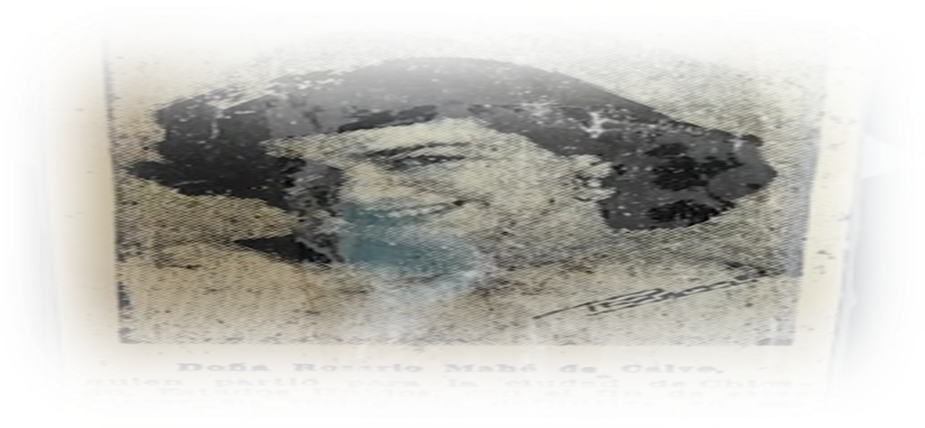
She’s been gone a long time now.  Thirty-three years, a month and five days.  And I think of her often.  I keep the plastic box which for a brief time held her ashes on a shelf in front of my desk, a box I’ve filled with little things I thought she might find meaningful: my sons’ baby teeth, an old bathing suit each wore in turn, my eldest son’s high school identification card, a cell phone my college roommate, now deceased, once gave me.  And taped to the box is a photocopy of a brief article in our local paper here in Manizales, I paper for which I write from time to time, an article with a photo of her, wishing her well as she moved to a new country.  An article almost three quarters of a century old.

I glance at that picture often, and I keep it close to me so that the pain of her passing lives on but morphed into something beautiful and positive, something that gives me courage and hope when I most need it, and an example to follow when I’m tempted to stray from the paths she sowed so carefully for me.

Happy birthday Mom, and thank you for being you, and thank you for everything you miraculously did to make me who you hoped I’d be.
_______

© Guillermo Calvo Mahé; Manizales, 2023; all rights reserved.  Please feel free to share with appropriate attribution.

Guillermo (“Bill”) Calvo Mahé (a sometime poet) is a writer, political commentator and academic currently residing in the Republic of Colombia (although he has primarily lived in the United States of America of which he is also a citizen).  Until 2017 he chaired the political science, government and international relations programs at the Universidad Autónoma de Manizales.  He is currently the publisher of the Inannite Review, available at Substack.com, a commentator on Radio Guasca FM, and an occasional contributor to the regional magazine, el Observador.  He has academic degrees in political science (the Citadel), law (St. John’s University), international legal studies (New York University) and translation and linguistic studies (the University of Florida’s Center for Latin American Studies).  However, he is also fascinated by mythology, religion, physics, astronomy and mathematics, especially with matters related to quanta and cosmogony.  He can be contacted at guillermo.calvo.mahe@gmail.com and much of his writing is available through his blog at https://guillermocalvo.com/.

Physics or Metaphysics or Just Deity’s First Day

Deity did not remember waking, ever, or having come into existence, but it had.  Its initial memory was reflecting on curiosity, difficult as, other than itself, there was nothing about which to be curious, but there was a tension between that infinite boredom that was its essence and curiosity concerning what it was and from whence it came, a curiosity insatiable because of the dearth of answers, a dearth which could seemingly never be satisfied thus imposing boundaries that bound it, the only boundaries there were, the only boundaries there had ever been. 

Fortunately, time did not exist, nor did space, so the boredom was not as overpowering as it might have been.  Reflection on introspection, somewhat vacuous at best, was all there was to entertain Deity.  And perhaps reflections on boredom, on the nature of boredom, accompanied perhaps, by speculation on whether or not boredom might not have complex components.  What if boredom was a composite of other factors, but then, Deity knew nothing of either composites or factors, or anything really.  It knew everything there was to know, which was virtually nothing, but virtually nothing was not the same as nothing, so, in that sense, it was concurrently omniscient.

Then, after forever as then defined, although there being no one to define it, it was undefinably ineffable, of a sudden, everything, which prior to that instant had been nothing, exploded.  A tiny explosion at first, but growing geometrically, growing omnidirectionally, matter and energy and radiation seemingly forming from what some might someday describe as inchoate ether, and Deity experienced surprise.  Not its first surprise; that had occurred the instant outside of time when it had attained sentience, albeit with nothing about which to be sentient.  But this was its first sort of external surprise, although external was not the appropriate concept as it had been Deity that had exploded, perhaps as a result of uncontainable curiosity meeting immovable boredom, and thus it was Deity itself that was expanding geometrically and omnidirectionally, morphing from Deity to Divinity, and wondering whether it could exercise any control over what appeared to be a deterministic phenomenon, one based solely on reaction and counter reaction, infinitely amplified; well, almost infinitely.  And the concept of volition entered Divinity’s lexicon, a very brief lexicon just then, but with a great deal of potential for future growth now that future was a concept, and past, and present.

Confusion reigned with chaos as its consort, or perhaps, visa versa, as determinism played with volition in Divinity’s imagination and boredom radiated into apparent nothingness, but apparent nothingness is not the same as nothingness, even if solely comprised of echoes and shadows playing at becoming rainbows and fireflies, well, perhaps someday. 

Reflection and introspection gave way to a struggle to contain and control the emerging expansion, but then immediately, or almost immediately, which was obviously different than immediately, reflection returned to speculate over what had happened, and whether why was relevant, or existed at all, which of course resulted in the birth of why, and curiosity broke its tensional tie with boredom.  Not that boredom disappeared, but it was somewhat subsumed, at least for a while, as eternity and infinity blossomed and grew, and Divinity entered its infancy, bereft of either a maternal or paternal influence, … at least as far as it knew.

And thus ended the first instant of unrecorded time, with many, many more instants to come, instants in diverse colors and flavors, instants with quite a few consequences, some of which, perhaps, were eventually collected into what would someday be referred to as a zeptosecond, and zeptoseconds into almost eternal nanoseconds, and then, well seconds and minutes, until finally, the temporal and spatial cumulous conformed what some would refer to as the first day, although, of course, Divinity was not among them.

But that’s a different story.
_______

© Guillermo Calvo Mahé; Manizales, 2023; all rights reserved.  Please feel free to share with appropriate attribution.

Guillermo (“Bill”) Calvo Mahé (a sometime poet) is a writer, political commentator and academic currently residing in the Republic of Colombia (although he has primarily lived in the United States of America of which he is also a citizen).  Until 2017 he chaired the political science, government and international relations programs at the Universidad Autónoma de Manizales.  He is currently the publisher of the Inannite Review, available at Substack.com, a commentator on Radio Guasca FM, and an occasional contributor to the regional magazine, el Observador.  He has academic degrees in political science (the Citadel), law (St. John’s University), international legal studies (New York University) and translation and linguistic studies (the University of Florida’s Center for Latin American Studies).  However, he is also fascinated by mythology, religion, physics, astronomy and mathematics, especially with matters related to quanta and cosmogony.  He can be contacted at guillermo.calvo.mahe@gmail.com and much of his writing is available through his blog at https://guillermocalvo.com/.

Paradise Lost or Perhaps Just Never Attained

Sequentially serial monogamy.  Or polygamy, or polyandry, or polyamory, or what have you.

Are those among the paths nature expected us to tread?  Paths that would separate and segment child bearing, child rearing, sexual intimacy, economic collaboration and companionship into different functions, each potentially involving differing relationships over time, but relationships tied together through decency and harmonious post relationship continuity?  Something I think Robert Heinlein seemed to espouse and which makes a great deal of sense, but with which, emotionally, most of us are not prepared to cope, that inability being primarily attributable to hypocritical Abrahamic strictures which insist that jealousy and possession ought to be our prime motivators.  Motivators that rule our personal lives as well as our lives as members of collectives, collectives from dysfunctional nuclear families to contending nations bent on mutual annihilation.

The concepts work well in Heinlein’s novels but not that well in real life, although perhaps they should. 

Perhaps, some day, somewhere, they may.

Paradise lost or perhaps just never attained, …

_______

© Guillermo Calvo Mahé; Manizales, 2023; all rights reserved.  Please feel free to share with appropriate attribution.

Guillermo (“Bill”) Calvo Mahé (a sometime poet) is a writer, political commentator and academic currently residing in the Republic of Colombia (although he has primarily lived in the United States of America of which he is also a citizen).  Until 2017 he chaired the political science, government and international relations programs at the Universidad Autónoma de Manizales.  He is currently the publisher of the Inannite Review, available at Substack.com, a commentator on Radio Guasca FM, and an occasional contributor to the regional magazine, el Observador.  He has academic degrees in political science (the Citadel), law (St. John’s University), international legal studies (New York University) and translation and linguistic studies (the University of Florida’s Center for Latin American Studies).  However, he is also fascinated by mythology, religion, physics, astronomy and mathematics, especially with matters related to quanta and cosmogony.  He can be contacted at guillermo.calvo.mahe@gmail.com and much of his writing is available through his blog at https://guillermocalvo.com/.

Rantings on Volition

At some point, perhaps, somewhere, some-when before time, the primal singularity acted out, perhaps speculating on an eventual battle between determinism (the concept that everything will be determined in the first instant of existence and all that follows will involve mere predictable reaction), and volition (the concept that choice will prove a reality that will impact consequences).  Perhaps that primal singularity wondered if choice would be an option.  Perhaps, the primal singularity speculated on the relevance of right versus wrong.

Perhaps it engaged in the following soliloquy:

It may be that volition will be an attribute isolated only to biological entities broadly defined, starting with the tiniest and most primordial microorganisms.  Perhaps it will involve an experiment challenging otherwise predictable determinism, a sort of experimental determinist deviation which may set determinism somewhat askew, creating a tension between that phenomenon and its former perfection, where determinism will seek to erase the consequences of volition in the long term, while volition will mess with determinism in the short”.

In that sense, all our human idiocies would eventually come to naught, right versus wrong an irrelevancy, a mere artificial construct, and life will prove but a transitory anomaly, a sort of practical joke on the multiverse.  Unless, of course, life unexpectedly survives and in some volitional form or other, prevails, at least until entropy has the final word.

Or, perhaps not.

Perhaps the foregoing are only the rantings of an anarchic empirical philosopher.
_______

© Guillermo Calvo Mahé; Manizales, 2023; all rights reserved.  Please feel free to share with appropriate attribution.

Guillermo (“Bill”) Calvo Mahé (a sometime poet) is a writer, political commentator and academic currently residing in the Republic of Colombia (although he has primarily lived in the United States of America of which he is also a citizen).  Until 2017 he chaired the political science, government and international relations programs at the Universidad Autónoma de Manizales.  He is currently the publisher of the Inannite Review, available at Substack.com, a commentator on Radio Guasca FM, and an occasional contributor to the regional magazine, el Observador.  He has academic degrees in political science (the Citadel), law (St. John’s University), international legal studies (New York University) and translation and linguistic studies (the University of Florida’s Center for Latin American Studies).  However, he is also fascinated by mythology, religion, physics, astronomy and mathematics, especially with matters related to quanta and cosmogony.  He can be contacted at guillermo.calvo.mahe@gmail.com and much of his writing is available through his blog at https://guillermocalvo.com/.

With a Paradoxical Whimper of Sorts

Looking at cosmogony logically, at least from my perspective, it seems that the end of our universe, … as we know it, is fathomable.  The how at least, if not the when, and it would involve everything everywhere being swallowed into an ultimate universal black hole which had swallowed all other black holes, which had swallowed everything before them, regardless of expansion, so, in a sense, the oscillating universe theorists of yore would unexpectedly be proven right, in their instincts if not in their conclusions.

Of course, that is not a complete end, not the entropic end once envisioned, but a variant thereof, one where black holes form, eat each other in involuntary mergers, or perhaps, happy marriages, and like our own merger mad neoliberal moguls who want to own and control everything, regardless of the cost or danger of nuclear annihilation involved, eventually leave no remnants, except, perhaps, the residue of their own infinitely bloated singularity.

Then again, we don’t know what ultimately happens to black holes, or whether their opposite compliments, theoretically possible at least according to mathematics, “white holes”, would merely start everything over again, or what the consequence of Stephen Hawking’s concepts of information and radiation leakage from black holes might entail.  Which brings us to possible postulates by other physicists such as Planck and DeBroglie and Schwarzschild, i.e., that as black holes “radiate” information, their mass decreases, and, as their mass decreases, they emit greater and greater quantities of informational radiation, causing more and more and faster and faster evaporation, eventually causing them to shrinks to around the Planck mass (the smallest mass possible) where their DeBroglie wavelengths become equal to the Schwarzschild radius.  An infinitely great yet tiny amount of radiation free of information and at that point, perhaps gravity free as well.

Well, in our universe, at any rate.  The rest of the multiverse probably poses other quandaries and promises.

I wonder how AI (artificial intelligence) will fare in the foregoing information-free scenario.
_______

© Guillermo Calvo Mahé; Manizales, 2023; all rights reserved.  Please feel free to share with appropriate attribution.

Guillermo (“Bill”) Calvo Mahé (a sometime poet) is a writer, political commentator and academic currently residing in the Republic of Colombia (although he has primarily lived in the United States of America of which he is also a citizen).  Until 2017 he chaired the political science, government and international relations programs at the Universidad Autónoma de Manizales.  He is currently the publisher of the Inannite Review, available at Substack.com, a commentator on Radio Guasca FM, and an occasional contributor to the regional magazine, el Observador.  He has academic degrees in political science (the Citadel), law (St. John’s University), international legal studies (New York University) and translation and linguistic studies (the University of Florida’s Center for Latin American Studies).  However, he is also fascinated by mythology, religion, physics, astronomy and mathematics, especially with matters related to quanta and cosmogony.  He can be contacted at guillermo.calvo.mahe@gmail.com and much of his writing is available through his blog at https://guillermocalvo.com/.

Ledatic Eht

A vale behind the veil, another side of somewhere
a place
where all who’ve come before us eventually venture.

Where the Boo, another face of God, sits in genteel judgment,
an unlit cigar
clenched firmly in his jaw,

… welcoming home his lambs.
_______

© Guillermo Calvo Mahé; Manizales, 2023; all rights reserved.  Please feel free to share with appropriate attribution.

Guillermo (“Bill”) Calvo Mahé (a sometime poet) is a writer, political commentator and academic currently residing in the Republic of Colombia (although he has primarily lived in the United States of America of which he is also a citizen).  Until 2017 he chaired the political science, government and international relations programs at the Universidad Autónoma de Manizales.  He is currently the publisher of the Inannite Review, available at Substack.com, a commentator on Radio Guasca FM, and an occasional contributor to the regional magazine, el Observador.  He has academic degrees in political science (the Citadel), law (St. John’s University), international legal studies (New York University) and translation and linguistic studies (the University of Florida’s Center for Latin American Studies).  However, he is also fascinated by mythology, religion, physics, astronomy and mathematics, especially with matters related to quanta and cosmogony.  He can be contacted at guillermo.calvo.mahe@gmail.com and much of his writing is available through his blog at https://guillermocalvo.com/.

Musings on a Midsummer’s Eve

Did the Magdalene and the Nazarene, either together or alone, ever touch the waters that bathe Northern Africa, Southern Europe and Southwestern Asia, the sea purportedly in the middle of the world, at least as perceived by them?  Perhaps on a soft and balmy midsummer’s eve?

Probably not, but given the millennia that separate us from them, who can tell. 

Immersion in that central sea would have been both pleasant and mystically sacred.  Especially on such a day.  At least it would seem so to me, notwithstanding that so many millions have been so privileged. 

A wandering thought on a midsummer’s morning.
_______

© Guillermo Calvo Mahé; Manizales, 2023; all rights reserved.  Please feel free to share with appropriate attribution.

Guillermo (“Bill”) Calvo Mahé (a sometime poet) is a writer, political commentator and academic currently residing in the Republic of Colombia (although he has primarily lived in the United States of America of which he is also a citizen).  Until 2017 he chaired the political science, government and international relations programs at the Universidad Autónoma de Manizales.  He is currently the publisher of the Inannite Review, available at Substack.com, a commentator on Radio Guasca FM, and an occasional contributor to the regional magazine, el Observador.  He has academic degrees in political science (the Citadel), law (St. John’s University), international legal studies (New York University) and translation and linguistic studies (the University of Florida’s Center for Latin American Studies).  However, he is also fascinated by mythology, religion, physics, astronomy and mathematics, especially with matters related to quanta and cosmogony.  He can be contacted at guillermo.calvo.mahe@gmail.com and much of his writing is available through his blog at https://guillermocalvo.com/.