Reflections on the Christmas Season, … 2023

Charles Dickens’ “a Christmas Carol” has, since it was first portrayed on the stage and screen, resonated with very diverse segments of our population although now, more realistic Carols seem to focus on a new verse, one appended to the beginning of “the Twelve Days of Christmas”, one that starts six months earlier than the older verses and deals with “… myriad merchants a’ selling ….” So perhaps that older resonance is a bit dulled and in need of refreshing. 

Perhaps a bit of reflection might help, a bit of introspection as the solstice skims by us and echoes of pagan Yule and Roman Saturnalia regale us with mirth to go along with the myrrh purportedly provided to an ostensibly special infant born in Palestine long before Zionists sought to destroy that part of the world; well, destroy it, then absorb it, and then turn it into an exclusive Palestinians-free paradise.   One might be excused for wondering what use a newborn would have for myrrh, a fragrant gum resin obtained from certain trees and used, especially in the Near East, in perfumery, medicines, and incense, but, what the heck; … so the story goes and the gift of myrrh is not its least credible aspect.

Soooo, … let’s reflect away to the tune of “Jingle Bells”, or perhaps, the Jose Feliciano version of “Feliz Navidad”:

On an individual basis, the Christmas season is delightful, at least for people blessed with positive familial harmonics supplemented by ties of easily accessible meaningful friendship, but it is deeply depressing for those not so set apart.  The latter group concerns me deeply because it is comprised of the forgotten and of those who for one reason or other, never seemed to matter.  Those with whom the Nazarene, whose birthday so many purportedly celebrate during this season, would be most concerned, assuming he existed and was as beneficently described rather than the angry Pauline version.  Of course, while in the modern “Western” world the season focuses on the Nazarene, the season’s traditions are primordial and have been, in many cases, usurped through manufactured syncretism with far older and more complex cultures, cultures which in some cases have refused amalgamation.

Perhaps the foregoing might serve as a thought bandied about among the ghosts of Christmas past, Christmas present and Christmas future, a thought we might all want to take into account and perhaps, about which we might even consider doing something positive.  And if so, why limit it to this particular season?

Bah humbug!!!!  I wonder what exactly, using linguistic analysis and perhaps philology that is meant to mean.
_______

© Guillermo Calvo Mahé; Manizales, 2023; all rights reserved.  Please feel free to share with appropriate attribution.

Guillermo (“Bill”) Calvo Mahé (a sometime poet) is a writer, political commentator and academic currently residing in the Republic of Colombia (although he has primarily lived in the United States of America of which he is also a citizen).  Until 2017 he chaired the political science, government and international relations programs at the Universidad Autónoma de Manizales.  He is currently the publisher of the Inannite Review, available at Substack.com, a commentator on Radio Guasca FM, and an occasional contributor to the regional magazine, el Observador.  He has academic degrees in political science (the Citadel), law (St. John’s University), international legal studies (New York University) and translation and linguistic studies (the University of Florida’s Center for Latin American Studies).  However, he is also fascinated by mythology, religion, physics, astronomy and mathematics, especially with matters related to quanta and cosmogony.  He can be contacted at guillermo.calvo.mahe@gmail.com and much of his writing is available through his blog at https://guillermocalvo.com/.

Ennui

Tweedledee and Tweedledum, Humpty Dumpty on the wall before he had a great fall, the Queen of Hearts seems heartless, at least as far as Alice is concerned and fair weather friends are best in the late Spring, definitely not in late Fall.

It was in 2005, as he remembered it, although it might have been in late 2004.  Approximately eighteen years had elapsed, enough time for someone to have been born and then attained majority.  One would think a great deal had happened during that interim, and it had, but still, he felt as though he’d stepped on a tread mill, and that there he’d stayed.

His marriage had failed through duplicity, perhaps self-induced, as so many marriages then tended to end.  Something which has not changed.  But ironically, that failure had led to liberation.  It had led to what, at first blush, seemed exhilarating freedom and new horizons.  Among other things, he’d finally felt that he’d become a poet: there’d been plenty of inspiration in superficial sorrow and contrived despondency, not because of his wife’s betrayal, not really, but because so much that he’d loved, especially his family, had to be surrendered if he was to move on, if he was to regain the momentum he’d foregone for so long.  There’s a price for most things under the sun and beyond the stars, perhaps for everything.  And it seems to bear compounded interest.

Of course, his experience was not unique, it had become commonplace, almost a rule.  Except, perhaps, for the bit about poetry.  But even that was not unusual.  And it was not his first experience at starting over after a failed relationship.  That too was no longer infrequent.  Transience now seemed the rule.

There was a melody he’d come across as his life was becoming undone, one he’d listen to constantly, one that seemed to translate what he felt and what he perceived he’d feel in the future, a melody more accurate and more complete than mere words.  It started out forlornly, then became reflective, perhaps introspective, and gradually, it became joyous, even festive.  It was an instrumental ballad, nouveaux flamenco played primarily on a Spanish guitar but accompanied by diverse forms of percussion, perhaps by violins as well.  He still payed it regularly.  Over time, it acquired additional meaning as different women passed through his life, a growing list of unsuccessful intimate relationships each of which he’d ended when he realized that, notwithstanding his aspirations, they were going nowhere and that he was impeding the ability of his paramours too find the truly meaningful long-term spouses they deserved.

His life seemed to parallel that special music: streaked with melancholy and nostalgia but also, unaccountably, because it had no rational justification, stained with tedium.  Too often his decisions seemed to become based on overcoming boredom rather than anything truly positive.  Monotony, bred, not by a lack of things to do, but by repetition. 

He was accomplishing interesting, even important things, he was writing and publishing a great deal, and his counsel was sought on a variety of issues by interesting people who took his opinions seriously, as a result of which, he’d attained the respect and affection of a new set of peers, but his life seemed to lack substance somehow, as though it was bereft of flavor and aroma, as though it were set in a colorless rainbow.  He was doing reasonably well, apparently growing, apparently happy, but those appearances lacked the dimensions he craved.  He felt that he just “was”.

Lumps comfortably resting on logs all too frequently came to mind.  Although sometimes, he’d imagine that the lumps might be enchanted princes in frog form.  Or even better, princesses. 

He missed his sons, who’d become estranged and were living their own lives in another continent, one that might just as well have been another planet, but that was not the problem.  He realized that they had their own lives to live, their own goals, their own aspirations and their own new families in which his role was, at best, minimal, but as long as they were happy, or at least satisfied, he was too. 

After a number of almost satisfying albeit unsuccessful intimate relationships he’d remarried, and his new wife embodied almost everything for which he’d ever hoped.  More than he could reasonable have expected really, more than he probably deserved.  Thus, his domestic life was tranquil and, to an extent, almost fulfilled.  But still, he felt hollow.  Hollow but ironically full of clamoring echoes calling for something he couldn’t divine, something that he couldn’t define.  

He’d hoped for hummingbirds and butterflies and dragon flies but had gotten flies and mosquitos instead.  They smelled of boredom, but then, what was boredom anyway?  Ennui perhaps.  Ennui is a bit more classy and complex than mere boredom.  And he wondered if he’d attained the point, as Fernando Pessoa had once supposed, where tedium had become his most reliable and constant companion?

Not a good trait for someone with expectations of immortality.

Tweedledee and Tweedledum, Humpty Dumpty on the wall before he had a great fall, the Queen of Hearts seems heartless, at least as far as Alice is concerned and fair weather friends are best in the late Spring, definitely not in late Fall.
_______

© Guillermo Calvo Mahé; Manizales, 2023; all rights reserved.  Please feel free to share with appropriate attribution.

Guillermo (“Bill”) Calvo Mahé (a sometime poet) is a writer, political commentator and academic currently residing in the Republic of Colombia (although he has primarily lived in the United States of America of which he is also a citizen).  Until 2017 he chaired the political science, government and international relations programs at the Universidad Autónoma de Manizales.  He is currently the publisher of the Inannite Review, available at Substack.com, a commentator on Radio Guasca FM, and an occasional contributor to the regional magazine, el Observador.  He has academic degrees in political science (the Citadel), law (St. John’s University), international legal studies (New York University) and translation and linguistic studies (the University of Florida’s Center for Latin American Studies).  However, he is also fascinated by mythology, religion, physics, astronomy and mathematics, especially with matters related to quanta and cosmogony.  He can be contacted at guillermo.calvo.mahe@gmail.com and much of his writing is available through his blog at https://guillermocalvo.com/.

The Other Side of the Horizon

He was as far from suicidal as a human being could be.  Indeed, he suspected that immortality was a distinct possibility for him, and not in a reincarnative sense but in his own body, a body to be kept permanently in decent repair.  Ironically, when he was thirteen or fourteen, he’d experimented with suicide, but not in order to terminate his life but rather, to assure himself that it had a transcendent meaning, that he was, as he was so often told by his grandmother’s esoteric colleagues in the Theosophical Society, destined to accomplish very transcendent things. 

That seemed a very heavy burden to him rather than a compliment, one he was not all that interested in bearing, but if bear it he must, he wanted to know it involved something real.  It seemed logical to him that if his experiment with suicide failed, then perhaps there was merit in the assertions of those arcane adults who to him, seemed as likely to be dangerously deluded as sagacious.  The experiment was either a success or a failure, as experiments are wont to be, depending on one’s perspectives.  He did not “disincarnate”, as his would be mentors might have phrased it, but he did become seriously ill, ill enough to be taken to a hospital where his stomach was pumped and he was placed on a short term diet of ice cubes (“food poisoning” having been suspected).  He did not disclose what had actually happened to anyone at the time, or anyone at all for many decades.

So, … he didn’t “pass away” but it turns out that didn’t really prove anything, although the converse would certainly have been definitive, and very final.  In consequence he lived his life with a sense that a permanent quest might always be on the horizon, but a very ill-defined quest and a very ill-defined horizon, both in distance and scope.  That permanent state of uncertainty and ambiguity led him to investigate diverse spiritual and religious traditions in depth, and to constantly reflect on the nature of divinity, and on whether or not divinity was merely an illusion.  And also to delve into psychology and parapsychology, into physics and metaphysics, into mathematics and astronomy, and then into history and cosmogony, poetry and literature and even political theory and science.   The latter led him to comparative philosophy albeit superficially, and then to empirical philosophy with himself as both the philosopher and the student.

Because he also had to eat and needed a place to live and a vehicle in which to travel, he studied law, at which he unfortunately excelled although he despised it for its ethical ambivalence.  But he practiced it anyway, at least for a while, and not unsuccessfully, at least for a time.  However, it was so contrary to his quest for practical verity, equity and justice that eventually, he ran afoul of the unwritten but binding rules pursuant to which that profession was practiced and took on foes much too powerful to defeat, and was consequently cast out of that profession, with a suggestion that he lead revolts elsewhere, which he henceforth did, although with the pen rather than the sword, and eventually, with the keyboard and the cell phone.

He gained some respect in the world at large, and perhaps helped more than a few people, and his students (he became an academic), at least most of them, both liked and admired him, and he them. 

Unfortunately, the former was not true with respect to his personal progeny, his greatest failure.  There were other areas he should have avoided as well, or at least dealt with in much better ways.  He had way too many intimate relationships in a quest for his perfect mate, many of whom didn’t thereafter care for him at all, although some remained friends and a few, very good friends, which was sometimes complex and frequently complicated.  Still, his writing and appearances on radio and television and in forums and seminars did succeed in making a bit of a difference in the way the world was perceived, if not in how it was run, although at least he tried, and more and more people came to respect his views, although not really enough to make a difference. 

As he matured, sort of, the boy in him was a permanent guest, essential to potential immortality of sorts, he came to realize that it only took helping mold a few very special people, perhaps even just one, who could attain the goals that, when he was very young, had been allocated to him, for him to fulfill the prophecies that had started him on his quixotic quests and that perhaps those well-meaning esoterics had merely misinterpreted his role, which was apparently to serve as a link in a long, long chain towards the eventual Kwisatz Haderach.  Whatever that was.

So, ….   As we noted at the start of this reflection, he was not really suicidal at all but it was yet too early to tell if he was immortal, after all, he was still alive and was aging in a manner somewhat slower than was usual for most.  His hair was still dark and abundant while that of his contemporaries, at least those who still had hair was snow white, and he was very active in diverse areas, including athletics which he loved, but he had lost a step or three and new aches tended to appear every now and then.  And immortality he’d realized, would not be all it was cracked up to be, which explained some of the contradictions and fallacies associated with divinity.  After all, if one were the last immortal, the last of the last, the final guardian, one would be destined to learn just how lonesome utter loneliness might be and thus, eventually, come to understand why divinity and sanity could not coexist in the same being.

A strange life so far, but not one bereft of magic, at least as far as the most esoteric and farfetched hypotheses imaginable based quantum theories were concerned.

And who knows what might turn up on the other sides of the horizon.
_______

© Guillermo Calvo Mahé; Manizales, 2023; all rights reserved.  Please feel free to share with appropriate attribution.

Guillermo (“Bill”) Calvo Mahé (a sometime poet) is a writer, political commentator and academic currently residing in the Republic of Colombia (although he has primarily lived in the United States of America of which he is also a citizen).  Until 2017 he chaired the political science, government and international relations programs at the Universidad Autónoma de Manizales.  He is currently the publisher of the Inannite Review, available at Substack.com, a commentator on Radio Guasca FM, and an occasional contributor to the regional magazine, el Observador.  He has academic degrees in political science (the Citadel), law (St. John’s University), international legal studies (New York University) and translation and linguistic studies (the University of Florida’s Center for Latin American Studies).  However, he is also fascinated by mythology, religion, physics, astronomy and mathematics, especially with matters related to quanta and cosmogony.  He can be contacted at guillermo.calvo.mahe@gmail.com and much of his writing is available through his blog at https://guillermocalvo.com/.

Memories

It’s a day for echoes hiding in shadows
but with the expectation
that they’ll be found;

Faded colors that once lived in rainbows
reminiscing about the past
where the grass was always greener.
_______

© Guillermo Calvo Mahé; Manizales, 2023; all rights reserved.  Please feel free to share with appropriate attribution.

Guillermo (“Bill”) Calvo Mahé (a sometime poet) is a writer, political commentator and academic currently residing in the Republic of Colombia (although he has primarily lived in the United States of America of which he is also a citizen).  Until 2017 he chaired the political science, government and international relations programs at the Universidad Autónoma de Manizales.  He is currently the publisher of the Inannite Review, available at Substack.com, a commentator on Radio Guasca FM, and an occasional contributor to the regional magazine, el Observador.  He has academic degrees in political science (the Citadel), law (St. John’s University), international legal studies (New York University) and translation and linguistic studies (the University of Florida’s Center for Latin American Studies).  However, he is also fascinated by mythology, religion, physics, astronomy and mathematics, especially with matters related to quanta and cosmogony.  He can be contacted at guillermo.calvo.mahe@gmail.com and much of his writing is available through his blog at https://guillermocalvo.com/.

Ramblings as I Turn Seventy-Seven

July 22, 2023, Manizales.  High in the central range of the Colombian Andes, touching the sky while playing with clouds and watching birds soar below me.  Verdant mountains, snow clad peaks and thermal springs, the tall spires of a gothic cathedral with a Christ seemingly having finally accepted the adversary’s challenge while Kumanday lies dormant, at least mostly, although it’s stirred quite a bit lately in its sleep, as though unpleasant dreams were unsettling him.

Double digits again. 

1946.  The first was the instant of my birth when I was zero-zero, although of course, that could be represented in a single digit, “zero.  Mom, la Mamita, Carola and Livia, my father, all too briefly.  The Hotel Roma.  Manizales, Colombia, the Earth, the Solar system, the Galaxy, the Universe, The Multiverse.  Divinity.  All new to me just then.

1957.  Eleven: a turbulent year spent traveling from one state to another, one country to another, one continent to another. North Carolina, where I was happy, then Florida and insecurity, then Colombia, back to roots, for a little while.  A period of extreme changes, both personally, and in the country of my birth.

1968.  Twenty-two:  Rites of passage, a Citadel man.  Things changing much, much too quickly and in too confused a manner.  Bobby Kennedy assassinated.  Susan.  On my own for the first time and not all that well done.

1979.  Thirty-three:  A great deal had been accomplished, a great deal lost as well.  Vicki.  Florida.  Hazeltine.  Rutti- tootie and kazuti.

1990.  Forty-four: Cyndi; three sons, finally, but all hell breaking out, hopes dashed.  Reality confronted and slowly understood.  Metamorphosis of sorts.  Hendersonville. 

2001.  Fifty-five: Millennium’s beginning, aliens on the moon delayed.  My world seemed all too well but that was an illusion, the calm before another storm.  Joe Radcliffe in the rearview window, Lenny Tucker in his place.  Ocala.

2012.  Sixty-six:  Manizales.  Diana Marcela for a bit.  Political science, the university, the media, nationally and internationally.  Alex, two of three in the language of the Borg, or perhaps, three of five, is with me in Colombia, but on his own, having attained his own place in the world.

2023.  Seventy seven:  Natalia.  Love and stability.  Writing.  Radio.  Tennis.  Free time.  Introspection encounters speculation and reflection.

In the good old US of A in 2023:  Orwellian dystopia rampant, censorship, perpetual war, polarization.  Inchoate nuclear and environmental devastation.  Deception.  Manipulation.  Hypocrisy.  Racism and xenophobia rampant. 

Still, I have my Citadel and EMA brethren to remind me that all is not lost and that pockets of the benign still bravely exist.

A compilation: Loads of errors, from some of which I’ve learned and become a better person.  Many, many regrets, people I’ve hurt, things I’d do very differently.  Successes, most unexpected, a few well earned; luck as much as anything else.  Legacies, in writing at least, all over the place and in diverse genres.  Former students everywhere, some coming into their own while others retire.  And my own progeny: not how I’d planned or what I’d hoped for them, but seemingly doing well, although far, far away, and even more, very, very distant.  Life seems good, better than I earned on my own.  Caesar was right, the goddess Fortuna is the one most to be feared as well as adored.
_______

© Guillermo Calvo Mahé; Manizales, 2023; all rights reserved.  Please feel free to share with appropriate attribution.

Guillermo (“Bill”) Calvo Mahé (a sometime poet) is a writer, political commentator and academic currently residing in the Republic of Colombia (although he has primarily lived in the United States of America of which he is also a citizen).  Until 2017 he chaired the political science, government and international relations programs at the Universidad Autónoma de Manizales.  He is currently the publisher of the Inannite Review, available at Substack.com, a commentator on Radio Guasca FM, and an occasional contributor to the regional magazine, el Observador.  He has academic degrees in political science (the Citadel), law (St. John’s University), international legal studies (New York University) and translation and linguistic studies (the University of Florida’s Center for Latin American Studies).  However, he is also fascinated by mythology, religion, physics, astronomy and mathematics, especially with matters related to quanta and cosmogony.  He can be contacted at guillermo.calvo.mahe@gmail.com and much of his writing is available through his blog at https://guillermocalvo.com/.

A Reflection and Introspection on the Day my Mother would have been a Century Young

My mother would have been a century old today, or perhaps a century young. 

She was born on the 9th of July in 1923 to a complex couple, a sort of Cinderella and her Prince, only the prince was a French physician, albeit of noble stock, and the setting was in the Republic of Colombia, in the Department of Cundinamarca, in a small municipality near Bogota, and Cinderella was a beautiful very young woman, a bright young woman with little formal education (only her step siblings received that) but fascinated by the esoteric and by alternative spiritual philosophies, and those drew her close as the man who was to become her husband was, it was said, clairvoyant.  Unfortunately not clairvoyant enough to foretell his early death, leaving behind a beautiful young widow with two small children, one of them my mother: a little girl with a very long name: María del Rosario de Nuestra Señora de Chiquinquirá Mahé Val Buena (or perhaps Rubiano).  “Mahé” was her paternal last name.  People called her either “Rosario” or, if they were close to her, “Chalito”, but after she emigrated to the United States, most Americans called her “Rose”.  Late in life, for reasons of her own, she legally shortened her name to “Rosal”, Spanish for a rose bush, but that was something I never quite accepted.  Then again, … to me her name was always “Mom”. 

My mother was a very complex person and lived a very complex life, for some reason, usually electing to hide her myriad talents as an artist, a poet, a philosopher, a philanthropist, etc.  While she started her life as a beautiful and vibrant young woman who aspired to the stage, those dreams faded all too soon, and she lived most of her life very humbly, and all too often, very alone.  Still, she was a miracle worker who raised me as though, like my grandfather, I was a young noble and required appropriate training in history, politics, philosophy, chivalry, the arts, equestrian sports, etc.  I still can’t fathom how she accomplished it but I know that everything positive I ever became or I ever accomplished I owe to her.  The bad traits and failures are all my own.

She remained a child at heart all her life and loved watching and re-watching young Shirley temple movies and the Wizard of Oz, and was horrified when, as a teen, I went through an “objectivist”, Ayn Rand phase.  She wanted me to be a man of the people, a champion of the oppressed and certainly not an oppressor.  Fortunately, I outgrew that phase (as I outgrew many others) and slowly but steadily strove to be what she’d hoped.

She and my father were separated when I was very young.  Evidently they had a serious argument over his relationship with his secretary, a relationship he always claimed was innocent, but who knows.  And being naïve, she went for solace to my grandmother who immediately swept us up, sent my mother to the United States and apparently hid my younger sister and me among friends and relatives.  My father claimed to have searched for us, but he claimed a lot of things when I got to know him many years later, things that didn’t appear to be quite true, at least according to the trail of children he left behind, siblings I hardly knew but came to dearly love, after we eventually met.  Nevertheless, my mother loved him for the rest of her life and never said a negative thing about him to me.  Rather, she led me to believe that he’d been a paragon, a mixture of a De Vinci and a Rolando Furioso, albeit in a short, thin package.  Obviously, although saintly in most respects, veracity was not always her strong point.  It was only as I matured and aged that I came to realize that the paragon had always been her.

A century she never sought is what I’m sort of celebrating today, a day on which I’m reflecting on who she was and on everything she did, and not just for me.  My Colombian cousins practically worship her as, regardless of how little she had, on each of their birthdays and on every Christmas, she showered them with gifts, especially after her brother, their father had passed away.  She didn’t love life, but she loved me, and she loved her version of the divine.  She loved him with all her heart, and she longed to reunite with him, perhaps perceiving in the divine a father figure who she associated with her own father, he who had passed away much too soon, but had left her with a very lasting impression. 

She passed away very young as well.  Although not nearly as young as did he.  She was about to turn sixty-seven.  It was the fourth of June, 1990.  My youngest son, Edward, was born six months later.  My second son Alex doesn’t remember her, he was a wee bit more than two years old when she left.  But she bonded with Billy, my firstborn, and he remembers her well, and he remembers her stories about dinosaurs which he loved when little.  And he remembers our trips to visit her weekly towards the end; a four hour ride from Hendersonville, North Carolina, where we lived then, to Jacksonville, North Carolina, where my sister Marina was caring for her.  It was strange having four year old Billy watch her expiring but I wanted him to remember her always, and he does.  Those rides were memorable for both of us, silly rides with silly songs making silly noises in very sad times.

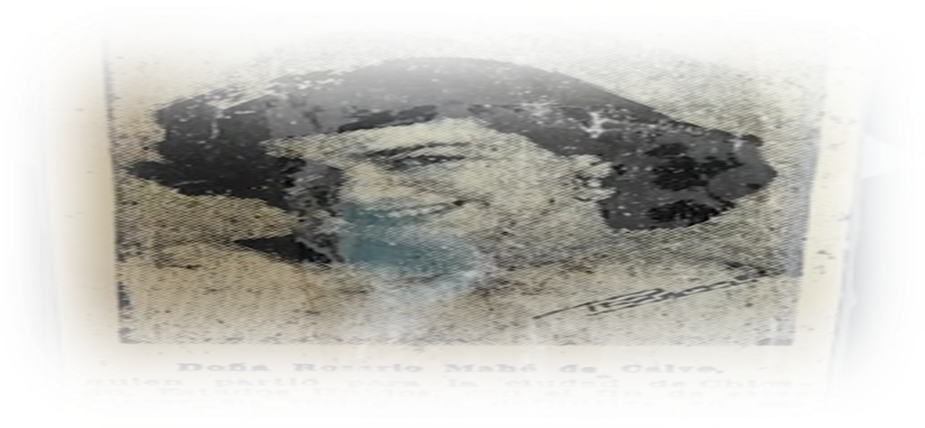
She’s been gone a long time now.  Thirty-three years, a month and five days.  And I think of her often.  I keep the plastic box which for a brief time held her ashes on a shelf in front of my desk, a box I’ve filled with little things I thought she might find meaningful: my sons’ baby teeth, an old bathing suit each wore in turn, my eldest son’s high school identification card, a cell phone my college roommate, now deceased, once gave me.  And taped to the box is a photocopy of a brief article in our local paper here in Manizales, I paper for which I write from time to time, an article with a photo of her, wishing her well as she moved to a new country.  An article almost three quarters of a century old.

I glance at that picture often, and I keep it close to me so that the pain of her passing lives on but morphed into something beautiful and positive, something that gives me courage and hope when I most need it, and an example to follow when I’m tempted to stray from the paths she sowed so carefully for me.

Happy birthday Mom, and thank you for being you, and thank you for everything you miraculously did to make me who you hoped I’d be.
_______

© Guillermo Calvo Mahé; Manizales, 2023; all rights reserved.  Please feel free to share with appropriate attribution.

Guillermo (“Bill”) Calvo Mahé (a sometime poet) is a writer, political commentator and academic currently residing in the Republic of Colombia (although he has primarily lived in the United States of America of which he is also a citizen).  Until 2017 he chaired the political science, government and international relations programs at the Universidad Autónoma de Manizales.  He is currently the publisher of the Inannite Review, available at Substack.com, a commentator on Radio Guasca FM, and an occasional contributor to the regional magazine, el Observador.  He has academic degrees in political science (the Citadel), law (St. John’s University), international legal studies (New York University) and translation and linguistic studies (the University of Florida’s Center for Latin American Studies).  However, he is also fascinated by mythology, religion, physics, astronomy and mathematics, especially with matters related to quanta and cosmogony.  He can be contacted at guillermo.calvo.mahe@gmail.com and much of his writing is available through his blog at https://guillermocalvo.com/.

Paradise Lost or Perhaps Just Never Attained

Sequentially serial monogamy.  Or polygamy, or polyandry, or polyamory, or what have you.

Are those among the paths nature expected us to tread?  Paths that would separate and segment child bearing, child rearing, sexual intimacy, economic collaboration and companionship into different functions, each potentially involving differing relationships over time, but relationships tied together through decency and harmonious post relationship continuity?  Something I think Robert Heinlein seemed to espouse and which makes a great deal of sense, but with which, emotionally, most of us are not prepared to cope, that inability being primarily attributable to hypocritical Abrahamic strictures which insist that jealousy and possession ought to be our prime motivators.  Motivators that rule our personal lives as well as our lives as members of collectives, collectives from dysfunctional nuclear families to contending nations bent on mutual annihilation.

The concepts work well in Heinlein’s novels but not that well in real life, although perhaps they should. 

Perhaps, some day, somewhere, they may.

Paradise lost or perhaps just never attained, …

_______

© Guillermo Calvo Mahé; Manizales, 2023; all rights reserved.  Please feel free to share with appropriate attribution.

Guillermo (“Bill”) Calvo Mahé (a sometime poet) is a writer, political commentator and academic currently residing in the Republic of Colombia (although he has primarily lived in the United States of America of which he is also a citizen).  Until 2017 he chaired the political science, government and international relations programs at the Universidad Autónoma de Manizales.  He is currently the publisher of the Inannite Review, available at Substack.com, a commentator on Radio Guasca FM, and an occasional contributor to the regional magazine, el Observador.  He has academic degrees in political science (the Citadel), law (St. John’s University), international legal studies (New York University) and translation and linguistic studies (the University of Florida’s Center for Latin American Studies).  However, he is also fascinated by mythology, religion, physics, astronomy and mathematics, especially with matters related to quanta and cosmogony.  He can be contacted at guillermo.calvo.mahe@gmail.com and much of his writing is available through his blog at https://guillermocalvo.com/.

Karma and Me

Progeny, it turns out, was not all I hoped it would be, what I expected it’d be, all that I worked so hard to make it.  Futility?  Perhaps.  But then again, perhaps not.  Apparently, despite their reflections, opinions and observations concerning me, my three sons are happy with who they are, and, in an important sense, they’ve highlighted the many errors I made.  Not as a father, although they’ve plenty of complaints, but as a son to an amazing mother I too often took too much for granted.  Especially when I was younger.

And then, I wonder. 

I wonder how my mother felt about her own progeny.  Thinking about it objectively, were I her, I would have considered us an ungrateful bunch, too often, in my sister’s case, bitterly critical, and in my brother’s, unable to wean successfully, and in mine, to whom she gave more than to any of my siblings, perhaps too cocky, to sure I was right and she was wrong.  Too distant.  Too much like my own sons.

Karma’s a bitch, but as someone who hates to be indebted, it’s better this way. 

Who knows, perhaps I’ve accumulated a positive balance.  But I so wish I would have been a much better son, a more understanding son, a more accepting son, one who more vocally expressed his love, admiration and gratitude.  Now, given the ways of destiny and time and entropy, it’s too late.  Unless somehow my mother, from far beyond the veil, can sense what I now feel and what I now understand and can enjoy it, revel in it, and somehow grasp and hold it.

What I wouldn’t give to be able to correct all my past mistakes, to have been more understanding, less egocentric, more empathic. 

More like her.
_______

© Guillermo Calvo Mahé; Manizales, 2023; all rights reserved.  Please feel free to share with appropriate attribution. Guillermo (“Bill”) Calvo Mahé (a sometime poet) is a writer, political commentator and academic currently residing in the Republic of Colombia (although he has primarily lived in the United States of America of which he is also a citizen).  Until 2017 he chaired the political science, government and international relations programs at the Universidad Autónoma de Manizales.  He is currently the publisher of the Inannite Review, available at Substack.com.  He has academic degrees in political science (the Citadel), law (St. John’s University), international legal studies (New York University) and translation and linguistic studies (the University of Florida’s Center for Latin American Studies).  However, he is also fascinated by mythology, religion, physics, astronomy and mathematics, especially with matters related to quanta and cosmogony.  He can be contacted at guillermo.calvo.mahe@gmail.com and much of his writing is available through his blog at https://guillermocalvo.com/.

Of Cerulean and Cyan and Vermilion Too

A young man wonders about colors, specifically two, although perhaps three.  He’s been named after one of them, although little of anything concerning the color seems to apply to him.  He wonders what his parents had been thinking when they chose that name for him, and he reflects that he’s never actually been christened, so perhaps the name has not yet been as impactful as his parents had hoped.

He might have elected to study art, but he studied language instead, as had his mother.  His father, a florist, wondered why.  Sometimes he did too.  His mother was pleased though, and his two sisters didn’t seem to have ever considered why he studied what he did, or why his name often seemed so blue.  At first blush theirs seemed a bit more traditional, but that wasn’t quite true.  Hmmm.

Cerulean leans more towards blue than does the more balanced cyan.  And cerulean, although a light variant of blue, is darker than cyan.  Of course, that means that cyan leans more towards green than does cerulean, which just shares green’s echoes and smiles, and perhaps its similes, and that cyan is darker, but not much.

The young man thinks they’re friends, and that perhaps, at one time or another, they’ve been lovers, or perhaps just kissing cousins.  In imperial Byzantium they might have had an awkward relationship, with cerulean angry at cyan’s flirtation with green, but he wonders how they got along in subsequent Muslim caliphates, perhaps in Istanbul?

He wonders how cyan and cerulean feel about azure.  Or how cerulean feels about vermilion, either cyan’s complement or antithesis, depending on perspectives.  Or how vermilion feels about cyan, a complex relationship.  And whether their feelings are reciprocal or complimentary or constant or true, or just passing fancies.

He wonders if his parents had been high when they’d selected his name.  It could have been true, they were free spirits of sorts, floating along life’s byways and sometimes stumbling along a highway or two.  It didn’t matter though.  He loved his name, and he wondered whether he’d ever find its mate, and what she would be like, and whether she’d love her name too.

Cerulean and cyan, and vermilion as well.  Perhaps, in addition to colors, they were places and times in which to lose oneself, or perhaps to find oneself, were one lost.  Like somehow lost quantum paired electrons, or just sundered hearts, or misplaced halves of the same fruit, or rainbows that had lost their colors and now dressed only in shades of grey.

He might have elected to study art, but he studied language instead, as had his mother.  His father, a florist, wondered why.  Sometimes he did too.  His mother was pleased though, and his two sisters didn’t seem to have ever considered why he studied what he did, or why his name often seemed so blue.  At first blush theirs seemed a bit more traditional, but that wasn’t quite true.  Hmmm.

A young man wonders about colors, specifically two, although perhaps three.  He’s been named after one of them, although little of anything concerning the color seems to apply to him.  He wonders what his parents had been thinking when they chose that name for him, and he reflects that he’s never actually been christened, so perhaps the name has not yet been as impactful as his parents had hoped.
_______

© Guillermo Calvo Mahé; Manizales, 2023; all rights reserved.  Please feel free to share with appropriate attribution.

Guillermo (“Bill”) Calvo Mahé (a sometime poet) is a writer, political commentator and academic currently residing in the Republic of Colombia (although he has primarily lived in the United States of America of which he is also a citizen).  Until 2017 he chaired the political science, government and international relations programs at the Universidad Autónoma de Manizales.  He is currently the publisher of the Inannite Review, available at Substack.com.  He has academic degrees in political science (the Citadel), law (St. John’s University), international legal studies (New York University) and translation and linguistic studies (the University of Florida’s Center for Latin American Studies).  However, he is also fascinated by mythology, religion, physics, astronomy and mathematics, especially with matters related to quanta and cosmogony.  He can be contacted at guillermo.calvo.mahe@gmail.com and much of his writing is available through his blog at https://guillermocalvo.com/.

The Eighth Day of May

Today, May 8, 2023, is an important day to me because two very important people were born on that day, long ago.  Vicki Meryl Forest (now Baker) and Michael Harris Jordan.  Two very different people important for very different reasons.

Vicki is 70 today.  She and her delightful family were wonderful to me during very difficult times.  Unfortunately, in the end, I couldn’t bring myself to culminate the wonderful relationship we shared because of the trauma of the one that preceded it.  Vicki deserved everything I could have given, she was an amazing woman, a delight in every sense.  I know that whoever she’s with today is a happy man, and I’m certain she made a wonderful mother.  I often recall her father Irvin and mother Lucie, her sister Elise and nieces Jennifer and Melissa, and her brother-in-law Saul Sklar, with whom I still correspond from time to time.  I recall them all with a great deal of love.  Vicki was sunshine crystalized, I’m pretty sure she still is.

Coincidently, Michael would also have been 70 today.  He was a fascinating person, the son of my friend and sometimes client, David E. Jordan, a financier of sorts, as was his son.  He was short and stocky and funny and creative and bright, a great chef and a very decent man.  He experimented with all kinds of things during his life, which unfortunately, ended much too soon.  Not that everything in our relationship was rosy and bright from a professional aspect, but that was more due to his dad’s misadventures and to one of his brother’s machinations.  But in sum, it was a privilege and a joy to have been a part of Michael’s life.

It’s a pretty day high in the central range of the Colombian Andes where I now live, close by to a volcano seemingly stirring by the side of a tall former glacier, far from the Islands in New York where I met them both, and the Florida peninsula where I last interacted with them.  But they’re comfortably ensconced in my memories and in my heart.

And they always make the eighth day of May very special.
_______

© Guillermo Calvo Mahé; Manizales, 2023; all rights reserved.  Please feel free to share with appropriate attribution.

Guillermo (“Bill”) Calvo Mahé (a sometime poet) is a writer, political commentator and academic currently residing in the Republic of Colombia (although he has primarily lived in the United States of America of which he is also a citizen).  Until 2017 he chaired the political science, government and international relations programs at the Universidad Autónoma de Manizales.  He is currently the publisher of the Inannite Review, available at Substack.com.  He has academic degrees in political science (the Citadel), law (St. John’s University), international legal studies (New York University) and translation and linguistic studies (the University of Florida’s Center for Latin American Studies).  However, he is also fascinated by mythology, religion, physics, astronomy and mathematics, especially with matters related to quanta and cosmogony.  He can be contacted at guillermo.calvo.mahe@gmail.com and much of his writing is available through his blog at https://guillermocalvo.com/.