On the Apotheotic Metamorphosis of Political Leaders and the Possibilities of Antichristic Reincarnation: a Gaelic Satire of Sorts


Abstract:  A Gaelic-style satire speculating on whether President Donald J. Trump is more likely to be a reincarnation of Gaius Julius Caesar Augustus Germanicus or the Pauline antichrist or possibly both or neither, and whether quantum theories provide other possibilities. [1], [2]  

Key Words: “Trump”, Caligula, Antichrist, “Saul of Tarsus”, Reincarnation, “Evolutionary monist panentheism”, “Gaelic satire”, “Quantum Theories”.

There are people today who claim to believe that Donald John Trump, the current president of the United States is the antichrist[3], the one predicted by Saul of Tarsus in his guise as Paulus, the Roman Jew who created the religions today grouped together as Christianity[4].  Only a few of those who make that claim, however, are really religious.  Nonetheless, their message has resonated, albeit primarily among political opponents.  I believe there may be a more likely, less supernatural possibility (or perhaps metaphor): one involving the possibility of “reincarnation”.  That concept is usually relegated to metaphysics and oriental religions but it’s actually a pretty widely held, although perhaps not a firmly held, belief[5].  However, there is a tempting hypothesis that makes it sound reasonable, one involving “evolutionary monist panentheism[6]” premised on a belief that the omniverse may be sentient and that it evolves by learning through experience, experience acquired using reincarnation of its biological components as a tool.  Waste not want not. 

The reincarnation hypothesis is as difficult to prove as it is impossible to disprove and with reference to the scientific method the question always is, is it “testable”?  It is not, not yet, perhaps never.  No hypotheses concerning the “after life” are but yet, they are widely held and by some pretty smart people (as well, of course, by many people of questionable sanity).  Still, the reincarnation hypothesis seems at least as possible as Paul’s beliefs concerning the antichrist.  Until, of course, the antichrist shows up.  If he or she does.  That would tend to render the hypothesis tested.

So, let’s examine both of the foregoing hypotheses.  First we’ll look at reincarnative possibilities and then we’ll delve into antichristic possibilities and finally, we’ll very briefly consider other alternatives. 

Cheers!!!  A nice goblet of brandy may go very well with the following.

On the Possibility that the Current President of the United States is a Reincarnation of a Late Roman Princeps[7]:

We initiate this analysis by recalling an event that occurred during October of the 37th year of the Common Era (although the timeline had yet to be designated as such).  It involved a young fellow by the name of Gaius Julius Caesar Augustus Germanicus (formerly just Gaius Julius Caesar, a name he shared with his great grandfather) but better known to history as “Caligula[8]” (“little boot”, a nickname he hated)[9].  That year Caligula (I’ll use that name given that I’m not all that fond of him) came to believe that he’d undergone an apotheotic metamorphosis and had been transformed, while alive, from a mortal into a divinity.  Such transformations, at that time, were not unusual but they generally occurred postmortem.  Today, well, it’s been a while, but ….

At the time of his apotheotic metamorphosis, Caligula was the anointed “princeps” (first citizen) of the Roman people, a title akin to that of Führer among twentieth century Germans (which raises another possible reincarnation scenario).  Caligula had many other titles though.  Titles which included but were not limited to Pater Patriae, Pontifex Maximus and consul (several time).  But for purposes of this speculation I especially like his title as “Optimus Maximus Caesar” (the Greatest and Best Caesar), one that would certainly appeal to Mr. Trump who would probably have added the term “Ever”.  Moderns seem to believe that Caligula was referred to as “emperor” but they’re mistaken, they frequently are. 

History has not treated Caligula kindly but then, history not infrequently[10] records events in a manner very different from that which an objective observer would consider accurate. History is, after all, a sort of calcified version of journalism and we know just how unreliable journalism can be.  It always has been[11].  All too frequently, as is the case of journalism and journalists, historical verities are completely obfuscated and, in the case of Caligula, or Gaius Julius Caesar Augustus Germanicus if you prefer, that might well have been the case (Barrett, 2015).

Now to the crux of our speculation: i.e., events in the United States of America that took place on the weekend of April 11 through 12 of 2026 when a “president” of the United States (not quite the same as a “princeps”, at least not yet, at least not that we know of although some suspect) apparently had an experience analogous to that of young Caligula after a dispute with the now current Roman Pontiff, Robert Francis Prevost (whose papal name is Leo XIV).  Interestingly, like Caligula, Pope Leo is a man of many titles, one of which is shared with Caligula, that of Pontifex Maximus.  But Leo is not the object of our speculation.

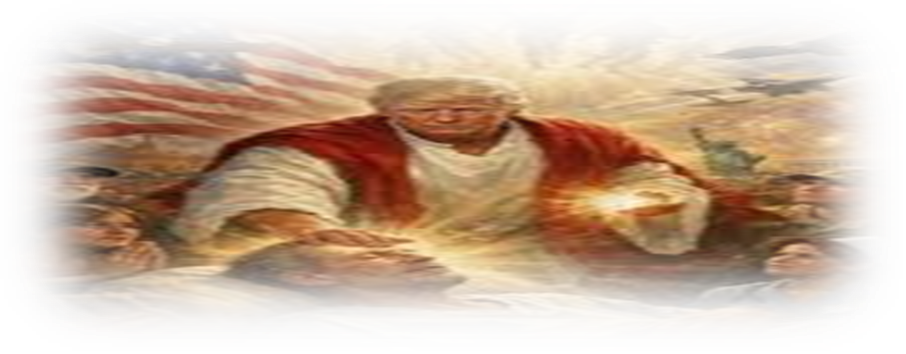
For some reason hard to decipher other than perhaps a belief that he had been, was being or would be deified while alive, Mr. Trump publicly shared artificial intelligence assisted artwork on a self-serving (some would assert, self-aggrandizing) Internet platform which he founded and ironically named “Truth Social”.  The “artwork” portrayed Mr. Trump as a divinity, apparently as Yešu the Nazarene[12], the itinerant Palestinian Hebrew civic activist and healer who may have lived several millennia ago[13].  After due reflection, well after due reflection following massive public outrage, Mr. Trump removed the offending post claiming that he’d been misunderstood, as usual, and that the “artwork” merely depicted him as a “physician” curing a patient through non-traditional means.  An interesting reaction.

Many people throughout the world found Mr. Trump’s post reminiscent of the ancient Roman princeps Caligula and speculation concerning similarities between Mr. Trump and Caligula became rife, although such speculation was not new[14].  In Mr. Trump’s defense, he might have referenced the fact that, unlike Caligula, he has yet to seek a seat in the Senate for a horse of which he is fond although, while Mr. Trump does not currently own horses, he famously owned a thoroughbred originally named Alibi which he renamed “D. J. Trump”, one he purchased for $500,000 in 1988, but the horse never raced due to health issues and was later retired to stud[15] before dying in 1991[16].  Hmmm, “stud”, that’s purportedly how Mr. Trump perceives of himself but, given J.D.’s demise in 1991, no equine senatorial candidate is likely to be nominated by Mr. Trump, at least for now.  Still, his critics would likely have pointed out that like young Caligula, Mr. Trump also fancies himself a great artist (perhaps the greatest artist ever), or at least a great interior decorator (ditto).  And a great exterior decorator as well (with ballrooms and arches of triumph a new specialty).  Previously it had been hotels and golf courses.  And beauty pageants!  Both Caligula and the president were fond of beauty pageants although Caligula’s involved involuntary participation in erotic activities in the style of Mr. Trump’s former friend, Jeffrey Epstein, by the wives of members of the Roman Senate.  That possibility has yet to occur to Mr. Trump.  At least as far as we know.  If ever released, the Epstein files might indicate otherwise[17].

But, superficial anecdotes and similarities aside, … About reincarnation?  Is it possible that Caligula, whose career was cut short by his own Praetorians, is revisiting us?

Well, “possible” is a very open ended concept.  It’s possible that the world we perceive doesn’t exist[18] and that we’re just players in a nightmare being experienced by the earliest life form, perhaps the primal prokaryote, so perhaps reincarnation is possible and, if so, perhaps an angry and vengeful Caligula has returned to correct erroneous impressions or, perhaps, to confirm them.  Let’s assemble evidence so that we can make an informed guess, comparing young Gaius Julius Caesar Augustus Germanicus with the current avatar of Donald John Trump (sometimes referred to, at his suggestion, as “the Donald”).  And let’s assemble it using the artificial intelligence of which the Donald seems so fond when creating images some might interpret as divine. 

According to a query concerning Caligula on the Internet platform known as Chrome and a response, apparently employing artificial intelligence, here is what is popularly known about Caligula’s attributes, with my own responsive observations concerning similarities with the Donald:

  • Divine Self-Image: Caligula frequently appeared in public dressed as various gods and demigods, such as Hercules, Mercury and Venus. He was known to have the heads removed from famous statues of gods and replaced with his own, treating himself as the supreme artistic masterpiece.”  Hmmm, to my knowledge, the Donald has yet to engage “publicly” in activities comparable to the foregoing (well, except with respect to planned changes in currency) but there is a sense that he just might, given time.  To date, he only does that in artificially enhanced artwork that he posts on his personal social media platform, “Truth Social”.  That’s something young Caligula could not match.  But similarities, hmmm.  Yep!
  • Oratory and Performance: Caligula was regarded as a “renowned declaimer” and enjoyed showing off his oratorical skills. He reportedly engaged in public performances and acted in various capacities, showcasing an ego that required public validation of his talents.”  While cognizanti concerning rhetoric and grammar ridicule Mr. Trump’s “eloquence”, he himself revels in displaying his oratorical antics and he certainly showcases an ego that requires public validation of his talents.  To his admirers and followers, he certainly seems to be a “renowned declaimer”.  So, once again, yep!
  • Emulating Hellenistic Kings: Caligula admired the style of Hellenistic rulers, who were often treated as living gods and viewed themselves as patrons or creators of high art.”  Hmmm, this raises interesting questions, especially in light of his latest antics.  It seems clear that Mr. Trump views himself, especially with respect to real estate construction, as a “creator of high art”, witness his decoration of the Oval Office and the White House, his planned White House Ballroom and his proposed Arch of Triumph (as well as his plans for Gaza).  And he also seems to see himself as a monarch (something he’s also portrayed on Truth Social with the help of artificial intelligence).  So, not a perfect match but then perfection is an elusive goal.  But similarities?  Yep!  Again.
  • Dismissal of Rivals: He was known to act with extreme arrogance, with accounts noting that “no one was allowed to outrank Caligula” in any regard”.  Well, in this regard Mr. Trump clearly outdoes young Caligula and that is even without regard to his recent denigration of Catholic Pope Leo XIV.  So; … absolutely!
  • Removal of Obstructions to Personal Power:  During his brief reign, Caligula worked to increase the unconstrained personal power of the princeps as opposed to countervailing powers within the Principate”.  That pretty definitely sounds like the Donald.  Separation of powers is certainly something he ignores as he ignores concepts such as the sovereignty of independent countries, the rules of international law and anything and everything that does not coincide with his personal morality of the moment (see, e.g., Yang, 2026).
  • Military Experience”; Caligula did not lead Roman troops in a conventional battle. In the year 40 of the Common Era but he marched an army to the English Channel for a planned invasion of Britain.  However, instead of fighting, he ordered the legionnaires to attack the waves with weapons and to collect seashells as “spoils of the sea” to celebrate an imagined victory over the sea god Neptune.”  While Mr. Trump attended a military high school in New York, he “declined” to serve in the military given that the conflict in Vietnam was not healthy for his feet[19].  He did however order the kidnapping of the president of Venezuela and a joint attack (along with Israel) on Iran, in both cases, hoping that their oil would qualify as a trophy, and he provided Israel with all the funds and armaments necessary to engage in genocidal ethnic cleansing throughout the Middle East.  That should count for something.
  • Impoverishing his subjects”: Caligula impoverished the Roman treasury by squandering 2.7 billion sesterces left by his predecessor, Tiberius, in less than a year. His lavish spending on spectacles, personal luxury and extravagant building projects led him to seize private property, raise taxes and resort to extortion to fund his reign.”  Hmmm, well, Mr. Trump also spends lavishly, largely at the behest of his buddy, Benjamin Netanyahu, and, together, they increased the United States national debt from less than twenty trillion dollars at the beginning of Mr. Trump’s initial term as president to almost forty trillion by the end of his fifth year in the presidency, albeit with a little help from his friend Joey Robinette Biden.  Well, not so much a friend as a bitter enemy but with shared values and goals (they both enjoyed plundering).  But Joey was the friend of a friend (Bibi) and it’s the thought that counts.  And Mr. Trump did raid and steal assets to help fund his extravagant ideas, especially from Venezuela.  Like Caligula (and Eric Cartman of South Park fame), the Donald’s motto has been “I can do whatever I want”!  And of course there’s the White House ballroom and the proposed Arc de Triomphe, etc., so, one more time, a hearty yep!

Hmm, it seems there may be disturbing trends echoing in from the past.  And they continue:

A Wikipedia entry with respect to Caligula[20] asserts that he was initially perceived as a “good, generous, fair and community-spirited” sort of guy but that he promptly became “increasingly self-indulgent, cruel, sadistic, extravagant and sexually perverted”, eventually evolving into “an insane, murderous tyrant who demanded and received worship as a living god, humiliated the Senate and planned to make his horse a consul”. However, the Wikipedia article notes that, on reflection, given the fact that his history was written by Senatorial detractors long after his assassination, modern historians “dismiss many of the allegations against him as misunderstandings, exaggerations, mockery or malicious fantasies”.   Well, the media, other than that controlled by pro-Israeli Zionists such as Fox News, has given Mr. Trump a pretty hard time up to now but, as a result, pro-Israeli Zionists have gone on a buying spree buying-up numerous media sources[21], especially those that have been critical of Mr. Trump, like CNN.  Sounds like the future may hold further similarities.  Here again echoes seem to ring loudly with reference both to the “unflattering” written conclusions concerning Mr. Trump and his defense by those inclined to view him more favorably.  Sycophants I think they’re called[22].

Continuing:

With reference to the observations of more prurient similarities between Mr. Trump and the Princeps, Caligula, for many decades Mr. Trump has been viewed as a sexual addict, a sexual predator and perhaps even a sexual pervert[23] (as was Caligula), especially given his close relationship with Jeffrey Epstein but, during his first term as president it can be argued that his intentions at least were “good, generous, fair and community-spirited”.  It is also clear that during that time his opponents engaged in a vicious and unfair campaign to discredit him[24].  However, apparently at least in part due to the abuse he suffered during his first term and even more, to the abuse he suffered during the Joseph Robinette Biden presidency, his second term has been very different from the positive aspects that seemed possible during his first term thus, all of the pejorative descriptions of Caligula seem to be have become germane with respect to Mr. Trump[25], except, of course, the references to equestrian matters.  At least for the nonce.  It seems unlikely that equines will soon obtain representation in the United States Senate; golf clubs however, may be a different matter.

Anyway:

Partially as a result of the Biden administration’s abuse of power and its own corruption following Mr. Trump’s initial term, a supportive reaction occurred among the electorate and he was elected to a non-consecutive second term, a rarity in United States political history.  He was elected amid expectations that he would reverse the Biden administration’s support for Israeli military adventures, genocide and ethnic cleansing and the foreign interventionism that had characterized four of the previous United States presidencies (the Clinton, Bush, Obama and Biden presidencies), after all, that’s what he’d promised (among a plethora of other things). 

So, another similarity crops up, predecessors!!  Caligula’s predecessor, Tiberius Claudius Nero (then Tiberius Julius Caesar, then Tiberius Julius Caesar Augustus) had been very unpopular towards the end of his reign and it was hoped, even expected, that the abuses of Tiberius would be curbed when Caligula came to power.  No such luck.  Pretty much the same can be said with respect to the Donald.  Almost immediately following his second inaugural however, all restraints were cast aside and delusions of grandeur comparable to those of young Caligula were made manifest. Well, at least more manifest than theretofore.  Indeed, Mr. Trump specifically insisted, in response to critics, that neither the United States Constitution nor international law nor the opinions of non-aligned religious leaders nor public opinion restricted his activities in any manner, only his own “morals of the moment” being relevant[26].  As a result, Mr. Trump has quickly become (as was the case with Caligula) the least popular president in recorded United States history[27], a perception shared throughout the world with the exception of genocidal Israel and the few world leaders who find both Mr. Trump and his apparent political master, Benjamin Netanyahu, men to be admired, a view however not shared by most of their subjugated populations.

The term “least popular” is complex though, at least among the United States electorate.  Mr. Trump’s most fervent followers profess to devout Christianity and continue to support him, no matter what, completely ignoring all vestiges of reality, even as his conduct becomes more and more deranged and at odds with the Christianity they claim to profess[28].  Thus this speculation (intended as a “satire” in the ancient Gaelic sense) is, in part, a reaction to the reactions of many people for whom the author cares and who he respects respects (having shared similar educational backgrounds) but whose ability to grasp reality now seems impossible for the author to understand.  Well, unless he takes into account the impact of B. F. Skinner’s behaviorist psychology and modern communications theory[29] and the apparent reality that facts not only do not impact strongly-held opinions but that contradictory facts seem to reinforce them[30].  The author is specifically alluding to attitudes by Mr. Trump supporting and enabling genocidal events in the Middle East by Israel, the Pearl Harbor-like attack on Iran by the United States and Israel and ignoring the Zionist attitude towards Christians in the Middle East where spitting on Christians and desecrating Christian artifacts and destroying churches is considered a Jewish tradition[31] (something with which non-Zionist Jews do not agree).  Facts with reference to the foregoing are plentiful and readily available but, as in the case of the “say no evil, see no evil and hear no evil simians”, such facts are blissfully ignored by United States citizens, many of them military veterans and religious Christians who one would think, based on heretofore shared values and shared educational experiences, would know better.  But they don’t, and they don’t aggressively.  They view those who believe as the author[32] does to be historically ignorant, deluded and lacking patriotism.  Fair enough.  Thus this “satire”.

So, enough about Mr. Trump as the incarnation of Caligula (for the moment).  The evidence is strong but not conclusive.  And we still have no definitive evidence that reincarnation exists at all, although it may be a possibility.  But what about Mr. Trump’s potential role as the antichrist?[33]

On the Possibility that the president of the United States is the Antichrist Envisioned by Saul of Tarsus (and others):

Some of Mr. Trump’s followers, perhaps many, assert that he is the catalyst for the second coming of Yešu and that his seemingly deranged current activities in the Middle East in support of the quest for Israeli hegemony should be seen as the precursors for the great battle they anticipate at Armageddon, the herald for Yešu’s return.  Of course, that would tend to support the hypotheses that Mr. Trump really is the antichrist[34] rather than merely the reincarnation of Caligula as the role of catalyst for Armageddon is usually ascribed to that entity.  But what are the purported attributes of the antichrist and how do they relate to Mr. Trump?  Again I’ll seek the assistance of a version of artificial intelligence as superficially provided by the Chrome Internet browser for assistance:  Based on Pauline prophecies the antichrist is depicted as a charismatic, deceitful global leader and dictator who appears during the end times[35]. Among his principal characteristics are the following, which I will compare with characteristics attributable to Mr. Trump:

  • The Man of Lawlessness/Sin: He is marked by total rebellion aiming to change established times and laws”.  Hmmm, pretty much on point as he has stated that he is bound neither by the Constitution or International law but only by his own “morality” of the moment (see, e.g., Yang, 2026), a morality that quickly changes as convenient.
  • “Blasphemous Ruler: He speaks arrogant words, blasphemes God.”  Hmm, I think Catholic Pope Leo XIV might have strong opinions on this point but, in a contrary fashion, so do his followers who equate his pronouncements with those of their god.
  • Charismatic Deceiver: He initially appears as a peaceful savior, using flattery and brilliant deception to gain power, often compared to a ‘little horn’ that grows in influence.”  Hmm, well, “ain’t that the truth!
  • Global Dictator: He will gain worldwide authority over nations and religions.”  Well, he certainly perceives himself in that light and is doing everything he can to make it a reality.
  • Economic Controller: He controls the global economy, forcing a mark on the right hand or forehead, forbidding anyone to buy or sell without it.”  Once again, hmmmm:  Donald Trump owns hundreds of trademarks and service marks globally, managed primarily through his company, DTTM Operations LLC. His portfolio includes over 800 trademarks in more than 80 countries, covering real estate, hotels, hospitality, apparel and merchandise, alongside political campaign slogans like “Make America Great Again”.  Aha!!!  MAGA.
  • Persecutor of Believers: He is a blood-thirsty dictator who wars against and destroys those who refuse to follow him.”  Wow!!!!  That pretty much describes the Donald, just ask former followers Tucker Carlson or Megyn Kelly or Candace Owens or Alex Jones or Clint Russell or Nick Fuentes, etc., and, of course, anyone who opposes him in any form.  Ask Pope Leo.

Observations & Contextualization

Although I usually refrain from using pejoratives such as “ignorant” and “stupid” (this speculation notwithstanding) because I feel they would be counterproductive if I am seeking to persuade, I have to admit that such thoughts do cross my mind.  And they sadden me with respect to the people who hold those beliefs who I personally know, men with whom I’ve studied or who’ve graduated from educational institutions I also attended.  And they are many.  Probably a majority.  Which leads me to ask myself how and why my perceptions and perspectives are so different from theirs.  That I may be wrong and they may be right is an essential postulate with respect to an open mind.  Empathy calls and only empathy can someday resolve our differences, assuming that empathy somehow survives.  Well then, a bit of personal revelation (a sort of pun) is probably in order, revelation that seems relevant in light of the nature of most current Trump supporters (other than Israelis) who believe themselves to be devout Christians (or else devout Zionists).  Revelation that may help to explain the differences in our perceptions, as well as similarities that may someday provide resolution. 

I’ve explored religions since I was seven years old[36] and as a young adult, taught courses on comparative religions and comparative mythologies.  Based on my research and on profound reflections I’ve come to rejected most, perhaps all the religions I’ve studied, at least as postulated, although I’ve not rejected their fundamental premises[37].  I’ve studied religions primarily from historical and philosophical perspectives using historical and philosophical sources accompanied by deep personal introspection, frequently introspection facilitated as I wrote and puzzled over, … well, the myriad puzzles[38] religions present, puzzles where questions multiply as answers become more and more evasive, although answers are not required where “faith” can substitute for facts and logic.  In doing so I encountered doctrines that were purportedly espoused[39] by Yešu and I found the precepts attributed directly to him with respect to interpersonal relationships both worthy and generous, with a sweet undertone, as opposed to those ascribed to the Pharisee, Saul of Tarsus so beloved of Trump supporters, whose doctrines seemed mean spirited and callous to me, all too frequently aligned with fund raising and control, almost the opposite of those attributed directly to Yešu.  And, of course, Saul is the primary originator of the antichrist mythos.

The association of Pauline Christianity with Mr. Trump is certainly a point of departure from Caligula who reigned during the birth of the movement that sprung up around Yešu during his lifetime.  But it’s a point of contact with respect to speculation involving the antichrist.  Caligula probably reigned shortly after Yešu’s demise, his demise either through crucifixion by the Romans, as related in what has come to be referred to as the New Testament, or torture, stoning and hanging by the Jerusalem Sanhedrin, as related in diverse versions of the Jewish Toledot Yeshu[40].  Muslims reject the notion that he was put to death and insist that Yešu (Isa to them) survived and eventually ascended directly into Heaven without a sojourn in Hell.  Caligula reigned from the years 37 through 41 of the Common Era and likely had no direct contact with or knowledge of early followers of Yešu (not yet Christians), who were still a small, emerging Jewish sect.  Of course, Mr. Trump’s Christian followers are more correctly followers of one of the many Pauline religions premised mainly on the death of Yešu rather than on the precepts he sought to imbue.  So, in matters of religion, the nexus between Mr. Trump and Caligula suffers from a temporal vacuum when it comes to how we might compare them other than the seeming fact that both appear to consider themselves divinities and that neither particularly respected religion, except in so far as it served to aggrandize them.  But the differences between Yešu’s ethical and moral teachings with respect to interpersonal relations and the divergent Pauline doctrines do a lot to explain the differing perceptions among those of us who otherwise share such similarities in education and values.  After all, Yešu never mentioned a “Christ” or an “antichrist”.

Far Off Hypotheses and Conclusions:

Wow, Caligula reincarnated versus the Pauline antichrist, it seems like a tie. 

In neither case is there demonstrably definitive probative evidence that either concept is valid which, however, is not the same as indicating that no supporting evidence exists.  “Demonstrably definitive probative evidence” is a much harder standard of proof than the “beyond a reasonable doubt standard” required for criminal conviction.  But there is definitely adequate proof that a Donald J. Trump exists (unfortunately) and it is very likely that there was a Gaius Julius Caesar Augustus Germanicus and a Saul of Tarsus and even a Yešu as well.

So, where are we in this comparative speculation in the guise of a Gaelic satire?  Are there any other possible conclusions we might want to consider?

Well, to be honest, farfetched though they may be, there are other alternative hypotheses concerning the possible apotheoses of Caligula and or Mr. Trump or others?  Indeed, there are several to the effect that fictional characters can incarnate.  One is posited by Daniil Andreev and taken seriously by some fairly intelligent people[41].  And supposedly “quantum” theories have confused everything while they have made everything possible.  So let’s speculate a bit on that hypothesis as a final element worthy of a Gaelic satire.  How about a presidential version of Yosemite Sam?  Yosemite Sam first came to public awareness during 1945, the year prior to the Donald’s birth.  While I personally don’t believe it’s likely that cartoon characters can reincarnate but the similarity is also, in some respects, uncanny.  My apologies to Sam.  The same holds true for Eric Cartman of South Park fame, another Donald Trump act-alike. 

So, in light of the foregoing, what might we conclude, recalling that this is a speculation in the form of a Gaelic satire?

Well, it’s theoretically possible that both primary speculations concerning Mr. Trump are accurate and that he is Gaius Julius Caesar Augustus Germanicus reincarnated and that both are the antichrist anticipated by Paulus, formerly Saul of Tarsus.  A sort of ribbon on this satiric package.  One seemingly more reasonable than the Yosemite Sam or Eric Cartman hypotheses.  Or, of course, none may be accurate and Mr. Trump may be sui generis, as he believes, although the nature of his uniqueness is certainly up for debate and may well be debated for centuries (as is the case with Caligula), assuming that the world survives Mr. Trump’s presidency.  At any rate, in closing, a traditional Gaelic “aspiration” may well be appropriate with reference to Mr. Trump:

Imeacht gan teacht ort!”

Interested readers may want to look it up.  It is certainly not the worst malediction one might contrive.

I wonder if this speculation qualifies as a syllogism, albeit a sarcastic and satirical syllogism.

Bibliography & Sources

Andreev, Daniil (1957, published in English 1997): The Rose of the World (translated by Jordan Roberts); Lindisfarne Books, London.

Barrett, Anthony A. (2015): Caligula: The Abuse of Power. 2nd ed. Routledge, London.

Brooks, Bras; Coster, Helen; Ax, Joseph (2026): “Trump’s AI image of himself as Jesus-like figure follows feud with Pope Leo”; Reuters, April 13, 202611:08 a.m., updated April 14, 2026, available at https://www.reuters.com/business/media-telecom/trump-posts-ai-image-himself-jesus-like-figure-drawing-outrage-2026-04-.13/#:~:text=Trump’s%20AI%20image%20of%20himself,follows%20feud%20with%20Pope%20Leo&text=Trump’s%20post%20depicts%20him%20in,with%20hand%20on%20man’s%20head.

Brown, Mark (2016): “Donald Trump has ‘fascinating parallels’ with Caligula, says historian”; The Guardian, June 1, 2016, available at https://www.theguardian.com/books/2016/jun/01/donald-trump-has-fascinating-parallels-with-caligula-says-historian.

Calvo Mahé, Guillermo (2024): “The Life of Yešu According to Diverse Jewish Sources”; Academia.edu available at https://www.academia.edu/124579552/The_Life_of_Ye%C5%A1u_According_to_Diverse_Jewish_Sources.

Calvo Mahé, Guillermo (2025): “Panentheistic Reflections on Evolutionary Structure”; The Inannite Review, Substack, September 28, 2025 available at https://open.substack.com/pub/guillermocalvomah/p/panentheistic-reflections-on-evolutionary?r=lwzkv&utm_campaign=post&utm_medium=web.

Chalmers, D. J. (2022): Reality+: Virtual worlds and the problems of philosophy; W. W. Norton & Company, New York City.

Clayton, P. (2004): Mind and emergence: From quantum to consciousness. Oxford University Press, New York City.

Frankel, Jeffrey (2026). “Caligula Reincarnated.” Belfer Center for Science and International Affairs, February 6, 2026.  Harvard Kennedy School; Cambridge, available at https://www.belfercenter.org/research-analysis/caligula-reincarnated.

Gibson, Caitlin (2017): “The Sad Saga of Thoroughbred D. J. Trump, Donald Trump’s Lone Foray into Horse RacingWashington Post, May 19, 2017 available at https://www.washingtonpost.com/news/sports/wp/2017/05/19/the-sad-saga-of-thoroughbred-d-j-trump-donald-trumps-lone-foray-into-horse-racing/.

Hedges, Chris (2026): “Trump the God”; The Chris Hedges Report, April 20, 2026 available at https://open.substack.com/pub/chrishedges/p/trump-the-god?r=lwzkv&utm_campaign=post&utm_medium=web.

Jones, Sarah (2019): “Here’s how We’d Really Know That Trump Is the Antichrist”; Intelligencer, August 21, 2019 available at https://nymag.com/intelligencer/2019/08/heres-how-wed-really-know-that-trump-is-the-antichrist.html.

M.K., anonymity required for personal protection (2023): “Spitting on Christians by Jewish fanatics continues”, WAFA, Palestinian News & Information Agency, October 4, 2023 available at https://english.wafa.ps/Pages/Details/137914.

McGinn, Bernard (1994): Antichrist: Two Thousand Years of the Human Fascination with Evil; HarperSanFrancisco, San Francisco.

McLaughlin, Roisin (2008): “Early Irish Satire”; Journal of the Galway Archaeological and Historical Society, Volume 62, January 2010; School of Celtic Studies, Dublin Institute for Advanced Studies. Dublin.

Morris EK, Smith NG, Altus DE. B. F. (2005): “Skinner’s contributions to applied behavior analysis”; The Behavior Analyst, Volume 28 Number Two, Fall 2005, pp. 99-131, available at https://pmc.ncbi.nlm.nih.gov/articles/PMC2755377/#:~:text=Our%20paper%20reviews%20and%20analyzes%20BF%20Skinner’s,role%20as%20the%20field’s%20originator%20and%20founder.

Nyhan, B. and Reifler, J. (2010):  “When corrections fail: The persistence of political misperceptions”. Political Behavior, Volume 32 Issue 2, pp. 303-330 available at https://www.jstor.org/stable/40587320.

Pauli, Adolf F. (1958): “Letters of Caesar and Cicero to Each Other”; The Classical World, Vol. 51, No. 5 (Feb., 1958), pp. 128-132.  The Johns Hopkins University, Baltimore available at https://www.jstor.org/stable/4344010.

Rottinghaus, B., & Vaughn, J. S. (2024): Presidential Greatness Project Expert Survey 2024. University of Houston; Coastal Carolina University. 

Shane, Leo, III (2019): “Trump made up injury to dodge Vietnam service, his former lawyer testifies”; Military Times Feb 27, 2019 available at https://www.militarytimes.com/news/pentagon-congress/2019/02/27/trumps-lawyer-no-basis-for-presidents-medical-deferment-from-vietnam/.

Sheehan, Colleen A. (2004): “Madison v. Hamilton: The Battle Over Republicanism and the Role of Public Opinion”; American Political Science Review, Volume 98, Issue 3, August 2004 pp. 405–424, available at https://www.jstor.org/stable/4145337].

Schneid, Rebecca (2025): “Inside Trump and Epstein’s Long, Complicated Relationship”; Time Magazine, Nov 12, 2025 available at https://time.com/7333365/trump-epstein-relationship-timeline/.

Stevenson, I. (1997). Reincarnation and Biology: A Contribution to the Etiology of Birthmarks and Birth Defects (Vols. 1–2). Praeger Publishers, Westport, CT.

Tabor, James D. (2013): Paul and Jesus: How the Apostle Transformed Christianity; Simon & Schuster, New York City.

Whitehead, Andrew L. and Samuel L. Perry. 2020. Taking America Back for God: Christian Nationalism in the United States. Oxford University Press, New York City.

Wikipedia contributors. (2026, April 12). Caligula. In Wikipedia, The Free Encyclopedia. Retrieved 00:42, April 20, 2026, from https://en.wikipedia.org/w/index.php?title=Caligula&oldid=1348470896.

Yang, Maya (2026): “‘I don’t need international law’: Trump says power constrained only by ‘my own morality’; The Guardian, Thursday January 8, 2026, 21.19 GMT, last modified on Sunday January 11, 2026 17.28 GMT, available at https://www.theguardian.com/us-news/2026/jan/08/trump-power-international-law.

_____

© Guillermo Calvo Mahé; Manizales, 2026; all rights reserved.  Please feel free to share with appropriate attribution.  This “speculation” or Gaelic satire was first published on Academia.edu.

Guillermo (“Bill”) Calvo Mahé (a sometime poet and aspiring empirical philosopher) is a writer, political commentator and academic currently residing in the Republic of Colombia (although he has primarily lived in the United States of America of which he is also a citizen). Until 2017 he chaired the political science, government and international relations programs at the Universidad Autónoma de Manizales. Previously, he chaired the social studies and foreign language departments at the Eastern Military Academy in Huntington, New York. He is currently the publisher of the Inannite Review available at Substack.com; an intermittent commentator on radio and television; and, an occasional contributor to diverse periodicals and publications. He has academic degrees in political science (BA, The Citadel, the Military College of South Carolina), law (JD, St. John’s University, School of Law), international legal studies (LL.M, the Graduate Division of the New York University School of Law) and translation and linguistic studies (GCTS, the University of Florida’s Center for Latin American Studies). However, he is also fascinated by mythology, religion, physics, astronomy and mathematics, especially with matters related to quanta, cosmology and cosmogony. He can be contacted at guillermo.calvo.mahe@gmail.com and much of his writing is available through his blog at https://guillermocalvo.com/.


[1] This piece is way too long, even as a Gaelic satire, but I just couldn’t help myself and for those with the patience to read it, I think you’ll find it at least entertaining and possibly informative.  Give it a try!!  I double down dare you!  It’ll piss Donald Trump off no end. 

Apologies: I hereby formally and sincerely apologize, beforehand and as an afterword, to Pope Leo XIV, to Yešu, to all my friends who will be offended by a Gaelic satire directed at someone they love, to fundamentalist Zionist Christians in general, to Yosemite Sam, to Eric Cartman and to Gaius Julius Caesar Augustus Germanicus.  Better late than never.  Finally, last but not least, should it turn out that Saul of Tarsus (a/k/a Paulus) was indeed the antichrist, my apologies for having attributed that possibility to Mr. Trump and to Mr. Germanicus (assuming that is the proper modern manner of addressing Caligula).

[2] For Gaelic satire, see generally McLaughlin, Roisin (2008): “Early Irish Satire”; Journal of the Galway Archaeological and Historical Society, Volume 62, January 2010; School of Celtic Studies, Dublin Institute for Advanced Studies. Dublin.

[3] For an academic discussion of the antichrist, see McGinn, Bernard (1994): Antichrist: Two Thousand Years of the Human Fascination with Evil; HarperSanFrancisco, San Francisco.

[4] See, e.g., Tabor, James D. (2013): Paul and Jesus: How the Apostle Transformed Christianity; Simon & Schuster, New York City.

[5] For an academic study delving into the possibility of reincarnation, see generally Stevenson, I. (1997). Reincarnation and Biology: A Contribution to the Etiology of Birthmarks and Birth Defects (Vols. 1–2). Praeger Publishers, Westport.

[6] “Evolutionary monist panentheism” is a philosophical and theological worldview that posits that all reality exists within a single, interconnected divine being that is both beyond the universe (transcendent) and immanent within it. This divine reality is not static; rather, it is constantly evolving alongside the universe, with all constituent parts striving toward greater complexity and “perfection”.  See generally Clayton, P. (2004): Mind and emergence: From quantum to consciousness. Oxford University Press, New York City; see also Calvo Mahé, Guillermo (2025): “Panentheistic Reflections on Evolutionary Structure”; The Inannite Review, Substack, September 28, 2025 available at https://open.substack.com/pub/guillermocalvomah/p/panentheistic-reflections-on-evolutionary?r=lwzkv&utm_campaign=post&utm_medium=web.

[7] See, e.g., Frankel, Jeffrey (2026). “Caligula Reincarnated.” Blog Post.  Belfer Center for Science and International Affairs, February 6, 2026.  Harvard Kennedy School; Cambridge, available at https://www.belfercenter.org/research-analysis/caligula-reincarnated.

[8] A sort of strange confession impacting my probable lack of objectivity concerning Caligula is in order.  The paternal line of my family (the Calvi) has long clung to what to me appears to be a historical delusion (a variant on an urban myth so, a family myth).  Some among them claim ancestry from a certain Gaius Calvisius Sabinus who was a Roman consul in the year 26 of the Common Era.  A prior Calvisius Sabinus from whom they also claim descent was co-consul with Octavian during the 4th year prior to the Common Era, the purported year of Yešu’s birth, at least according to some.  The former  Calvisius Sabinus (although later in time) was a Roman senator who fell out of favor during Caligula’s reign, long after he’d served as consul, because he and his wife Cornelia had been accused of conspiring against the Princeps (a point of pride among those old members of my family who cling to the myth). To avoid a certain conviction Calvisius and Cornelia both committed suicide during the year 39 of the Common Era thus avoiding the trial.  Notwithstanding my certainty that the familial relationship is mythical, it did impact my earliest perceptions with respect to Caligula.  On the other hand, given evolutional biological probabilities, most people with southern European roots may well be descended indirectly from most people who bore children in that region during antiquity. Just not in a direct line as my own ancestors seem to believe.

[9] For a detailed academic discussion relating to Caligula, see generally Barrett, Anthony A. (2015): Caligula: The Abuse of Power. 2nd ed. Routledge, London.

[10] A double negative, I know, I know, I claim poetic license, after all, Gaelic satires are poetic in nature.

[11] “Yellow Journalism” preceded the Pulitzer – Hearst battles of the 19th century, see for example, the vicious journalistic battles involving Founding Fathers Thomas Jefferson (with the assistance of James Madison) versus Alexander Hamilton and even Aaron Burr [see, e.g., Sheehan, Colleen A. (2004): “Madison v. Hamilton: The Battle Over Republicanism and the Role of Public Opinion”; American Political Science Review, Volume 98, Issue 3, August 2004 pp. 405–424, available at https://www.jstor.org/stable/4145337] and, even before Caligula, Marcus Tullius Cicero and Gaius Julius Caesar engaged in written rhetorical battles were truth was not infrequently victimized, see, e.g., Pauli, Adolf F. (1958): “Letters of Caesar and Cicero to Each Other”; The Classical World, Vol. 51, No. 5 (Feb., 1958), pp. 128-132.  The Johns Hopkins University, Baltimore available at https://www.jstor.org/stable/4344010.

[12] Known primarily under Greek variants of the name such as Jesus (English), Jesús (Spanish), Jésus (French), Gesù (Italian), and Yesu (Swahili/Hindi).

[13] See Brooks, Bras; Coster, Helen; Ax, Joseph (2026): “Trump’s AI image of himself as Jesus-like figure follows feud with Pope Leo”; Reuters, April 13, 202611:08 a.m., updated April 14, 2026, available at https://www.reuters.com/business/media-telecom/trump-posts-ai-image-himself-jesus-like-figure-drawing-outrage-2026-04-.13/#:~:text=Trump’s%20AI%20image%20of%20himself,follows%20feud%20with%20Pope%20Leo&text=Trump’s%20post%20depicts%20him%20in,with%20hand%20on%20man’s%20head.

[14] See, e.g., Brown, Mark (2016): “Donald Trump has ‘fascinating parallels’ with Caligula, says historian”; The Guardian, June 1, 2016, available at https://www.theguardian.com/books/2016/jun/01/donald-trump-has-fascinating-parallels-with-caligula-says-historian.

[15] That was probably a better reward for a beloved horse than a seat in our contentious Senate.

[16] See Gibson, Caitlin (2017): “The Sad Saga of Thoroughbred D. J. Trump, Donald Trump’s Lone Foray into Horse RacingWashington Post, May 19, 2017 available at https://www.washingtonpost.com/news/sports/wp/2017/05/19/the-sad-saga-of-thoroughbred-d-j-trump-donald-trumps-lone-foray-into-horse-racing/.

[17] See, e.g., Schneid, Rebecca (2025): “Inside Trump and Epstein’s Long, Complicated Relationship”; Time Magazine, Nov 12, 2025 available at https://time.com/7333365/trump-epstein-relationship-timeline/.

[18] See, e.g., Chalmers, D. J. (2022): Reality+: Virtual worlds and the problems of philosophy; W. W. Norton & Company, New York City.

[19] See, e.g., Shane, Leo, III (2019): “Trump made up injury to dodge Vietnam service, his former lawyer testifies”; Military Times Feb 27, 2019 available at https://www.militarytimes.com/news/pentagon-congress/2019/02/27/trumps-lawyer-no-basis-for-presidents-medical-deferment-from-vietnam/.

[20] Not that Wikipedia is always a reliable source, especially as to things about which exuberant contributors feel strongly.  Caligula, however, for now, seems a safe topic.  See Wikipedia contributors. (2026, April 12). Caligula. In Wikipedia, the Free Encyclopedia. Retrieved 00:42, April 20, 2026, from https://en.wikipedia.org/w/index.php?title=Caligula&oldid=1348470896.

[21] E.g., Paramount Global, Warner Brothers Discovery, HBO/HBO Max, CNN, DC Comics and Warner Bros. Pictures and TikTok USA, etc.

[22] Hedges, Chris (2026): “Trump the God”; The Chris Hedges Report, April 20, 2026 available at https://open.substack.com/pub/chrishedges/p/trump-the-god?r=lwzkv&utm_campaign=post&utm_medium=web.

[23] See, e.g., Padilla, Mariel (2023): “Defend and Deny: What we know about Trump and accusations of sexual misconduct”; The 19th, October 26, 2023, 11:04 updated November 14, 2025, available at https://19thnews.org/2023/10/donald-trump-associates-sexual-misconduct-allegations/#:~:text=Jill%20Harth%2C%20who%20worked%20with,according%20to%20the%20Associated%20Press.

[24] Indeed, this author frequently defended Mr. Trump in diverse published articles as well as on radio and television from a number of the unfair attacks levelled against him although always stressing that such defense did not indicate positive support for Mr. Trump or for Mr. Trump’s conduct, beliefs or proposed policies.  While I profoundly regret the fact that Mr. Trump has been elected president of the United States and, as in the case of his predecessor, has been a facilitator directly responsible for genocide, ethnic cleansing and Israel’s campaign of lebensraum in the Middle East, I do not regret having defended him from unfair accusations and attacks which in fact made him more popular than ever.  Such defense, I feel, provides my critiques of Mr. Trump with more credibility, at least I hope so.

[25] Hmm, that brings up another possibility, one unrelated to the antichrist or reincarnation, spiritual possession.  But that’s beyond the scope of this already far too long “speculation”.

[26] See Yang, Maya (2026): “‘I don’t need international law’: Trump says power constrained only by ‘my own morality’; The Guardian, Thursday January 8, 2026, 21.19 GMT, last modified on Sunday January 11, 2026 17.28 GMT, available at https://www.theguardian.com/us-news/2026/jan/08/trump-power-international-law.

[27] See, e.g., Rottinghaus, B., & Vaughn, J. S. (2024): Presidential Greatness Project Expert Survey 2024. University of Houston; Coastal Carolina University.

[28] See, e.g., Whitehead, Andrew L. and Samuel L. Perry. 2020. Taking America Back for God: Christian Nationalism in the United States. Oxford University Press, New York City.

[29] See, e.g., Morris EK, Smith NG, Altus DE. B. F. (2005): “Skinner’s contributions to applied behavior analysis”; The Behavior Analyst, Volume 28 Number Two, Fall 2005, pp. 99-131, available at https://pmc.ncbi.nlm.nih.gov/articles/PMC2755377/#:~:text=Our%20paper%20reviews%20and%20analyzes%20BF%20Skinner’s,role%20as%20the%20field’s%20originator%20and%20founder.

[30] See, e.g., Nyhan, B. and Reifler, J. (2010):  “When corrections fail: The persistence of political misperceptions”. Political Behavior, Volume 32 Issue 2, pp. 303-330 available at https://www.jstor.org/stable/40587320.

[31] See, e.g., M.K. (anonymity required for personal protection; 2023): “Spitting on Christians by Jewish fanatics continues”, WAFA, Palestinian News & Information Agency, October 4, 2023 available at https://english.wafa.ps/Pages/Details/137914.

[32] Okay, I’ll confess, “I” am the author referenced above.  I was just briefly trying to maintain a more academic attitude which for some reason eschews use of the first person.  But that has quickly become tedious.  I will therefor return to using I, or me, or myself, etc., from here on out.  I can almost sense the grammatical first person smiling while the third person frowns.

[33] As a disclaimer or better yet, an admission, I’ve always believed that if an antichrist ever existed it was the man who invented the concept, Saul of Tarsus but, for purposes of this speculation, I’ll pretend to keep an open mind.  Sort of the way a journalist would.

[34] See, e.g., Jones, Sarah (2019): “Here’s how We’d Really Know That Trump Is the Antichrist”; Intelligencer, August 21, 2019 available at https://nymag.com/intelligencer/2019/08/heres-how-wed-really-know-that-trump-is-the-antichrist.html.

[35] See generally McGinn, Bernard (1994), supra.

[36] Hence my familiarity with reincarnation in the evolutional monist panentheistic sense.

[37] I confess however to being drawn to the concept of evolutional monist panentheism in an agnostic sense.

[38] As a barely relevant (perhaps irrelevant) aside, I’ve taught comparative religions in conjunction with which I’ve studied all three branches of the Abrahamic faiths as well as the Indian religions (all Indian religions revolve around a mixture of Hindu concepts sometimes mixed somehow with Islam), Buddhism, Zoroastrianism, Theosophy, primitive mythologies (which my students wisely referred to as “other peoples’ religions), etc.  In trying to understand current world politics, a study of the Abrahamic religions and their interrelationship seems essential and my friends, those who were catalysts for this speculation, clearly have a poor and superficial understanding of that topic which may help explain our divergent perspectives.  The Three Abrahamic religions, Judaism, Christianity and Islam are a complex mix of contradictions and their interrelationship is incoherent.  Islam is the bridge between the toe polar opposites, Judaism and Christianity.  It shares a very positive view of Yešu with Christianity but shares the strict monotheism of Judaism thus Islam respects both of its two related religious branches.  Indeed, were it not for Islamic tolerance, Judaism might well have been successfully expunged by intolerant Christians but, as has occurred with the Persians who saved the Hebrews from their Babylonian exile, Islam is facing existentially genocidal attacks as Israel, with United States assistance, picks off one group of Muslims after another while wealthy Muslim countries watch, perhaps not realizing their turn is coming (reminiscent of the situation criticized by German pastor Martin Niemöller with reference to the cowardice and inaction of spectators during the Nazis’ rise to power, see United States Holocaust Memorial Museum. [2023, April 11] Martin Niemöller: “First they came for the Socialists…”Holocaust Encyclopedia. Retrieved April 21, 2026, from https://encyclopedia.ushmm.org/content/en/article/martin-niemoeller-first-they-came-for-the-socialists).

[39] A sort of a digression (again), a sort of silly one this time, I’ve also studied linguistics and words tend to fascinate me.  As I wrote the word “espoused” above it occurred to me to reflect on its etymology and how it is related to both marriage on the one hand (spouse) and to support for a cause.  I guess both concepts involve “support” albeit in very different senses.  According to Chrome, the link involves a “commitment”.  Rats!  Now I’ve become interested in the etymology of the term “commit” and its use with respect to dedication as opposed to a sort of imprisonment.

[40] See, e.g., Calvo Mahé, Guillermo (2024): “The Life of Yešu According to Diverse Jewish Sources”; Academia.edu available at https://www.academia.edu/124579552/The_Life_of_Ye%C5%A1u_According_to_Diverse_Jewish_Sources.

[41] Strange as it may seem, the concept of fictitious characters incarnating or “reincarnating” into reality has been explored in both esoteric writing and speculative fiction.  See, e.g., Andreev, Daniil (1957, published in English 1997): The Rose of the World (translated by Jordan Roberts); Lindisfarne Books, London.  In The Rose of the World (Roza Mira) Mr. Andreev posits that fictional characters are not merely products of the imagination but rather entities that exist in other planes of reality and are channeled by poets and artists.  Consequently, he proposed a complex meta-geography where fictional characters can be seen as manifestations or indeed, as beings, either demonic or enlightened, that enter the human consciousness through creative inspiration.  Hmmm!!!  Pretty interesting.

On the Demise of Empathy and Tolerance and Perhaps, Everything Else: Admittedly a Rant

I’m not a believer in the divinity of a purported Hebrew Palestinian who allegedly lived several millennia ago and is worshipped by billions of people today under names he probably never heard, Jesus for Christians and Isa al-Masih for Muslims.  His name, if he indeed lived would have been Yešu, the Aramaic variant of the foregoing Greek and Arabic versions.  But while I am not a believer in his divinity and have no way to determine whether he in fact ever existed, I am a profound believer in the fundamental messages that echo in his name: to love one another and treat others as we would have them treat us and to protect the weakest and most humble among us.  According to the “gospel” of someone named Matthew, a man who never knew Yešu but claimed to know a great deal about him, Yešu’s teachings might be summarized in eight blessings known as the “beatitudes”, i.e., blessed are the poor in spirit for theirs is the kingdom of heaven; blessed are those who mourn for they will be comforted; blessed are the meek for they will inherit the earth; blessed are those who hunger and thirst for righteousness for they will be filled; blessed are the merciful for they will be shown mercy; blessed are the pure in heart for they will see God; blessed are the peacemakers for they will be called children of God; blessed are those who are persecuted because of righteousness for theirs is the kingdom of heaven; and, blessed are you when people insult you, persecute you and falsely say all kinds of evil against you because of me.

Unfortunately, today, and, to be honest, relatively shortly after they were purportedly uttered, those teachings seem, at least to me, to have been completely distorted, principally by the followers of a certain Pharisee from Tarsus by the name of Saul, a strange man who subsequently went by a Roman name to which he claimed entitlement, Paulus.  History knows him as Paul at least in English (Pablo in Spanish, Paulo in Portuguese and Italian, etc.) and ironically, from my perspective, he has been recognized as a saint (although never formally beatified or canonized).  Jews, in diverse versions of their Toledot Yeshu claim that he was always one of theirs and that he infiltrated and distorted the embryonic organization of those who initially followed Yešu in order to save Judaism by severing the followers of Yešu into a new religion, one whose members Paul referred to as Χριστιανοί (Christianoí, in English, today Christians).  To me, he was, is and always will be, a psychotic fraud.

Based on what many people I care for and respect who consider themselves Christian have indicated to me, the beatitudes have little relevance with respect to what they perceive as a promise of salvation and eternal bliss (as opposed to a threat of damnation and eternal torture).  To many, perhaps most of them, the beatitudes are an irrelevance.  All that is required is a belief that Yešu is your personal savior and that “salvation” is a gift from the “holy spirit”, an aspect of Yešu and of his purported father, YHWH; a gift that can never be earned regardless of how good a person is.  However, that is not a universally held belief among Christians, or among Muslims (a religion that stems from Christianity in a manner similar to the way Christianity stems from Judaism).  There is a major dispute among those who consider themselves Christian as to whether or not “belief alone” is enough to attain “salvation” or whether it must be accompanied by “actions” that would be pleasing to Yešu and his father and to (I can’t quite qualify the nature of the relationship) the Holy Spirit.  A third variant believes that salvation is a predestined decision by YHWH/Yešu/Holy Spirit who arbitrarily (one assumes, by consensus) pre-select men and women for salvation before they are born (the “elect”).  There are tens of thousands of variants of Christianity organized into separate sects, many of which believe that only the members of their sect can attain salvation (plus 144,000 Jews), all others, including other Christians, being destined for “the Pit”, and that salvation will become possible only after Yešu returns to earth to establish a millennial kingdom which can only occur after a battle popularly referred to as Armageddon[1], a worldwide holocaust originating near the ancient Canaanite city of Jerusalem.

Yešu, had he lived and had he been a divine avatar, might have agreed with any of the foregoing hypotheses but if he was merely a man, albeit one with a profound sense of empathy and tolerance and hope and faith in human nature would, if he somehow returned to our world and studied our history, he would in all probability be appalled to see what has been done and what is being done in his name, although perhaps in Paul’s name would be more accurate, given that Christianity is a Pauline invention.

Many Christians, especially fundamentalist Christians in the United States, are thrilled with the conflict currently broiling in the Middle East as the Zionist State of Israel attacks all of its neighbors, engaging in horrific acts of genocide and ethnic cleansing which such Christians see as the prelude to Armageddon and they see the current president of the United States, Donald John Trump and his political movement within the Republican Party (Make America Great Again; “MAGA”) as the divinely inspired catalyst for such event.  That perception is rock solid notwithstanding Mr. Trump’s hedonism and alleged pedophilia, with his followers noting that most acts people believe to be anathema and mortal, even cardinal sins[2] are fine (as long as they don’t involve blasphemy) if undertaken by Jews (or on their behalf) against the Goyim (non-Jews) despite the fact that Christians (like them) are irredeemably Goyim.  Logic does not seem to be an impediment to such beliefs, rather, illogic is a strong suit in their support, illogic being an essential element of “faith” (see infra).

It is difficult for me to understand how any sane person, especially a well-educated sane person would accept the foregoing, especially one who is among the Goyim, but many people I love and respect somehow do. In order to try and understand the phenomenon, I’ve done quite a bit of historical, philosophical and religious research, something which started when I was very young, although, at that time, not being prescient, my interest in the quest for truth and for a potential divinity was not in response to the situation today.  Concurrently with such research I have, during the past decade, tried to understand the demise of concepts like empathy and tolerance which I have always associated with the teachings of Yešu.  Indeed, they seem to be at the core of his philosophy but alien to the version of Yešu’s philosophy espoused on his behalf by Paul and, unfortunately, alien to the movement Paul founded purportedly in the name of Yešu.  The movement to which so many of my friends belong.

The history of the myriad Pauline religions seems to involve irreconcilable existential internecine conflict, conflict frequently requiring the slaughter of those with differing perspectives in the name of incoherent trivia such as the nature of Yešu, i.e., whether or not he was human, divine or both, and if both, how those natures interacted and which had priority; what the appropriate hierarchical structure of Pauline institutions should be; and, which written accounts of Yešu and diverse humans raised to a semi-divine status as saints, were more or were less accurate.  And of course, whether belief “trumps” (pun intended) empathy, tolerance and good works.  Many of my friends, way too many, believe that murder, indeed mass murder; indeed genocide and rape and mayhem in the name of the quest for Armageddon and Israeli supremacy, are virtuous, while concurrently believing that economic doctrines that emphasize equality and equity such as promoted by Yešu (e.g., socialism) over property rights are anathema.  And their beliefs are somehow centered in their devout Christianity.  How weird is that?  They explain their posture by citing scripture, chapter and verse, although not quoting Yešu, rather, quoting Paul and his colleagues or, at times, the Hebrew Tanakh

We humans have an amazing capacity to rationalize and to accept the inexplicable as valid based on a concept we refer to as “faith”.  “Faith” can purportedly move mountains and not only requires no factual support, but even suggesting that facts might be useful in analyzing beliefs held by faith alone is considered anathema and sinful (e.g., the Trinitarian belief that monotheism is not impacted by the coexistent existence of three independent divine personalities in a single godhead; or, questioning the concept of “free will” where its exercise in a non-approved manner results in eternal damnation; or, the nature of divine love that sentences its subjects to, once again, eternal damnation; or, where a perfect creator’s imperfect creation permits the murder and rape and torture of the innocent).  Thus “faith” permits some of my friends to believe in the “sanctity of evil” and in the evil inherent in empathy and tolerance and, of course, the evil inherent in egalitarian concepts such socialism and communism as well as in the supreme importance of peace.[3]

To be honest, after having studied and taught comparative religions and related philosophies for over well over half a century, although I believe that I actually love the concept of Yešu as a philosopher, one akin to Siddhartha Gautama of the Sakya Clan (whose followers refer to as the Buddha), and perhaps even Laozi (formerly Lao Tzu, he of “the Way”) and Zoroaster, the ethical dualist, etc., I find the entirety of the ahistorical Abrahamic cosmogony/cosmology to be not only impossible to credit (absent complete reliance on “faith”), but internally self-destructive and incoherent and, as an example to follow, truly anathema.  It is the Abrahamic trilogy of faiths that more than anything else has led us to where we find ourselves: a world where greed, as embodied in the Calvinist concept of the Protestant Ethic, is good and the supremacy of one group of people over others, as in racism and xenophobia is divinely ordained, but that empathy, tolerance and equity are evil; where wars are a positive and peace merely a sign of weakness and lack of ambition.  And where the refusal to win at all costs is the surest pathway to perdition.

While based on the context truth may exist independently, in the absence of divinity, it seems that in order to create standards such as good and evil, morality and ethics, we humans invent superior supernatural parental figures but, since we are absolutely imperfect, we do a poor job in the god-creation department and even where we create decent divine examples, we ignore the directives that we ourselves evolutionally attribute to them through our ability to rationalize.  That is certainly the case with the Abrahamic religions and may be the case generally.  It probably is.  Which is why empathy and tolerance, etc., never really had a chance, other than as ideals most of us consign to “utopias” while we live in “dystopias”.  Today, April 18, 2026, I see no way out of the above described dilemmas, at least for humanity.  I hope that I’m wrong and that recent events in the Middle East and their echoes in the United States have merely brought on a sort of depression.  But if I’m not wrong, perhaps if humanity passes away, the planet might be saved, even if it has to start all over again with a new dominant life form.  But if it isn’t saved (due to our “bequests”), perhaps our solar system will not notice our virulent demise.  And if our solar system does not notice it, certainly our galaxy shouldn’t either.  We can only hope that life has not, does not and will not infect other aspects of the multiverse the way we have in our tiny corner of creation.

So, so much for empathy and tolerance and survival.

What a depressing retrospective!
_____

© Guillermo Calvo Mahé; Manizales, 2026; all rights reserved.  Please feel free to share with appropriate attribution.

Guillermo (“Bill”) Calvo Mahé (a sometime poet and aspiring empirical philosopher) is a writer, political commentator and academic currently residing in the Republic of Colombia (although he has primarily lived in the United States of America of which he is also a citizen). Until 2017 he chaired the political science, government and international relations programs at the Universidad Autónoma de Manizales. Previously, he chaired the social studies and foreign language departments at the Eastern Military Academy in Huntington, New York. He is currently the publisher of the Inannite Review available at Substack.com; an intermittent commentator on radio and television; and, an occasional contributor to diverse periodicals and publications. He has academic degrees in political science (BA, The Citadel, the Military College of South Carolina), law (JD, St. John’s University, School of Law), international legal studies (LL.M, the Graduate Division of the New York University School of Law) and translation and linguistic studies (GCTS, the University of Florida’s Center for Latin American Studies). However, he is also fascinated by mythology, religion, physics, astronomy and mathematics, especially with matters related to quanta, cosmology and cosmogony. He can be contacted at guillermo.calvo.mahe@gmail.com and much of his writing is available through his blog at https://guillermocalvo.com/.


[1] Really a place, or, based on its Hebrew etymology, har məgīddō (הר מגידו), “a mountain” or “a range of hills”.

[2] “Sin” is a strange concept, without a consistent logical connection, and is branched, at least by Christians, into a hierarchy which, from lesser towards anathema, starts with venial sins, then mortal sins, then cardinal sins and culminates in blasphemy.  It’s only common link is that sin displeases the divine entity and most displeasing of all appears to be anything that challenges that entity’s claim to supremacy.

[3] On the other hand, in the absence of a defining divinity, good and evil, morals, ethics, etc., may only be human concepts unaligned with nature and “relativists” among us argue that values are really non-existent so, in that case, … Never mind.

Reflections on a Conceivably Inept Creator

Reflecting on religion this morning, specifically on the Abrahamic variants to which most of my religious friends adhere, friends I profoundly respect and generally find to be genuinely good people, it came to me that they appear to consider their creator inept. 

They obviously, albeit respectfully, consider the creator to have been incapable of creating a decent product.  Indeed, their worship is full of lamentations concerning how terrible they are and acknowledging that their deficiencies are inherent and unavoidable. Indeed, purportedly not a single one of the creator’s creations have been free from defects except, perhaps, for himself, as incarnated, but then again, can one really be one’s own creation?

Perhaps.

Don’t know why but Ford Edsels come to mind.

Anyway, “mea culpa, mea culpa, mea maxima culpa” is an obligatory refrain by his creations when engaged in formal worship although, of course, logically, the “culpa” should really be ascribed to the entity, divine or otherwise, who designed such creations, especially if it was omniscient and omnipotent at the time.  Perhaps the refrain should more accurately be: “tua culpa, tua culpa, tua maxima culpa”.

Every time we criticize human fallibility, human frailty, the human proclivity to err against the divine will, we are criticizing, not only ourselves (the divine creation) but also the angelic supervision to which we are purportedly subject.  That concept of divinity posits not only an inept creator but one so full of hubris that it blames its errors on its creations, whether on us directly or on his angelic host, some of which also proved, let’s say … “deficient”.  Nephilim come to mind, as do their fathers.

Perhaps that explains the world in which we live, one where one branch of the Abrahamic faiths, the one involving the creator’s purportedly chosen people, engage, in the creator’s name, in genocide, massive and constant theft, justified rape, etc., (and not only recently, it’s a historical trend), and his more recent adherents in another branch, the Christians (originally Nazarenes and then Cristers) look the other way like the three famous simians who see no evil, hear no evil and certainly don’t expose any evil except with respect to whatever minor transgressions they themselves have engaged in, which they bemoan and chastise, … mainly on Sundays.

My reflections are, of course, blasphemous and heretical and somehow or other, probably evil.  Or, perhaps, the creator would agree that its followers are, perhaps inadvertently, being too critical of their creator.  Being very sensitive to any criticism (consider how it purportedly dealt with its archangel Hel-el, subsequently mistranslated by the abysmally ignorant St. Jerome as “Lucifer”; or how it dealt with almost all of its creations when, in a fit of temper, it drowned them all), … it may be worth reconsidering those aspects of its worship.  Just saying, …..

Still, as Elphaba Thropp, the purported wicked witch of the west, perhaps reflecting on YHWH or perhaps just on water, exclaimed with her dying breath in the 1930s version of the Wizard of Oz (the foregoing name is, however, as envisioned many decades later by author Gregory Maguire): …

What a world, what a world!!!!

_____

© Guillermo Calvo Mahé; Manizales, 2025; all rights reserved.  Please feel free to share with appropriate attribution.

Guillermo (“Bill”) Calvo Mahé (a sometime poet and aspiring empirical philosopher) is a writer, political commentator and academic currently residing in the Republic of Colombia (although he has primarily lived in the United States of America of which he is also a citizen). Until 2017 he chaired the political science, government and international relations programs at the Universidad Autónoma de Manizales. Previously, he chaired the social studies and foreign language departments at the Eastern Military Academy in Huntington, New York. He is currently the publisher of the Inannite Review available at Substack.com; an intermittent commentator on radio and television; and, an occasional contributor to diverse periodicals and publications. He has academic degrees in political science (BA, The Citadel, the Military College of South Carolina), law (JD, St. John’s University, School of Law), international legal studies (LL.M, the Graduate Division of the New York University School of Law) and translation and linguistic studies (GCTS, the University of Florida’s Center for Latin American Studies). However, he is also fascinated by mythology, religion, physics, astronomy and mathematics, especially with matters related to quanta, cosmology and cosmogony. He can be contacted at guillermo.calvo.mahe@gmail.com and much of his writing is available through his blog at https://guillermocalvo.com/.

Yešu the Nazarene; “They would not listen, they’re not listening still; perhaps they never will”

Of all the beliefs attributed to Yešu the Nazarene, none alienated him more from mainstream Judaism and indeed, from his Roman masters than did his profound belief in equity, equality and justice, beliefs that in the economic sphere are, given the attitudes of his modern followers, especially in the United States, profoundly ironic and indeed, oxymoronic.  And they were not just beliefs but practices, both during his life among his apostles and, after his demise, in the Jerusalem community briefly led by his brother James until the movement was corrupted and perverted into the modern concepts collectively referred to as “Christianity” by Saul of Tarsus, a man who, according to Jewish lore, lore reflected in both the Jerusalem and Babylonian Talmuds but also in the series of alternative gospels known under the collective name of the Toledot Yeshu, was a Jewish mole in the Nazarene movement whose mission it was to separate followers of Yešu from mainstream Judaism, something in which Saul, better known to “Christians” as “Paul”, was eminently successful.

Most people in the United States and Europe who consistently use the term “communism” have no idea what it entails, just as they have no idea what “socialism” or “fascism” entail, believing only that they are evil totalitarian political and economic philosophies.  That they are merely pejoratives to be indiscriminately hurled against those that they oppose, regardless of how incoherent the context.  Their ignorance is not their fault, it has been carefully cultivated by both Jewish leaders and the leaders of “Christianity”, the movement established by Saul of Tarsus which captured and distorted the movement founded by Yešu, the Nazarene.  “Communism” is the direct reflection of Yešu’s teachings to the effect that we should share what we have with those less fortunate and that no one should accumulate more than is needed, especially if doing so deprives others of necessities.  Needles and camels come to mind.  That is also the premise of socialism.  Neither communism nor socialism have anything to do with totalitarianism, or with authoritarianism, or with dictatorship, or with tyranny although, as in the case of capitalism, neoliberalism, globalism, etc., those negative antilibertarian control features have been combined with economic doctrines in order to maintain elites in power.  And Yešu’s economic philosophies had nothing to do with maintaining elites in power.  Rather they urged leveling of the playing field and equality and equity for all, with justice tempered by mercy.  Remember, he preferred the company of sinners to that of hypocrites.

Of course, Yešu’s philosophies were quickly overwhelmed and subsumed by those of Saul of Tarsus, and eventually, by those of numerous Catholic Popes and then, by the philosophies incoherently evolved by followers of Martin Luther and John Calvin in Yešu’s name, e.g., the Protestant ethic and capitalism.  How Yešu must hate that, especially if he is the being who his purported followers believe him to be.  How Yešu must despise neoliberalism and globalism and neoconservatism.  How disappointed he must be that his teachings have, for the most part, been so completely perverted.  How shocked he must be as his purported followers support genocide, and ethnic cleansing and apartheid and eschew tolerance. 

Yešu, ironically given modern perceptions, was a dedicated communist.  I am not a believer in the divinity of Yešu but I profoundly respect and admire what he tried to teach us and regret that as in the song “Vincent” written by Don McLean as a tribute to Vincent van Gogh, “…. They would not listen, they’re not listening still; perhaps they never will”.

_____

© Guillermo Calvo Mahé; Manizales, 2024; all rights reserved.  Please feel free to share with appropriate attribution.

Guillermo (“Bill”) Calvo Mahé (a sometime poet) is a writer, political commentator and academic currently residing in the Republic of Colombia (although he has primarily lived in the United States of America of which he is also a citizen). Until 2017 he chaired the political science, government and international relations programs at the Universidad Autónoma de Manizales. Previously, he chaired the social studies and foreign language departments at the Eastern Military Academy in Huntington, New York. He is currently the publisher of the Inannite Review available at Substack.com; an intermittent commentator on radio and television; and, an occasional contributor to diverse periodicals and publications. He has academic degrees in political science (BA, The Citadel, The Military College of South Carolina), law (JD, St. John’s University, School of Law), international legal studies (LL.M, the Graduate Division of the New York University School of Law) and translation and linguistic studies (GCTS, the University of Florida’s Center for Latin American Studies). However, he is also fascinated by mythology, religion, physics, astronomy and mathematics, especially with matters related to quanta, cosmology and cosmogony. He can be contacted at guillermo.calvo.mahe@gmail.com and much of his writing is available through his blog at https://guillermocalvo.com/.

Syncretic Evolutionary Accretion in Human Spirituality

I recently commented on an academic colleague’s article contrasting Christian and Jewish perspectives concerning the disgraced apostle Judas Iscariot, perhaps unfairly criticizing her observations based on the Jewish Toledot Yeshu as shallow[1].  The article described Christian attitudes with respect to Judas as reflecting the most extreme example of evil and betrayal possible, an attitude indeed shared by many, but not one universally shared among more modern Christians, especially in light of twentieth century efforts to rehabilitate Judas and ameliorate the perception of the Jewish role in the arrest, torture and execution of Yešu[2], given the climactic horrors of antisemitism during the Second World War seeking to treat both in a more neutral manner. 

The Jewish attitude towards Judas, as reflected in the Toledot Yeshu (as well as in both the Jerusalem and Babylonian Talmud), predictably regard him as a hero, albeit as a hero without ethical boundaries, and as the savior of Judaism in the face of encroachment by Yešu-inspired heretics (not yet misnamed “Christians” by Saul of Tarsus[3]).  My point in criticizing (too strong a word really) the authors’ description of related Christian perceptions concerning Judas was that, to an increasing number of Christians, rather than an arch-villain, Judas Iscariot is a tragically complex figure who faced irresolvable conflicts of interest between his aspirations seeking a messianic Jewish liberator and the otherworldly idealism attributed to the victim of his betrayal, a conflict complicated by the reality that, at any rate, he was irrevocably bound to the fate decreed for him by the always strange Abrahamic deity which both he and Yešu believed they served. 

For some reason, the forgoing led me to reflect on the accretive nature of Abrahamic religions and then, to reflect on the reality that most if not all religions seem accretive.  A strange leap but that’s my story and I’m sticking to it!

Consider:

The roots of all Abrahamic religions lie in the city of Uruk in ancient Sumer.  They all start with a certain Sumerian, ironically given subsequent beliefs, the son of an idol maker.  That Sumerian’s original name was phonetically Abiramu but has reached us as Abraham.  Based on the foregoing it seems clear that most of the stories in the Hebrew Book of Genesis, e.g., the Garden, the Flood, etc., have Sumerian roots, but as Abiramu and his sister-wife Sarai and their descendants fled though Egypt into Canaan, and Judaism slowly evolved as a religion, cultural borrowing was heavy and included Akhenaton’s monotheism, the Midian religion wholesale, and from Canaan, its divinity, YHWH, one of the seventy sons of the chief Canaanite god, El.  Somewhere along the line however, for reasons unknown, Judaism shed its female deities, the numerous wives of YHWH including Anat-Yahu, Aholah and Aholibah , Asherah, Anatha of the Lions and Ashima of the Doves, not to mention the Shekinah, a process largely rejected for centuries by the common people until Hebrew women were reduced to objects bereft of rights and a religious, civic and social patriarchy, purportedly divinely ordained, was established, history having been reformulated and recorded, as necessary.  Of course, all of the foregoing also forms the predicate for both Christianity and Islam, although Christianity added a number of Hellenic religious and philosophical concepts via Saul of Tarsus (Islam has always been much closer to Orthodox Judaism, ironic given today’s genocidal antipathies).  Wow!!!  What a journey in every sense.

Syncretism is a term used to describe the dialectic process through which accretion leads to religious evolution and it was certainly evident among the religions of the country the ancient Hebrews referred to as “Mizraim” (which we call Egypt) where gods from diverse regions were added to a growing common pantheon where they eventually tended to meld.  The same seems true with respect to divinities and their respective cults in the Indian subcontinent and to the divinities prominent in ancient Greece and Rome.  It may well be true of religions in the Americas as well. 

As a young academic many, many decades ago, I taught a course on comparative religions which I elected to divide into three major segments, the first dealt with primitive spiritual concepts such as animism and totems, the second with mythologies which my students denominated “other peoples’ religions” and finally, to the enormous diaspora of spiritual and religious concepts that have become prevalent during the past three millennia.  Through it all I sensed a fount of religious instincts sprouting from somewhere in central Asia, perhaps somewhere in what is today modern day Mongolia, the place from which, periodically, waves upon waves of refugees turned invaders seemed to erupt, waves that included the Huns, the Mongols and those to whom we refer as Indo-European, Hindus, Achaeans, Aryans, etc.  I visualized the foregoing as a crescendo of peoples and beliefs, perhaps sharing a common origin, then diffracting and subsequently reassembling in differing configurations.  However, all too soon, as tends to occur, the young academic I once was found his academic pursuits deflected into first history, then political science, then law, and my quest for “a unified theory of socio-spiritual evolution” returned to the ether from which it had apparently once sprung, … until recently.  Until when, after semi-retiring to pursue personal interests and research, I returned to old roots exploring the “legends” of Gilgamesh and the origins of YWHW and of the myriad faces of Yešu, which, somehow or other, after reading the article by Ora Limor and Israel Jacob Yuval (“Judas Iscariot: Revealer of the Hidden Truth”), led me back to this introspective reflection concerning the diametrically opposed perspectives concerning both Judas Iscariot and Yešu that have subtlety but profoundly impacted our history during the past two millennia, and that has led me to reflect on how much our socio-religious perspectives are changing as time goes by, as our values change and as our memories evolve. And of how long-held traditional religious beliefs are being considered by some among our new generations as mere myths, a sort of inversion of how the students in my class on comparative religion once considered mythology, while others seem willing to accept and espouse new hypotheses concerning intergalactic aliens as the sources of our civilizations and even, of the possibility that our remote biological ancestors from the Mesozoic Era, the dinosaurs, in fact survived and merely went underground, literally, where they await in their own civilizations for a chance to return to the surface once, in our arrogance, we arrange for our own extinction.

Chaos to me is not a negative but rather, the primal state where once upon a time everything at all was a possibility and contradictions comfortably cohabited as compliments.  Strangely, modern theories of physics involving both minimalist quantic phenomena and omniversal string theories seem filled with echoes of that primordial chaos, the chaos that seems to have existed before the Big Bang or the divine seven days of creation, take your pick. 

Today, as I write, confusion appears to reign, happily enthroned and smiling, as we impatiently seek to untangle the confused webs we’ve woven and somewhere perhaps, echoes from Elphaba Thropp’s refrain at the conclusion of the 1930’s movie, the Wizard of Oz, as she slowly melted, laid low by water, “… what a world, what a world” happily resonate, and perhaps, somewhere outside the bounds of time and space, Yešu and Judas dispassionately debate.

_____

© Guillermo Calvo Mahé; Manizales, 2024; all rights reserved.  Please feel free to share with appropriate attribution.

Guillermo (“Bill”) Calvo Mahé (a sometime poet) is a writer, political commentator and academic currently residing in the Republic of Colombia (although he has primarily lived in the United States of America of which he is also a citizen). Until 2017 he chaired the political science, government and international relations programs at the Universidad Autónoma de Manizales. Previously, he chaired the social studies and foreign language departments at the Eastern Military Academy in Huntington, New York. He is currently the publisher of the Inannite Review available at Substack.com; an intermittent commentator on radio and television; and, an occasional contributor to diverse periodicals and publications. He has academic degrees in political science (BA, The Citadel, The Military College of South Carolina), law (JD, St. John’s University, School of Law), international legal studies (LL.M, the Graduate Division of the New York University School of Law) and translation and linguistic studies (GCTS, the University of Florida’s Center for Latin American Studies). However, he is also fascinated by mythology, religion, physics, astronomy and mathematics, especially with matters related to quanta, cosmology and cosmogony. He can be contacted at guillermo.calvo.mahe@gmail.com and much of his writing is available through his blog at https://guillermocalvo.com/.


[1] Limor, Ora and Israel Jacob Yuval (2011): “Judas Iscariot: Revealer of the Hidden Truth” in Peter Schäfer, Michael Meerson, and Yaacov Deutsch, eds., Toledot Yeshu (The Life Story of Jesus) Revisited: A Princeton Conference; pp. 197-220; Mohr Siebeck, Tübingen available at https://www.academia.edu/43624042/Ora_Limor_and_Israel_Jacob_Yuval_Judas_Iscariot_Revealer_of_the_Hidden_Truth_in_Peter_Sch%C3%A4fer_Michael_Meerson_and_Yaacov_Deutsch_eds_Toledot_Yeshu_The_Life_Story_of_Jesus_Revisited_A_Princeton_Conference_T%C3%BCbingen_Mohr_Siebeck_2011_197_220.

[2] “Yešu” is the correct Aramaic phonetic pronunciation of the Hellenized name of the principle protagonist of the diverse Christian faiths usually referred to as “Jesus”.

[3] According to some versions of the Toledot Yeshu, Saul of Tarsus whose Roman name was Paulus and who is referred to by Christians as St. Paul, was really a Jewish infiltrator into the evolving Yešu heresy whose role it was to sunder the movement from Judaism in order to decelerate and minimize conversion.

The Life of Yešu According to Diverse Jewish Sources

The life of the man or divinity worshipped by Christians as “Jesus” and the “Christ” and honored by Muslims as Isa or Issa is dealt with in collections known as the New Testament of the Bible and the Quran but it is also dealt with in diverse sources by Jews who despise and deprecate him as a fraud and a sorcerer. A Jewish alternative to the Christian gospels and Muslim reports in the Quran is reflected in diverse parts of the Talmud, both in the Palestinian and the Babylonian versions, but it is perhaps most detailed in a series of narratives of unknown origin or date entitled the Sefer Toledot Yeshu (the Life of Jesus; in Hebrew, ספר תולדות ישו). The numerous versions share common themes but differ widely in details and are divided into different family groups based on their similarities, principle among them being the Helena group, the Pilate group, the Herod group, the Aramaic Group, the Hebrew Group and the Yiddish Group.

The author stumbled on the Toledot Yeshu while researching the causes of cyclical antisemitism not only during the Common Era but starting with the antipathy between the ancestors of the Hebrews and the Egyptians and then the Canaanites and the Hellenes, something that seems important as the ironic Israeli attitude towards genocide is once again increasing antipathy towards Jews because of the conduct of  a politicized segment of Judaism known as Zionism which seeks to speak and act in the name of all Jews despite the objections of many who insist that Zionists do not act in their name, especially with reference to the slaughter of Palestinians and increasingly, Muslims in general.  The attitude reflected in the Toledot Yeshu is scurrilous, insulting and humiliating but then, the conduct of Christians with respect to Jews since their schism has also been scurrilous, insulting and humiliating.  Notwithstanding its tenor and purpose however, the diverse variants of the Toledot Yeshu provide interesting insights into the divergence of the Abrahamic faiths in a manner which seems to mirror the mythical relationship between their common ancestors, Cain and Abel, and provide interesting alternative perspectives with respect to the life of a mytho-historical figure who has had a major impact, for good but also for terrible evil during the past two millennia.

In this article, the author uses what he understand is the Aramaic version of the protagonist’s name, Yešu, although Christians refer to him as Jesus or Christ and Jews as Yeshua or Yeshu[1] and melds different variants of the Toledot Yeshu into a coherent narrative using footnotes to highlight alternative versions. Rather than an academic, historic and linguistic analysis, the goal of this article is to provide the general public with information concerning the substance of the narratives reflected in diverse versions of the Toledot Yeshu in an easily readable and digestible summary.  For serious and detailed academic treatments of the Toledot Yeshu reference is made to the conference held in 2011 at Princeton University under the leadership of Michael Meerson, Peter Schäfer and Yaacov Deutsch which includes articles by diverse academics and authorities on this topic and in a symposium text edited by Daniel Barbu entitled “The Jewish ‘Life of Jesus’ in Early Modern Contexts: Case Studies” found in Cromohs’ Cyber Review of Modern Historiography, Issue 25, 2022 published by the Firenze University Press, in Florence, Italy.  Cromohs is an organization that specializes in publication of “theoretically informed work from a range of historical, cultural and social domains that interrogate cross-cultural and connected histories, intersecting the history of knowledge, emotions, religious beliefs, ethnography, cartography, the environment, material culture and the arts”.  Specific suggested readings and sources are listed at the end of the article.

The Sefer Toledot Yeshu
ספר תולדות ישו

Introduction & Overview:

There is little agreement as to when the events described in the many variants of the  Toledot Yeshu took place (McDowell, 2023).  Some versions claim that the events on which they report took place as early as the year 90 before the start of what became known as the Common Era (“BCE”), the year 3671 according to the Hebrew Calendar, in the days of King and High Priest Alexander Jannaeus, while others imply that they took place almost four centuries later under the reign of the Roman Emperor Constantine.  Most, however, agree that they started during the reign of Octavius, the first of Rome’s Emperors during the first decade BCE and came to a climactic ending sometime during the last part of the reign of the Roman Emperor Tiberius or the early part of the reign of the Roman Emperor Gaius, known as Caligula during the fourth decade of the Common era.  The confusion in large part stems from variants of the Toledot Yeshu in which a royal personage by the name of Elena, Helen, Heleni or Helena plays a principle role.  In some variants, the earliest chronologically, the personage is Queen Salome Alexandra, the wife of Alexander Jannæus for some reason called Helene, but most refer to Heleni of Adiabene[2], a queen from a nearby Parthian vassal kingdom or to Helen Augusta, the mother of the Roman Emperor Constantine (Deutsch: 2011, p. 59) who lived long after Yešu’s death and the founding of Christianity.

Variants of the Toledot Yeshu differ a great deal concerning Yešu’s immediate ancestry, his birth, the sexual proclivities of his mother and how he became a heretical schismatic although they all accept the fact that he was adept at the performance of benign supernatural acts including creation and return of life, something his followers believed to involve miracles but which Jewish sources claim involved black magic using one of two sources of power.  In a majority of the cases the source involved knowledge and use of the letters of the ineffable name of the Hebrew deity, the “Shem HaMephorash” also referred to as the Tetragrammaton, the four-letter Hebrew theonym יהוה‎ transliterated as YHWH or YHVH (referred to herein as the “Ineffable Name”), but other sources claimed that Yešu’s supernatural power was based on Egyptian magic, either obtained during a sojourn in Egypt or provided to him by his cousin, the person known to Christians as John the Baptist. 

The Ineffable Name was apparently carved on the foundation stone of the most sacred section of the Hebrew temple constructed by Herod the Great to replace the temple initially built by Solomon but destroyed by the Babylonians, the same temple subsequently destroyed by the Romans (referred to herein as the “Second Temple”).  The part of the Second Temple involved was apparently the room in which the arc of the covenant was kept, a relic referred to as the “Holy of Holies”, and was accessible only once a year to the Hebrew High Priest.  If that were not the place referenced and instead, it was more generically within that precinct but more accessible, then anyone entering it might have had easy access to the Ineffable Name (unless it was hidden, perhaps somehow covered or disguised).  It seems incoherent that an almighty divinity would have been so easily manipulated by anyone with access to its name, making it seem more a tool than a sovereign. 

According to the variants that claim that Yešu’s purported miracles were accomplished through use of the Ineffable Name, Yešu was not the only one with inappropriate access thereto as the Jewish leaders who opposed him made access to the name available to various opponents of Yešu, including the person Christians refer to as Judas Iscariot but to whom Jews refer in a number of other ways, among them, as a rabbi by the name of Yehuda (Deutsch: 2011, p. 293) and to Yešu’s uncle Shimon to assist him in deceiving and betraying Yešu’s followers (Gager, 2011, pp. 224-225). Yehuda, frequently described as a learned Jewish rabbi, is the hero in most versions of the Toledot Yeshu as he defeats Yešu in an aerial battle by depriving him of the knowledge or use of the Ineffable Name by anally raping him although more subtle versions substitute the rape with urination or merely pollination with semen.

Most if not all versions of the Toledot Yeshu deal with a trial of Yešu, although disagreeing as to who presided over the trial.  In some versions it was one of the aforementioned foreign queens residing in Jerusalem. One wonders at the nature of her jurisdiction over the Jews since except in the case of Salome Alexandra, she was either the spouse of a sovereign from the Parthian vassal state of Adiabene or else the mother of a future Roman emperor, in every case during times that do not coincide with the general hypotheses concerning the period during which Yešu lived.  A second major series of versions of the Toledot Yeshu have the trial of Yešu presided over by the Roman procurator of Palestine, Pontius Pilate, somewhat coinciding with the version reflected in the Christian gospels, but assigning the execution of Yešu to the Jews themselves, Pilate having refused to take part.  Indeed, one point on which all versions of the Toledot Yeshu agree is that it was the Jews themselves who executed Yešu, something disputed publicly by Jewish leaders[3] during the twentieth century although proudly asserted in private.  A third series of variants involve the Roman emperor Tiberius, claiming that Tiberius was responsible for the execution of Yešu when a promised miracle, the virgin birth of a grandson through a daughter of Tiberius did not take place as, through the intervention of members of the Sanhedrin, the embryo miraculously given life by Yešu was turned to a stone, thus making Yešu appear to Tiberius as a heretical fraud.  Finally, a fourth series of variants have the trial of Yešu presided over by Herod Antipas, tetrarch over Galilee and Perea, rather than by the leaders of the Jerusalem Sanhedrin, and are, among other things, distinguished by the assertion that rather than having “stolen” access to the Ineffable Name, Yešu simply learned the name while at the Beit Midrash (the Jewish school), Deutsch, 2022, p. 143.

The core of all versions is similar in that Yešu was a mesmer (bastard) conceived while his mother was menstruating, that he falsely claimed to be the son of the Hebrew god and his messiah and that his deception was discovered and he was executed by the Jews for his blasphemies but there are very diverse differences among the various versions of the Toledot Yeshu concerning not only Yešu’s ancestry, birth and upbringing, but also concerning events following his trial.  In some, Yešu escaped only to be recaptured by or with the assistance of Yehuda while in others the members of the Sanhedrin proceed directly to execute Yešu, although not without difficulties, most stemming from Yešu’s use of the Ineffable Name to prevent trees from being used to hang him (hanging, rather than crucifixion being a common theme), a difficulty overcome by using other forms of vegetation, usually cabbage stalks for such purpose. Another common theme in the different variants of the Toledot Yeshu involves the temporary disappearance of Yešu’s corpse after his execution but with a number of different details concerning how it was eventually recuperated and disposed of (after an initial period when it appeared that it had ascended to join the Hebrew divinity in Heaven).

Some variants of the Toledot Yeshu continue the story beyond the disposition of Yešu’s corpse, with two further series of episodes. One deals with Yešu’s uncle Shimon and how he deceived and betrayed Yešu’s followers, leading many to their deaths by having them believe he was miraculously taking then to battle Yešu’s enemies levitating them onto a cloud only to drop them to their collective deaths, and the other, a much more interesting variant, deals with the apostles Peter, Paul and sometimes John, indicating that they were Jewish infiltrators among the followers of Yeshu whose task it was to take over the young movement and separate it from Judaism in order to minimize conversion of Jews by having the followers of Yeshu organize a separate religion with different holy days and even a different alphabet (see, e.g., Chuecas, 2022, pp. 172-175), pretty much what Saul of Tarsus, who Christians call St. Paul, did, perverting Yešu’s original teachings into the Christianity we know today.

Compilation of the Alexander Jannæus[4], Helena, Helene and Heleni of Adiabene [5] Versions

The following narrative combines elements from the version of the Toledot Yeshu that started during the reign of Judean King Alexander Jannæus (circa 103-76 BCE) prior to the Roman conquest in the year 63 BCE with versions that take place almost a century later during the period when the Parthian vassal queen Heleni of Adiabene resided in Jerusalem, purportedly as if she ruled there.  In part, that decision is based on the coincidence of factors involving the diverse Helena, Helene and Heleni variants, one of which involves King Alexander Jannæus’ wife Salome Alexandra who apparently exercised significant power following his demise.  It thus combines several disparate versions in order to provide a more ample range of events than any one of them provided independently.  Consequently, the initial events are as reported in the Alexander Jannæus variant, but the trial of Yešu is based on the narratives that predominate in the diverse Helena, Helene and Heleni of Adiabene versions.  In this regard it should be noted that there are hundreds of different manuscripts of the Toledot Yeshu with differing narratives and differing points of emphasis, none of which can be deemed more representative than the others.

The Alexander Jannæus version[6] relates that there had lived in Bethlehem an attractive albeit disreputable man of the tribe of Judah[7] whose name was Joseph Pandera[8] and who lusted after an attractive but chaste woman by the name of Miriam[9].  Miriam was the daughter of a widow and betrothed to a god fearing Torah scholar descended from the royal house of David whose name was Yohanan. At the close of a certain Sabbath, Joseph Pandera, apparently with the connivance of Miriam’s mother[10], surreptitiously entered Miriam’s darkened room late at night, surprising her as, although under Jewish law, Yohanan, as her betrothed, was entitled to enjoy carnal relations with her, he had declined to do so or did so infrequently, but at any rate, because she was menstruating and it would have been inappropriate for him to have had intimate relations with her at that time.  At any rate, on that night, Joseph Pandera, pretending that he was Yohanan, had forced her to engage in conjugal relations with him notwithstanding her menstruation, after which he had departed[11].  When next Miriam had encountered Yohanan and criticized his behavior, so alien to his normal strict adherence to Jewish laws and traditions, he, shocked, had denied that he had forced himself on her or had even been with her that night, and, after they had both questioned Miriam’s mother, Miriam and Yohanan became aware of her rape by Joseph Pandera.  Even worse, the rape of Miriam had left her with child. [12]

Furious and horrified, Yohanan had sought counsel from Shimon ben Shetach, a Pharisee scholar and Nasi (referred to in rabbinic literature as a rabbinic Sage ranking with Hillel) of the Sanhedrin closely connected with the royal court.  Unfortunately, according to Rabban Shimeon ben Shetach, because of the absence of qualified witnesses to the rape (usual, of course, in the case of rape), neither Yohanan nor Miriam had any legal recourse against Joseph Pandera who thus escaped the incident free of punishment, Jewish law being notoriously antifeminine.  Devastated but also irresponsible, Yohanan had then abandoned Miriam to her fate and left for Babylonia.  In some variants, Miriam then fled to her relatives in Bethlehem but they refused to help her and she gave birth in a stable (Yellin, 2022, p. 151) while other variants claim that Yohanan left for Egypt with Miriam and accepted the child as his own.

At any rate, Miriam eventually gave birth to a son she named Yehoshua after her brother (or, in some versions, her father) and, as called for under Hebrew law, he was duly circumcised on the eighth day following his birth[13].  When he attained the proper age, Miriam had him admitted to the study of Jewish traditions in Jerusalem, a study at which he excelled, excelled so much that not infrequently he corrected scholars assigned to teach him and his peers, much to his teachers’ embarrassment and annoyance. On one such occasion, while the rabbis were discussing the Tractate Nezikin[14], he gave his own impudent interpretation of the law and, in an ensuing debate, held that Moses could not be the greatest of the prophets if he’d had to receive counsel from Jethro. Because of his conceit and arrogance he was not popular with either his teachers or with his classmates, both groups eventually finding opportunities to cause him significant harm, opportunities made possible, according to this variant, by Yehoshua’s own childish carelessness and conduct and, notwithstanding his erudition, by his inattention to ritual details.

According to the Alexander Jannæus version of the Toledot Yeshu, one day Yehoshua (the name initially used prior to his excommunication) had disrespectfully walked in front of the “sages” (either his teachers or members of the Jerusalem Sanhedrin, or both) with his head uncovered and had greeted only his own teacher while ignoring the rest of the scholars present.  That had set them to speculating on his unnatural nature.  Much more seriously on a subsequent occasion, he had been playing with a ball (or hoop) and, chasing it, had inadvertently entered the Second Temple, again bareheaded. Because of the foregoing, and because of the malice that the scholars bore against Yehoshua they decided to conduct a thorough investigation as to his background, an investigation which eventually led them back to the famous Rabban Shimeon ben Shetach, the rabbi with whom Yohanan had consulted concerning the rape of Miriam and in whom he had confided, and the rabbi had shared with the members of the Sanhedrin involved the information with which he had been entrusted by Yohanan, information which, after being threatened with torture and death, Miriam had confirmed[15].  Thus, Yehoshua was declared a mamzer (a bastard), expelled from his studies, excommunicated from his faith and his name had been expunged (whereupon he became known merely as Yeshu[16]) and forced to flee to Upper Galilee where he remained until King Alexander Jannæus expired and his wife, Salome Alexandra assumed the leading role in the governance of Judah.

Upon the change in leadership, Yeshu had purportedly slipped back to Jerusalem and then surreptitiously entered the sacred precincts of the Second Temple, entry that had been forbidden him when he’d been excommunicated[17] and while there had come upon the Ineffable Name of the Hebrew god which was carved on the stone tablet on which the Arc of the Covenant was set[18].  The Arc of the Covenant, the most sacred relic in all of Judaism and referred to as the Holy of Holies, was kept in a room in the shape of a perfect cube fifteen feet in every direction modeled on the wilderness tabernacle that had been constructed in accordance with the specific instructions given to Moses by the Hebrew god himself, a room considered so sacred that only one person, the High Priest, was allowed to enter it, and then only one day out of the entire year, because it was claimed that it was the actual dwelling place of the Hebrew god[19]

The Ineffable Name was protected by two figurines in the shape of huge brass lions (or perhaps dogs, it was hard to tell) stationed at the entrance to the innermost precincts of the Second Temple so that anyone who improperly obtained knowledge of the Ineffable Name would be shocked by their roars into forgetting it upon passing them as he left.  Knowing of this because of his studies of Hebrew law and lore, Yeshu had copied the letters of the Ineffable Name using a bit of charcoal from the brazier set near the entrance to the Holy of Holies on a tiny slip of parchment that he had fortuitously brought with him, and, using the power of the Ineffable Name to perform miracles, he had sliced open his thigh (or perhaps his calve) without feeling pain and had hidden the small parchment inside his own skin, healing, the incision with the power thus obtained thereby making it possible to recover the knowledge he would lose after exiting the Second Temple. As he’d left, the brass lions (or dogs) had roared as expected and he’d forgotten the Ineffable Name but not the fact that he’d obtained it, or how, and thus, when he came to the dwelling in Jerusalem where he’d been hiding since his return, he reopened the cut in his flesh with a knife and withdrew the parchment, recovering the knowledge he’d lost and thus attaining the ability to perform all kinds of miracles through use of the letters of the Ineffable Name, including, the miracle of immediately healing the incision he had made.[20]

Using the ability thus obtained, Yeshu made himself known in Jerusalem and throughout diverse sectors of Judea[21] including the towns of Bethlehem and Nazareth and the Upper Galilee, performing benign miracles by helping the afflicted and diseased, miracles he always attributed to the Hebrew god and, eventually, he gathered a following of three hundred and ten young Jewish men.  He also refuted those who had spoken ill of his birth and those who had excommunicated him, asserting that they had done so only because they had been jealous of his knowledge which threatened their quest for wealth and power and despised him because of his criticism of their abuses and corruption. Yeshu proclaimed that he was in fact the “Messiah” of whom Isaiah had prophesied, quoting diverse prophetic texts such as “Behold, a virgin shall conceive, and bear a son, and shall call his name Immanuel” insisting that King David, who he claimed as his ancestor, had prophesied concerning him, and that the Hebrew god himself had spoken to him, saying “Thou art my son, this day have I begotten thee.”

Of course, he’d had to provide evidence for his claims as even his most devoted followers had proven skeptical and insisted on proofs.  He’d provided the evidence demanded by curing a man who’d been lame from birth, and another who suffered from leprosy, in each case using the letters of the Ineffable Name, after which even the most skeptical among his followers had accepted him as the Messiah and the son of the Hebrew god. As one might anticipate, when word of the foregoing reached the Sanhedrin in Jerusalem, its members, furious, had decided to infiltrate the nascent movement and capture Yeshu. To do so they recruited two volunteers, a certain Annanui and a certain Ahaziah, who, pretending to be disciples, suggested to Yešu that he accept an invitation to visit the Sanhedrin in Jerusalem. Concerned because of his devastating prior experiences with Jewish authorities Yeshu had agreed to accept the invitation but only if the Sanhedrin’s members agreed beforehand to accept him in accordance with his claims of Davidic descent. The leaders of the Sanhedrin had deceptively agreed and, in accordance with the prophecy of Zechariah, Yeshu had travelled towards Jerusalem arriving at Knob where he acquired an ass on which he rode into Jerusalem.  However, when he arrived, the leaders of the Sanhedrin had immediately broken their oaths and had bound him and brought him before a Queen[22] then residing in Jerusalem, accusing him of sorcery and enticement to violate Jewish law.[23]

Rather than despairing, Yeshu had confidently addressed the Queen asserting that the prophets had long ago prophesied his coming, quoting “… and there shall come forth a rod out of the stem of Jesse” and proclaiming that he was the one of whom they’d foretold and, further, evidently with respect to his accusers but directed at the Queen as well, quoting “blessed is the man that walks not in the counsel of the ungodly”.  Impressed, the Queen had turned to the leaders of the Sanhedrin and asked them whether or not what Yeshu had quoted was indeed in the Hebrew Torah, which they’d had to admit.  But they’d then forcefully responded that it did not apply to Yeshu and, also quoting from scripture, their spokesman had replied “… and that prophet which shall presume to speak a word in my name which I have not commanded him to speak or that shall speak in the name of other gods, even that prophet shall die.”  They had then insisted that Yeshu had not fulfilled the signs and conditions of the Messiah.

The Queen, confused by the rhetorical battle had turned to Yeshu who’d again addressed her insisting that he was indeed the Messiah and that as proof thereof he had, as prophesied revived the dead.  The Queen had reacted to that claim by calling for a corpse to be brought before Yeshu and, in her presence and in the presence of his accusers, Yeshu had pronounced the Ineffable Name and the corpse had sprung up, alive, seemingly proving his claim to the Queen’s satisfaction.  Astonished and angered, she had then turned to the leaders of the Sanhedrin and reproached them, saying “this is a true sign” and had sent them off, humiliated, from her presence.

For a while thereafter Yeshu’s following increased as did the opposition led by the leaders of the Sanhedrin, dividing and polarizing Israel[24]. Eventually, Yeshu left Jerusalem to visit the Upper Galilee where he’d dwelt in exile.  However, as soon as he left the leaders of the Sanhedrin had returned to the Queen, again insisting that everything Yeshu did he did through sorcery and that rather than engaging in benign healing, Yeshu was merely seeking to lead the Jewish people astray.  Vacillating before the insistence of the Sanhedrin, the Queen partially acquiesced in their demands by sending the two false disciples who’d initially lured Yeshu back to Jerusalem, Annanui and Ahaziah, with orders for him to again present himself before her.  When they found him and sought to arrest him, his followers had intervened but Yeshu had ordered them not to oppose the summons with a battle, rather, he had asserted that he would once more prove himself to the Queen using the power of his father in Heaven.  He did so before large crowds as witnesses by first molding birds from clay and then, using the Ineffable Name, had breathed life into them and set them to flight.  Then, he had recited the letters of the Ineffable Name over a millstone which had been sunk into deep waters, whereupon it had floated to the surface and he’d sat upon it, floating as if in a boat. When the people had witnessed those miracles they had marveled and, at the behest of Yeshu, Annanui, Ahaziah and the other emissaries sent by the Queen had departed and had faithfully reported what they’d seen to the Queen who had trembled in astonishment, regretting her doubts. 

Notwithstanding the foregoing the leaders of the Sanhedrin had not only remained unrepentant and unconvinced but had decided to violate the holy law that forbade access to the Ineffable Name and, determined to fight fire with fire, had elected a rabbi by the name of Judah Iskarioto (a variant on Yehuda) who they brought into the sanctuary and, despite the fact that he was not the High Priest and that it was not the feast day on which the High Priest was authorized to enter into the presence of the Holy of Holies, had permitted him to enter the sacred precinct and to copy the Ineffable Name, as Yeshu had done, and as Yeshu had done, to reacquaint himself with its letters once outside the Second Temple and to thereby also attain and retain the power to perform miracles.  Then, for a third time Yeshu found himself summoned to appear before the Queen to prove his claims, but this time, unbeknown to him, opposed by another with access to the Ineffable Name.  On this final occasion, Yeshu sought to prove his status as the true Messiah by ascending in the air[25] as if towards Heaven, but then the leaders of the Sanhedrin ordered Judah Iskarioto who was also present to do likewise, which he did, chasing Yeshu and seeking to force him to earth whereupon an aerial battle ensued.  For a while, neither was able to gain the upper hand but eventually, again in complete disregard for Jewish law or traditions, Judah Iskarioto engaged in an act that defiled the Ineffable Name for both of them, spewing his semen on Yeshu, and they both crashed to earth, polluted and, having lost knowledge of the Ineffable Name and thus unable to invoke their powers.  The agents of the Sanhedrin, not waiting for a further decision from the Queen had seized Yeshu, covered his head and beaten him with pomegranate staves after which they’d taken him as their prisoner to a synagogue in Tiberias[26].  There, they’d bound him to a pillar and tortured him, forcing him to drink bitter vinegar instead of water and had impaled his head with a crown of thorns (a situation similar to that reflected in the Christian gospels).

Reacting to the foregoing, Yeshu’s followers in Tiberias, Jerusalem, Bethlehem, Nazareth and Upper Galilee had assembled to battle the members and agents of the Sanhedrin who’d captured and imprisoned Yeshu and they’d eventually prevailed, freeing him and fleeing with him to a region near Antioch[27] where Yeshu had remained, recuperating, until the eve of the following Passover.[28]

Unable to continue his ministry without access to knowledge of the Ineffable Name which was lost when he was polluted with the semen of Judah Iskarioto, Yeshu eventually resolved to abandon his exile and return to Jerusalem in order to re-acquire such knowledge and he set his return to coincide with certain prophecies associated with a Passover that was to coincide with a Sabbath.  Thus, on the eve of that Passover, Yeshu, accompanied by many of his disciples and welcomed by many others returned to Jerusalem riding upon an ass and, after a triumphal entry, headed for the Second Temple surrounded by many of his closest disciples who sought to create confusion as to which one among them was Yeshu thus minimizing the risk of interference with his mission by agents of the Sanhedrin and the temple priests who opposed him. However, Judah Iskarioto, also disguised, had infiltrated Yeshu’s disciples and sent word to the leaders of the Sanhedrin concerning Yeshu’s plans and further, had indicated that he himself would unmask him to agents of the Sanhedrin and the priests at the Second Temple by bowing to him.  Unfortunately for Yešu, events unfolded in the manner which Judah Iskarioto, the Sanhedrin and the priests had arranged and, once more, Yeshu found himself in their hands.

When he was seized, Yeshu had been asked his name by his captors to which he’d replied with various names and recited diverse versus from Jewish lore, all contradicted by the representatives of the Sanhedrin present with counter quotations whereupon, without a trial, he’d been sentenced to death by hanging at the sixth hour of the eve of the Passover (after which, the laws of the Sabbath would have forced a delay during which the followers of Yeshu might have engaged in more mischief and perhaps even rescued him again)[29].  However, when the members of the Sanhedrin sought to hang him[30], every tree they tried to use for such purpose refused to support his weight apparently because, while still able to conjure using the Ineffable Name, he’d enchanted all trees so that they would not cooperate in causing him harm.  But his plan was flawed as it had been limited to trees and thus did not apply to the carob-stalk, more a plant than a tree, and thus, the members of the Sanhedrin, the priests and their agents eventually succeeded in executing Yeshu by hanging him, albeit not in the traditional manner.  His corpse remained hanging from the carob-stalk until the hour for afternoon prayer, for it was written in Scripture that the body of a person executed by hanging could not remain throughout the night upon the “tree” so they had cast his corpse in a hole they’d caused to be dug outside of Jerusalem adjacent to an estuary near a river where refuse and human waste where regularly scattered (i.e., a dung heap), thus desecrating it.

Yeshu had prophesied his death but also, that he would not remain dead and would instead, ascend to join his father in Heaven and, for a while, it seemed that his prophecy had been fulfilled.  When his followers had visited the place where his body had been cast and sought to claim it, it had vanished therefrom, something of which they promptly informed the Queen, claiming that it proved the claims Yeshu had made to her and disproved those of the members of the Sanhedrin.

Shocked, the members of the Sanhedrin and the priests together with emissaries sent by the Queen immediately went to the spot where Yeshu’s body had been cast and found that indeed, it had disappeared.  When that information was conveyed to the Queen, she was furious as well as distraught considering that she may have been deceived into permitting the murder of the true Messiah but the members of the Sanhedrin and the priests dissuaded her from punishing them immediately, obtaining a reprieve of three days during which they would either provide evidence that Yeshu had not ascended to Heaven or be severely punished by the Queen.

As the deadline was set to expire towards the end of the third day, while walking in the field where Yeshu’s body had been cast, lamenting over his fate and praying for a miracle, one of the leaders of the Sanhedrin, Rabbi Tanhuma, met the owner of a certain nearby garden who, upon hearing the rabbi’s laments, approached him and confessed that he himself had removed the corpse and had buried it in the sand in his own garden so that Yeshu’s followers would be unable to steal the body and claim that he had ascended into heaven[31]. Elated and relieved, Rabbi Tanhuma quickly shared the news with the other members of the Sanhedrin and the priests whereupon, together, they dug up the corpse and, tying it by the hair to the tail of a horse, transported it to the Queen, exclaiming gleefully “This is Yeshu who is said to have ascended to heaven”.  Presented with such evidence, the Queen once more reversed her judgment agreeing that the prophecy of Yeshu’s ascension to Heaven had been false and that, consequently, Yeshu had proven to be a false prophet who had enticed the people and led them astray, after which she ridiculed Yeshu’s followers and praised those who had exposed him.

However, many of Yeshu’s followers refused to accept the judgment of the Queen and twelve of them dispersed to preach his message among diverse people.  Three went to the mountains of Ararat, three to Armenia, three to Rome and three to the kingdoms by the sea, each preaching that the followers of the Sanhedrin had slain “the Messiah of the Lord”.  Miriam, Yešu’s mother,

…. became ill after the death of her son and therefore made a will. She ordered the faithful followers of her son to set a tombstone over her grave. She died and the news quickly spread. Many came to her funeral to mourn her and deliver a funeral oration … recounting her good deeds and those of her son. …. The Sanhedrin then had the tombstone torn down and forbade anyone to erect a new one in the same place [making it] impossible to see that anyone had ever been buried there (Michels, 2022, p. 94).[32]

The Israelites loyal to the Sanhedrin had mockingly replied to the message of Yešu’s followers, taunting them and claiming that they had been foolishly deluded by a false prophet and for thirty years there was endless strife and discord between the two groups.  However, disturbingly, more and more Jews became deceived into following the heretical teachings of Yeshu’s followers.  In response to that growing dilemma, the leaders of the Sanhedrin devised a scheme to subvert the growing movement of Yeshu’s followers by once again infiltrating it, this time, with a mission to create an irreversible schism between the followers of Yeshu and loyal Jews.

The person that the Sanhedrin chose to implement its scheme was a greatly learned man, a rabbi by the name of Shimon Kaipha[33] who went to Antioch, then the main city of the followers of Yeshu who had taken to referring to themselves as “Nazarenes” and he claimed to them that he had been among the principle disciples of Yeshu and the Yeshu himself had charged him with leading his followers after his death and had empowered him to perform miracles “as Yeshu himself has done”, something he was indeed able to do because, as in the case of Judah Iskarioto, the priests of the Second Temple had made the power of the Ineffable Name available to him by granting him access to its secret.  Thus, he easily deceived Yeshu’s followers into accepting him as Yeshu’s heir by healing a leper and a lame man. Once the followers of Yeshu, the so called Nazarenes, had accepted him as their leader, Shimon Kaipha, as had been planned by the Sanhedrin, convinced them that now that Yeshu was enshrined in Heaven at the right hand of his father, he had ordained that his followers were to reject many of the most sacred aspects of the Hebrew faith, claiming that in a vision, Yeshu from Heaven had ordained that he and the Father abhorred the Hebrew new moons and feasts and even the Hebrew alphabet, and that his Nazarenes were thenceforth to observe as sacred the first day of the week instead of the seventh, the Resurrection instead of the Passover, the Ascension into Heaven instead of the Feast of Weeks, the finding of the Cross instead of the New Year, the Feast of the Circumcision instead of the Day of Atonement, the New Year instead of Chanukah; they were also to be indifferent with regard to circumcision and the dietary laws. Finally, that they were to follow the teaching of turning the right if smitten on the left and the meek acceptance of suffering.

All these new ordinances which Shimon Kaipha (or Paul, as he was known to the Nazarenes) taught them were really meant to separate these Nazarenes from the people of Israel and to bring the internal strife to an end.  It’s interesting that this Shimon Kaipha was represented as Paul, supposedly formerly Saul of Tarsus, rather that Peter (formerly Cephas, or Simeon or Simon), given the nature of the names involved, but then, Peter was usually portrayed in the Christian gospels as poorly educated and not particularly intelligent.  However, other versions of the Toledot Yeshu claim that Peter was indeed also an infiltrator and a learned, erudite and talented author as well (Gager, 2011, pp. 221-246).

Concluding Observations

The diverse versions of the Toledot Yeshu were, in part, based on information contained in the Palestinian and Babylonian Talmuds and other formal Jewish teachings but a good deal probably involve folklore; traditions orally passed on, especially during periods when such teachings involved serious personal danger.  Thus, the earliest versions of the Toledot Yeshu have proven impossible to date and an original version impossible to identify. In one sense, the diverse versions of the Toledot Yeshu are counterpoints to the Christian gospels, the canonical gospels as well as the apocryphal gospels (those rejected by traditional Christians), many of the latter having come to light in the last century.  In another sense, they seem a form of psychological passive resistance to the abuses heaped by Christians on Jews since the epoch of the Roman Emperor Constantine. Unfortunately, they are also, in part, responsible for the periodic tides of vehement antisemitism as they evoke the most lurid aspects of accusations by Christians against Jews, holding Jews collectively responsible for the death of Yešu.  Interestingly, beginning in the middle of the twentieth century, after the Nazi Holocaust, Jewish leaders externally denied any role in the death of Yešu, a claim formally accepted as valid by the Catholic Church and many other Christian denominations, while internally, disparate groups of Jews continue to cling to many of the claims made in the diverse versions of the Toledot Yeshu, if perhaps not to its outlandish supernatural aspects. Outlandish but perhaps not unusual or very different from the miracles claimed by all three of the Abrahamic faiths: Judaism, Christianity and Islam.  Claims which seem entirely credible within each branch, but ludicrous when espoused by another.

Personally, the author is particularly taken by the versions of the Toledot Yeshu that claim that saints Peter and Paul, the two most important saints in Christendom, were in fact, Jewish agents charged with infiltrating and subverting the nascent heresy into a full blown schism and in that manner, minimizing conversion of gullible Jews.  That is certainly a strategy worthy or the ancestors of today’s Mossad and Shin Bet and resonates with the role that Saul of Tarsus in fact played in the evolution of Christianity from one of the many variants of Judaism that existed two millennia ago into the myriad of frequently antisemitic, Hellenized variants of Christianity that exist today.  It’s ironic that Islam, which evolved seven centuries later, seems so much closer to the Judaism prevalent at the dawn of the Common Era than do most variants of today’s Judaism and certainly more so than any major branch of Christianity, and that Christians and Jews today so thoroughly criticize Islamic insistence on strict obedience to the Judaic Laws purportedly delivered to Moses directly by YHWH.

In conjunction with how similar beliefs are viewed so differently when espoused by others, it seems appropriate to reflect, at least for a moment, on the concept of genocide, a concept deemed abhorrent and anathema when applied to a group of which we are part, but sacred and holy when applied to others, at least among the Abrahamic faiths. Illustrative of the latter, of course, is the current genocide being inflicted by Zionists claiming to act in the name of and for the benefit of all Jews, a claim vociferously rejected by many Jews of conscience, especially when contrasted with the genocide perpetrated against Jews (and others, indeed, most victims were not Jews but Slavs, Russians, gypsies, homosexuals, etc.) by the Nazis during the second “war to end all wars”.  But the current Zionist attitude towards genocide is not alien historically to Jews who according to the Torah approved of genocide on numerous occassions, e.g., with respect to the Flood; to the killing of the Egyptian primogenitors; to the killing of all the men, women, elderly and children of Jericho by Joshua after the death of Moses; to the slaughter of the Canaanites throughout the Middle East; to the slaughter of Christians in Jerusalem during the Persian conquest of the city in the seventh century of the Common Era, etc. And of course, that is not a phenomenon unique to Jews, consider the genocide perpetrated by Europeans of all stripes on indigenous populations in the Americas, in Africa, in Australia and in Asia, especially by the United Kingdom, the Spaniards, the Portuguese, the Dutch, the Belgians and last but certainly not least, by the United States.

Bibliography, Sources and Suggested Readings:

Alexander, Philip (2011): “The Toledot Yeshu in the Context of Jewish-Muslim Debate”; Toledot Yeshu (“The Life Story of Jesus”) Revisited: A Princeton Conference; Michael Meerson, Peter Schäfer, Yaacov Deutsch (Eds.), pp. 101-__; Volume 143 of Texts and studies in ancient Judaism; Mohr Siebeck, Tübingen.

Asimov, Isaac (1981): Guide to the Bible, Wings Books (Random House), New York.

Barbu, Daniel (2022): “Emotions and the Hidden Transcript: The Jewish Gospel Toledot Yeshu in Early Modern Italy”; pp. 110-141 in Barbu, Daniel, Ed. (2022): “The Jewish ‘Life of Jesus’ in Early Modern Contexts: Case Studies”; Cromohs, Cyber Review of Modern Historiography, Issue 25, 2022; Firenze University Press, Florence available at https://www.academia.edu/104749904/The_Jewish_Life_of_Jesus_Toledot_Yeshu_in_Early_Modern_Contexts_Case_Studies.

Barbu, Daniel (2022): “Foreword”; pp. 77-79 in Barbu, Daniel, Ed. (2022): “The Jewish ‘Life of Jesus’ in Early Modern Contexts: Case Studies”; Cromohs, Cyber Review of Modern Historiography, Issue 25, 2022; Firenze University Press, Florence available at https://www.academia.edu/104749904/The_Jewish_Life_of_Jesus_Toledot_Yeshu_in_Early_Modern_Contexts_Case_Studies.

Barbu, Daniel, Ed. (2022): “The Jewish ‘Life of Jesus’ in Early Modern Contexts: Case Studies”; Cromohs, Cyber Review of Modern Historiography, Issue 25, 2022; Firenze University Press, Florence available at https://www.academia.edu/104749904/The_Jewish_Life_of_Jesus_Toledot_Yeshu_in_Early_Modern_Contexts_Case_Studies.

Baring-Gould, Sabine (1874): The Lost and Hostile Gospels: An Essay on the Toledoth Jeschu, and the Petrine and Pauline Gospels of the First Three Centuries of Which Fragments Remain; Ulan Press edition, (2012), Neuilly sur Seine.

Berenbaum, Michael; Skolnik, Fred, eds. (2007): “Ashkenaz”; Encyclopaedia Judaica. Vol. 2, pp. 569–71 (2nd ed.); Macmillan Reference, Detroit.

Brunner, José (2007): Demographie–Demokratie–Geschichte: Deutschland und Israel; Verlag, Wallstein.

Carmilly-Weinberger, Moshe (1977): Censorship and Freedom of Expression in Jewish History; Yeshiva University Press), New York page 185.

Casey, Maurice (2011). Jesus of Nazareth: An Independent Historian’s Account of His Life and Teaching; T&T Clark, London.

Chajes, H.P. (1903): “Ben Statla (Notes on the period before the Destruction of the Second Temple)”, S. A. Horodetski’s Ha-Goren, Berdichev, 1903, IV, pp. 33-37; Tel Aviv.

Chuecas Saldias, Ignacio Javier (2022): “The ladino Istoriah de Iesus natsareno (E.H. 47 D 10) as the Vorlage of the Huldricus version of the Toledot Yeshu”; pp. 160-187 in Barbu, Daniel, Ed. (2022): “The Jewish ‘Life of Jesus’ in Early Modern Contexts: Case Studies”; Cromohs, Cyber Review of Modern Historiography, Issue 25, 2022; Firenze University Press, Florence available at https://www.academia.edu/104749904/The_Jewish_Life_of_Jesus_Toledot_Yeshu_in_Early_Modern_Contexts_Case_Studies.  

Cohen, Jeremy Cohen (1982): The Friars and the Jews: The Evolution of Medieval Anti-Judaism; Cornell University Press, Ithica.

Cohen, Rodrigo Laham (2019): “Jesús en las narrativas judías del primer milenio”; Anuario del Centro de Estudios Históricos Profesor Carlos S. A. Segreti, pp. 34-53; Consejo Nacional Argentino de Investigaciones Científicas y Técnicas, Cordoba.

De Young, James (2004): Terrorism, Islam, and Christian Hope: Reflections on 9-11 and Resurging Islam; Wipf and Stock, Eugene OR.

Derenbourg, Hartwick (1867): Essai sur les formes des pluriels arabes; Imprimerie Imperial, Paris.

Deutsch, Yaacov (2011): “The Second Life of the Life of Jesus: Christian Reception of Toledot Yeshu”; Toledot Yeshu (“The Life Story of Jesus”) Revisited: A Princeton Conference; Michael Meerson, Peter Schäfer, Yaacov Deutsch (Eds.), pp. 283 – 295; Volume 143 of Texts and studies in ancient Judaism; Mohr Siebeck, Tübingen.

Deutsch, Yaacov (2022): “Deutsch, An Unknown German Translation of Toledot Yeshu by Franz Ferdinand Engelsberger, a Seventeenth Century Christian Convert from Judaism”; pp. 142-159 in Barbu, Daniel, Ed. (2022): “The Jewish ‘Life of Jesus’ in Early Modern Contexts: Case Studies”; Cromohs, Cyber Review of Modern Historiography, Issue 25, 2022; Firenze University Press, Florence available at https://www.academia.edu/104749904/The_Jewish_Life_of_Jesus_Toledot_Yeshu_in_Early_Modern_Contexts_Case_Studies.

Di Segni, Riccardo (2022); “Afterword: The Changing Fortunes of Toledot Yeshu Research”; pp. 188-190 in Barbu, Daniel, Ed. (2022): “The Jewish ‘Life of Jesus’ in Early Modern Contexts: Case Studies”; Cromohs, Cyber Review of Modern Historiography, Issue 25, 2022; Firenze University Press, Florence available at https://www.academia.edu/104749904/The_Jewish_Life_of_Jesus_Toledot_Yeshu_in_Early_Modern_Contexts_Case_Studies.

Ekstrand, Donald W. (2008): Christianity; Xulon Press, Maitland, FL.

Elwell, Walter A. (Ed.) (2001): Evangelical Dictionary of Biblical Theology, Baker Academic, Ada MI.

Espin, Orlando (2007): Introductory Dictionary of Theology and Religious Studies; Liturgical Press, Collegeville, MN.

Foote, George William; J.M. Wheeler (1885): The Jewish Life of Christ; Progressive Publishing Co., London.

Gafni, Isiah H. and Stephen G. Wald (2011): “Rethinking Talmudic History: the challenge of literary and redaction criticism”; Jewish History volume 25 pp. 355–375; The Hebrew University of Jerusalem, Jerusalem.

Gager, John (2011): “Simon Peter, Founder of Christianity or Saviour of Israel?”; Toledot Yeshu (“The Life Story of Jesus”) Revisited: A Princeton Conference; Michael Meerson, Peter Schäfer, Yaacov Deutsch (Eds.), pp. 201-245; Volume 143 of Texts and studies in ancient Judaism; Mohr Siebeck, Tübingen.

Gribetz, Sarit Kattan (2011): “Hanged and Crucified: The Book of Esther and Toledot Yeshu”; Toledot Yeshu (“The Life Story of Jesus”) Revisited: A Princeton Conference; Michael Meerson, Peter Schäfer, Yaacov Deutsch (Eds.), pp. 159-180; Volume 143 of Texts and studies in ancient Judaism; Mohr Siebeck, Tübingen.

Griffiths, Emma (2004): “Why get cross about Xmas?”; BBC News, London.

Harvey, Richard S (1991): Raymundus Martini and the Pugio Fidei – the Life and Works of a Medieval Controversialist; University College, London.

Hasan-Rokem, Galit (2011): “Polymorphic Heleni – Toledot Yeshu as a Palimpsest of Religious Narratives and Identities”; Toledot Yeshu (“The Life Story of Jesus”) Revisited: A Princeton Conference; Michael Meerson, Peter Schäfer, Yaacov Deutsch (Eds.), pp. 246 -282; Volume 143 of Texts and studies in ancient Judaism; Mohr Siebeck, Tübingen.

Herford, R. Travers (1903): Christianity in Talmud and Midrash; Williams & Norgate, London.

Hildesheim: OIms. 1977).

 Hindson, Ed; Caner, Ergun (2008): The Popular Encyclopedia of Apologetics: Surveying the Evidence for the Truth of Christianity; Harvest House, Eugene OR.

Horbury William (2010): “Rabbinic Perceptions of Christianity and the History of Roman Palestine”, 165 Proceedings of the British Academy, p. 353-76, London.

Howard, George (1998): Hebrew Gospel of Matthew; Mercer University Press, Macon.

Ilan, Tal (2009): “Helenie, Queen of Adiabene”; The Shalvi/Hyman Encyclopedia of Jewish Women, Newton, MA.

Kjær-Hansen, Kai (1992). “An Introduction to the Names Yehoshua/Joshua, Yeshua, Jesus and Yeshu”; Jews for Jesus, San Francisco.

Klausner, Joseph (1922): Jesus of Nazareth: His life, times, and teaching (Engl. transl. 1925); George Allen & Unwin, London.

Klausner, Joseph (1925, translation 1944): Jesus of Nazareth: His Life, Times and Teachings; The MacMillan Company, London.

Krauss, Samuel (1902): Das Leben Jesu nach jiidischen Quellen; S. Calvary, Berlin; reproduced,

Langton, Daniel R. (2010): The Apostle Paul in the Jewish Imagination; Cambridge University Press, Newcastle upon Tyne.

Limor; Ora and Israel Jacob Yuval (2011): “Judas Iscariot: Revealer of the Hidden Truth”; Toledot Yeshu (“The Life Story of Jesus”) Revisited: A Princeton Conference; Michael Meerson, Peter Schäfer, Yaacov Deutsch (Eds.), pp. 196-200; Volume 143 of Texts and studies in ancient Judaism; Mohr Siebeck, Tübingen.

Martini, Raimundo (1651): Pugio fidei adversus Mauros et Judaeos; Gregg Press (1967); University of Lausanne, Lausanne.

McDowell, Gavin (2023): “The Alternative Chronology: Dating the Events of the Wagenseil Version of Toledot Yeshu,” pp. 59-80 in Toledot Yeshu in Context: The Jewish “Life of Jesus” in Ancient, Medieval, and Modern History, ed. D. Barbu and Y. Deutsch; Mohr Siebeck, Tübingen, available at https://hal.science/hal-03928867/document.

Mead, George Robert Sow (1903): “Chapter X – The Talmud Ben Stada Jesus Stories”; Did Jesus Live 100 B.C.?; Theosophical Pub. Society; London.

Meerson, Michael (2011: “Meaningful Nonsense: A Study of Details in Toledot Yeshu”; Toledot Yeshu (“The Life Story of Jesus”) Revisited: A Princeton Conference; Michael Meerson, Peter Schäfer, Yaacov Deutsch (Eds.), pp. 181-195; Volume 143 of Texts and studies in ancient Judaism; Mohr Siebeck, Tübingen.

Meerson, Michael and Peter Schäfer (2014): Toledot Yeshu, vol. 1:286–304 (English) and vol. 2:211–37 (Hebrew); Mohr Siebeck, Tübingen.

Meerson, Michael, and Peter Schäfer (2014): “Toledot Yeshu: The life story of Jesus”; Texts and Studies in Ancient Judaism; p. 159 et. seq.; Mohr Siebeck, Tubingen.

Michels, Evi (2022): “Marian Devotion and the Jewish Gospel (Toledot Yeshu) in Eighteenth Century Amsterdam” in Barbu, Daniel, Ed. (2022): “The Jewish ‘Life of Jesus’ in Early Modern Contexts: Case Studies”; Cromohs, Cyber Review of Modern Historiography, Issue 25, 2022; Firenze University Press, Florence, available at https://www.academia.edu/104749904/The_Jewish_Life_of_Jesus_Toledot_Yeshu_in_Early_Modern_Contexts_Case_Studies.

Montini, Giovanni Battista Enrico Antonio Maria (1965): Declaration on the Relation of the Church to Non-Christian Religions, Nostra Aetate Proclaimed by His Holiness Pope Paul VI on October 28, 1965; Vatican Archives, Vatican City, available at https://www.vatican.va/archive/hist_councils/ii_vatican_council/documents/vat-ii_decl_19651028_nostra-aetate_en.html.

Mosk, Carl (2013): Nationalism and economic development in modern Eurasia; Routledge, New York.

Oppenheim, D., and J. Oppenheim (1861): “Ueber Den Verfasser Des Nischmath Und Das Alter Der Piutim”; Monatsschrift Für Geschichte Und Wissenschaft Des Judentums, vol. 10, no. 6, 1861, pp. 212–24; Dresden/Breslau/Berlin.

Origen (Ed. Roberts, Alexander, James Donaldson and A. Cleveland Coxe, translated by Frederick Crombie (original, sometime during the third century of the Common Era, translation, 1885): “Origen Against Celsus, Book I, Chapter XXXII”; Ante-Nicene Fathers, Volume IV; Christian Literature Publishing Co., Buffalo, NY.

Patrick, John (2009): The Apology of Origen in Reply to Celsus;

Például Gero, Stephen (1988). “The Nestorius Legend in the Toledoth … Apocryphal Gospels: A Survey of Textual and Literary Problems”; Hildegard–Haase, Wolfgang (hrsg.): Aufstieg und Niedergang der römischen Welt (ANRW), II.25.5: pp 3969–3996; de Gruyter, Berlin.

Piovanelli, Pierluigi (20119: “The Toledot Yeshu and Christian Apocryphal Literature: The Formative Years”; Toledot Yeshu (“The Life Story of Jesus”) Revisited: A Princeton Conference; Michael Meerson, Peter Schäfer, Yaacov Deutsch (Eds.), pp. 88-100; Volume 143 of Texts and studies in ancient Judaism; Mohr Siebeck, Tübingen.

Prager, Edward (2005): A Dictionary of Jewish-Christian Relations; Cambridge University Press. Cambridge.

Pritsak, Omeljan (1978): The Khazar Kingdom’s Conversion to Judaism; Harvard Ukrainian Studies Vol. 2, No. 3 (September 1978), pp. 261-281; Harvard Ukrainian Research Institute, Cambridge.

Rice, Bradley N. (2017): “The Apocryphal Tale of Jesus’ Journey to India: Nicolas Notovitch and the Life of Saint Issa Revisited”; Fakes, Forgeries, and Fictions: Writing Ancient and Modern Christian Apocrypha: Proceedings from the 2015 York University Christian Apocrypha Symposium. Edited by Tony Burke, 265-284. Cascade Books, Eugene, OR.

Riddell, Peter G. (2001): Islam and the Malay-Indonesian World: Transmission and Responses; University of Hawaii Press, Honolulu.

Rokeah, David (1970) “Ben Stara is Ben Pantera: In Search of Clarification of a Historical Philological Problem”, Tarbiz, vol. 39, number 1, pp. 9-18; Magnes Publishing House at the Hebrew University, Jerusalem;

Schäfer, Peter (2002): Mirror of His Beauty: Feminine Images of God from the Bible to the Early Kabbalah; Princeton University Press, Princeton.

Schoeps, H (1948): Simon Magus in der Haggada; 21 Hebrew Union College Annual. 258; Hebrew Union College, Cincinnati.

Schonfield, Hugh J. (1937): According to the Hebrews; Duckworth, London.

Stanislawski, Michael (2011): “A Preliminary Study of a Yiddish “Life of Jesus” (Toledot Yeshu): JTS Ms. 2211”; Toledot Yeshu (“The Life Story of Jesus”) Revisited: A Princeton Conference; Michael Meerson, Peter Schäfer, Yaacov Deutsch (Eds.), pp. 78-87; Volume 143 of Texts and studies in ancient Judaism; Mohr Siebeck, Tübingen.

Tartako, Paola (2011): “The Toledot Yeshu and Jewish-Christian Conflict in the Medieval Crown of Aragon”; Toledot Yeshu (“The Life Story of Jesus”) Revisited: A Princeton Conference; Michael Meerson, Peter Schäfer, Yaacov Deutsch (Eds.), pp. 283 – 295___; Volume 143 of Texts and studies in ancient Judaism; Mohr Siebeck, Tübingen.

The Qur’an (M.A.S Abdel Haleem, Trans.) (2004): Oxford University Press.

Theissen, Gerd; Merz, Annette (1998): The Historical Jesus: A Comprehensive Guide: Augsburg Fortress, Minneapolis.

United Church of God (2011): “What Do ‘Messiah’ and ‘Jesus Christ’ Mean?”; Beyond Today, Charlotte, NC.

Urantia Foundation (1955): The Urantia Book; Urantia Foundation, Chicago.

Van Voorst, Robert E (2000): Jesus Outside the New Testament: An Introduction to the Ancient Evidence. WmB Eerdmans Publishing.

Whitehead, James; Burns, Michael (2008): The Panther: Posthumous Poems. Moon City Press, Springfield.

Wikipedia contributors (2024), September 1). The Urantia Book. In Wikipedia, The Free Encyclopedia. Retrieved 21:06, October 5, 2024, from https://en.wikipedia.org/w/index.php?title=The_Urantia_Book&oldid=1243405890

Yassif, Eli (2011): “Toledot Yeshu: Folk-Narrative as Polemics and Self-Criticism”; Toledot Yeshu (“The Life Story of Jesus”) Revisited: A Princeton Conference; Michael Meerson, Peter Schäfer, Yaacov Deutsch (Eds.), pp. 101-180; Volume 143 of Texts and studies in ancient Judaism; Mohr Siebeck, Tübingen.

Yoffie, Adina M (2011): “Observations on the Huldreich Manuscripts of the Toledot Yeshu”; Toledot Yeshu (“The Life Story of Jesus”) Revisited: A Princeton Conference; Michael Meerson, Peter Schäfer, Yaacov Deutsch (Eds.), pp. 61-78; Volume 143 of Texts and studies in ancient Judaism; Mohr Siebeck, Tübingen.

Zanzig, Thomas (2000): Jesus of history, Christ of faith; Saint Mary’s Press, Winona, MN.

About the Author:

Guillermo (“Bill”) Calvo Mahé (a sometime poet) is a writer, political commentator and academic currently residing in the Republic of Colombia (although he has primarily lived in the United States of America of which he is also a citizen). Until 2017 he chaired the political science, government and international relations programs at the Universidad Autónoma de Manizales. Previously, he chaired the social studies and foreign language departments at the Eastern Military Academy in Huntington, New York. He is currently the publisher of the Inannite Review available at Substack.com; an intermittent commentator on radio and television; and, an occasional contributor to diverse periodicals and publications. He has academic degrees in political science (BA, the Citadel, The Military College of South Carolina), law (JD, St. John’s University, School of Law), international legal studies (LL.M, the Graduate Division of the New York University School of Law) and translation and linguistic studies (GCTS, the University of Florida’s Center for Latin American Studies). However, he is also fascinated by mythology, religion, physics, astronomy and mathematics, especially with matters related to quanta, cosmology and cosmogony. He can be contacted at guillermo.calvo.mahe@gmail.com and much of his writing is available through his blog at https://guillermocalvo.com.


[1] Phonically of course, as neither Hebrew nor Aramaic use the Latin alphabet.

[2] Heleni of Adiabene (Hebrew: הֶלֵּנִי‎ Hellēnī, who died circa 50–56 of the Common Era), was a queen mother in the Parthian vassal state of Adiabene.  She was, at least initially, purportedly married to her brother Monobaz I to whom she bore the monarchs Izates II and Monobaz II. About the year 30 of the Common Era, well within the most commonly accepted timeline for the life of Yešu, she and her family converted to Judaism to which she became devoted and, upon her death, she was buried in a pyramidal sepulchral in Jerusalem. According to Josephus, she was the daughter of King Izates I and according to Moses of Chorene she was the chief wife of Abgar V, king of Edessa, rather than of her brother, Monobaz I (although perhaps, at different times she had been wife to them both).  Problematic with respect to her inclusion in diverse variants of the Toledot Yeshu is the probability that she only moved to Jerusalem in the year 45 or 46 of the Common Era, well after the crucifixion of Yešu (Hasan-Rokem: 2011, p. 266).

[3] The public repudiation by Jewish leaders having been formally accepted by Catholics at least in the Second Vatican Council (1962–1965) when Pope Paul VI issued the declaration Nostra aetate (“In Our Time”; Montini, 1965).

[4] See generally Meerson, 2014.

[5] See generally, Ilan, 2009; Hasan-Rokem, 2011.

[6] Frequently referred to as the Wagenseil version.

[7] In some versions, a nobleman.

[8] Interestingly, the initial reference to a purported Pantera as a possible father of Yešu was by a Roman philosopher by the name of Celsus, a second century Greek philosopher and opponent of early Christianity, in his literary work, The True Word, see Patrick, 2009; Origen, circa 3rd century, C.E.; Gager, 2011, p. 242.

[9] Miriam, or more probably Mariam, was the Aramaic and Hebrew form of the Greek name, “Maria”, anglicized to “Mary”.

[10] Some variants, however, have Joseph Pandera enter Miriam’s home by cutting a hole in the roof.

[11] Other related versions have Miriam willingly engaging in intimate relations with Joseph Pandera because they were both very attractive and desirable but Yohanan, her betrothed, had shown little interest in Miriam physically.  Thus she was an adulteress and Yohanan a cuckold.  In some of those versions, Miriam remained with Joseph Pandera after she was abandoned by Yohanan.  Indeed, in one version, Yohanan helped her escape her de facto imprisonment through the window of her bedroom using a ladder, after which they had eloped (Checas, 2022, p. 167).

[12] The Alexander Jannæus version is the kindest version with respect to Mary/Miriam/Mariam, as most have her as either a prostitute or a promiscuously unfaithful wife.  Most, if not all versions, have her conception of Yešu take place during her menstrual period.  In some versions, she deceives her fiancé Yohanan into believing that Yešu is his child, and he remains and raises him as if he were (see Michels, 2022).

[13] Other variants assert he was not circumcised and refused to adhere to Jewish dietary laws.

[14] A tract on the nature of damages under Jewish law, part of the fourth Order of the Mishna (also the Tosefta and Talmud) which dealt with Jewish criminal and civil law and the Jewish court system.

[15] Related versions had Yešu demand that his mother claim that he had been born from her forehead, and that she had acquiesced, claiming to have remained a virgin.  Furthermore, in those versions, she is a vocal supporter of Yešu when he is imprisoned and assists in his escape (see Michels, 2022).

[16] A negative acronym meaning “may his name and memory be blotted out” (Yimach Shmo Uzichro), Gribetz, 2011, p. 174.

[17] Incoherently implying that prior to his excommunication he’d had access to the sacred precinct reserved only to the High Priest, and that only once a year.

[18] Other versions assert that he came upon the Ineffable Name accidentally earlier when, in an incident somewhat similar to the one described above, as a child, he had entered the sacred precincts while chasing the hoop (or ball) but had inappropriately appropriated its use pretty much in the manner here described.

[19] Apparently, as illustrated in many versions of the Toledot Yeshu, it was a frequently violated sacred rule as not only Yešu but members of the Sanhedrin seemed to come and go there whenever they found it convenient to make the Ineffable Name available to someone for use in opposing Yešu.

[20] Consistent, apparently, with the general tenor of Jewish criticism of Jesus’ miracles going at least as far back as Celsus (second century of the Common Era, Gager, 2011, p. 242), which does not deny Jesus’ ability to perform miracles, accusing him instead of practicing magic. This version even accepts the divine origin of the miracles, attributing them to his misuse of the divine name. In the Alphabet of Ben Sira, Lilith is accused of a similar crime purportedly using the power of the Ineffable Name to escape from the Garden of Eden (Schäfer, 2011, p. 6).

[21] Most versions have the events taking place in the diverse parts of what would become the Roman province of Judaea but the Romans had not yet conquered Judea during the reign of Alexander Jannæus.

[22] Given that the Queen in question might have been any one of the various Helena, Helene or Heleni alluded to, the author has elected to just refer to the queen in question generically as the “Queen”.

[23] At this point, this compilation transitions to one more related to the Queen Helena, Helene and Heleni variants even though confusion reigns given the role played after the demise of King Alexander Jannæus by his wife, Salome Alexandra for some reason also referred to as Helene, all of which seem similar.

[24] Although the events took place in either a kingdom known as Judaea or a subsequent Roman province also referred to by that name, before its name was changed to Palestine, the term “Israel” was used to refer to its Jewish inhabitants.

[25] Described in some versions as riding on a sunbeam (Chuecas, 2011, p. 161).

[26] There is a good bit of incoherence here as Tiberias was founded sometime around 18–20 CE in the Herodian Tetrarchy of Galilee and Perea by the Roman client king Herod Antipas, son of Herod the Great.  However, the narration purports to be from the Alexander Jannæus variant of the Toledot Yeshu which takes place almost a century earlier.

[27] Some traditions say Egypt.

[28] In a variation on the story, Judah was able to out-miracle Yeshu in the sign contest without defiling him and Yeshu was thus discredited, arrested, but, as in this version, his followers had been able to break him free, and, he had not forgotten the letters of the Ineffable Name. In that variant he had escaped to Egypt in hopes of learning Egyptian magic (regarded as the best magic in the world) but Judah had gone to Egypt and again infiltrated Yeshu’s disciples, posing as one himself.  From that vantage point that Judah had been able to cause Yeshu to forget the Ineffable Name, resulting in Yeshu’s decision to return to Jerusalem and relearn it. But Judah had promptly sent warnings to the leaders of the Sanhedrin along with suggestions as to how to arrest Yeshu.

[29] In this variant, no queen is present as Yeshu is convicted and executed directly by the Sanhedrin, which differs from most other Queen Helena or Heleni variants, and indeed, from the variants which have Emperor Tiberius, King Herod or Pontius Pilate presiding over a trial.

[30] Perhaps a euphemism for crucifixion but most variants of the Toledot Yeshu seem to insist that he was hung, rather than crucified, and that is consistent with the claim that it was the Sanhedrin rather than the Romans who executed Yešu as crucifixion was a Roman form of execution.

[31] One variant at least has the body deliberately removed by a rabbi, Gamliel, rather than a gardener, and hidden in order to prevent Yešu’s followers from stealing it and claiming that it had ascended, a plot that went astray when it inadvertently supported the suppositions of Yešu’s followers, but was subsequently corrected when Gamliel disclosed where he had hidden it so that it could be disclosed to the Queen.

[32] Another variants states the following concerning Miriam’s death and burial:

In those days, Mary, the mother of Jesus, died. King (Herod) ordered her to be buried under the tree where her son had been hanged, as well as the brothers of Jesus and his sisters, whom the king ordered to be hanged. And they hanged them and wrote on the tombstone, ‘Here the children of fornication (Hos 2:6) were hanged, and their mother was buried beside them. Shame on them!’ But some villains (פריצים) from Jesus’s family came and stole the tombstone and put another in its place, on which they wrote, ‘Behold, a ladder is set up on the earth with its top reaching the heavens, and the angels of God are ascending (Gen. 28:12). The mother of the children rejoices. Praise the Lord! (Ps. 113:9).’ When the king heard what the villains ( פריצים) had done, he ordered to demolish the tombstone, and he killed about 100 relatives of Jesus (Michels, 2022, pp. 95-95).

[33] Diverse variants claim it was not one person who infiltrated and sabotaged the evolving movement but two or three, men who promptly became major saints of the evolving heresy and who are known to foolish Christians as saints Peter, Paul and John.


Reflections on the Christmas Season, … 2023

Charles Dickens’ “a Christmas Carol” has, since it was first portrayed on the stage and screen, resonated with very diverse segments of our population although now, more realistic Carols seem to focus on a new verse, one appended to the beginning of “the Twelve Days of Christmas”, one that starts six months earlier than the older verses and deals with “… myriad merchants a’ selling ….” So perhaps that older resonance is a bit dulled and in need of refreshing. 

Perhaps a bit of reflection might help, a bit of introspection as the solstice skims by us and echoes of pagan Yule and Roman Saturnalia regale us with mirth to go along with the myrrh purportedly provided to an ostensibly special infant born in Palestine long before Zionists sought to destroy that part of the world; well, destroy it, then absorb it, and then turn it into an exclusive Palestinians-free paradise.   One might be excused for wondering what use a newborn would have for myrrh, a fragrant gum resin obtained from certain trees and used, especially in the Near East, in perfumery, medicines, and incense, but, what the heck; … so the story goes and the gift of myrrh is not its least credible aspect.

Soooo, … let’s reflect away to the tune of “Jingle Bells”, or perhaps, the Jose Feliciano version of “Feliz Navidad”:

On an individual basis, the Christmas season is delightful, at least for people blessed with positive familial harmonics supplemented by ties of easily accessible meaningful friendship, but it is deeply depressing for those not so set apart.  The latter group concerns me deeply because it is comprised of the forgotten and of those who for one reason or other, never seemed to matter.  Those with whom the Nazarene, whose birthday so many purportedly celebrate during this season, would be most concerned, assuming he existed and was as beneficently described rather than the angry Pauline version.  Of course, while in the modern “Western” world the season focuses on the Nazarene, the season’s traditions are primordial and have been, in many cases, usurped through manufactured syncretism with far older and more complex cultures, cultures which in some cases have refused amalgamation.

Perhaps the foregoing might serve as a thought bandied about among the ghosts of Christmas past, Christmas present and Christmas future, a thought we might all want to take into account and perhaps, about which we might even consider doing something positive.  And if so, why limit it to this particular season?

Bah humbug!!!!  I wonder what exactly, using linguistic analysis and perhaps philology that is meant to mean.
_______

© Guillermo Calvo Mahé; Manizales, 2023; all rights reserved.  Please feel free to share with appropriate attribution.

Guillermo (“Bill”) Calvo Mahé (a sometime poet) is a writer, political commentator and academic currently residing in the Republic of Colombia (although he has primarily lived in the United States of America of which he is also a citizen).  Until 2017 he chaired the political science, government and international relations programs at the Universidad Autónoma de Manizales.  He is currently the publisher of the Inannite Review, available at Substack.com, a commentator on Radio Guasca FM, and an occasional contributor to the regional magazine, el Observador.  He has academic degrees in political science (the Citadel), law (St. John’s University), international legal studies (New York University) and translation and linguistic studies (the University of Florida’s Center for Latin American Studies).  However, he is also fascinated by mythology, religion, physics, astronomy and mathematics, especially with matters related to quanta and cosmogony.  He can be contacted at guillermo.calvo.mahe@gmail.com and much of his writing is available through his blog at https://guillermocalvo.com/.