A satire of sorts in the ancient Keltic style
The following is an obviously fictional account (probably) of a future event, predicated on being able to project using currently undisclosed aspects of quantum dynamics. This manuscript was provided by a would-be-publicity-seeking-pseudo-whistleblower, you know, one of those crazed conspiracy theorists that fact checkers at Facebook, Twitter, Instagram, Google and their pseudo siblings filter out so we won’t have to decide on our own what’s accurate and what’s not (only commie traitors and Putin puppets think otherwise). It’s only shared to demonstrate the perverted depths to which Russian and Chinese troll farms (not even using humans, but artificial intelligence), will go.
Anyway, purportedly …. According to a source we’re not free to identify (perhaps, because it doesn’t exist) …., the following events will transpire, probably in Chicago during the summer of 2024. Echoes of 1968 may still be resonating then, and the Happy Warrior may be all but forgotten as will the cries of his victims, but, probably no one will really care. It was all Mayor John Daily’s fault anyway. One might then wonder whether the then current incarnation of the Daily Show, in contrast to the original, will have been coopted by that famous political family (the Dailys) for the event. I also wonder about what Jon Stewart will think then. I kind of like Jon!
….
So, ….
It’s mid-summer, probably July, in 2024. Chicago, Illinois. The city is swollen with politicians, pseudo journalists, pseudo celebrities and their groupies as well as with purportedly woke, cancel culture warrior wannabes. Theretofore despised public authorities are on full alert everywhere in the city and its suburbs lest the citizenry be riled by the plethora of “guests”.
The convention grounds are[1] surrounded by local and state police, National Guard troops, CIA operatives, Secret Service agents and a few mercenaries (i.e., regular military troops temporarily separated for clandestine duty). They’ve certainly not forgotten 1968.
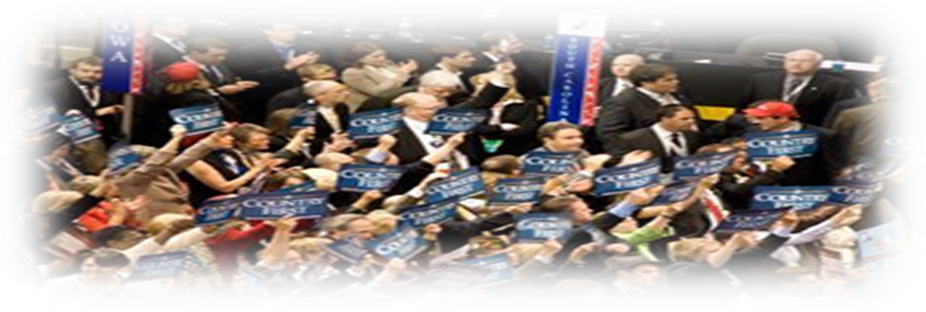
The convention hall is huge; as long and high-tiered as it is broad, … but somehow, … it seems hollow, even though it is full of bellowing sycophants, sycophants of every race, gender, nationality, religion, and sexual orientation, all in appropriate percentages, all firmly “woke” (in the new, pejorative sense of the term). Many are waving state flags and other symbols, confetti fluttering in the hot air. A lot of hot air, .… In several senses. Not all of the hot air is atmospheric in nature. Handshakes and hugs are omnipresent but inchoate blades await new homes in unsuspecting backs.
It’s summer during a leap year! Time to select candidates for the next federal elections scheduled for November 5, the first Tuesday after the first Monday in November, the sixtieth presidential election since adoption of the constitution of 1787-1789. Somehow, in many states, ballots, already including the names of as yet, un-nominated nominees, have already been mailed, whether the designated recipient has asked for one or not. Some have even reached their correct destinations and some, how many will in all probability never be known if recent history is any guide, are being successfully commercialized, either by their owners or others of an entrepreneurial bent. Evidently, the right to commercialize the vote, turning it into a tangible asset, is now sacred. Following up on the euphemism that a bird in the hand is worth two in the bush, massive mailing of ballots now permits their conversion into cash prior to actual elections. Something frowned upon in earlier, less enlightened times, and even now, in less enlightened parts of the world. But it is now as American as apple pie, or perhaps pizza. Or chicken wings. “Make every vote count!” For something anyway.
An interesting thought comes to mind related to the philosophical query of whether or not a tree falling in an utterly uninhabited forest makes noise as it falls. Is a crime a crime if it is so carefully plotted as to elude evidence? Or if those charged with investigating it refuse to do so. Does a criminal act that does not end in prosecution render the act non-criminal? Unlike the case with our tree, or the chicken or the egg, in this case, we apparently have an answer, at least according to the corporate media, prosecutors and the courts. And the answer is ….
¿What was the question? Yep, definitely! That’s the answer.
Anyway, back to the future (good title for a movie or two, or three, ….). But not just yet. We still need a bit of context.
“Federal elections” are a misnomer. Interestingly, there are no real federal elections in the United States and only one variant even purports to be national, i.e., nationwide: the one where a president and vice president are purportedly elected. All United States elections are held on a state by state basis, even those for federal officers such as members of the House of Representatives, members of the Senate, the president and the vice president. Actually, the election for vice president is rarely separate in any sense, rather, since the fiasco in 1800 with Aaron Burr, it is part of the election for president unless the purported Electoral College fails in its task, or a sitting vice president has to be replaced. Then, as indicated below, the election falls to the Senate (not to “We the People”).
In addition, voters never really vote directly for a president or vice president, only for state members to the fictional Electoral College, a non-existent institution (as it has no tangible presence anywhere), whose members never meet but who purportedly select a president and vice resident by majority vote. Whether or not they have the right and duty to exercise their best judgment is such process (as was originally hoped) appears irredeemably confused based on a conflict between state and federal laws on point. Pluralities among the electors results in sending the election of the president to the House of Representatives and of the vice president to the Senate. Still, national conventions for the two major parties that form the duopolous dictatorship in the United States, even if not all that relevant, or perhaps more relevant than is supposed (a quandary), are a sight to see. A show really, albeit with the reality being carefully hidden away. At least usually.
Sooo, for the United States, at least on the federal level, no democracy, no democracy at all, or liberty really, and the purported Bill of Rights appears to be made of Swiss cheese (although it smells a bit more gamy after two and half plus centuries, more like limburger perhaps). Like the purported Constitution, it’s purportedly “organic”, whatever that means. Anyway (again), be that as it may, …. Back to the hall!
It is the metaphorical eve of another in a long series of purportedly existential elections. Another election in which voters will have to determine which evil posited is lesser, and rarely if ever will they be permitted to merely vote for that in which they believe. That is almost never on the ballot, at least in a manner which renders it an effective choice. Only evil is granted that role, only evil has a chance to win, at least usually, at least, … almost always; … perhaps always.
This is “the” Convention. The quadrennial (like the Olympiads) national convention. One of two. There are many other political parties, political movements and independent candidacies, but of course, on a federal level, since 1860, only two have ever really been in play. The Supreme Court has defined American “democracy” in that way, asserting that the nation has a vested interest in a two party “system” (others define that as a duopolous dictatorship and the member of the Supreme Court as incoherent, calcified fossils, and other less flattering appellations).
Be that as it may (again), ….
A lot of planning and even more plotting has been involved in orchestrating exactly the right results for this convention, as has been true, if not since time immemorial, at least for a very long time. Some of the electorate think decisions are really made at national political conventions but, then again, some of them even believe they play a real role in the process rather than being mere extras. Some even believe in ludicrously inefficient concepts like truth and justice and honor. Most, however, at least most of those present at the convention, realize that the tooth fairy, the Easter bunny, Santa Claus, fairies, elves and imaginary friends are as likely to be real as those utopian imaginings.[2]
Not everyone is welcome at this or at any other purportedly national political convention. Indeed, the concept of “We the People” is apparently anathema at national political conventions. After the 2016 election, in an unsuccessful law suit brought against the Democratic Party for failure to abide by its own primary rules[3], the judiciary sanctified the right of at least one of the two “major” political parties to do whatever its leadership wants with respect to nominations, thus, codifying existing Democratic Party elitist practices. But, in an attempt to create an illusion of fairness, there exists a multilayered screening process designed to assure that only reliable partisans attend nominating conventions. It is called the primaries’ system but also includes a strange concept referred to as the caucus’ system, in each case controlled through something referred to as “super delegates”. The process is not always totally effective, although of late, it has been much improved. Still, notwithstanding earnest efforts to homogenize the party’s party (so to speak), this time, at this specific convention, there is a very, very uninvited party crasher illegally (sort of) present. A spy really (although not one of those authorized, even invited spies present assigned by what has euphemistically come to be known as the Deep State). Not a professional spy notwithstanding the very sophisticated beta version equipment she’s been lent (or is it loaned) and which she hopes will permit her to translate the hyperbole flooding the fetid air of the convention into useful information: seemingly innocuously looking techno-spectacles purportedly and earplugs using neurolink technology (we use that word a lot for legal reasons) specially designed for a wealthy South African impresario which he’s purportedly, for unknown, non-philanthropic reasons, personally made available to the uninvited guest, along with a related set of earplugs.
Both gadgets purportedly work by translating brainwaves into images and sounds which reveal the underlying reality behind subterfuge. Being beta versions, they are not perfect, but they’re good enough, and anyway, nothing better is available. Ironically, they’d been commissioned for use by the United States intelligence agencies which pretty much operate the Deep State, though they do not own it; that is above their admittedly very high pay grades. Ownership is currently limited to the billionaire class, but not every billionaire is eligible. Even more ironic is the fact that the almost anonymous donor is taking the risk of changing the original purpose for which the two devices were designed in order to at least attempt to thwart the long term plans of those who’d commissioned them.
The purported impresario is very famous (assuming he is whom we believe him to be). He is perhaps the world’s wealthiest man, … at least some of the time. To continue our train of irony, as someone not born in the United States, the purported donor apparently has no personal benefit to attain from messing with the pending elections or with any future elections, at least not directly. Xenophobia has always been preeminent in the United States and no one foreign-born can ever successfully aspire to its highest offices. Still, he is a member of the human race and the entire human race is impacted by political decisions taken in the good old US of A. And of course, the purported “highest offices” actually have little to do with governance. The latter is why it is hard to understand why the donor is interested in events such as the convention at all, unless, of course, his peers have “DFI-ed him (designated him for assignment, a sports metaphor some readers may understand). He tends to ignore “rules of engagement” (which have nothing to do with nuptials) and that annoys his peers. Plus, he is not of the old aristocracy, rather, a bit like the intruder, he is a bit of a gate crasher. Despite his wealth and power, he has apparently not been invited into the Deep State club, although the Deep State seeks to keep him in line via the carrot, i.e., grants of massively profitable government contracts.
Equipped with the misdirected devices, the intruder[4] watches and listens, ensconced amidst a pile of electoral debris in a concealed alcove that is normally full of cleaning supplies. “Funny”, the intruder thinks; in a sense, it is still full of “cleaning supplies” (her and her gadgets), especially should her efforts prove successful.
The purported South African donor usually knows what he’s doing, and is usually successful, notwithstanding the constant barrage of criticism to which he is usually subjected. Being skeptical, as real journalists are wont to be, the intruder wonders whether, rather than a South African, the donor is really the South African’s nemesis, the owner of the world’s largest retail vendor and of one of the more prominent exponents of the yellow journalists’ trade, an offshoot of poorly plotted creative fiction. Anyway, whoever he is, apparently criticism not only rolls off of him like water off of a duck’s back, but it actually motivates him, it inspires him to succeed, regardless of the odds, and regardless of the costs, at least to others. Hmmm, the intruder thinks, the alternate to the South African as the donor rather reminds her of a fictional commercial spokesperson for a cleaning product referred to for over half a century as “Mr. Clean”, although that appellation in no sense would have applied to him. But the intruder still wonders why, whichever multibillionaire the donor is, he’s taken the risk of helping her. Anyway, this is not the time for speculation. That will come later. It’s show time.
The intruder carefully dons and adjusts the spectacles and earplugs, they have to be perfectly in place for the bidirectional neurolinks involved to function adequately, and she listens to and watches the scene unfolding below her. For some reason, the name of an old, black and white television program she’s never watched comes to mind, “The Twilight Zone”:
….
The convention hall is filled to the brim with slightly intoxicated men and women, most of legal age, indeed, most way older than legal age. Indeed, some are also significantly more than slightly intoxicated. Consequently, the hall reeks of stale beer, whiskey, tequila, rum, tobacco smoke, other smoke of a somewhat sweeter-smelling vintage, but most of all, it stinks of bodies that could use a shower and lots of soap, notwithstanding a state of the art air-conditioning system plus functioning at full blast (the plus involves the ability, if necessary, to discretely spray a variety of psychotropic vapors to be inhaled by unsuspecting participants). Everyone seems to be talking at once until a chant is picked up in which they all (or at least most) eventually join. The chant was started by a gaunt older woman seemingly addicted to plastic surgery. She insists on being referred to as the “Speaker”, a role she’d once held in the House of Representatives and is determined to keep that fact at least somewhat present in everyone’s mind; kind of like a former federal attorney general in the ill-fated Obama administration has done, insisting on being referred to as AG (followed by his last name) in his constant tirades and demands for donations to save “democracy” from the opposition, which ought never, under any circumstances, be permitted to ever, ever, ever win any elections at all. Something with which the Speaker and most participants at the convention fervently agree.
Anyway, …
“Let us sin!” the Speaker seems to shout (remember, that’s the earplug translation version, she actually intoned: “let us pray”). Interestingly, outside the convention hall, tens of thousands of angry and disappointed “activists (i.e., unpaid, abused and manipulated, naïve young “volunteers”) are chanting something that sounds like “let us sin” but is actually “let us in”. They’ve not been credentialed and thus are barred from the hall, being deemed too unreliable, especially when nothing they’ve been promised is actually going to be delivered there.
Anyway, … back to the Speaker. She’s a practicing Catholic, if not all that true to her purported faith (or anything else). But then, nowadays, few Catholics really are. Actually, few Catholics ever have been. Few followers of any religion really are. Religion is fascinatingly like politics in that the more vociferously its principle tenets are proclaimed, the less they seem to be adhered to. Consider how many humans have been killed or maimed, how many lives destroyed in the name of love and peace and in the names of myriad deities and their prophets. Instead of being “true believers”, many Catholics who deem themselves “modern”, like Reformed Jews, treat their faith really more as a cultural thing, but, the Speaker’s purported Catholicism has been useful to her (and to others) in her political endevors, even when Catholic leaders condemn her for her apparent apostasy. Perhaps especially when she is so condemned.
The Speaker looks very different through the intruder’s filtering spectacles than the carefully coiffed image she seeks to portray in real life (if her life can, in any sense, be considered real), although her photographs always require quite a bit of air-brushing. She is, in actuality, stylishly dressed in a white designer pantsuit, however, the spectacles show her wearing garish blood red garments trimmed in brackish gilt and garlanded in fake garnets, and instead of her actual stylish small cap, it shows her wearing an antlered helm, a bit askew, apparently knocked off kilter as her faux-passion-on-demand controlled fake fury seems to agitate her. Kind of like a fundamentalist preacher performing faith healings.
“Let us sin” her enflamed congregants seemingly respond (remember the earplugs) in a roar!
The spectacles seem to show a complex mob. Some have tally books in hand, and have begun to furiously lodge double dubbed entries into ledger books and balance sheets. Others, who appear to have suitcases full of what appeared to be purloined or purchased ballots, head to areas set aside as vote exchanges where offers and bids for the ballots fly wildly, establishing electoral odds for pundits to declaim, with winning bidders and enriched sellers merrily laughing and singing as the purchasers fill in their newly acquired pre-signed ballots. If one vote is priceless, how about a thousand? Price is obviously relative. “Count every vote” they laugh and jeer. “Count every vote”!
Still other “mob” members (perhaps a double entendre certain Italians are especially well-suited to grasp) head to what the techno-spectacles interpret as troll farms but which such members refer to as social media communications centers, places where, using thousands of interrelated computer systems, messages warning of fabricated crises fly back and forth, hither and yon, demanding donations, but in carefully crafted and disrespectfully-respectable, even pleading tones. “They’ll destroy social security, they’ll bring back slavery”, “they’ll take away your right to sell your vote”, “they’ll force women to bear all the children while men are unfairly exempted from that duty”, “they’ll force you to participate in sporting events according to birth gender”, and other such stridently effective fund raising themes. Actually, the earplugs just let those slogans slip by without much real translation. The fundraising gurus actually said things similar to those (and others just as effective), albeit in every case, at best distortions or even more frequently, blatant falsehoods (the latter being obviously favored). The suckers will buy anything if their emotions are riled enough!
Who cares as long as the bucks keep flowing in: small donations, large donations, huge donations, money set aside for mortgages and food and education, they all count, and they’ll all end up in the “right hands”, or at least a good deal of them will, and anyway, just which are the “right” hands is open to interpretation. It depends on what the meaning of “is” is.
From the back of the hall, in the upper tiers, apparently furious backbenchers also take up a chant, soon echoed from every nook and cranny, except for the tiny nook which sometimes doubles as a cleaning closet, now temporarily occupied by the intruder:
“We want war, we want war, kill the damned Ruskies the stinking Chinks too, and the freakish Iranians, and the damned North Koreans, and the stupid Syrians, and heretical rag headed Muslims!!! More money for defense and for homeland security!!! Everyone’s out to get us! More money to stamp out unauthorized news! Real patriots pay whatever taxes need to be imposed … but borrowing is just as good; in fact, better! Sacrifice is awesome!
No to infrastructure, no to universal healthcare and free education, no to guaranteed minimum wage, the money is needed elsewhere!!! No, no, no, no, noooooo!
We want war, we want war …!”
Again, the earplugs rest. No need to translate all that much, except with respect to the pejoratives and racist aspects, those are, in reality, couched in more polite terms.
The crowd is on fire!!!! Hell on Earth in a sense, a very figurative as well as literal sense.
The intruder, wanting to do an equipment check and to contextualize the situation to assure that her report will be accurate, removes the spectacles and earplugs and this is what she sees:
Below her, on the flag bedecked main stage, at the podium, stands the carefully coiffured and only slightly mummified recent Speaker of the House of Representatives, continuing to address the massive crowd of carefully screened political delegates, all sworn to monolithic obedience. Others who’d expected to speak, imagine large hooks pulling her off of the stage.
Outside the hall, muffled screams can be heard from excluded Bernie Sanders’ supporters, but Bernie himself is just fine, indeed, he’s been given a prime speaking role (assuming the Speaker ever gives up the podium) and promised plum committee assignments after the next election, guaranteed assignments as the election is apparently in the bag. After all, enough of the ballots have already been sent out and “re-acquired”. Good old AOC, she whose name has become an acronym (and a curse to some), watches, entertained, dreaming that perhaps soon enough, perhaps even this cycle, it will be her turn, and not just at the podium, … if she can just keep “her” squad under control.
For all the orchestration and fine performances, some almost Oscar worthy[5], the comforting and comfortable fact is that the seemingly hard fought results supposedly to be determined have already been tabulated by friendly monitors in the intelligence community, the Department of Justice and the Judiciary. It’s great to have loyal and reliable friends, not only in high places, but burrowing among the wonderful federal bureaucracy; even among the purported opposition. Of course, the intruder is not directly privy to the foregoing, but she gets the drift. The sensations comfortingly set in stone in the minds of the delegates enter the gadgets’ neurolinked translation matrixes.
Posters are plastered everywhere urging voters to re-elect “Honest Joe”. Interesting that the “president” has elected to attempt to grow a Lincoln-style chin beard. He’s not been successful but the posters have been doctored to make it seem as though he has. And a Lincoln-style stove top hat has also been included, as well as an image of the log cabin, albeit in Pennsylvania, where “honest” Joe is now rumored to have been born. Indeed, it is being whispered-about that “Joe” was really his second name, and that his real first name is “Abraham”, so he is really Abraham (Abe) Joseph Robinette Biden Jr., the name having been purportedly selected after a medium present at his baptism had fainted and begun to speak in tongues, fortunately variants of English, proclaiming that the newborn was fated to become the most beloved and respected United States president ever (make some room on Mount Rushmore). It was only because of his humility that he’d elected to be called Joe. One should remember that plagiarism has always been “honest” Joe’s strong point. Other posters show “first son” Hunter as a naval war hero after he’d purportedly served unstintingly in the Peace Corps all over Africa and won several “father” and “husband of the year” awards, all as recently reported in all major corporate media (except for a furious Fox News, whose broadcasts have encountered inexplicable transmission problems).
From another part of the crowd comes another chant: “Honest Joe, honest Joe, honest Joe, everyone’s friend!! Honest Joe, honest Joe, honest Joe, everyone’s friend!! Honest Joe, honest Joe, honest Joe, everyone’s friend!! Honest Joe, honest Joe, honest Joe, everyone’s friend!!” Posters indicating that “Labor Loves Joe” are ardently waved by earnest union-busting execs from a number of high tech, Silicon Valley companies as well as by senior management of the nation’s railroads and the heads of some major unions, especially teachers’ and entertainment industry unions.
But all is not just carefully scripted “guns and roses”:
To the dismay of the Speaker and honest Joe, a counter cry of “we want Hillary” is taken up from somewhere, even though it seems no one is really involved. The Speaker suspects that Hillary may have somehow gamed the hall’s state of the art sound system and had it piped in, although Hillary herself is modestly sitting on the platform, blowing kisses and waving as though she hopes that the counter chant will end, … or perhaps soon end. The Speaker is in a bind. She secretly hates Hillary but can never admit to that. She isn’t all that fond of Joe either, feeling that they’ve both screwed her out of her rightful place in history. So she just ignores the counter-chant and, seemingly thrilled, keeps waving her hands and smiling. Blowing kisses is out. It requires use of too many face muscles paralyzed through overuse of Botox.
Unfortunately for Hillary, there are counter-counter cries of “Michelle, Michelle, Michelle” as well, which irk Hillary no end. Michelle is not demurely sitting at the speakers’ platform though but actively encouraging those chants, as is her husband and their erstwhile assistant, good old AG. AOC theretofore sitting patiently on the speakers platform is thoroughly steamed, she’s been upstaged. She’d not thought about having her own chant piped into the sophisticated, computer controlled (and thus, eminently hackable) sound system. “Stupid, stupid, stupid, stupid” she berates herself, under her breath.
It’s what the intruder expected, although she’d hoped otherwise. After all, she may technically still be a Democrat, she’s not yet changed her registration, although she’s in a bit of a moral and ethical quandary given that her hero, or actually, heroine, a former Congresswoman from Hawaii, has officially left the Democratic Party. Uncomfortable with her thoughts, the intruder re-dons the anti-bovine feces neurolink-spectacles and earplugs, and stares at the scene below while listening to the translated proceedings.
She feels a bit queasy, a bit ill, a bit like regurgitating, and she hates to regurgitate. She’s voted Democrat all her life. She is black so she’s had to. Or else! At one point, her political volunteer supervisor had insisted she denounce her womanhood in favor of “transhood”, and she’d played along; forced to stop reading or watching anything that had to do with Harry Potter, et. al. Perhaps, now that she’s joined Tulsi’s new movement, she’ll be expelled, not only from her party but from her race and from her gender.
What will she be then? Will she be somehow transformed into a racist, xenophobic, misogynic white male?
….
The spectacles and earplugs, again in place, portray the following scene:
Down in the hall, on the speakers’ platform, the Speaker, still in monologue mode, watches happily. The chants in favor of honest Joe and Hillary and Michelle (but not in favor of AOL) have quieted down, perhaps because she’s been maniacally banging her gavel for order (she loves to do that, it reminds everyone she’s been Speaker of the House). She smiles broadly, her tightly crafted face stretched to the limit, stubborn wrinkles hidden behind a mask of powdered gold, wig glued firmly in place. She cackles and croons and begs and threatens and cajoles. Fund raising is her favorite thing, her strong point. And her legal team has advised her that Congressional immunity (some would say impunity) permits her to say whatever she wants, free of detrimental legal consequences.
The earplugs translate her televised words as follows: “more, damn you, don’t hold anything back!!! College funds, dowries, retirement savings; you can take out mortgages and loans, and those credit card balances-available are an affront to decency. Pitch in and save our country from the rabble that would make it theirs.” Her actual words are much more polished, even humble and pleading. Begging even.
Then, she switches audiences. Faster, and wilder on closed circuit to the delegates, she continues and the earplugs, getting a bit overheated, translate: “there are no limits, just fabricate as needed”. “If enough of us firmly believe something (or claim that we do), then that’s the truth, … or it will be”! And her congregants: purchased jurists and faux journalists and molish federal bureaucrats answer jubilantly, “so it’ll be written, for we’re the ones writing it, and so it’ll appear, no matter what happens” while others chant over and over again, “history is what we say it was, tear down those monuments, censor those books or better yet, burn them, especially George Orwell’s and Aldous Huxley’s and Kurt Vonnegut’s” and other phrases sacred and pleasing to the hallowed cackling sort of shrew (hey, it’s the earplugs translating and that’s how her audience really views her, her opponents opinions make those observations very tame in comparison).
Finally, once again, the sacred phrase (as translated) is shouted and echoed throughout the halls of the great convocation: “Let us go forth and sin, and sin and sin!” And other slogans like “Sin is in” and “All hail the happy harpies of the apocalypse”. The latter chant seems to bother the Speaker as she feels it includes her nemeses, Hillary and Michelle. Maybe even AOC.
….
Back to context: Of course, as indicated above (several times to avoid misinterpretations and law suits), the foregoing is a translation, perhaps a transliteration, and subjective at that. The neurolink-spectacles and earplugs have apparently been provided by someone claiming to represent Elon Musk, but not Telsa, definitely not Telsa, or Space-X. In all likelihood, Mr. Musk had nothing to do with any of it, even though the spectacles and earplugs had apparently been developed by one of his many smaller companies. But not even he would be stupid enough to risk all the government contracts coming his way. Or would he? He can be pretty weird. Naw!!! It must have been some other South African billionaire entrepreneur responsible, another one whose own former sports car orbits the sun. Or, maybe, taking a page out of Machiavelli’s purported masterpiece, The Prince[6], Elon’s main rival, on earth as well as in space, is responsible, the Beeeeezzzz man, and he just wants Elon to take the fall. After all, the Securities and Exchange Commission already hates him, and they can bring down anyone.
The chants and exhortations are certainly loud. The phrase “Damned Trump” now seems omnipresent, and cries of “where’s Hillary” and “where’s Michelle” are also very popular, which does not really please the Speaker. Or AOC.
Anyway, … the spectacles and earplugs haven’t really changed things all that much. Not all that much to change. And the odor in the hall, what a whiff. Practically deadly. The intruder should have asked that guy from South Africa (or wherever) for nose plugs too. She’ll have to talk to Tulsi about that when she gets out. Before her next gig.
If she gets out.
As opposed to her hero/heroine as a woman, as a real journalist, the intruder’s hero (though she is loath to admit it publicly) sits imprisoned in an English jail, held without bail, while Biden administration attorneys seek to have him turned over in the name of freedom of the press to face what passes for justice in the purported Land of the Free and Home of the Brave. And she is all too well aware what will await her, should she be caught.
Of course, if she gets out, she has another similar assignment pending concerning a sort of slightly distorted mirror image national convention (mirror image in the sense of mirrors once found in county fair funhouses way back when), a convention to be held by the purported opposition. It too will be carefully controlled by the Deep State, perhaps even more so as a recent convention got out of hand with disastrous results. Many of the Deep State spies present at the current convention will also be present, under different guises, at the GOP national convention. The parts are virtually interchangeable, except, of course, for the Speaker and Hillary and Michelle and AOL. They are pretty much inimitable, at least in their own opinions. But Nicky Hailey will be there, as, in all probability, will Alaska’s own Sarah Palin, and Mitch McConnell and other cartoonish Republicans. Donald Trump is not expected to be there if attorneys general in New York and Georgia and Democrat appointed judges and traditionalist members of his own party have any say, which they might not. He terrifies them as much as he sets off Democrats.
That should be quite a show as well.
The intruder wonders what will happen to the information and imagery she is gathering, even if she is successful in getting it out. Would even Consortium News dare to print it? And even if it did, would the Masters of the Internet let it circulate?
And even if it did circulate, would anyone read it?
And even if some people read it, would anyone believe it?
She thinks of Edward Snowden, and before him, John Crane, and she thinks of Chelsea Manning and Daniel Hale. And of course, she remembers Troy’s Cassandra.
Not all that comforting.
[Cut!!!]
Caveat!!! While this “story” may be useful in seeking to understand the realities underlying the United States’ political system, the author recommends against citing it as a source for civics class research papers. Instructors may not be amused. On the other hand, ….
Further Caveat!!! Civics instructors might find this “story” useful for their classes but their principals, and especially, their local school boards, might disagree. …. Vehemently.
_______
© Guillermo Calvo Mahé; Manizales, 2023; all rights reserved. Please feel free to share with appropriate attribution.
Guillermo (“Bill”) Calvo Mahé (a sometime poet) is a writer, political commentator and academic currently residing in the Republic of Colombia (although he has primarily lived in the United States of America of which he is also a citizen). Until 2017 he chaired the political science, government and international relations programs at the Universidad Autónoma de Manizales. He has academic degrees in political science (the Citadel), law (St. John’s University), international legal studies (New York University) and translation and linguistic studies (the University of Florida’s Center for Latin American Studies). However, he is also fascinated by mythology, religion, physics, astronomy and mathematics, especially with matters related to quanta and cosmogony. He can be contacted at guillermo.calvo.mahe@gmail.com and much of his writing is available through his blog at https://guillermocalvo.com/.
[1] Actually, “will be”, but it will be grammatically too confusing to keep using the future tense so we’ll revert to resent or past tenses (simple, continuous, perfect, conditional, progressive, etc.) anything being possible in the quantic realms anyway.
[2] Some among us, on the other hand, would call those people despicable cynics, there existing no definitive proof for the non-existence of the Easter bunny, Santa Claus, fairies, elves and imaginary friends, or even unicorns. Thus, as to such things, we must remain agnostic, if the scientific method is to be respected, and acknowledge the impossibility of proving any negative definitively. It is possible that the intruder as well as Elon Musk, like Nikola Tesla, are at least among “we the agnostics”.
[3] Carol Wilding, et al., Plaintiffs, vs. DNC Services Corp., D/B/A/ Democratic National Committee and Deborah Wasserman Schultz, 941 F.3d 1116 (2019).
[4] Actually a journalist, a real journalist rather than one of those puffed up pseudo professionals who hog the airwaves as well as the quickly fading print media, already almost irrelevant.
[5] All the old cinematic awards have been coopted, as have the Pulitzer prizes, the Nobels, the Golden Globes, the Grammies, etc.
[6] Machiavelli had actually much preferred his Discourses on the First Ten of Titus Livy, which led to very different conclusions.