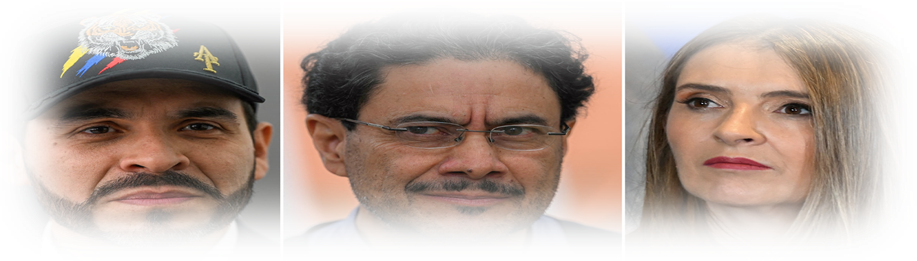
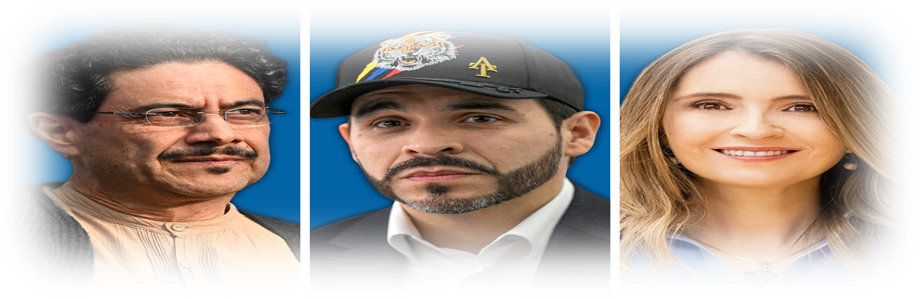
Como era predecible, Colombia va a segunda vuelta con Abelardo de la Espriella e Iván Cepeda y, con el dinero disponible para de la Espriella desde sus propias fuentes y fuentes con origen en países como los EE.UU., Israel, Argentina, etc., tiene buena posibilidad, quizás probabilidad de ganar en segunda vuelta, en especial si hay reconciliación con Paloma Valencia, Álvaro Uribe y el Centro Democrático.
Paloma Valencia cometió muchos errores y le costó. Más que todo en su decisión sobre su fórmula vicepresidencial, Juan Daniel Oviedo Arango, quien, por ser gay, le restó muchos más votos de los que le agregó. Los votos que le resto se fueron con de la Espriella y los votos que le agrego se los cobro a Iván Cepeda. Esa es nuestra Colombia. Ademas, por buscar aproximarse al casi inexistente centro político colombiano, perdió muchos votos de derecha, todos los cuales, con mucho placer, los acepto Abelardo de la Espriella.
En el caso de Iván Cepeda, también creo le costó mucho su selección de formula vicepresidencial, Aida Marina Quilcue Vivas, una mujer noble y admirable, pero comparada con José Manuel Restrepo Abondano, la formula vicepresidencial de Abelardo de La Espriella, sufrió mucho. José Manuel Restrepo Abondano le sumo mucho a de la Espriella en temas de educación, trayectoria académica y gubernamental, importantes debilidades de Abelardo de la Espriella. Y la masiva diferencia en los gastos de dinero hizo el resto. También, creo que los jóvenes no salieron en forma masiva para apoyar al senador Cepeda como lo hicieron con Gustavo Petro. Eso siempre ha sido el problema con contar con el apoyo de las generaciones más jóvenes.
Abelardo de la Espriella recaudo y gastó más que el doble las sumas que les eran disponibles a Paloma Valencia e Iván Cepeda y eso, sin contar la masiva cantidad de dinero adicional gastado “indirectamente” por interventores internacionales. Ese dinero dominó a los medios sociales, en especial TikTok e Instagram. Los dominó, no solo con apoyadores, sino con “bots”, falsas noticias, espectáculo, etc., manejados con la enorme experiencia y dinero del sionismo. Y el apoyo casi total por los medios de comunicación que les pertenecían en algunos casos a antiguos clientes, no sobró.
No sé si en segunda vuelta Iván Cepeda se pueda recuperar a no ser que, por el constante y exagerado triunfalismo del liderazgo del Pacto Histórico, muchos de sus adherentes se encontraron perezosos este domingo. Y ahora se encuentran totalmente despiertos. Lo dudo. Entonces, esperemos que la carne de mula, como ahora se come en Argentina, nos guste. Por suerte, soy más que todo vegetariano.
Guillermo Calvo Mahé es escritor, comentarista, analista político y académico residente en la República de Colombia. Aspira ser poeta y filósofo empírico y a veces se lo cree. Hasta el 2017 coordinaba los programas de Ciencia Política, Gobierno y Relaciones Internacionales de la Universidad Autónoma de Manizales. En la actualidad, participa en entrevistas radiales y televisadas, foros, seminarios y congresos cívicos y edita y publica la revista virtual, The Inannite Review disponible en Substack.com/. Tiene títulos académicos en ciencias políticas (del Citadel, la universidad militar de la Carolina del Sur), derecho (de la St. John’s University en la ciudad de Nueva York), estudios jurídicos internacionales (de la facultad posgrado de derecho de la New York University) y estudios posgrado de lingüística y traducción (del Centro de Estudios Latinoamericanos de la Universidad de la Florida). Sin embargo, también es fascinado por la mitología, la religión, la física, la astronomía y las matemáticas, especialmente en lo relacionado con lo cuántico y la cosmogonía. Puede ser contactado en guillermo.calvo.mahe@gmail.com y gran parte de su escritura está disponible a través de su blog en https://guillermocalvo.com/.
On Sunday May 31, 2026, a week from the day on which I write this introspection, Colombians will head to the polls for a presidential election. In Colombia as in much of the world, the electoral process is less controversial than in the United States, with participatory rights carefully monitored through required identification through official, state issued identification documents. Also, in Colombia, if a candidate receives more than 50% of the vote, he or she will be the victor, if not, the top two vote recipients will face off in a runoff on the 21st of June. In Colombian the candidate with less votes never wins, as happens from time to time in the United States, although how votes are counted may impact that observation, as it did with respect to the manipulated, well, perhaps stolen is a more honest term, election that took place in Colombia on the 19th of April in 1970. However, notwithstanding precautions, as in much of the world the electorate’s confidence in electoral integrity may be at a low point and that because, as in the United States, information manipulation is rampant.
In that regard, the primary election for the selection of a Republican candidate for the House of Representatives from the State of Kentucky’s 4th Congressional District is illustrative as to how massive infusions of cash can distort the vote through massive albeit temporary increases in questionable participation. To be fair, the same was probably the case in recent senatorial elections in the State of Georgia so it’s a bipartisan phenomenon. It may also have been the case in the United States’ presidential election of 2020 (which reflected massive but subsequently not duplicated electoral participation). So, what does Mr. Massie’s improbable defeat in Kentucky have to do with Colombian presidential elections about to take place?
Well, Mr. Massie was defeated by massive infusions of cash orchestrated by groups aligned with a foreign government, the State of Israel to be specific, and the State of Israel is very interested in the results of the presidential election in Colombia, as it was in the last presidential election in Argentina, and in Honduras and in El Salvador and in Bolivia and throughout Latin America, especially in those countries that have proven to be critics of Israeli genocide and ethnic cleansing. In those countries, money illegally provided by Israel or Israeli supporters made the difference between the election of a progressive popular government and the victors, all governments led by admirers of current United States president Donald Trump and Israeli Prime Minister, Benjamin Netanyahu. Two of the three leading candidates for the Colombian presidency are also admirers of Messrs. Trump and Netanyahu and, as in the case of the aforementioned Latin American countries, have been able to spend massive amounts of money on their campaigns, albeit not necessarily directly. Somehow, social media has proven extremely kind to them, even beyond the posts admittedly paid for by them and their supporters (as was the case in Mr. Massie’s Kentucky primary election). Indeed, attribution to the sponsors of the most outlandish Colombian posts is almost impossible to ascertain.… Almost as though they involved intelligence agency professionals.
Notwithstanding the foregoing, neither of the pro-Zionist Colombian candidates currently leads the electoral pack. That position is held by Senator Iván Cepeda Castro, a progressive follower of current Colombian president Gustavo Francisco Petro Urrego, a vocal critic of genocide and ethnic cleansing. He has comfortably led throughout the electoral campaign in all reliable polls (although the term “reliable” with reference to polls may be an oxymoron). His two chief competitors are Abelardo Gabriel de la Espriella Otero and Paloma Susana Valencia Laserna, both right wing politicians although Ms. Valencia has tried to capture some of the political center by ironically selecting as her running mate a gay male, Juan Daniel Oviedo Arango. Ironic because Ms. Valencia has always been opposed to most LGBT+ issues but, as the ubiquitous “they” say “politics makes strange bedfellows”. Mr. de la Espriella is a successful albeit unsavory lawyer having represented the worst elements of Colombian society including paramilitary death squad leaders and corrupt politicians. He refers to himself as “el Tigre”, employs a sharp military salute whenever possible (despite, like Mr. Trump, having “legally” avoided compulsory military service) and is bereft of any government experience, running as an “outsider”. Ms. Valencia on the other hand is from a prominent Colombian political family, has been a member of Congress for a long time and was personally selected as a candidate by former Colombian president Alvaro Uribe Velez. She enjoys the support of most traditional political parties and politicians although party members in some cases, especially with respect to the Liberal Party, have refused to accept the decision of their party’s leaders. In addition to the three front runners there are numerous other candidates, some of whom are well known, but none has more than a 3% following in recent polls.
Currently Mr. Cepeda, whose father was a Colombian senator assassinated by paramilitaries (such as those represented by Mr. de la Espriella) leads Mr. de La Espriella by more than 10% and Ms. Valencia by well over 20% but the sum of Mr. de la Espriella’s numbers and those of Ms. Valencia roughly equal those of Mr. Cepeda thus, while Mr. Cepeda is close to the 50% threshold for victory in the first round of elections, he is not there. That makes a potential second round competitive, given the ideological compatibility of Mr. de la Espriella and Ms. Valencia and their mutual dedication to former president Uribe. That creates an ideal scenario for foreign electoral interference in which both the State of Israel and the United States are clearly participants and rather well experienced.
The question then is, as it was in Kentucky, whether enough voters are willing sell out their country’s interests to foreign states, as voters in other Latin American countries have recently done (and, honestly, as has so often happened in the past) or whether given the disasters that the recently elected Trump and Netanyahu aligned right wing governments have proven to be (contrasted with the success on most fronts of Colombia’s current progressive government), Colombians will prove wiser and more patriotic than their continental counterparts (and also, wiser and more patriotic that the majority of United States’ voters in the State of Kentucky’s 4th Congressional District).
The reaction in the United States to Mr. Massie’s defeat has ranged from smug arrogance on the part of the Israeli-First component of Donald Trump’s MAGA coalition to dismay among those Trump voters who believed that he would prove different than the American Israel Public Affairs Committee (AIPAC) owned presidents of the past half century, something that might lead to a huge electoral reversal for the Republican Party in the United States this November, although the reality is that AIPAC controls both the United States’ Republican and Democratic parties, at least at the leadership levels. The decision in Colombia is likely to impact not only Colombia’s future but also elections in other countries, not least of which might be this autumn’s United States congressional elections, and it might also impact the future of the Middle East, realities of which Colombian voters, for the most part, are blissfully unaware. In the meantime, as has apparently become the norm … everywhere, false news and rabid calumnies fill Colombian airwaves and social media.
So, Sunday, May 31, 2026, perhaps a day to be long remembered; …
Guillermo (“Bill”) Calvo Mahé (a sometime poet and aspiring empirical philosopher) is a writer, political commentator and academic currently residing in the Republic of Colombia (although he has primarily lived in the United States of America of which he is also a citizen). Until 2017 he chaired the political science, government and international relations programs at the Universidad Autónoma de Manizales. Previously, he chaired the social studies and foreign language departments at the Eastern Military Academy in Huntington, New York. He is currently the publisher of the Inannite Review available at Substack.com; an intermittent commentator on radio and television; and, an occasional contributor to diverse periodicals and publications. He has academic degrees in political science (BA, The Citadel, the Military College of South Carolina), law (JD, St. John’s University, School of Law), international legal studies (LL.M, the Graduate Division of the New York University School of Law) and translation and linguistic studies (GCTS, the University of Florida’s Center for Latin American Studies). However, he is also fascinated by mythology, religion, physics, astronomy and mathematics, especially with matters related to quanta, cosmology and cosmogony. He can be contacted at guillermo.calvo.mahe@gmail.com and much of his writing is available through his blog at https://guillermocalvo.com/.
Gerrymandering is now completely out of control thanks to the GOP, the Democrats and the politicized judiciary. The only practical solution is one adopted by most countries in the world and that is multi-legislator districts, preferably on a state wide basis, with proportional representation. How would that work? Or better yet, how does it work successfully in so many places.
Well, take California with, I believe, 55 representatives elected to the House of Representatives. Each California voter would have 55 votes which he or she could allocate to a single candidate (55) or divide among a number of candidates. As an illustration, if a voter wanted to allocate his or her votes equally among eleven candidates, each would receive five votes, or the 55 votes could be distributed among the eleven candidates in any manner the voter deemed appropriate. Or the voter could provide one vote each to 55 candidates. California, with the largest representation in the House is the most complex example, states with less representation would be inversely simpler. It is, in essence, what happens in the states that only elect one member to the House, it is a statewide contest with no gerrymandering possible.
To make things easier, California and other states with large House membership could be divided into smaller voting districts. In the California case for example, it could be divided into five voting districts, each electing eleven legislators, While that would still permit efforts to distort the vote through gerrymandering, it would be more difficult to do so and less efficient, but in any case, much better that the single member system we have now. And it can be implemented on a state by state basis through local legislation rather than on a federal level which would, in my opinion, require a constitutional amendment. The latter might be the best solution for the long term but harder to implement.
Something to consider for those who really care about electoral integrity rather than merely about maximizing the power of the political party to which they have become subservient. _____
Guillermo (“Bill”) Calvo Mahé (a sometime poet and aspiring empirical philosopher) is a writer, political commentator and academic currently residing in the Republic of Colombia (although he has primarily lived in the United States of America of which he is also a citizen). Until 2017 he chaired the political science, government and international relations programs at the Universidad Autónoma de Manizales. Previously, he chaired the social studies and foreign language departments at the Eastern Military Academy in Huntington, New York. He is currently the publisher of the Inannite Review available at Substack.com; an intermittent commentator on radio and television; and, an occasional contributor to diverse periodicals and publications. He has academic degrees in political science (BA, The Citadel, the Military College of South Carolina), law (JD, St. John’s University, School of Law), international legal studies (LL.M, the Graduate Division of the New York University School of Law) and translation and linguistic studies (GCTS, the University of Florida’s Center for Latin American Studies). However, he is also fascinated by mythology, religion, physics, astronomy and mathematics, especially with matters related to quanta, cosmology and cosmogony. He can be contacted at guillermo.calvo.mahe@gmail.com and much of his writing is available through his blog at https://guillermocalvo.com/.