Reevaluating Genocide during and after the Second World War: a Critique of History and Historians

On Tuesday, October 17, 2023, Jonathan Cook published an article in Consortium News (Volume 28, Number 284), entitled “Israel’s Official Ethnic Cleansing Program”.  He’s absolutely correct, but reacting to the long term consequences of root problems is inadequate without addressing the root causes.  In this case, we historians and journalists are the great facilitators, and the hypocrisy following the second war to end all wars, popularly referred to as the Second World War or World War II, is the root cause.

The second war to end all wars was followed by a series of trials based on application of promising ex post facto ius cogens that proclaimed that genocide was impermissible under any circumstances and that violators could be subjected to the death penalty, notwithstanding provisions of domestic law under which their actions were obligatory.  The trials were held in the cities of Nuremberg in Germany and Tokyo in Japan and purportedly established the framework on which future interstate belligerency would be judged.  A number of former Axis political and military leaders were executed and, in the ensuing decades, numerous lower level personnel were convicted and punished for following orders deemed violative of the new norms for armed conflicts, even though such norms did not exist at the time the conduct in question took place.  The repugnance with which such conduct was to be judged henceforth justified the violation of the prohibition of ex post facto penal law.

Subsequent history has demonstrated that the foregoing scenario was a fraud and that the Nuremberg and Tokyo trials were mere expressions of the vengeance of conquerors on the conquered, albeit packaged in beautiful and inspirational camouflage.  That should have been obvious given the reality that both sides in the second war to end all wars engaged in blatant genocidal actions: consider Hiroshima and Nagasaki, but also the obliteration of German and Japanese cities from the sky and the utter absence of related accountability, so it ought to be no surprise that subsequent more neatly packaged and sold examples of genocidal conduct continue, not only unpunished, but as in the case of Israel and the Palestinians, even extolled.

The only real lasting consequence of the second war to end all wars seems to have been that the British quest for global political and economic hegemony was transferred to the United States and that hypocrisy continued its unabated bludgeoning of truth in what passed for journalism and history.  Genocide continues to be celebrated, most notably by adherents of the primordial Abrahamic faith during Hanukkah and Passover while the same cultural group constantly decries the genocide practiced on it (and others) by the Germans, incoherently using it as justification for its own long term campaign of genocide against Palestinians and other adherents of the junior branches of the Abrahamic faith.  One wonders if Abram realized the horrendous long term consequences of his sexual abuse of his wife, Sarai’s, handmaiden Hagar.

I have taught and researched international law at the university level and have sadly concluded that, as with so much that purports to involve moral, ethical and legal norms, it exists only as an aspiration, but an aspiration carefully kept at bay and pulled out only when it is convenient for those who wield sufficient control over the use of force to force their will on others, but who insist on being portrayed as morally and ethically justified.  We historians are largely at fault for being so inept and hypocritical in our chosen avocation, as are purported journalists for the same reason.  Indeed writers of acknowledged fiction, writers such as, for example, Gore Vidal, come much closer to the truth than we ever do, earning us a place in a Shakespearean hell alongside lawyers, clerics and politicians.  Rather than eulogized, we deserve disdain and worse because the genocidal murder of so many rests all too comfortably on what passes for our consciences.

Something to think about as we attend and participate in seminars and congresses and teach our classes and publish our articles and books and accept the compensation we are awarded for the foregoing, and perhaps, hope that there is neither a Heaven nor a Hell, other than the one we help create and perpetuate here on earth.
_______

© Guillermo Calvo Mahé; Manizales, 2023; all rights reserved.  Please feel free to share with appropriate attribution.

Guillermo (“Bill”) Calvo Mahé (a sometime poet) is a writer, political commentator and academic currently residing in the Republic of Colombia (although he has primarily lived in the United States of America of which he is also a citizen).  Until 2017 he chaired the political science, government and international relations programs at the Universidad Autónoma de Manizales.  He is currently the publisher of the Inannite Review, available at Substack.com, a commentator on Radio Guasca FM, and an occasional contributor to the regional magazine, el Observador.  He has academic degrees in political science (the Citadel), law (St. John’s University), international legal studies (New York University) and translation and linguistic studies (the University of Florida’s Center for Latin American Studies).  However, he is also fascinated by mythology, religion, physics, astronomy and mathematics, especially with matters related to quanta and cosmogony.  He can be contacted at guillermo.calvo.mahe@gmail.com and much of his writing is available through his blog at https://guillermocalvo.com/.

A Brief Reflection on Distressing Historical Realities

How would Zionists have perceived of Adolf Hitler if instead of a final solution to the Jewish problem, he’d sought to implement a final solution to the Muslim problem?  Not using the same tactics but rather, a more subtle and gradual form of violent genocide with much better public relations?  How would the United States and the “Western Europeans” have perceived of him and his henchmen?

That seems worth considering as we see just that taking place in the tiny Gaza Strip, indeed, throughout Palestine, and in Lebanon and Syria too with Iran on the wish list; as we witness how Benjamin Netanyahu and his henchmen are perceived by Zionists, the United Kingdom and the countries that make up the NATO alliance.

The answer to the foregoing is deeply disturbing as we see the reflections of those we’ve characterized as history’s worst villains reflected in our own mirrors.  It says a great deal about the hypocrisy inherent in our purported value systems and in the history we are taught and then, in turn, teach.  Is it any wonder then that, not recognizing them, we seem utterly unable to learn from our past mistakes, to correct them, instead endlessly repeating them?

How would the “holocaust” be remembered had the foregoing scenario been the one that took place in the decade from 1936 through 1945? 

Probably a great deal like Hanukkah and Passover are celebrated today, and that is a terrible reflection on who we’ve become.
_______

© Guillermo Calvo Mahé; Manizales, 2023; all rights reserved.  Please feel free to share with appropriate attribution.

Guillermo (“Bill”) Calvo Mahé (a sometime poet) is a writer, political commentator and academic currently residing in the Republic of Colombia (although he has primarily lived in the United States of America of which he is also a citizen).  Until 2017 he chaired the political science, government and international relations programs at the Universidad Autónoma de Manizales.  He is currently the publisher of the Inannite Review, available at Substack.com, a commentator on Radio Guasca FM, and an occasional contributor to the regional magazine, el Observador.  He has academic degrees in political science (the Citadel), law (St. John’s University), international legal studies (New York University) and translation and linguistic studies (the University of Florida’s Center for Latin American Studies).  However, he is also fascinated by mythology, religion, physics, astronomy and mathematics, especially with matters related to quanta and cosmogony.  He can be contacted at guillermo.calvo.mahe@gmail.com and much of his writing is available through his blog at https://guillermocalvo.com/.

The Other Side of the Horizon

He was as far from suicidal as a human being could be.  Indeed, he suspected that immortality was a distinct possibility for him, and not in a reincarnative sense but in his own body, a body to be kept permanently in decent repair.  Ironically, when he was thirteen or fourteen, he’d experimented with suicide, but not in order to terminate his life but rather, to assure himself that it had a transcendent meaning, that he was, as he was so often told by his grandmother’s esoteric colleagues in the Theosophical Society, destined to accomplish very transcendent things. 

That seemed a very heavy burden to him rather than a compliment, one he was not all that interested in bearing, but if bear it he must, he wanted to know it involved something real.  It seemed logical to him that if his experiment with suicide failed, then perhaps there was merit in the assertions of those arcane adults who to him, seemed as likely to be dangerously deluded as sagacious.  The experiment was either a success or a failure, as experiments are wont to be, depending on one’s perspectives.  He did not “disincarnate”, as his would be mentors might have phrased it, but he did become seriously ill, ill enough to be taken to a hospital where his stomach was pumped and he was placed on a short term diet of ice cubes (“food poisoning” having been suspected).  He did not disclose what had actually happened to anyone at the time, or anyone at all for many decades.

So, … he didn’t “pass away” but it turns out that didn’t really prove anything, although the converse would certainly have been definitive, and very final.  In consequence he lived his life with a sense that a permanent quest might always be on the horizon, but a very ill-defined quest and a very ill-defined horizon, both in distance and scope.  That permanent state of uncertainty and ambiguity led him to investigate diverse spiritual and religious traditions in depth, and to constantly reflect on the nature of divinity, and on whether or not divinity was merely an illusion.  And also to delve into psychology and parapsychology, into physics and metaphysics, into mathematics and astronomy, and then into history and cosmogony, poetry and literature and even political theory and science.   The latter led him to comparative philosophy albeit superficially, and then to empirical philosophy with himself as both the philosopher and the student.

Because he also had to eat and needed a place to live and a vehicle in which to travel, he studied law, at which he unfortunately excelled although he despised it for its ethical ambivalence.  But he practiced it anyway, at least for a while, and not unsuccessfully, at least for a time.  However, it was so contrary to his quest for practical verity, equity and justice that eventually, he ran afoul of the unwritten but binding rules pursuant to which that profession was practiced and took on foes much too powerful to defeat, and was consequently cast out of that profession, with a suggestion that he lead revolts elsewhere, which he henceforth did, although with the pen rather than the sword, and eventually, with the keyboard and the cell phone.

He gained some respect in the world at large, and perhaps helped more than a few people, and his students (he became an academic), at least most of them, both liked and admired him, and he them. 

Unfortunately, the former was not true with respect to his personal progeny, his greatest failure.  There were other areas he should have avoided as well, or at least dealt with in much better ways.  He had way too many intimate relationships in a quest for his perfect mate, many of whom didn’t thereafter care for him at all, although some remained friends and a few, very good friends, which was sometimes complex and frequently complicated.  Still, his writing and appearances on radio and television and in forums and seminars did succeed in making a bit of a difference in the way the world was perceived, if not in how it was run, although at least he tried, and more and more people came to respect his views, although not really enough to make a difference. 

As he matured, sort of, the boy in him was a permanent guest, essential to potential immortality of sorts, he came to realize that it only took helping mold a few very special people, perhaps even just one, who could attain the goals that, when he was very young, had been allocated to him, for him to fulfill the prophecies that had started him on his quixotic quests and that perhaps those well-meaning esoterics had merely misinterpreted his role, which was apparently to serve as a link in a long, long chain towards the eventual Kwisatz Haderach.  Whatever that was.

So, ….   As we noted at the start of this reflection, he was not really suicidal at all but it was yet too early to tell if he was immortal, after all, he was still alive and was aging in a manner somewhat slower than was usual for most.  His hair was still dark and abundant while that of his contemporaries, at least those who still had hair was snow white, and he was very active in diverse areas, including athletics which he loved, but he had lost a step or three and new aches tended to appear every now and then.  And immortality he’d realized, would not be all it was cracked up to be, which explained some of the contradictions and fallacies associated with divinity.  After all, if one were the last immortal, the last of the last, the final guardian, one would be destined to learn just how lonesome utter loneliness might be and thus, eventually, come to understand why divinity and sanity could not coexist in the same being.

A strange life so far, but not one bereft of magic, at least as far as the most esoteric and farfetched hypotheses imaginable based quantum theories were concerned.

And who knows what might turn up on the other sides of the horizon.
_______

© Guillermo Calvo Mahé; Manizales, 2023; all rights reserved.  Please feel free to share with appropriate attribution.

Guillermo (“Bill”) Calvo Mahé (a sometime poet) is a writer, political commentator and academic currently residing in the Republic of Colombia (although he has primarily lived in the United States of America of which he is also a citizen).  Until 2017 he chaired the political science, government and international relations programs at the Universidad Autónoma de Manizales.  He is currently the publisher of the Inannite Review, available at Substack.com, a commentator on Radio Guasca FM, and an occasional contributor to the regional magazine, el Observador.  He has academic degrees in political science (the Citadel), law (St. John’s University), international legal studies (New York University) and translation and linguistic studies (the University of Florida’s Center for Latin American Studies).  However, he is also fascinated by mythology, religion, physics, astronomy and mathematics, especially with matters related to quanta and cosmogony.  He can be contacted at guillermo.calvo.mahe@gmail.com and much of his writing is available through his blog at https://guillermocalvo.com/.

Observations on the Other Side of the Veil and Just where Jimmy Buffet Might Be

Nirvana doesn’t appeal to me.  Nor frankly do Heaven, Hell, Purgatory, etc., although heaven is such an amorphous concept it can encompass anything. 

Abrahamic heaven is certainly not my thing.  At best, horribly boring with perpetual psalms, harping and sycophancy. 

But an afterlife with everyone I’ve cared for would be interesting even if complex given competing and inconsistent relationships; at least in my case.

Hell is apparently were all the fun people go so a hell without the torment would be pretty awesome.  I wonder if Jimmy Buffet is there, and the Beatles who’ve passed on, and Elvis, and Mickey Mantle and Joe DiMaggio.  Awesome artists of course, Vincent van Gogh and Picasso, Rembrandt and da Vinci, Raphael and el Greco, Michelangelo too.  And actors and actresses and writers, and of course, poets.  Of course, a lot of unpleasant characters would be there as well, loads of politicians and lawyers and pseudo journalists, pederasts and rapists and  reams upon reams of religious leaders, popes, cardinals, bishops, priests, rabbis, pastors.  And a lot of military officers, especially generals and field marshals and such.  And monarchs and judges and jurists who made mistaken decisions. 

So Hell, … interesting but not really for me.  Too much like the current world.

Purgatory.  Hmmm, probably pretty cool, maybe the best of Hell without its downside.  But Limbo?  Well, sort of vacuous with a lot of babies wailing wondering just what the heck they were doing there, and who they were, and why they’d been abandoned. 

What kind of deity creates the foregoing and where ought he, she, it or they be reigning, if anywhere at all.

But Nirvana. 

I guess I’m not yet evolved enough to yearn for the absence of everything and anything, everyone and anyone.  As though I’d never been, which I find philosophically confusing.  Why all the effort, all the incarnations and suffering and, well, pleasure too, if the goal is to return to what I was before I was.  Unless, of course, it’s just an exercise for the education, training and evolution of the omnidivine.

But what happens when the omnidivine attains Nirvana?

Now Margaritaville. 

That would be something else.
_______

© Guillermo Calvo Mahé; Manizales, 2023; all rights reserved.  Please feel free to share with appropriate attribution.

Guillermo (“Bill”) Calvo Mahé (a sometime poet) is a writer, political commentator and academic currently residing in the Republic of Colombia (although he has primarily lived in the United States of America of which he is also a citizen).  Until 2017 he chaired the political science, government and international relations programs at the Universidad Autónoma de Manizales.  He is currently the publisher of the Inannite Review, available at Substack.com, a commentator on Radio Guasca FM, and an occasional contributor to the regional magazine, el Observador.  He has academic degrees in political science (the Citadel), law (St. John’s University), international legal studies (New York University) and translation and linguistic studies (the University of Florida’s Center for Latin American Studies).  However, he is also fascinated by mythology, religion, physics, astronomy and mathematics, especially with matters related to quanta and cosmogony.  He can be contacted at guillermo.calvo.mahe@gmail.com and much of his writing is available through his blog at https://guillermocalvo.com/.

A Reflection and Introspection on the Day my Mother would have been a Century Young

My mother would have been a century old today, or perhaps a century young. 

She was born on the 9th of July in 1923 to a complex couple, a sort of Cinderella and her Prince, only the prince was a French physician, albeit of noble stock, and the setting was in the Republic of Colombia, in the Department of Cundinamarca, in a small municipality near Bogota, and Cinderella was a beautiful very young woman, a bright young woman with little formal education (only her step siblings received that) but fascinated by the esoteric and by alternative spiritual philosophies, and those drew her close as the man who was to become her husband was, it was said, clairvoyant.  Unfortunately not clairvoyant enough to foretell his early death, leaving behind a beautiful young widow with two small children, one of them my mother: a little girl with a very long name: María del Rosario de Nuestra Señora de Chiquinquirá Mahé Val Buena (or perhaps Rubiano).  “Mahé” was her paternal last name.  People called her either “Rosario” or, if they were close to her, “Chalito”, but after she emigrated to the United States, most Americans called her “Rose”.  Late in life, for reasons of her own, she legally shortened her name to “Rosal”, Spanish for a rose bush, but that was something I never quite accepted.  Then again, … to me her name was always “Mom”. 

My mother was a very complex person and lived a very complex life, for some reason, usually electing to hide her myriad talents as an artist, a poet, a philosopher, a philanthropist, etc.  While she started her life as a beautiful and vibrant young woman who aspired to the stage, those dreams faded all too soon, and she lived most of her life very humbly, and all too often, very alone.  Still, she was a miracle worker who raised me as though, like my grandfather, I was a young noble and required appropriate training in history, politics, philosophy, chivalry, the arts, equestrian sports, etc.  I still can’t fathom how she accomplished it but I know that everything positive I ever became or I ever accomplished I owe to her.  The bad traits and failures are all my own.

She remained a child at heart all her life and loved watching and re-watching young Shirley temple movies and the Wizard of Oz, and was horrified when, as a teen, I went through an “objectivist”, Ayn Rand phase.  She wanted me to be a man of the people, a champion of the oppressed and certainly not an oppressor.  Fortunately, I outgrew that phase (as I outgrew many others) and slowly but steadily strove to be what she’d hoped.

She and my father were separated when I was very young.  Evidently they had a serious argument over his relationship with his secretary, a relationship he always claimed was innocent, but who knows.  And being naïve, she went for solace to my grandmother who immediately swept us up, sent my mother to the United States and apparently hid my younger sister and me among friends and relatives.  My father claimed to have searched for us, but he claimed a lot of things when I got to know him many years later, things that didn’t appear to be quite true, at least according to the trail of children he left behind, siblings I hardly knew but came to dearly love, after we eventually met.  Nevertheless, my mother loved him for the rest of her life and never said a negative thing about him to me.  Rather, she led me to believe that he’d been a paragon, a mixture of a De Vinci and a Rolando Furioso, albeit in a short, thin package.  Obviously, although saintly in most respects, veracity was not always her strong point.  It was only as I matured and aged that I came to realize that the paragon had always been her.

A century she never sought is what I’m sort of celebrating today, a day on which I’m reflecting on who she was and on everything she did, and not just for me.  My Colombian cousins practically worship her as, regardless of how little she had, on each of their birthdays and on every Christmas, she showered them with gifts, especially after her brother, their father had passed away.  She didn’t love life, but she loved me, and she loved her version of the divine.  She loved him with all her heart, and she longed to reunite with him, perhaps perceiving in the divine a father figure who she associated with her own father, he who had passed away much too soon, but had left her with a very lasting impression. 

She passed away very young as well.  Although not nearly as young as did he.  She was about to turn sixty-seven.  It was the fourth of June, 1990.  My youngest son, Edward, was born six months later.  My second son Alex doesn’t remember her, he was a wee bit more than two years old when she left.  But she bonded with Billy, my firstborn, and he remembers her well, and he remembers her stories about dinosaurs which he loved when little.  And he remembers our trips to visit her weekly towards the end; a four hour ride from Hendersonville, North Carolina, where we lived then, to Jacksonville, North Carolina, where my sister Marina was caring for her.  It was strange having four year old Billy watch her expiring but I wanted him to remember her always, and he does.  Those rides were memorable for both of us, silly rides with silly songs making silly noises in very sad times.

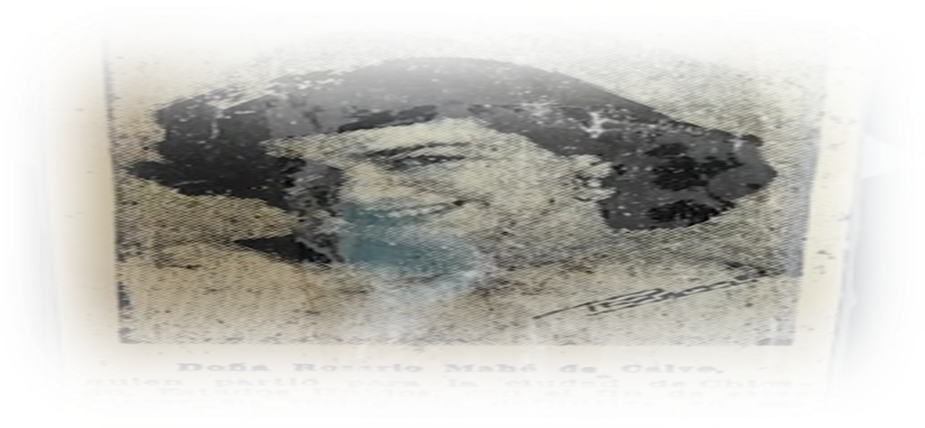
She’s been gone a long time now.  Thirty-three years, a month and five days.  And I think of her often.  I keep the plastic box which for a brief time held her ashes on a shelf in front of my desk, a box I’ve filled with little things I thought she might find meaningful: my sons’ baby teeth, an old bathing suit each wore in turn, my eldest son’s high school identification card, a cell phone my college roommate, now deceased, once gave me.  And taped to the box is a photocopy of a brief article in our local paper here in Manizales, I paper for which I write from time to time, an article with a photo of her, wishing her well as she moved to a new country.  An article almost three quarters of a century old.

I glance at that picture often, and I keep it close to me so that the pain of her passing lives on but morphed into something beautiful and positive, something that gives me courage and hope when I most need it, and an example to follow when I’m tempted to stray from the paths she sowed so carefully for me.

Happy birthday Mom, and thank you for being you, and thank you for everything you miraculously did to make me who you hoped I’d be.
_______

© Guillermo Calvo Mahé; Manizales, 2023; all rights reserved.  Please feel free to share with appropriate attribution.

Guillermo (“Bill”) Calvo Mahé (a sometime poet) is a writer, political commentator and academic currently residing in the Republic of Colombia (although he has primarily lived in the United States of America of which he is also a citizen).  Until 2017 he chaired the political science, government and international relations programs at the Universidad Autónoma de Manizales.  He is currently the publisher of the Inannite Review, available at Substack.com, a commentator on Radio Guasca FM, and an occasional contributor to the regional magazine, el Observador.  He has academic degrees in political science (the Citadel), law (St. John’s University), international legal studies (New York University) and translation and linguistic studies (the University of Florida’s Center for Latin American Studies).  However, he is also fascinated by mythology, religion, physics, astronomy and mathematics, especially with matters related to quanta and cosmogony.  He can be contacted at guillermo.calvo.mahe@gmail.com and much of his writing is available through his blog at https://guillermocalvo.com/.

With a Paradoxical Whimper of Sorts

Looking at cosmogony logically, at least from my perspective, it seems that the end of our universe, … as we know it, is fathomable.  The how at least, if not the when, and it would involve everything everywhere being swallowed into an ultimate universal black hole which had swallowed all other black holes, which had swallowed everything before them, regardless of expansion, so, in a sense, the oscillating universe theorists of yore would unexpectedly be proven right, in their instincts if not in their conclusions.

Of course, that is not a complete end, not the entropic end once envisioned, but a variant thereof, one where black holes form, eat each other in involuntary mergers, or perhaps, happy marriages, and like our own merger mad neoliberal moguls who want to own and control everything, regardless of the cost or danger of nuclear annihilation involved, eventually leave no remnants, except, perhaps, the residue of their own infinitely bloated singularity.

Then again, we don’t know what ultimately happens to black holes, or whether their opposite compliments, theoretically possible at least according to mathematics, “white holes”, would merely start everything over again, or what the consequence of Stephen Hawking’s concepts of information and radiation leakage from black holes might entail.  Which brings us to possible postulates by other physicists such as Planck and DeBroglie and Schwarzschild, i.e., that as black holes “radiate” information, their mass decreases, and, as their mass decreases, they emit greater and greater quantities of informational radiation, causing more and more and faster and faster evaporation, eventually causing them to shrinks to around the Planck mass (the smallest mass possible) where their DeBroglie wavelengths become equal to the Schwarzschild radius.  An infinitely great yet tiny amount of radiation free of information and at that point, perhaps gravity free as well.

Well, in our universe, at any rate.  The rest of the multiverse probably poses other quandaries and promises.

I wonder how AI (artificial intelligence) will fare in the foregoing information-free scenario.
_______

© Guillermo Calvo Mahé; Manizales, 2023; all rights reserved.  Please feel free to share with appropriate attribution.

Guillermo (“Bill”) Calvo Mahé (a sometime poet) is a writer, political commentator and academic currently residing in the Republic of Colombia (although he has primarily lived in the United States of America of which he is also a citizen).  Until 2017 he chaired the political science, government and international relations programs at the Universidad Autónoma de Manizales.  He is currently the publisher of the Inannite Review, available at Substack.com, a commentator on Radio Guasca FM, and an occasional contributor to the regional magazine, el Observador.  He has academic degrees in political science (the Citadel), law (St. John’s University), international legal studies (New York University) and translation and linguistic studies (the University of Florida’s Center for Latin American Studies).  However, he is also fascinated by mythology, religion, physics, astronomy and mathematics, especially with matters related to quanta and cosmogony.  He can be contacted at guillermo.calvo.mahe@gmail.com and much of his writing is available through his blog at https://guillermocalvo.com/.

Ledatic Eht

A vale behind the veil, another side of somewhere
a place
where all who’ve come before us eventually venture.

Where the Boo, another face of God, sits in genteel judgment,
an unlit cigar
clenched firmly in his jaw,

… welcoming home his lambs.
_______

© Guillermo Calvo Mahé; Manizales, 2023; all rights reserved.  Please feel free to share with appropriate attribution.

Guillermo (“Bill”) Calvo Mahé (a sometime poet) is a writer, political commentator and academic currently residing in the Republic of Colombia (although he has primarily lived in the United States of America of which he is also a citizen).  Until 2017 he chaired the political science, government and international relations programs at the Universidad Autónoma de Manizales.  He is currently the publisher of the Inannite Review, available at Substack.com, a commentator on Radio Guasca FM, and an occasional contributor to the regional magazine, el Observador.  He has academic degrees in political science (the Citadel), law (St. John’s University), international legal studies (New York University) and translation and linguistic studies (the University of Florida’s Center for Latin American Studies).  However, he is also fascinated by mythology, religion, physics, astronomy and mathematics, especially with matters related to quanta and cosmogony.  He can be contacted at guillermo.calvo.mahe@gmail.com and much of his writing is available through his blog at https://guillermocalvo.com/.

The True Meaning of Life and all that Rot (Literally; or is it “figuratively”?)

Philosophy is an interesting human concept, our very own innovation designed to concurrently enlighten and befuddle us.  It both opens our minds and channels them into narrow calcified tunnels with light so distant as to become virtually invisible, and hence, rendering real knowledge ungraspable.  At least that’s frequently the case.  But not always.  Take the “meaning of life as an example.  Is it really as complicated and unfathomable as we´ve made it?  Or, is it rather simple and basic?  Based on the following hypothesis, you be the judge.

Sooo, about the “meaning of life” about which we[1] humans spend so much time wondering and, with regards to which, we spend so much time bemoaning the absence of answers.  At least some of us.  At least during certain stages of our lives (for example, during the onset of puberty at adolescence, then as we approach midlife crises, then as we approach what we refer to as our third or golden years, and finally, as we face transition beyond the veil). 

I think I may have found it (it being “the” answer), at least as far as “we” humans are concerned, but, notwithstanding the conclusions of Douglas Adams (wherever he is now that he’s passed beyond the veil), it has nothing to do with the number forty-two.

I would warn readers that the answer’s a bit humbling and hardly grandiose.  Rather, it’s quite utilitarian, although still rather important.  And it applies narrowly and specifically to only one of life’s realms, thus other forms of life have other primal purposes since, when we ask what the purpose of life is, we are referring to the purpose of life and its meaning among we humans.  Accordingly, the answer lies there. 

But what are our premises?  After all, every well thought out answer starts with premises.

Well, interestingly enough, there seem to be just three.  First[2] we have to acknowledge that we humans are part of the animal kingdom, or at least evolved therefrom[3]; second, that the animal and plant kingdoms are both an innovation of our joint forefathers eukaryotes; and third, that those animals possessed of alimentary canals which process ingested nourishment into waste, are our direct ancestors.  There!  We’re set.  Sort of.

Based on the foregoing, the reality with respect to the meaning of life, or perhaps, more accurately, our lives, is that the primary and perhaps sole purpose and function of the denizens of the branch of the animal kingdom of which we’re a part was supposed to be, according to nature (our progenitor), the proliferation of vegetable species, most importantly fruit, beyond their normal range.  That was to be accomplished through the combination of our innovative freedom of movement, compared to the plants we were digesting, and our excretionary functions.  Consequently, we were not “forbidden” to eat the fruit of life, but, as Eve would in no uncertain terms conform, impelled to do so, and to digest it, and having digested it into a compost that included seeds and the fertilizing agents necessary for propagation, excrete the residue to spread vegetable life far and wide.

The plant and animal kingdoms (all multicellular animals), of course, constitute only two of the five currently recognized living realms, the others being fungi (moulds, mushrooms and yeast), protists (amoeba, chlorella and plasmodium) and prokaryotes (bacteria and blue-green algae) but in the context of our foundational inquiry, we are only concerned with the first two, and with respect to those, original purposes soon became complicated and convoluted, perhaps resulting in our current confusion and despair.

While our original purpose for existing as part of the living realms was clear, the animal kingdom duchy (sort to speak, or perhaps principality) of which we are part soon deviated as carnivores insisted on intruding onto the alimentary premises which the vegetable kingdom found imperative, and rather than consuming plants and fruit, especially fruit, they insisted on a form of primordial cannibalism and expanding on that, we humans evolved into omnivores, consuming anything and everything that did not consume us first.  But that was not enough for us, we then degraded the importance of our excretions.  Indeed, we disdained and contained them through nonproductive (at least from the vegetable kingdom’s perspective) purportedly salutary practices, such deviation from our primary purpose having been erroneously premised on cultural misinterpretation of our role, our “prime directive” as Gene Roddenberry might have put it, and then, of course, misdirection.  Since then, we’ve invented myriads of fields of reflection and introspection trying to rediscover the purpose we ourselves rendered, if not obsolete, at least anachronistic.

Following the hypothesis that no good deed goes unpunished, at least for long, the animal kingdom, duchy of which we are a part, through the intervention and innovations of we humans, has and continues to conquer and devastate our creators in the vegetable kingdom, indeed, in all five of life’s realms, which may be the source of the rumor spread by Friedrich Nietzsche to the effect that “God”, whoever or whatever that was (hint, it’s obviously nature) is dead, although Nietzsche was merely projecting nature’s future.

Interestingly, the foregoing also implies another epiphany, one that involves the identity of the “adversary, to whom some humans unfairly refer in their purportedly sacred writings as Lucifer, or Satan, or Shaitan, but which more accurately, was a certain Hêl él[4].  In fact, if the foregoing is accurate, the adversary was in fat not some deviant archangel but rather, a certain Robert Thom, the Scott[5] who initiated sewage treatment in the city of Paisley[6]; the clearest and most expansive example of the law of unintended consequences. 

If only plants could speak what stories they could tell. 

Sooo, … about artificial intelligence …!
_______

© Guillermo Calvo Mahé; Manizales, 2023; all rights reserved.  Please feel free to share with appropriate attribution.

Guillermo (“Bill”) Calvo Mahé (a sometime poet) is a writer, political commentator and academic currently residing in the Republic of Colombia (although he has primarily lived in the United States of America of which he is also a citizen).  Until 2017 he chaired the political science, government and international relations programs at the Universidad Autónoma de Manizales.  He is currently the publisher of the Inannite Review, available at Substack.com, a commentator on Radio Guasca FM, and an occasional contributor to the regional magazine, el Observador.  He has academic degrees in political science (the Citadel), law (St. John’s University), international legal studies (New York University) and translation and linguistic studies (the University of Florida’s Center for Latin American Studies).  However, he is also fascinated by mythology, religion, physics, astronomy and mathematics, especially with matters related to quanta and cosmogony.  He can be contacted at guillermo.calvo.mahe@gmail.com and much of his writing is available through his blog at https://guillermocalvo.com/.


[1] I know, I know, it should be “us”, but I don’t really like the way “us” sounds in this context, and, … I am the author, with all rights to “poetic license”, sooo, “we” it is.

[2] I know, I know, … again.  “Premises, premises”, but what can we do without them.

[3] The “derived therefrom” phrase preemptively addresses arguments insisting that we are qualitatively different than animals.

[4] Look him up, it’s worth it.

[5] I hate to admit that the English may have been correct when some postulated that the devil was most certainly a Scott.  But evidently, at least in this one instance, it appears they were on to something.  I guess the axiom that no one is always wrong may, in fact, be somewhat correct.

[6] Although the Minoan civilization of Crete and the Roman Empire used underground clay pipes for “sanitation” purposes.  So perhaps the identity of the “adversary” is all too securely hidden.

Calcium: a very strange introspective rant

Achilles, Zoroaster, Siddhartha Gautama of the Sakyas, Gaius Iulius Caesar, Yeshua the Nazarene, Karl I of the Carolingians (Charlemagne), Napoleon Bonaparte, Robert E. Lee, Mohandas Gandhi, Martin Luther King, Jr., Nelson Mandela, Pepe Mujica, Francis I (maximum pontiff among the Catholic): some of my “hysterically historical … sort of “friends”, or at least I’ve hope they would have been among my friends if I’d enjoyed the privilege of having known them.  They are perhaps portrayed bit hyperbolically by their biographers, at least as initially depicted to me, but I really identify with them.  On some level.  Or, … well, … with how they were been presented to me by our weird communicative media complex (you know, teachers, journalists, historians and best of all, novelists), mainly since that’s how they seemed when I sort of first “met” them.  Virtually of course.  That changed in time.  They changed when, through my own research, it seemed to me that I’d gotten to know them better, more accurately, more profoundly.  When, as a historian of sorts, I’d somehow been able to grasp their more complex realities, but then, that’s only what I perceived and reality was (and probably is) different, perhaps much different. 

Maybe.  ….  But even so, … first impressions tend to stick notwithstanding subsequent evidence, whether involving reactive affection or disdain.

We humans are like that.  Well, except perhaps for my late and sainted mother.  Once our minds are made up about just about anything; once we’ve decided what to believe our minds are very, very, very hard to change.  That, to some extent, explains sports fans, and political perspectives, and, unfortunately, history as well.  And long lost loves, and simmering enmities.  And loyalties.  All “for better or for worse”, as expressed in aspirational traditional marital vows; although, perhaps, more frequently, much more frequently, for the worse.

We tend to calcify our beliefs, although we prefer to refer to the process as crystallization.  Crystals seem more attractive than calcium.  We clearly have wonderful powers of self-aggrandizement through delusion and rationalization.  The concept of American Exceptionalism, a variant of the Hebrew concept of the Chosen People and the Nazi concept of the superiority of the Aryan peoples are prime examples.  As is the European concept of the “White Man’s Burden”.  Or our democratic delusion that if enough of us are wrong, everything will turn out right.

It seems amazing that we ever accepted “reflections” as accurately portraying anything, preferring not to see ourselves as we are but as we wish we were.  Which of course explains, to an extent, the popularity of plastic surgery and girdles, and well, clothing (as well as the nudity taboo), and, on an emotive sense, the popularity of psychotherapy and perhaps, although it would seem oxymoronic, of purportedly self-reflective psychoanalysis.  It’s a wonder we have no taboo concerning mirrors.

All of the foregoing, during strangely lucid intervals (or at least intervals which, for some reason or other I perceive as lucid), makes me wonder what I’m really like, what I really look like, who I really am and just how close to accurate what I perceive of as reality really is.  Then I wonder just how lucid I’ve been as a write this, and whether it’s something I’ll ever re-read, or, for that matter, whether anyone else will ever read it. 

Then I picture alien anthropologists from deep in the future, perhaps just short of the instant when entropy finally wrestles gravity to a draw, finding and, after long and usually fruitless efforts, finally deciphering what I’ve written, and wondering, perplexed, just who and what we were.

Something we probably need to do ourselves, while we still can.
_______

© Guillermo Calvo Mahé; Manizales, 2023; all rights reserved.  Please feel free to share with appropriate attribution.

Guillermo (“Bill”) Calvo Mahé (a sometime poet) is a writer, political commentator and academic currently residing in the Republic of Colombia (although he has primarily lived in the United States of America of which he is also a citizen).  Until 2017 he chaired the political science, government and international relations programs at the Universidad Autónoma de Manizales.  He is currently the publisher of the Inannite Review, available at Substack.com.  He has academic degrees in political science (the Citadel), law (St. John’s University), international legal studies (New York University) and translation and linguistic studies (the University of Florida’s Center for Latin American Studies).  However, he is also fascinated by mythology, religion, physics, astronomy and mathematics, especially with matters related to quanta and cosmogony.  He can be contacted at guillermo.calvo.mahe@gmail.com and much of his writing is available through his blog at https://guillermocalvo.com/.

Windfall Profits, the Defense Industry and the American Tax Payer:

Reflections during another Memorial Day

The fulcrum on which political decisions are leveraged and the world’s future mortgaged is inherently tied to the welfare of investors in “defense” industries, of their senior executives and directors, and secondarily, the welfare of ancillary industries and businesses that profit from war and the threat of war, and if war and the threat of war are constants, then investments in “defense” industries are predictably secure.  Something the commander of allied forces in the Second World War and later, president of the United States, Dwight David Eisenhower begged us to avoid.  To the extent related government expenditures are not carefully monitored and waste prevails, so much the better.  That millions subsidize such profits with their lives in diverse parts of the world is merely “collateral damage”, at least to those not suffering such consequences, directly or indirectly.  And of course, on this Memorial Day, we recognize that such casualties are not only innocent foreigners, but also the bravest Americans, those who, believing that their service is essential, volunteer to put their lives and welfare on the line.

The Athenians attitude towards those who provided the armaments for their military and naval forces was wise.  They were required to serve on the front lines.  Not so our own war profiteers, neither they nor their families, except in extremely rare cases, serve at all, being too busy enjoying the fruits of others’ labors.  And most of those who do serve, Albert Gore and George W. Bush being prime examples, do so ensconced in protective cocoons, far from danger, surrounded by photographers so that their purported service can be documented for future use.  The Clintons and the Obamas and the Bidens (Joe and Hunter and Jimmy) and the Trumps were excused from service through the labyrinth of useful loopholes available to those wealthy or influential enough to avoid service, something which needs to be differentiated from the refusal to serve by those opposed to war, and who would never send the children, spouses, siblings or relatives of others to tread where they refused to serve.  Those who declined to serve but on attaining power of any sort, do not hesitate to send others to die or kill, and to suffer and cause mayhem, and to suffer and cause irreparable psychological trauma, are contemptuously referred to by those who served, as well as by conscientious objectors, as “chicken hawks”.  Our country is led by chicken hawks.  Chicken hawks in government, in the “defense” industries and in the corporate media as well.  And the results are predictable.  Profits for the few, massive profits.  But famine and chaos and mayhem and death and destruction for far too many on the other side of the ledger.  Some of them our own.  Some of them the best among us.

This Memorial Day takes place at an interesting time.  There has been hugely hyperbolic debate between the Republican led House of Representatives and the Biden administration concerning the need to raise the national debt limit, an increase once again required, for the 82nd time, because rather than pay for federal expenditures through taxes, to which voters would object and, as a result, might seriously consider what their taxes were being used to fund, it is more palatable, at least for now, to just, well, … borrow the money.  Federal debt financing is done through unsecured borrowing from third parties, largely banks and financial institutions but also investors, foreign and domestic.  Interestingly, the interest paid to holders of United States debt securities is higher than that paid by financial institutions to the Federal Reserve for the money borrowed to acquire such securities, among other things.  Many might wonder why the prohibitions against “ponzi” schemes which the Federal government prosecutes, are not applicable to the largest ponzi scheme of all.

The current direct national debt, that which is disclosed (it may well be substantially greater and does not include state, municipal or local debt), currently stands at almost thirty-two-trillion dollars[1], but the Biden administration insists that it must be increased immediately, if not sooner, and traditionalist members of the Republican Party are in agreement, although its populist branch is  not.  There is a current proposal on the table in Congress to acquiesce to the Biden administration’s demand to increase the national debt during the period preceding the next presidential election (so that it need not be revisited and become a political issue therein), by one-and-a-half-trillion dollars.

Sooo.  Why?

Because the United States government wants to spend the Russian Federation and the People’s Republic of China into oblivion by funding wars involving the Ukraine, already under way, and Taiwan, even at the risk of a nuclear holocaust, and anyway, that addition to the national debt, like the accumulated debt before it, ends up in the pockets of, well, you may have already guessed the answer from the introductory material above, “investors in “defense” industries, their senior executives and directors, and secondarily, the welfare of ancillary industries and businesses that profit from war and the threat of war”.

And who, you may ask, will pay that accumulated debt?

The answer is interesting and reminiscent of the attitude of French King Louis XV, you know, the one who preceded Luis XVI, who, along with his family and many others, lost his head in the French Revolution of 1789 (which, to an extent, may explain the drastic reaction by the powers that be to the political protests of January 6, 2020).  The answer is, … “who cares”!  At worse, the United States could print the money necessary to pay off the debt, although that would create never before imagined hyperinflation, inflation that would make that suffered in Germany following the War to End All Wars (well, we now call it the first of the world wars) at the dawn of the twentieth century a trifle.  One might recall that the inflation following the first of the world wars led to the rise of fascism in various countries, and threatened to do the same in most others.  Of course, some consider that fascism is currently in vogue among those who most criticized it way back then.

This Memorial Day, as I mourn my many friends and my former classmates who’ve perished in combat during the past six decades (I’m a Citadel graduate), it occurred to me that the answer to our ludicrous national debt crisis is rather simple and does not require a reinvention of the wheel.  It’s called a “windfall profits tax”.  One that should be imposed on those who’ve so profited from the perpetual wars (what would Emanuel Kant think).  You may have guessed the answer again, it’s the same as the answer to the former query: “investors in “defense” industries, their senior executives and directors, and secondarily, the welfare of ancillary industries and businesses that profit from war and the threat of war”.  A tax of 90% on all profits derived from them, directly and indirectly, from whatever sources and wherever derived, until the national debt is paid off, with tax avoidance punishable by forfeiture of all assets and life imprisonment.

Simple, sort of.  At least in a democracy where voters have some awareness of how things work, and why.

A suggestion as we remember those of our fellow men and woman who’ve sacrificed so much, unfortunately, all too often uselessly, on this Memorial Day.

Something on which not only to reflect, but perhaps on which to act.
_______

© Guillermo Calvo Mahé; Manizales, 2023; all rights reserved.  Please feel free to share with appropriate attribution.

Guillermo (“Bill”) Calvo Mahé (a sometime poet) is a writer, political commentator and academic currently residing in the Republic of Colombia (although he has primarily lived in the United States of America of which he is also a citizen).  Until 2017 he chaired the political science, government and international relations programs at the Universidad Autónoma de Manizales.  He is currently the publisher of the Inannite Review, available at Substack.com.  He has academic degrees in political science (the Citadel), law (St. John’s University), international legal studies (New York University) and translation and linguistic studies (the University of Florida’s Center for Latin American Studies).  However, he is also fascinated by mythology, religion, physics, astronomy and mathematics, especially with matters related to quanta and cosmogony.  He can be contacted at guillermo.calvo.mahe@gmail.com and much of his writing is available through his blog at https://guillermocalvo.com/.


[1] Information based on the national debt clock as of this Memorial Day, available at https://www.usdebtclock.org/.