
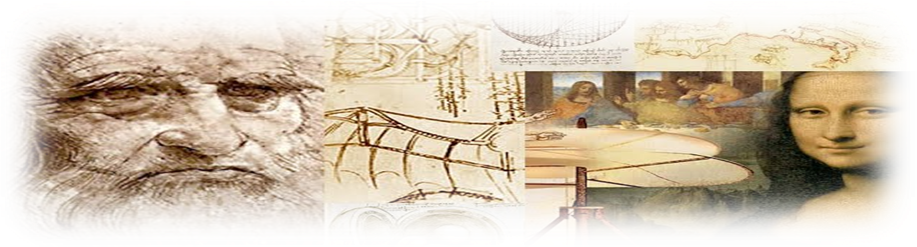
Ever since I can remember I’ve been an admirer of Leonardo da Vinci, the bastard son of Ser Piero da Vinci d’Antonio di ser Piero di ser Guido, a successful Florentine legal notary, and Caterina di Meo Lippi. Leonardo was apparently born in either Anchiano, a country hamlet near the Florentine commune of Vinci, or in a house in Florence, part of the ancient Italian region of Tuscany, owned by his father, in either case, seeking privacy to hide the illegitimate birth. His mother may have been an Arab or Chinese slave although a book published by Martin Kemp and the archival researcher Giuseppe Pallanti claims that she was born in 1436 to a poor farmer, was orphaned at the age of fourteen and gave birth to Leonardo da Vinci at the age of sixteen, after which she purportedly had five other children with a different man, also a poor farmer. Leonardo was initially raised in relative poverty by his mother and her husband but eventually Leonardo came to enjoy a positive relationship with his father’s family, especially with his uncle and grandfather, although perhaps not with his father who was too busy with business matters. Consequently, he only received a very basic and informal education in writing, reading, and mathematics, although his artistic talents were recognized at an early age and emphasis was quickly placed on their development.
It is telling and very worth considering that from such inauspicious beginnings perhaps the world’s most universally talented man arose and to ask ourselves how many other multifaceted geniuses born under comparable circumstances never had the opportunity to attain their potential. In my own life I’ve known a number of men and women who fit that characterization. In this regard, the world owes a great debt to Andrea del Verrocchio, an Italian sculptor, painter and goldsmith who was a master of a workshop in Florence and who apparently accepted Leonardo, first as a studio boy but when he turned 17, as an apprentice, setting him on his path to greatness, first as an artist and then, … well, as a universal genius.
Leonardo di ser Piero da Vinci is one of my greatest heroes, but I admire him less for his myriad successes than because he attained them despite the humility of his origins. One thing I have always found incomprehensible however is the fame of his most famous painting, the Mona Lisa, and the worshipful claims concerning the subject’s beauty, and especially her smile. To my perhaps jaded and certainly inexpert tastes, she is not even particularly attractive and as for the “enigmatic” nature of her smile, I find nothing at all special about it, especially when compared to my wife’s. I assume many other husbands, boyfriends and fathers share my perspective and that some may also share my curiosity. What most troubles me however concerning the Mona Lisa hysteria is that it obscures Leonardo’s truly great achievement, having risen from such humble beginnings to such stunning heights without the intervention of martial opportunities and successes, the more usual route to success for those born of humble origins. One wonders how many people who might eventually have proven to be a new Leonardo we trash as we expel those desperate to become part of our society and who ask only to be permitted to work and grow among us? “… [g]ive me your tired, your poor, your huddled masses yearning to breathe free, the wretched refuse of your teeming shore …” indeed.
The foregoing frequently leads me to reflect on the reality that when people are not assisted in attaining their potential, it is not only they who suffer, but the whole world, and on the stupidity and cupidity of those who oppose state assistance to the most humble among us. We certainly desperately need a world were the most humble can attain their full potential, a concept which the Athenian philosopher Plato referred to as an essential component of “justice” and understood as essential for optimal societal development, the common welfare and attainment of the best possible world. Something which, despite the millennia since Plato, his mentor Socrates and his student Aristotle contemplated how to attain justice, we are very, very far from attaining.
_____
© Guillermo Calvo Mahé; Manizales, 2026; all rights reserved. Please feel free to share with appropriate attribution.
Guillermo (“Bill”) Calvo Mahé (a sometime poet and aspiring empirical philosopher) is a writer, political commentator and academic currently residing in the Republic of Colombia (although he has primarily lived in the United States of America of which he is also a citizen). Until 2017 he chaired the political science, government and international relations programs at the Universidad Autónoma de Manizales. Previously, he chaired the social studies and foreign language departments at the Eastern Military Academy in Huntington, New York. He is currently the publisher of the Inannite Review available at Substack.com; an intermittent commentator on radio and television; and, an occasional contributor to diverse periodicals and publications. He has academic degrees in political science (BA, The Citadel, the Military College of South Carolina), law (JD, St. John’s University, School of Law), international legal studies (LL.M, the Graduate Division of the New York University School of Law) and translation and linguistic studies (GCTS, the University of Florida’s Center for Latin American Studies). However, he is also fascinated by mythology, religion, physics, astronomy and mathematics, especially with matters related to quanta, cosmology and cosmogony. He can be contacted at guillermo.calvo.mahe@gmail.com and much of his writing is available through his blog at https://guillermocalvo.com/.

 Guillermo Calvo Mahé