Rethinking Delusional Popular Governance

The concept of democracy in conjunction with governance seems a sacred cow, unfortunately, a dysfunctional sacred cow given that the concept of democracy is neither understood nor respected and that what is required for the constitutionally guaranteed “public welfare” is efficient, transparent and honest governance with the capacity for long range planning and for providing its constituents with the opportunity to fully realize their capabilities and to lead peaceful, comfortable, happy and fulfilled lives.  That is certainly not what exists anywhere today.  Rather, we have self-perpetuating systems built on pillars of omnipresent corruption implemented through corrupt mass media and administered by corrupt entrenched bureaucracies.  Human rights, as the long-term Israeli genocide in Palestine supported by the United States and NATO makes clear, are mere delusions.

There are two principal poles for what is considered democratic governance, presidential systems with legislatures elected for fixed terms, and parliamentary systems which meld legislative and executive functions for variable terms, the exact length depending on how well the executive, which stems from the legislature, and the legislature are able to function collaboratively.  The latter is both more democratic and more coherent, but has its own internecine flaws.  In addition, there are forms of governments that require voters to participate (or else), generally in uniparty Communist systems, the most successful being those in the Peoples Republics of China and Vietnam, but according to the western press at least, they apply serious restrictions on personal liberty.

Looking at the most efficient governments, those most able to function strategically as well as tactically, it appears that long term executive leadership is essential, leadership such as that demonstrated in Germany during the long chancellorship of Angela Merkel and in the Russian Federation during the Putin era and the aforementioned Chinese and Vietnamese systems.  Of course, corrupt and inept long term leadership, such as that in Egypt, is awful.  Trusting that a majority of the people make the best electoral decisions has proven a fallacy, largely because the “people” are not free to select candidates, that function in reality being effected through a partisan filtering system controlled by purported elites and now, imposed in countries like the United States through blatant judicial manipulation as well.  In addition, the resulting disinterest results in lack of participation so no candidate is likely to ever receive more than 50% of the eligible vote, the quintessential aspect of democracy.

If the foregoing is accurate, then perhaps we need to consider how to implement a meritocratic rather than democratic method of selecting our leadership on a long term basis, but a method subject to earlier democratic revocation for misfeasance or malfeasance and with significant personal penalties in the case of any such revocation.  It could, for example, involve, in the first instance, a selection process embodying the philosophy of the original Electoral College in the United States, with a democratic revocatory process exercised both periodically, say every five years, or on the spot if invoked by a significant portion of the electorate dissatisfied with the results of the incumbent leader.  Electoral participation by the citizenry would, as it was in ancient Athens, be a duty and not a right, with serious consequences for shirking it or exercising it in a corrupt manner (e.g., selling or renting it).  It smells a bit too much like the fascist ideal of an overall, all-powerful leader, except for the revocatory mechanisms but those make all the difference.  Admittedly, the concept needs to be polished a bit with a check and balance mechanism such as a negative legislature, an elected body charged with political control functions and the ability to veto executive decrees (which would replace traditional legislative functions), but not responsible for enacting legislation.  A multi cameral negative legislature would be best, one chamber being selected democratically, one based on pluralistic concepts and one selected meritocratically based on expertise in diverse areas but all three chambers voting as one.  Of course, an independent judiciary would be essential, but not one charged with constitutional control or review, as would an independent body controlling the electoral system, perhaps a body selected by the legislature.  The most serious penalties under the penal system would be reserved for violation of political and judicial duties, pretty much the way it is today in the People’s Republic of China.

If it ain’t broke don’t fix it is a saying reflective of a great deal of common sense but one that does not apply to our current models of governance.

Something to at least consider, although implementation in the face of the entrenched and ruthless deep state makes any kind of real reform improbable.
_______

© Guillermo Calvo Mahé; Manizales, 2023; all rights reserved.  Please feel free to share with appropriate attribution.

Guillermo (“Bill”) Calvo Mahé (a sometime poet) is a writer, political commentator and academic currently residing in the Republic of Colombia (although he has primarily lived in the United States of America of which he is also a citizen).  Until 2017 he chaired the political science, government and international relations programs at the Universidad Autónoma de Manizales.  He is currently the publisher of the Inannite Review, available at Substack.com, a commentator on Radio Guasca FM, and an occasional contributor to the regional magazine, el Observador.  He has academic degrees in political science (the Citadel), law (St. John’s University), international legal studies (New York University) and translation and linguistic studies (the University of Florida’s Center for Latin American Studies).  However, he is also fascinated by mythology, religion, physics, astronomy and mathematics, especially with matters related to quanta and cosmogony.  He can be contacted at guillermo.calvo.mahe@gmail.com and much of his writing is available through his blog at https://guillermocalvo.com/.

Reflections on the Christmas Season, … 2023

Charles Dickens’ “a Christmas Carol” has, since it was first portrayed on the stage and screen, resonated with very diverse segments of our population although now, more realistic Carols seem to focus on a new verse, one appended to the beginning of “the Twelve Days of Christmas”, one that starts six months earlier than the older verses and deals with “… myriad merchants a’ selling ….” So perhaps that older resonance is a bit dulled and in need of refreshing. 

Perhaps a bit of reflection might help, a bit of introspection as the solstice skims by us and echoes of pagan Yule and Roman Saturnalia regale us with mirth to go along with the myrrh purportedly provided to an ostensibly special infant born in Palestine long before Zionists sought to destroy that part of the world; well, destroy it, then absorb it, and then turn it into an exclusive Palestinians-free paradise.   One might be excused for wondering what use a newborn would have for myrrh, a fragrant gum resin obtained from certain trees and used, especially in the Near East, in perfumery, medicines, and incense, but, what the heck; … so the story goes and the gift of myrrh is not its least credible aspect.

Soooo, … let’s reflect away to the tune of “Jingle Bells”, or perhaps, the Jose Feliciano version of “Feliz Navidad”:

On an individual basis, the Christmas season is delightful, at least for people blessed with positive familial harmonics supplemented by ties of easily accessible meaningful friendship, but it is deeply depressing for those not so set apart.  The latter group concerns me deeply because it is comprised of the forgotten and of those who for one reason or other, never seemed to matter.  Those with whom the Nazarene, whose birthday so many purportedly celebrate during this season, would be most concerned, assuming he existed and was as beneficently described rather than the angry Pauline version.  Of course, while in the modern “Western” world the season focuses on the Nazarene, the season’s traditions are primordial and have been, in many cases, usurped through manufactured syncretism with far older and more complex cultures, cultures which in some cases have refused amalgamation.

Perhaps the foregoing might serve as a thought bandied about among the ghosts of Christmas past, Christmas present and Christmas future, a thought we might all want to take into account and perhaps, about which we might even consider doing something positive.  And if so, why limit it to this particular season?

Bah humbug!!!!  I wonder what exactly, using linguistic analysis and perhaps philology that is meant to mean.
_______

© Guillermo Calvo Mahé; Manizales, 2023; all rights reserved.  Please feel free to share with appropriate attribution.

Guillermo (“Bill”) Calvo Mahé (a sometime poet) is a writer, political commentator and academic currently residing in the Republic of Colombia (although he has primarily lived in the United States of America of which he is also a citizen).  Until 2017 he chaired the political science, government and international relations programs at the Universidad Autónoma de Manizales.  He is currently the publisher of the Inannite Review, available at Substack.com, a commentator on Radio Guasca FM, and an occasional contributor to the regional magazine, el Observador.  He has academic degrees in political science (the Citadel), law (St. John’s University), international legal studies (New York University) and translation and linguistic studies (the University of Florida’s Center for Latin American Studies).  However, he is also fascinated by mythology, religion, physics, astronomy and mathematics, especially with matters related to quanta and cosmogony.  He can be contacted at guillermo.calvo.mahe@gmail.com and much of his writing is available through his blog at https://guillermocalvo.com/.

On Equatorial Solstices and Balancing Harmonics

The solstices which take place in the arbitrarily denominated months of June and December (at least in what is commonly referred to, for inexplicable reasons given the nature of directions, as “western” culture) generate complex emotional vortexes, emotive textures woven of delight and depression, both inter and intra-personally.  

Topographically, in the northern hemisphere, the December solstice marks the end of lengthening nights and the beginning of longer days, in the south, the opposite is true.  The inverse occurs in each north-south hemisphere in June.  But what happens right on the equator? 

Perhaps a bit of confusion as to what all the fuss is about.  Or perhaps the solstices are at their most unique, most special and most profound on the equator, especially if one were to set one foot in the northern hemisphere and the other in the southern, something possible in southern Colombia and in the other twelve countries which the equator bisects (Ecuador, Brazil, Sao Tome & Principe, Gabon, the Republic of the Congo, the Democratic Republic of the Congo, Uganda, Kenya, Somalia, the Maldives, Indonesia and Kiribati).  The so called Coriolis Effect based on the consequences of the earth’s rotation, makes storms swirl clockwise in the southern hemisphere and counterclockwise in the northern hemisphere, thus, physically, unlike the arbitrary denominations of east and west as static points, or the arbitrary temporal division into months of varying lengths, the concepts of “north” and “south” have actual physical consequences.  But what happens at the equator, especially during the solstices? 

One would think the equator would be the site of special ceremonies during the two annual solstices in each country through which it passes.  There are, of course, myriad festivals related to the two solstices almost everywhere (other than on the equator itself).  Think, of course, of Christmas, originally celebrated on or about the exact date of the solstice until Pope Gregory XIII shifted dates around and the law of unintended consequences extracted astronomical significance from that festival.  Of course, like east and west and calendar months, the placement of the Christmas season in December was completely arbitrary, counterintuitive and incoherent given available evidence, apparently seeking primarily to obscure the date theretofore assigned to the Zoroastrian god Mithras (born of a virgin on December 25) and perhaps the Roman festival of Saturnalia as well as a plethora of “pagan” solstice related festivals (whatever “pagan” means).  Like the foregoing, other solstice related festivals are generally focused on climactic consequences in one of the two north-south hemispheres.  In Ecuador for example, Inti Raymi (the Fiesta del Sol) has been long celebrated on June 21 to the south of the equator rather than exactly along the border, that exactitude being infinitesimal and difficult to set with exactitude, other than through, for example, striding it.  The Inti Raymi was a traditional religious ceremony of the Inca Empire in honor of the god Inti (Quechua for sun), the most venerated deity in the Inca religion.  It was declared a festival of “intangible cultural heritage” on June 29, 2016, and it is still celebrated throughout the formerly Incan Andean region due to its association with indigenous cosmogony and with the bounty provided by the Pacha Mama (a Gaia-like indigenous deity popular in the Andes). 

Oddly, festivals set exactly adjacent to both sides of the equator during the solstices do not appear to exist, at least not formally, which is surprising.  It would seem a perfect trajectory and day, perhaps a perfect instant, for reflection and introspection, for seeking a perfect balance, for merging the negative and the positive, the ying and the yang, for celebrating the similarities in things that seem opposed.  To acknowledge the harmonics possible in polarization and how they can generate dialectic evolution.  An instant to pray for peace and harmony.

Which, perhaps, explains the dearth of related ceremonies.  The military industrial complex which rules us all the way that Tolkien’s “one ring” ruled the rest would never permit such a festival.

Still, if that impediment could somehow be overcome, what about a semi-annual ceremony along the equator, once for each solstice, where a line of people one person wide, alternating men and women perhaps, is formed along the entire land portion of the equator, with every participant straddling the equator and holding hands with those before and after them, all assembled several minutes before the solstice and disbanded several minutes afterward to assure coincidence with the instant of the solstice, all focusing during that time on a world at peace, one where all opinions respected, one seeking continuing evolution towards harmonious unity and perfection.

Wouldn’t that be something?  Perhaps it’s something to consider.
_______

© Guillermo Calvo Mahé; Manizales, 2023; all rights reserved.  Please feel free to share with appropriate attribution.

Guillermo (“Bill”) Calvo Mahé (a sometime poet) is a writer, political commentator and academic currently residing in the Republic of Colombia (although he has primarily lived in the United States of America of which he is also a citizen).  Until 2017 he chaired the political science, government and international relations programs at the Universidad Autónoma de Manizales.  He is currently the publisher of the Inannite Review, available at Substack.com, a commentator on Radio Guasca FM, and an occasional contributor to the regional magazine, el Observador.  He has academic degrees in political science (the Citadel), law (St. John’s University), international legal studies (New York University) and translation and linguistic studies (the University of Florida’s Center for Latin American Studies).  However, he is also fascinated by mythology, religion, physics, astronomy and mathematics, especially with matters related to quanta and cosmogony.  He can be contacted at guillermo.calvo.mahe@gmail.com and much of his writing is available through his blog at https://guillermocalvo.com/.

Or So They Say

Alabaster and indigo, or is it, … “or” indigo.  Negative entropy blues, anyway.

It’s said, albeit in an all too unreliable source, that “for everything there is a season and a time for every matter under heaven”.  Perhaps there’s a bit of truth there.  Perhaps not.

It’s approaching the Ides of December in an odd-numbered year, a year preceding one in which February will be a day longer.  An illusion of course, as are all months in a solar year.  But, at any rate, it’s at least a metaphorical season, a season for memories as another galactic solstice approaches.

A season for melancholy and nostalgia, for yule logs and the revels of Saturnalia and little drummer boys not yet blasted to shreds; a season for wistful bagpipes and for sanguine guitars, Arabic music melding with Keltic.  A season for reflecting on the pasts we’ve lived and on those we might have lived, for good or ill.  A season for introspection and for reflection on feelings of love we’ve shared and for speculation on loves we should have shared but let slip away, and perhaps, for regretting some that might best have been avoided. 

A season, perhaps, for discarding enmities and hatreds, although that’s all too often much too hard to do.  A season for remembering friends who’ve passed beyond the veil and for regretting the time not found to spend with them.  Perhaps a season for wondering whether there’s a state of unity that might make everything worthwhile (if, in fact, “for everything there [really] is a season, and a time for every matter under heaven”) or, a season for lamenting that the purported prince of Peace was an illusion.

Introspective reflection is as dangerous as it is beneficent.  Perhaps more so.

Reflections are all too often more bitter than sweet.  So many regrets, so many mistakes, so many paths not taken.  So many twists and turns into obscure shadows, flashing echoes drawing us further and further into a dark abyss where terror dwells as others, thundering, warn us away.  Cherished memories more and more quickly fading; more and more tarnished with each passing day as things in which we once took pride turn out to all too often have been mere delusions.

Here and there, barely noticed and all too often ignored, unexpected rainbows play with fireflies and tiny birds buzz in place sipping sweet nectar from flowers blooming in myriad tones and hues.  Clouds form shifting tapestries on azure fields above swirling waves of peaks changing from greens to greys then from blues to purples and, every once in a while, tipped with gleaming cones of winter’s bright white; peaks interspersed with golden fields and silvered river valleys, all doing their best to ignore intrusive asphalt roads and cement cities.  Transient monuments to imagined triumphs slowly but surely returning to the dust from whence, like us, they came.

The Ides of December are upon us, … again.  Then the solstice will arrive, winter in half the globe, summer in the rest.  Cycles continue.  Divergent rites of passage form myriad wakes woven into strange tapestries by disinterested fates, one a crone, another a mother and the third barely a lass.  All the while, Alekto, Megaera and Tisiphone, the Eumenides, curious but patient, continue to watch, certain that all things, good or ill, will come to those who wait.

Or so, the ubiquitous “they”, say.

Alabaster and indigo, or is it, … “or” indigo.  Negative entropy blues, … anyway.
_______

© Guillermo Calvo Mahé; Manizales, 2023; all rights reserved.  Please feel free to share with appropriate attribution.

Guillermo (“Bill”) Calvo Mahé (a sometime poet) is a writer, political commentator and academic currently residing in the Republic of Colombia (although he has primarily lived in the United States of America of which he is also a citizen).  Until 2017 he chaired the political science, government and international relations programs at the Universidad Autónoma de Manizales.  He is currently the publisher of the Inannite Review, available at Substack.com, a commentator on Radio Guasca FM, and an occasional contributor to the regional magazine, el Observador.  He has academic degrees in political science (the Citadel), law (St. John’s University), international legal studies (New York University) and translation and linguistic studies (the University of Florida’s Center for Latin American Studies).  However, he is also fascinated by mythology, religion, physics, astronomy and mathematics, especially with matters related to quanta and cosmogony.  He can be contacted at guillermo.calvo.mahe@gmail.com and much of his writing is available through his blog at https://guillermocalvo.com/.

Vincent, an Ode to Van Gogh

If this is not the most beautiful song ever, there are none more beautiful: Don McLean’s Vincent, an Ode to Van Gogh.  More beautiful as poetry than as music and, set to prose it might read like this:

Starry, starry night, paint your palette blue and gray, look out on a summer’s day with eyes that know the darkness in my soul.

Shadows on the hills, sketch the trees and the daffodils, catch the breeze and the winter chills in colors on the snowy, linen land.

Now, I understand what you tried to say to me and how you suffered for your sanity, and how you tried to set them free.  They would not listen, they did not know how; perhaps they’ll listen now.

Starry, starry night, flaming flowers that brightly blaze, swirling clouds in violet haze reflect in Vincent’s eyes of china blue; colors changing hue, morning fields of amber grain, weathered faces lined in pain are soothed beneath the artist’s loving hand.

Now, I understand, what you tried to say to me, how you suffered for your sanity, how you tried to set them free.  They would not listen, they did not know how, perhaps they’ll listen now.

For they could not love you, but still your love was true and when no hope was left inside on that starry, starry night, you took your life as lovers often do.  But I could have told you, Vincent, this world was never meant for one as beautiful as you.

Starry, starry night, portraits hung in empty halls, frameless heads on nameless walls with eyes that watch the world and can’t forget, like the strangers that you’ve met; the ragged men in ragged clothes, the silver thorn of bloody rose lie crushed and broken on the virgin snow.

Now, I think I know what you tried to say to me, how you suffered for your sanity, how you tried to set them free.  They would not listen, they’re not listening still, perhaps they never will.
_______

Lyrics set to prose copyrighted by Don McLean.  Observations and commentary, © Guillermo Calvo Mahé; Manizales, 2023; all rights reserved.  Please feel free to share with appropriate attribution.

Guillermo (“Bill”) Calvo Mahé (a sometime poet) is a writer, political commentator and academic currently residing in the Republic of Colombia (although he has primarily lived in the United States of America of which he is also a citizen).  Until 2017 he chaired the political science, government and international relations programs at the Universidad Autónoma de Manizales.  He is currently the publisher of the Inannite Review, available at Substack.com, a commentator on Radio Guasca FM, and an occasional contributor to the regional magazine, el Observador.  He has academic degrees in political science (the Citadel), law (St. John’s University), international legal studies (New York University) and translation and linguistic studies (the University of Florida’s Center for Latin American Studies).  However, he is also fascinated by mythology, religion, physics, astronomy and mathematics, especially with matters related to quanta and cosmogony.  He can be contacted at guillermo.calvo.mahe@gmail.com and much of his writing is available through his blog at https://guillermocalvo.com/.
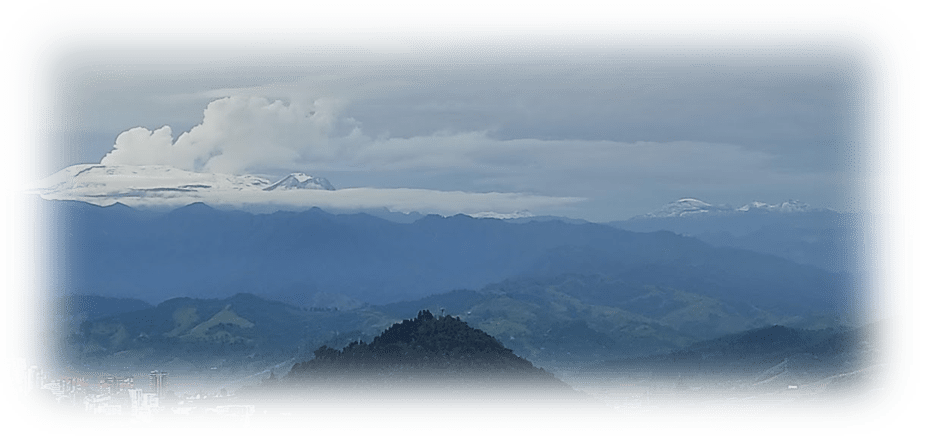
A Beautiful Day in the Central Range of the Colombian Andes, As the World Burns

It’s a beautiful, sunny Saturday in the city in the sky.  The one set among snow clad peaks and thermal springs near an adjacent volcano or two and the remnants of several glaciers.  The one set atop the central range of the Colombian Andes in the midst of a sea of mountains dressed in diverse verdant shades.  It seems summery although in the Northern Hemisphere, the part of our planet in which this part of Colombia is set, it is late autumn, just short of winter.  But then, this close to the equator, seasons tend to meld and shift and be measured in hours rather than months.

The world seems as bad as it’s been since the second war to end all wars a bit over three quarters of a century ago, all the lessons it purportedly taught at best unlearned but more they were probably just fictitious attempts at justifying unjustifiable terminal follies.  Again.  After all, the second war to end all wars took place less than two decades after the first war to end all wars ended.  And wars?  Well, they’re just fine, in fact, perhaps healthier than ever.

Still, … as individuals here and there, life plows on, life: full of interpersonal challenges and triumphs, its own interpersonal beauty and mystique artfully masking our own errors and mistakes.

The Global South (which ironically includes Russia and China and Iran but definitely not the Ukraine) seems to be making headway in its quest for liberation from the constant abuse, humiliation and looting that flows from the North.  But not without severe challenges as the Global North has no intention of brooking what it considers insolence by lesser species.  By people almost but not quite human. 

Notwithstanding the hypocritical “woke”, condescension still rules. 

Still, … there is a scent of a different sort of future and lingering echoes seem to wonder whether such future will be better or just filled with shadows from the past, and whether the images we’ll see in our future mirrors will reflect who we’ve been, or we claim to have been, or who we wish we had been, or who we’d like to be, or who we’ve been forced to become.  Hopefully the images that stare back at us will not be too much like those of those who for so long have oppressed so many.  Wishful thinking, I know, but “if our reach does not exceed our grasp, then what’s a heaven for”, as Robert Browning wrote.  But then, he was a poet, not a politician, a journalist or a historian (the illusory professions).

Omnipresent, dystopia seems to rule.  We seem to be a people in transition, greedily tearing down the past without any agreement on what will replace the corrupt social institutions that have been decaying, putrefied for millennia.  Decaying but refusing to die.  That confuses and polarizes us as we’re manipulated by the worst among us, the Northern hegemonic wannabe leaders who refuse to let go and definitely decline to share, but who still exercise almost total control.  Yet, “almost” is an optimistic harbinger, a qualifier that hints at possible changes, perhaps even beneficent changes.

Who can tell? 

But we can hope. 

Especially on a beautiful sunny Saturday in early December, one in which at least some of us are safely ensconced among some of those we most love, … at least for the day. 

The carnage, genocide and ethnic cleansing underway in Palestine by the worst cultural descendants of the tribe which, after looting Egypt, went on to plunder and murder every man woman and child in ancient Jericho, continues unabated despite popular condemnation in the Global South and even, among an enlightened minority in Europe, the United States and even Israel, although, from here in the heights of the Andes, as in the United States and Europe, to some, that all seems very far away.  Far enough away so that the screams of pain and dying gasps and mourning and lamentations are barely audible and thus, perhaps, at least for them, can be sanitized and washed away.

Or at least shouted down and obfuscated through carefully crafted rhetoric, with reckoning postponed, if not for ever, at least for another day.   

After all, who mourns for ancient Jericho today?
_______

© Guillermo Calvo Mahé; Manizales, 2023; all rights reserved.  Please feel free to share with appropriate attribution.

Guillermo (“Bill”) Calvo Mahé (a sometime poet) is a writer, political commentator and academic currently residing in the Republic of Colombia (although he has primarily lived in the United States of America of which he is also a citizen).  Until 2017 he chaired the political science, government and international relations programs at the Universidad Autónoma de Manizales.  He is currently the publisher of the Inannite Review, available at Substack.com, a commentator on Radio Guasca FM, and an occasional contributor to the regional magazine, el Observador.  He has academic degrees in political science (the Citadel), law (St. John’s University), international legal studies (New York University) and translation and linguistic studies (the University of Florida’s Center for Latin American Studies).  However, he is also fascinated by mythology, religion, physics, astronomy and mathematics, especially with matters related to quanta and cosmogony.  He can be contacted at guillermo.calvo.mahe@gmail.com and much of his writing is available through his blog at https://guillermocalvo.com/.