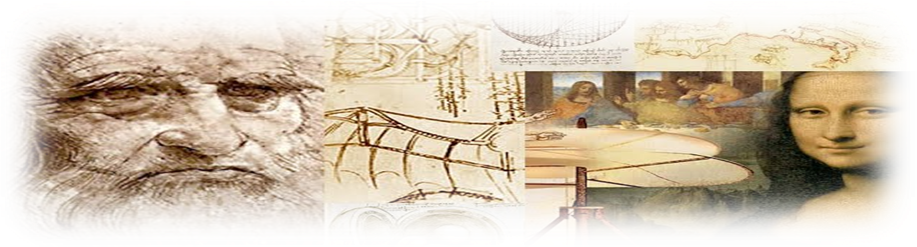
Ever since I can remember I’ve been an admirer of Leonardo da Vinci, the bastard son of Ser Piero da Vinci d’Antonio di ser Piero di ser Guido, a successful Florentine legal notary, and Caterina di Meo Lippi. Leonardo was apparently born in either Anchiano, a country hamlet near the Florentine commune of Vinci, or in a house in Florence, part of the ancient Italian region of Tuscany, owned by his father, in either case, seeking privacy to hide the illegitimate birth. His mother may have been an Arab or Chinese slave although a book published by Martin Kemp and the archival researcher Giuseppe Pallanti claims that she was born in 1436 to a poor farmer, was orphaned at the age of fourteen and gave birth to Leonardo da Vinci at the age of sixteen, after which she purportedly had five other children with a different man, also a poor farmer. Leonardo was initially raised in relative poverty by his mother and her husband but eventually Leonardo came to enjoy a positive relationship with his father’s family, especially with his uncle and grandfather, although perhaps not with his father who was too busy with business matters. Consequently, he only received a very basic and informal education in writing, reading, and mathematics, although his artistic talents were recognized at an early age and emphasis was quickly placed on their development.
It is telling and very worth considering that from such inauspicious beginnings perhaps the world’s most universally talented man arose and to ask ourselves how many other multifaceted geniuses born under comparable circumstances never had the opportunity to attain their potential. In my own life I’ve known a number of men and women who fit that characterization. In this regard, the world owes a great debt to Andrea del Verrocchio, an Italian sculptor, painter and goldsmith who was a master of a workshop in Florence and who apparently accepted Leonardo, first as a studio boy but when he turned 17, as an apprentice, setting him on his path to greatness, first as an artist and then, … well, as a universal genius.
Leonardo di ser Piero da Vinci is one of my greatest heroes, but I admire him less for his myriad successes than because he attained them despite the humility of his origins. One thing I have always found incomprehensible however is the fame of his most famous painting, the Mona Lisa, and the worshipful claims concerning the subject’s beauty, and especially her smile. To my perhaps jaded and certainly inexpert tastes, she is not even particularly attractive and as for the “enigmatic” nature of her smile, I find nothing at all special about it, especially when compared to my wife’s. I assume many other husbands, boyfriends and fathers share my perspective and that some may also share my curiosity. What most troubles me however concerning the Mona Lisa hysteria is that it obscures Leonardo’s truly great achievement, having risen from such humble beginnings to such stunning heights without the intervention of martial opportunities and successes, the more usual route to success for those born of humble origins. One wonders how many people who might eventually have proven to be a new Leonardo we trash as we expel those desperate to become part of our society and who ask only to be permitted to work and grow among us? “… [g]ive me your tired, your poor, your huddled masses yearning to breathe free, the wretched refuse of your teeming shore …” indeed.
The foregoing frequently leads me to reflect on the reality that when people are not assisted in attaining their potential, it is not only they who suffer, but the whole world, and on the stupidity and cupidity of those who oppose state assistance to the most humble among us. We certainly desperately need a world were the most humble can attain their full potential, a concept which the Athenian philosopher Plato referred to as an essential component of “justice” and understood as essential for optimal societal development, the common welfare and attainment of the best possible world. Something which, despite the millennia since Plato, his mentor Socrates and his student Aristotle contemplated how to attain justice, we are very, very far from attaining. _____
Guillermo (“Bill”) Calvo Mahé (a sometime poet and aspiring empirical philosopher) is a writer, political commentator and academic currently residing in the Republic of Colombia (although he has primarily lived in the United States of America of which he is also a citizen). Until 2017 he chaired the political science, government and international relations programs at the Universidad Autónoma de Manizales. Previously, he chaired the social studies and foreign language departments at the Eastern Military Academy in Huntington, New York. He is currently the publisher of the Inannite Review available at Substack.com; an intermittent commentator on radio and television; and, an occasional contributor to diverse periodicals and publications. He has academic degrees in political science (BA, The Citadel, the Military College of South Carolina), law (JD, St. John’s University, School of Law), international legal studies (LL.M, the Graduate Division of the New York University School of Law) and translation and linguistic studies (GCTS, the University of Florida’s Center for Latin American Studies). However, he is also fascinated by mythology, religion, physics, astronomy and mathematics, especially with matters related to quanta, cosmology and cosmogony. He can be contacted at guillermo.calvo.mahe@gmail.com and much of his writing is available through his blog at https://guillermocalvo.com/.
I’ve frequently wondered as to what motivated the inept linguist or translator who turned the word “flutterby” into “butterfly”. That usually brings to mind (at least to my mind) the inept Catholic “saint”, Jerome of Stridon, who made a mess of his Latin translation of the Greek version of the Hebrew Tanakh. Poor Lucifer, demoted by the purported saint from the Roman god of truth and light into a rebellious archangel and the patron of evil (a role that belonged to a Hebrew “entity” whose name was Hel-El).
Flutterby is obviously the correct term to describe the fluttering, flying insect, often beautiful, that has nothing to do with butter but is stuck with that appellation. I don’t suppose Jerome was responsible, he knew nothing of English, but who knows. The absence of knowledge never stopped him.
And as to the “Latin” version of the Bible on which the St. James and other mistranslations are based, what can one say other than perhaps, …
Guillermo (“Bill”) Calvo Mahé (a sometime poet and aspiring empirical philosopher) is a writer, political commentator and academic currently residing in the Republic of Colombia (although he has primarily lived in the United States of America of which he is also a citizen). Until 2017 he chaired the political science, government and international relations programs at the Universidad Autónoma de Manizales. Previously, he chaired the social studies and foreign language departments at the Eastern Military Academy in Huntington, New York. He is currently the publisher of the Inannite Review available at Substack.com; an intermittent commentator on radio and television; and, an occasional contributor to diverse periodicals and publications. He has academic degrees in political science (BA, The Citadel, the Military College of South Carolina), law (JD, St. John’s University, School of Law), international legal studies (LL.M, the Graduate Division of the New York University School of Law) and translation and linguistic studies (GCTS, the University of Florida’s Center for Latin American Studies). However, he is also fascinated by mythology, religion, physics, astronomy and mathematics, especially with matters related to quanta, cosmology and cosmogony. He can be contacted at guillermo.calvo.mahe@gmail.com and much of his writing is available through his blog at https://guillermocalvo.com/.
Once upon a time, not a very long time ago nor in a very faraway place, there lived, for a very brief instant in time, a very young title in search of a story. It had heard of Neil Gaiman’s short story “Forbidden Brides of the Faceless Slaves in the Secret House of Dread Desire” and that had turned out rather well, thus, it found itself inspired, albeit perhaps not quite prepared for success. The following is what, after not looking all that long or, to be honest, without very much exertion, it created:
The story started with an exclamation bereft of an introduction or of any character development or context, although, to an extent, context sort of followed:
“So what! Who cares? What’s the difference anyway?”
In that manner, in a huff, a disputation appeared to end, one between inanimate marble busts of “purported saints” Peter and Paul, sculptures crafted by one of Pablo Diego José Francisco de Paula Juan Nepomuceno Cipriano de la Santísima Trinidad Ruiz Picasso’s lesser known relatives who, for reasons of his or her own, chose to remain anonymous.
The busts had been stored in a vestibule deep in the heart of the Vatican, a vestibule located within a labyrinth of sorts, not an artfully designed or planned labyrinth but rather, one that had seemingly evolved on its own as discarded tomes and relics and pieces of art accumulated in utterly random order, or rather, in a sort of articulated disorder. Both saints on whom the busts had been purportedly modeled were reputed, within certain clandestine circles, to have been secret agents planted several millennia ago by Sanhedrin agents (precursors to the current Israeli Mossad) as provocateurs among naïve early followers of a troublesome Nazarene rabbi in order to undermine the early Judaic heretic sect all too quickly spreading like some sort of early virus (although viruses preceded humans by many eons).
For some odd reason, the busts of the purported saints, both of whom found themselves somewhat unexpectedly set in carefully hidden niches, were declaiming in a variant of sorts of modern English, although with blended Brooklyn-Yiddish accents, perhaps understandably given that the event to which we are alluding occurred relatively shortly after a visit by a group of the Vatican janitors and Swiss Guards assigned to the Vatican’s deepest dungeons, or perhaps storerooms; an incognito visit to the tourist filled Bioparco di Roma which was just then hosting a large American tourist group of former Yeshiva students. One should, however, keep in mind, that the phrase “relatively shortly” may have a relative temporal meaning where the Vatican is involved.
Although, … perhaps the foregoing was just a dream one of the janitors or Swiss Guards was having after a hearty but poorly prepared meal using ingredients perhaps well past their due dates, certainly none of which met with Kosher dietary exigencies. It’s been known to happen. Well, not exactly in this fashion, but perhaps, metaphorically ….
Or perhaps not.
On the other hand ….
No Neil Gaiman here, … unfortunately, he’s regrettably otherwise occupied. _____
Guillermo (“Bill”) Calvo Mahé (a sometime poet) is a writer, political commentator and academic currently residing in the Republic of Colombia (although he has primarily lived in the United States of America of which he is also a citizen). Until 2017 he chaired the political science, government and international relations programs at the Universidad Autónoma de Manizales. Previously, he chaired the social studies and foreign language departments at the Eastern Military Academy in Huntington, New York. He is currently the publisher of the Inannite Review available at Substack.com; an intermittent commentator on radio and television; and, an occasional contributor to diverse periodicals and publications. He has academic degrees in political science (BA, The Citadel, The Military College of South Carolina), law (JD, St. John’s University, School of Law), international legal studies (LL.M, the Graduate Division of the New York University School of Law) and translation and linguistic studies (GCTS, the University of Florida’s Center for Latin American Studies). However, he is also fascinated by mythology, religion, physics, astronomy and mathematics, especially with matters related to quanta, cosmology and cosmogony. He can be contacted at guillermo.calvo.mahe@gmail.com and much of his writing is available through his blog at https://guillermocalvo.com/.
What if words are in fact components of sentient collective streams that actually control us; that use our organic components as tools for their own internecine purposes?
What if words are, in fact, sentient memes and memeplexes that ride us the way we are led to believe by them that we use animals and tools for what we erroneously perceive to be our own purposes.
Mightn’t that explain why, in the end as in the beginning, our conduct tends towards incoherence, at least from our own reactive rather than volitional perceptions?
Mightn’t the word, “internecine” say it all, or at least, a great deal?
What if rather than “being because we think” we just “think we are”?
What would a mimetically sentient “god of the words” be like, after all, purportedly, “in the beginning was the Word”? _____
Guillermo (“Bill”) Calvo Mahé (a sometime poet) is a writer, political commentator and academic currently residing in the Republic of Colombia (although he has primarily lived in the United States of America of which he is also a citizen). Until 2017 he chaired the political science, government and international relations programs at the Universidad Autónoma de Manizales. Previously, he chaired the social studies and foreign language departments at the Eastern Military Academy in Huntington, New York. He is currently the publisher of the Inannite Review available at Substack.com; an intermittent commentator on radio and television; and, an occasional contributor to diverse periodicals and publications. He has academic degrees in political science (BA, The Citadel, The Military College of South Carolina), law (JD, St. John’s University, School of Law), international legal studies (LL.M, the Graduate Division of the New York University School of Law) and translation and linguistic studies (GCTS, the University of Florida’s Center for Latin American Studies). However, he is also fascinated by mythology, religion, physics, astronomy and mathematics, especially with matters related to quanta, cosmology and cosmogony. He can be contacted at guillermo.calvo.mahe@gmail.com and much of his writing is available through his blog at https://guillermocalvo.com/.
Mary, Mary, quite contrary, was wondering how her garden grew when, lo and behold, of a sudden, she thought she spotted a little lamb, one that perhaps might become her own.
Nearby, a certain Miss Muffat sat on her tuffet, eating her curds and weigh, while a friendly if somewhat frightening, somewhat hungry and a bit jealous arachnid (none other than the trickster deity known as Anansi), hanging by a silken thread, curiously passed her way.
As Miss Muffat and Anansi looked on, Mary, Mary, quite contrary, fondled what she thought was her new lamb but the ovis aries, in reality the Egyptian deity Khnum, reacted unexpectedly, at least as far as Mary, Mary, quite contrary, was concerned. Anansi couldn’t help but giggle, which almost gave the game away.
Khnum, at first seemingly young and small, turned out not to have been either, not at all. He was in fact very, very ancient really, and in reality, quite a bit larger than a lamb, and he had budding horns and, … well …, reacting to Mary, Mary, quite contrary’s soft caresses, seemed unusually amorous for a lamb, at least as far as little Miss Moffat could tell.
Then, slam bam, thank you mam …. The lamb turned out to be a ram … and …. not just any ram, but the primordial creator of human bodies and of the life force known as kꜣ (“ka”), and Anansi’s giggles turned into guffaws.
Thus, some months later, to Miss Muffat’s surprise and the spider’s strange delight (it loved irony and was as much a contrarian as Mary), Mary, Mary, quite contrary, indeed had her little lamb.
Which was not just any little lamb at all.[1] _____
Guillermo (“Bill”) Calvo Mahé (a sometime poet) is a writer, political commentator and academic currently residing in the Republic of Colombia (although he has primarily lived in the United States of America of which he is also a citizen). Until 2017 he chaired the political science, government and international relations programs at the Universidad Autónoma de Manizales. Previously, he chaired the social studies and foreign language departments at the Eastern Military Academy in Huntington, New York. He is currently the publisher of the Inannite Review available at Substack.com; an intermittent commentator on radio and television; and, an occasional contributor to diverse periodicals and publications. He has academic degrees in political science (BA, the Citadel, the Military College of South Carolina), law (JD, St. John’s University, School of Law), international legal studies (LL.M, the Graduate Division of the New York University School of Law) and translation and linguistic studies (GCTS, the University of Florida’s Center for Latin American Studies). However, he is also fascinated by mythology, religion, physics, astronomy and mathematics, especially with matters related to quanta, cosmology and cosmogony. He can be contacted at guillermo.calvo.mahe@gmail.com and much of his writing is available through his blog at https://guillermocalvo.com/.
[1] An afterword of sorts. It is sadly strange that in this puritanical age, puritanical concerning sexual matters but not bothered by genocide at all, I would feel uncomfortable, perhaps even ironically guilty, in having written this satire on the ancient myth of Leda and the Swan.
If this is not the most beautiful song ever, there are none more beautiful: Don McLean’s Vincent, an Ode to Van Gogh. More beautiful as poetry than as music and, set to prose it might read like this:
Starry, starry night, paint your palette blue and gray, look out on a summer’s day with eyes that know the darkness in my soul.
Shadows on the hills, sketch the trees and the daffodils, catch the breeze and the winter chills in colors on the snowy, linen land.
Now, I understand what you tried to say to me and how you suffered for your sanity, and how you tried to set them free. They would not listen, they did not know how; perhaps they’ll listen now.
Starry, starry night, flaming flowers that brightly blaze, swirling clouds in violet haze reflect in Vincent’s eyes of china blue; colors changing hue, morning fields of amber grain, weathered faces lined in pain are soothed beneath the artist’s loving hand.
Now, I understand, what you tried to say to me, how you suffered for your sanity, how you tried to set them free. They would not listen, they did not know how, perhaps they’ll listen now.
For they could not love you, but still your love was true and when no hope was left inside on that starry, starry night, you took your life as lovers often do. But I could have told you, Vincent, this world was never meant for one as beautiful as you.
Starry, starry night, portraits hung in empty halls, frameless heads on nameless walls with eyes that watch the world and can’t forget, like the strangers that you’ve met; the ragged men in ragged clothes, the silver thorn of bloody rose lie crushed and broken on the virgin snow.
Now, I think I know what you tried to say to me, how you suffered for your sanity, how you tried to set them free. They would not listen, they’re not listening still, perhaps they never will. _______
Guillermo (“Bill”) Calvo Mahé (a sometime poet) is a writer, political commentator and academic currently residing in the Republic of Colombia (although he has primarily lived in the United States of America of which he is also a citizen). Until 2017 he chaired the political science, government and international relations programs at the Universidad Autónoma de Manizales. He is currently the publisher of the Inannite Review, available at Substack.com, a commentator on Radio Guasca FM, and an occasional contributor to the regional magazine, el Observador. He has academic degrees in political science (the Citadel), law (St. John’s University), international legal studies (New York University) and translation and linguistic studies (the University of Florida’s Center for Latin American Studies). However, he is also fascinated by mythology, religion, physics, astronomy and mathematics, especially with matters related to quanta and cosmogony. He can be contacted at guillermo.calvo.mahe@gmail.com and much of his writing is available through his blog at https://guillermocalvo.com/.
I’m reading Hermann Hesse’s Steppenwolf, possible even rereading it. I owned a copy in my twenties and thought I’d read it but it now seems obvious to me that I didn’t.
There are several translations available but the one I’m reading seems inadequate to me. I have a graduate degree in translation studies and linguistics (although it is not my primary profession) so perhaps I tend to be more critical than might be fair. Still, the disappointment at what seemed a poor translation of a seminal novel faded as I “plowed” through it until, suddenly, it seemed much less inadequate. The “plowing” ceased and sowing started, especially after I was introduced to “Hermine”.
Originally, the title of this article, a sort of literary review, was to be “Reflections on Hermine”, perhaps it still should be, but as readers will note towards the end, the more traditionally serious civic and literary aspects of this piece devolve into what some will consider sophomoric parody, hence the modification to the title. Hermine does not deserve to be tainted by parody, nor is it the intent of the latter part of this article to engage in parody, but one cannot control the reflections of readers or critics, especially those lacking in both a sense of humor and joy in the sensual; something now all too common as somehow, the liberal perspectives of the 1960s have morphed into censorious Puritanism.
“The” Steppenwolf’s transcendent fame is centered on its psychological reflections and on its refractive introspection with reference to human nature, but for me, at least so far, I’ve derived more from its perhaps unintended sociological and historical revelations as well as from the irreverent digression referenced above. On the more serious historical side, shortly after Hermine was introduced I was struck by the protagonist’s bitterness towards German jingoists who virulently attacked him and other pacifists, much as happens today in the United States, the United Kingdom, Europe and of course, Israel. What most struck me with reference to the foregoing is that the novel was published in 1927, long before Hitler’s ascent, and thus belied much of the fault assigned to him for subsequent events. The blame, of course, rightfully belongs to the Treaty of Versailles and the viciousness of the victorious Entente, as hypocritical a group as ever blemished the face of our planet. It was their greed and hypocrisy that generated bitterness and desire for revenge among the populace of the German nation, a supranational society that included not only the Weimer Republic but Austria as well, and parts of Poland and Czechoslovakia. A subsurface fury very similar to that generated among Muslims and especially Palestinians today by the disdain with which they are treated by those same countries.
Those brief passages generated cascading reflections on my part as they so accurately presaged the future and now, today’s present. And not only with respect to the rise of the Nazis and their defeat in the oxymoronic “second war to end all wars”. It also struck me that it was members of this same “alliance” now calcified in NATO, namely the United States, the United Kingdom and France, which orchestrated the now obviously hypocritical Nuremberg and Tokyo post war tribunals, proceedings disguised as efforts to impose ex post facto rules of war and legal norms applicable with respect to treatment of subjugated minorities. Rules totally ignored with respect to the victors, not only during those proceedings but ever since. Witness the United States’ facilitation of the slaughter of tens of thousands of Palestinian civilians by Israel for the past three quarters of a century, and especially since October 7, 2023. But then, as Hesse notes, hypocrisy has almost always, perhaps always been the only norm governing interstate, international and intercultural conflicts. It seems ingrained in our nature as the Steppenwolf aspect of Hesse’s protagonist so emotively observed. As I focused on those brief passages, I couldn’t help but recall how the victors in the second war to end all wars, as they were in the first war to end all wars, were as guilty as the vanquished in too many instances, and that the same lot of hypocritical victors, led for centuries by the United Kingdom, have kept the world in constant conflict as they successfully exploited and looted the Global South. Slavery has not really been eliminated, it’s just been camouflaged and swept under rugs.
Having taught history for a decade in my relative youth and, during the past several decades, having been actively involved in political analysis, both academically as chair of university political science, government and international relations programs, and as a participant in numerous media events, television and radio programs, etc., I was inexcusably caught off guard by the epochal reality brought to light for me by Hermann Hesse, i.e., the early appearance of underlying trends which would all too soon blossom into militarist fascism preceding the rise of the Nazi’s, although, on reflection, it is obvious that the Nazis did not sprout fully formed from ether. And although I should not have been surprised, I was again caught off guard by the reality that “all too frequently one learns a great deal more from analyzing an epoch’s or a culture’s fiction than one does from assiduously studying learned historical treatises”, respected albeit inaccurate sources which all too frequently only blend strains of propaganda seasoned with rationalization in order to obfuscate what really happened and why. It is fascinating to realize that either Herman Hesse was prescient or, more likely, that the history we are taught is so bogus that “the more we claim things change, the more they actually stay the same”.
I have another author to thank for my renewed interest in Hermann Hesse, one who reminds me of a now deceased friend, the brilliant translator and poet, Sam Hamill, who founded “Poets against War” as the disastrous second United States incursion into Iraq loomed. His name is Germán Eugenio Restrepo and I met him at the introduction of his latest “sort-of-novel in a fascinating blend of art gallery, cultural center, restaurant and bar in the City of Manizales, a special and somewhat esoteric place with the very appropriate name, given the context of this article, of “El Bestiario” (the Bestiary in Spanish). Germán mentioned Herman Hesse in passing in his novel, and then, responding to my detailed observations, reflections and analysis, admitted that, like so many others, he’d found Steppenwolf particularly meaningful in his youth, perhaps even foundational. That led me to almost immediately purchase a copy of Steppenwolf, along with copies of other Herman Hesse’s novels I’d either never read or had lost (I’ve always kept a copy of Siddhartha nearby but I now also own Narcissus and Goldmund, Beneath the Wheel and The Glass Bead Game, all of which I’ve yet to start).
Germán’s novel is entitled, in Spanish, Diatriba de un Ángel Caído (Diatribe of a Fallen Angel). He’s a complex, erudite and talented fellow who, as in the case of Chilean Nobel laureate, Pablo Neruda, can “confess that he has lived. His “novel” is full of insights and allusions to other works, of references to numerous philosophers and to enlightening esoterica. Indeed, such allusions seemed as though they, rather than any of the characters in his book, were the protagonists, but its most endearing quality was the personal introspection it stimulated and the lost memories and feelings it evoked. Germán’s novel also provided emotionally enlightening insights into the Republic of Colombia where I was born, and where, after half a century abroad, I again live, and of its disastrous history of bellicosity and inequity. Unfortunately, his novel will probably be difficult to obtain, although with todays’ virtual world, perhaps electronic copies will be available. It hope so. It is one thing to read history and quite another to feel as though one were actually a participant in the distressing historical realities narrated, something both Hesse and Germán were able to elicit.
I’m a bit over two thirds of the way through The Steppenwolf and “Hermine”, the female protagonist, is evolving from the initial impression Hesse generated, although “her evolution” is not quite contextually accurate, she is who she always was and it is only my impression of who she is that is evolving. I was initially struck by her ability to immediately attain total control over the chief protagonist, Harry Haller, something I’d once experienced (as the object) with a woman who kept me enthralled for about a decade in what now seems another life, but Hermine is quickly becoming more multidimensional and I find myself in that delightful point where, immersed in literature, I seem personally involved; recognizing the situation in which the protagonists find themselves but, as in the case of John Rawls’ “veil of ignorance”, unsure just how that resonance will play out. I can’t help but contrast Steppenwolf with Hesse’s Siddhartha, an allegorical novel which I have loved for decades, and the comparison is still very much in the latter’s favor, but I’m intrigued by how that perception may evolve given the fame of the former. The Steppenwolf seemed a bit convoluted at the start but has become a bit more human in the middle. I guess the transcendent elements are yet to come, at least for me.
“The” Steppenwolf, which I enjoy using as the title instead of merely Steppenwolf, is, in my opinion, the more appropriately translated title, although “the Steppenwolves” might have been more contextually accurate, as the novel deals with a bipolar hypothesis tested by multipolarity, one with which I’ve played in some of my own writings, especially in relationship to analyzing reincarnation, where I posit that if it exists, then our physical bodies are likely simultaneous experiential vehicles for myriads of entities requiring specific experiences, sort of like the “Legion” with whom Yeshua the Nazarene once interacted, but in a much more benign sense. I’m intrigued by the spiritual concept of panentheism and in that sense, reincarnation would be the panentheistic means through which the divine, learns, evolves and approaches perfection (which it can never attain). A context in which we are merely Divinity’s cells and organs. In that sense, I’ve irreverently toyed with the idea that the more we pray, the more the Divine suffers from migraines.
In my own writings I frequently explore alternative perspectives from a contrarian viewpoint, exploring how, for example, Lucifer, Caine, Benedict Arnold and others almost universally adjudged arch villains perceive of themselves in relation to their antagonists. And that proclivity is not limited to fiction. I tend to champion causes disdained by many of my peers, even so far as to defend people whose values I find distasteful, Donald Trump being an example.
Sort of in that vein but taking another turn towards the irreverent (but perhaps not irrelevant), I will here dare to read between the lines writ by Hesse, delving into an essential aspect of the human psyche, one dealt with but perhaps not adequately articulated in The Steppenwolf (although, as I am only about two thirds of the way through the novel, I may be quite wrong). It deals with the allegorical reality that not all literary wolves are wild animals. Indeed, metaphorically, men who are enthralled by the predatory physical expression of lust (albeit usually denominated as love), are also referred to as “wolves” and thus, perhaps a person who perceives of himself as in a state of bipolarity between such a wolf and a more decent, more respectable or at least more superficially acceptable personality might, after having read Hermann Hesse’s Steppenwolf, consider himself a “schtuppenwolf”. Personally, I find that term somewhat horrifyingly corny and way too much of a pun, but it just won’t go away as I share these impressions. So, how might I share with the reader just what that impression entails? Perhaps the concept can best be illustrated through an example in recent “media culture” (I can’t help but reflect that the phrase “media culture” seems somewhat oxymoronic). The example that comes to mind involves the qualities, traits and practices fictionally memorialized in a comedic television series no longer generally available (having been judged as politically incorrect); i.e., the character of Charley Harper, played by Charlie Sheen (Carlos Estevez) in “Two-and-a-Half-Men”. I wonder if Mr. Estevez ever read Steppenwolf, or any of the novels written by Hermann Hesse. Others more critical of Mr. Estevez may unfairly wonder if he ever read anything at all. Much earlier during the dawn of the television era, my example would have been the protagonist in a series about a photographer, The Bob Cummings Show.
Admittedly this turn in these observations seems a bit frivolous. But it’s also relevant in the context of the complexity evoked by Hermann Hesse’s literary creation. At least as far as I can glean (so far), Harry, the male protagonist in Steppenwolf, unexpectedly has room in his confusion for levity as well gloom, something Hermine clearly understands. So, it seems fair to wonder, at least I do, what Hermann Hesse would have thought of the concept of a schtuppenwolf.
At first blush, one might suspect that he would have found it disagreeable, but then, given his defense of multipolarity instead of bipolarity, there would certainly be room in the complex human psyche he portrayed for one or more schtuppenwolves, as well as for all sorts of alternative psychosocial personalities. Indeed, to an extent, finding and extracting the schtuppenwolf seems to be what Hermann Hesse’s heroine, “Hermine”, sought to accomplish with Harry Haller when she intimately acquainted him with her friend, Maria.
Initially the antithesis of Charley Harper, Harry eventually incorporates some of Charley Harper’s attributes into his complex of personalities. Or perhaps, he merely becomes reacquainted with them, having experienced them during a happier youth, and then misplaced them. It occurs to me that Carlos Estevez/Charlie Sheen/Charley Harper might also have opinions with reference to the foregoing (after all, he already has multiple names). One wonders whether he might not find Derr Schtuppenwolf an excellent title for his own composite biography, or even better, autobiography. Oh what a tale that could make, with dozens of Hermines and Marias, etc.
I wonder what my new friend Germán will think of these observations. He is profoundly serious and eclectic but not bereft of a sense of humor. And sexual passion and eroticism play crucial roles in his own novel so that the concept of a schtuppenwolf might actually have a role to play therein, albeit unwritten; as it does in many poets and artists, or at least had before the Dawn of the Woke. Schtuppenwolves, if not extinct, must now be carefully obfuscated.
What an admittedly strange digression in an article concerning serious novels, but perhaps, not one uncalled for. Rather, what a sad reflection on our values and with reference to the world in which we find ourselves that, rather than joyous, the concept of a schtuppenwolf seems so incongruously out of place when analyzing one of Hermann Hesse’s seminal novels. Actually, out of place anywhere if one hopes to avoid career shattering litigation. Ask Johnny Depp for example.
If only the schtuppenwolf’s onomatopoeic component and “punnic” (as a neologistic derivative adjective for pun) aspects were not so prominent.
Postscript of sorts:
I’ve now passed the three quarters mark, I’m towards the end of the masked ball, Hermine has already revealed herself to Harry and, no, Harry lacks the qualities essential for a schtuppenwolf. The desire is there, and the physical joy, as is the eroticism, but not the predatory elements necessary for a real schtuppenwolf. In fact, it is Hermine and Maria who possess the requisite combination of energy and apparent disdain that make a schtuppenwolf. But there’s still almost a quarter of the novel to go, a quarter of the novel in which, perhaps, I`ll find its existential nature, and perhaps a schtuppenwolf or two.
“Yearning”, a fox trot. Wondering what made it so special to Harry and the rest of the guests at the masque ball, I played it on YouTube. Alas, I guess I lacked the appropriate context, or perhaps I was too full of context Harry and the others had yet to experience, nor could I identify the sounds of a saxophone Pablo would have been playing. Oh well. Still, Hesse made me curious enough to step out of the novel for an instant. Nicely done! On the other hand, YouTube automatically played “Suave” by Johannes Linstead next and, though separated by almost a century, Pablo on the saxophone seemed eerily present, eerily but happily. And it occurred to me that if Harry was not a schtuppenwolf, Pablo most probably was, happily and innocently so. Can a schtuppenwolf be innocent though?
Now it’s done, resolution irresolutely unresolved and the existential experience denied me. A strange journey though, in that Magic Theater, the one starring Pablo as the schtuppenwolf and quite a bit more. _______
Guillermo (“Bill”) Calvo Mahé (a sometime poet) is a writer, political commentator and academic currently residing in the Republic of Colombia (although he has primarily lived in the United States of America of which he is also a citizen). Until 2017 he chaired the political science, government and international relations programs at the Universidad Autónoma de Manizales. He is currently the publisher of the Inannite Review, available at Substack.com, a commentator on Radio Guasca FM, and an occasional contributor to the regional magazine, el Observador. He has academic degrees in political science (the Citadel), law (St. John’s University), international legal studies (New York University) and translation and linguistic studies (the University of Florida’s Center for Latin American Studies). However, he is also fascinated by mythology, religion, physics, astronomy and mathematics, especially with matters related to quanta and cosmogony. He can be contacted at guillermo.calvo.mahe@gmail.com and much of his writing is available through his blog at https://guillermocalvo.com/.
For someone who seeks linguistic exactitude, third person pronouns sometimes cause quandaries requiring that they be avoided in order to minimize confusion, take the following reflection, for example:
So, he reflected, the title should really have been “The Steppenwolf” rather than just “Steppenwolf”; but what a horrible translation by Basil Creighton. He had a graduate degree in translation studies and linguistics and was a pretty active writer besides (“he”, not Basil, although perhaps Basil did as well, although Basil was no longer among the living and thus, not likely to be offended by the observation). Perhaps, he considered, Basil was trying too hard to reflect the original German rather than the meaning Hesse sought to attain and the emotional reaction he sought to elicit. Although, to be fair, he (hmmm, which he?) wasn’t absolutely, 100% positive that the Picador edition he was reading was that specific translation, one copyrighted in 1929. A revised translation had been copyrighted in 1963. Evidently it was revised by Joseph Mileck and Borst Frenz. If so, the collaborative translation by the three was still terrible. Whoever had translated the editions of Hesse’s Siddhartha he’d frequently read was infinitely more successful (again, which he; although it seems obvious to me). The original translation was by Hilda Rosner; Sherab Chödzin Kohn evidently translated it later. He may have read them both (again, which he) although the Rosner version was more likely. Indeed, the latest copy he had was translated by Joachim Neugroschel. In an interview that touched on his translation process, Neugroschel had claimed that he “never read a book before translating it” claiming that he had no reason to do so. “I do not” he’d expressed “translate the words literally. Only a bad translator would translate literally …. It is a question of music and rhythm.” What a shame that Joachim did not translate Steppenwolf.
Linguistic questions such as those reflected in the foregoing, with many more profoundly impactful issues, impact translation. It should be so smooth that the reader should feel that what he or she was reading was the original, in the original language, and that requires not only translation but acculturation, unless of course, it is important that the passages read seem as though the speaker was not totally comfort in the language being used, and foreign indicia were thus important. The passage used as an example is quite correct in criticizing the Hermann Hesse masterpiece in question which is extremely awkward, robbing the text of the impact Hesse attained in the original German among German audiences. But still, the work is acknowledged in numerous languages as a major literary, psychological and sociological tour de force.
One is tempted to attempt one’s own translation.
I wonder when the copyright expires? 2026 I think, although it might have expired in 2020. _______
Guillermo (“Bill”) Calvo Mahé (a sometime poet) is a writer, political commentator and academic currently residing in the Republic of Colombia (although he has primarily lived in the United States of America of which he is also a citizen). Until 2017 he chaired the political science, government and international relations programs at the Universidad Autónoma de Manizales. He is currently the publisher of the Inannite Review, available at Substack.com, a commentator on Radio Guasca FM, and an occasional contributor to the regional magazine, el Observador. He has academic degrees in political science (the Citadel), law (St. John’s University), international legal studies (New York University) and translation and linguistic studies (the University of Florida’s Center for Latin American Studies). However, he is also fascinated by mythology, religion, physics, astronomy and mathematics, especially with matters related to quanta and cosmogony. He can be contacted at guillermo.calvo.mahe@gmail.com and much of his writing is available through his blog at https://guillermocalvo.com/.
On Sunday October 1, 2013, yesterday as I write this, Patrick Lawrence published an article in Consortium news entitled “IMPEACHMENT: ‘Cognitive Warfare’ on Capitol Hill” (Volume 28, Number 269 — Monday, October 2, 2023). It’s an important article reflecting truths obvious to any objective, cognitively competent person. At least one would think so, but Patrick sort of makes the point that such might not be the case, and explains some of the reasons why.
I do have one issue with Patrick, his use of the phrase “liberal authoritarian ideology” with respect to this otherwise praiseworthy article. “Liberal authoritarianism” is an oxymoronic phrase unfortunately used more and more by decent and intelligent people. The same is true of terms like “progressive” and “leftist” when coupled with the concepts of authoritarianism, totalitarianism and censorship. The Democratic Party is not liberal, progressive or leftist, and it is to that political party that Patrick’s observations are (or should be) directed. Unfortunately, language has become so utterly manipulated that its capacity to serve as an efficient communicative tool is now trivialized.
It is worth noting that the term “democracy” too has been perverted. Now, as used by the corporate media, the term demands facilitation of electoral fraud through relaxation of identity verification and use of unsecured ballots. It is no wonder, at least to me, that opponents of such measures suspect that they’re meant to be used to improperly impact elections. In the Republic of Colombia, for example, where I now live, where for almost a decade I chaired a university political science program, and thus, with which I’m familiar, the concept of voting without identity verification through picture ID supplemented by signature verification and ballot access available only at polling stations during actual voting would be considered anathema. The same is true almost everywhere else in the world. But not in many states in the United States of America, purportedly the “land of the free and the home of the brave” (at least according to slavery advocate Francis Scott Key).
There is a sort of new term that has become essential in order to understand what is happening socially, politically and economically in the United States, and to understand the gist of Patrick’s article, and that term is “Deep State”. The Deep State is an unfortunate reality, albeit not as an organized entity but rather, as a loose confederation of like-minded villains who now control the corporate media, most of the federal bureaucracy (especially the Department of Justice, all of the intelligence agencies and the federal judiciary), with analogs at the state, county and municipal levels in a number of jurisdictions. The two major political parties were long controlled by the Deep State, although a successful rebellion by the so called “Tea Party” has made the GOP unpredictable and thus, well, unreliable. Because of such lack of reliability as far as the Deep State is concerned, a dictatorship (in the non-pejorative sense of consolidation of legislative, executive and judicial power) by the so called “Democratic” Party has been become essential, with all theoretical “checks and balances” disabled, which brings me to the subject matter of Patrick’s well thought out article, i.e., “cognitive warfare”, both domestically and abroad, something Cassandrically prescient dystopian authors have been warning us about for at least a century, most notably Eric Arthur Blair writing as George Orwell, in his novels, Animal Farm and 1984, but also, ironically, President Dwight David Eisenhower in his farewell address.
Patrick’s article deals with the possible impeachment of current president Joseph Robinette Biden for numerous felonies and is set in the context of the cognitive warfare with which it is being opposed. Impeachment was once something drastic, but not so since the Clinton presidency, a presidency that accomplished so much long term institutional malevolence, from moving the Democratic Party away from its liberal roots to creating a mockery of verity, crystalized in Bill Clinton’s quote “it depends on what the meaning of ‘is’ is.” The two impeachments of then president Trump turned the concept into a partisan political stunt, as a consequence of which, all future impeachment proceedings become suspect, even one where the evidence is likely to be as obvious as it is in the case discussed in the article (remember when the emoluments clause of the Constitution was a big deal?).
We are, of course, as Patrick implies, in the post truth era, a predictable successor to the era when the concept of verity was stripped of meaning through the hypothesis that verity was non-existent, all meaning being relative based on the perceptor’s cognitive functions. The article is well worth reading, even if, as the Trojan prophetess Cassandra might have keened, were she among us: “things are not likely to improve so we’d best start to appreciate the benefits, if any, of authoritarian chaos, perpetual war and civil strife”: in essence, an updated version of Hobbes’ state of nature. _______
Guillermo (“Bill”) Calvo Mahé (a sometime poet) is a writer, political commentator and academic currently residing in the Republic of Colombia (although he has primarily lived in the United States of America of which he is also a citizen). Until 2017 he chaired the political science, government and international relations programs at the Universidad Autónoma de Manizales. He is currently the publisher of the Inannite Review, available at Substack.com, a commentator on Radio Guasca FM, and an occasional contributor to the regional magazine, el Observador. He has academic degrees in political science (the Citadel), law (St. John’s University), international legal studies (New York University) and translation and linguistic studies (the University of Florida’s Center for Latin American Studies). However, he is also fascinated by mythology, religion, physics, astronomy and mathematics, especially with matters related to quanta and cosmogony. He can be contacted at guillermo.calvo.mahe@gmail.com and much of his writing is available through his blog at https://guillermocalvo.com/.
I was watching the “Black List” last night, “binging” on the latest season available on Netflix, an obvious US propaganda piece as is most of what comes out of Hollywood and its clones (the reality as far back as Woodrow Wilson’s epoch). But amazingly, in that episode something resonated in a humanistically positive manner.
Imagine that.
For some unfathomable reason, I enjoy the program. Perhaps it’s the acting, especially by James Spader. And it provides insights into the manner in which US propaganda has culturally conquered much of the world with brazen distortions. But I rarely find the really useful human element that permits us to better understand ourselves, and improve who we are. The element essential in great works of art.
I did last night, and it involved a gift, the gift being a very used old portable radio.
Economically, today, I am not well off. But like most among my current peers, I am living well enough, largely because I became an expatriate of sorts, living in a beautiful albeit affordable place, a beautiful city high in the central range of the Colombian Andes. Beautiful mountains, snowcapped peaks, thermal springs, perpetual spring, but no oceans or beaches. A place where social security is a bit more than enough to get by. But where friends and family are a long way off.
I’ve been much better off, wealthy even, in a past where limousines were not an occasional luxury but a normal tool, where the making of an expensive gift was “no big deal”. But I’ve also been much less well off than I am now, and it’s that time in my life that resonated with the “Black List” episode I viewed last night. And it dealt with the character I find least interesting, least credible, most boring: Diego Klattenhoff as agent Donald Ressler.
The resonance involved the realization that the most important gifts I ever made where those that involved something I already owned, something I had to sacrifice under the circumstances of the moment because I lacked the wherewithal to merely “buy something appropriate”. Usually it was a book, but sometimes a keepsake I’d picked up somewhere or other. It involved a sacrifice of something for which I really cared, something I’d miss, but which to me, at the time, seemed important to pass on. I’ve also received gifts like that and last night I realized that I’d not appreciated their worth at the time. I do now.
In this materialistic and polarized world, one where empathy is hard to generate and harder to find, where a touch of humanity seems a rare thing but is actually omnipresent, hidden in the quotidian, especially in the lives of the least well-off. Hidden in plain sight amidst the most vulnerable among us. Hidden among that silent majority where almost everything involves a sacrifice, but where such sacrifices are joyfully made and never regretted, but also, perhaps, as in my case, where such sacrifices are not quite fully appreciated by the recipients. At least not until it’s much too late to express our gratitude.
It made me think, especially of my mother. Eventually a single mom who made the best of what I’ve become and accomplished possible without ever stressing the many sacrifices she and the rest of my family had to make, things I just took for granted until she was gone.
Her case and mine, unfortunately, are not unusual. Especially today when the generational shift is so bitter, and where too many of the young consider themselves ethically and morally superior, while concurrently entitled, and view their parents and their parent’s generation as out of touch bigots. A generation that has no idea what the adage “it’s better to give than to receive” means, or worse, that it even exists. Where giving is something that’s done with the taxes other people pay, and mainly given to industries dedicated to legalized murder on a massive scale, in the name of liberty and peace and equality.
Amazingly, the episode made me think, rather than just react and enjoy the action and the acting.
Guillermo (“Bill”) Calvo Mahé (a sometime poet) is a writer, political commentator and academic currently residing in the Republic of Colombia (although he has primarily lived in the United States of America of which he is also a citizen). Until 2017 he chaired the political science, government and international relations programs at the Universidad Autónoma de Manizales. He is currently the publisher of the Inannite Review, available at Substack.com. He has academic degrees in political science (the Citadel), law (St. John’s University), international legal studies (New York University) and translation and linguistic studies (the University of Florida’s Center for Latin American Studies). However, he is also fascinated by mythology, religion, physics, astronomy and mathematics, especially with matters related to quanta and cosmogony. He can be contacted at guillermo.calvo.mahe@gmail.com and much of his writing is available through his blog at https://guillermocalvo.com/.






 Guillermo Calvo Mahé