
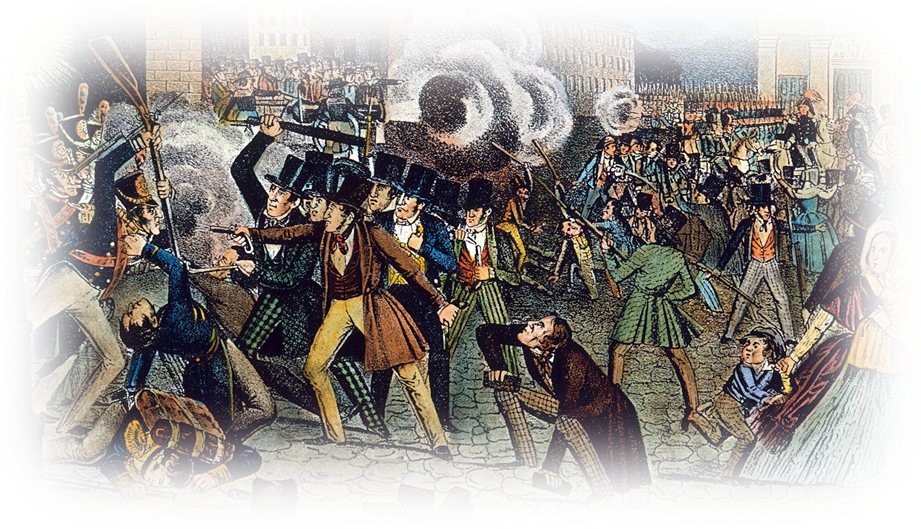
The “Make America Great Again” (MAGA) Trumpian political movement[1] within the United States Republican Party, is hardly original. It is merely a reflection of the profound xenophobia that has characterized the United States since well before its founding; at least since descendants of English invaders[2] deemed new German immigrants during the colonial era unworthy of sharing the colonial society the English were in the process of founding. But MAGA has a more direct historical ancestor: the mid-nineteenth century “American Party” (better known as the Know-Nothing Party). The latter was a name it proudly applied to itself based on a pledge required of its members to preserve secrecy concerning party activities by answering all queries with the phrase “I know nothing”, a phrase ironically adopted by a comic character in a sitcom set in a German prisoner of war camp over a century later[3], rather than in praise of ignorance (although a pretty good case might be made for the latter).
The American Party was an outgrowth of secretive groups like the Order of the Star-Spangled Banner[4] (which somewhat explains its paranoiac tendencies) and became a major third party political movement during the 1850s (interestingly, a time as polarized as our own) rivaling not only the traditional parties at the time (the Democratic and Whig parties) but also the emerging abolitionist (and industrialist[5]) Republican Party. It was ideologically characterized by nativist Protestant supremacism and anti-immigrant sentiment particularly targeting Irish and German immigrants and, like MAGA today, advocated for stricter naturalization laws (proposing to extend the residency requirement for citizenship from five to twenty-one years) and seeking to keep the foreign-born, even if they had attained United States citizenship, from voting or holding public office. They did not address the “birthright” citizenship issue as the 14th amendment to the constitution on which it is based had yet to be adopted, but they would assuredly have agreed with MAGA on that issue as well. The party gained significant power during the 1854 – 1855 electoral period, capturing several state governments and sending numerous representatives to Congress. Former President Millard Fillmore was their 1856 candidate securing 21% of the popular vote but winning only Maryland. However, the party quickly fragmented into northern and southern factions leading to its collapse by the time of the Civil War.
While similar to MAGA in ideology, the American Party was a bit more coherent than MAGA in its xenophobia given the control exerted over MAGA by Israel through its American Israeli Public Affairs Committee (AIPAC). AIPAC finances the political campaigns of all MAGA affiliated members of Congress who are then required to place Israeli interests over those of the United States (which would have been anathema to the American Party); however, that subservience is not limited to MAGA or the GOP given that such phenomenon equally impacts the Democratic Party. Indeed, using the “wag the dog” analogy, there are international analysts who view the United States as a mercantilist Israeli colony, regardless of which domestic political party attains political power, a hypothesis supported by the immense transfer of United States tax revenue directly to Israel for both domestic and military purposes.
So, not much new with MAGA, just a rehash of old prejudices but this time, ironically, in the service of a foreign, non-Protestant power.
The foregoing brings to mind the Peter Allen song published in 1974, “Everything Old is New Again”:
When trumpets were mellow and every gal only had one fellow, no need to remember when because everything old is new again. Dancing at church, Long Island jazzy parties; waiter bring us some more Bacardi. We’ll order now what they ordered then because everything old is new again.
Get out your white suit, your tap shoes and tails; let’s go backwards when forward fails and movie stars you thought were alone then are now framed beside your bed. Don’t throw the past away, you might need it some rainy day; dreams can come true again when everything old is new again
Get out your white suit, your tap shoes and tails; put it on backwards when forward fails. Better leave Greta Garbo alone, be a movie star on your own and don’t throw the past away; you might need it some other rainy day. Dreams can come true again when everything old is new again.
When everything old is new again, I might fall in love with you again
Well, at least sort of new. Perhaps, with an innovation or two.
An anthem of sorts for MAGA.
_____
© Guillermo Calvo Mahé; Manizales, 2026; all rights reserved. Please feel free to share with appropriate attribution.
Guillermo (“Bill”) Calvo Mahé (a sometime poet and aspiring empirical philosopher) is a writer, political commentator and academic currently residing in the Republic of Colombia (although he has primarily lived in the United States of America of which he is also a citizen). Until 2017 he chaired the political science, government and international relations programs at the Universidad Autónoma de Manizales. Previously, he chaired the social studies and foreign language departments at the Eastern Military Academy in Huntington, New York. He is currently the publisher of the Inannite Review available at Substack.com; an intermittent commentator on radio and television; and, an occasional contributor to diverse periodicals and publications. He has academic degrees in political science (BA, The Citadel, the Military College of South Carolina), law (JD, St. John’s University, School of Law), international legal studies (LL.M, the Graduate Division of the New York University School of Law) and translation and linguistic studies (GCTS, the University of Florida’s Center for Latin American Studies). However, he is also fascinated by mythology, religion, physics, astronomy and mathematics, especially with matters related to quanta, cosmology and cosmogony. He can be contacted at guillermo.calvo.mahe@gmail.com and much of his writing is available through his blog at https://guillermocalvo.com/.
[1] One wonders whether Donald John Trump (or, “The Donald” as he styles himself) has registered intellectual property rights to the “MAGA” name? I wouldn’t be surprised; indeed, I’d be surprised if he hasn’t.
[2] They called themselves colonists but the indigenous population of the continent saw them somewhat differently, actually, saw them pretty much in the same way as the invaders saw all subsequent undocumented “immigrants”.
[3] Hogan’s Heroes.
[4] A nativist, anti-Catholic and anti-immigrant secret society founded in New York City in 1849 by Charles B. Allen.
[5] Indeed, despite its abolitionist veneer, the emerging Republican Party was largely a pro-industrial revolution, pro-capitalist political movement that sought to centralize the government in order to facilitate the consolidation of the North American continent and the imperialistic expansion of the United States.
 Guillermo Calvo Mahé