I’ve done many things over the years and I’ve lived in many places. Until 2016 I chaired the Political Science, Government and International Relations Program at the Universidad Autónoma de Manizales in the Republic of Colombia where I taught political science (human rights law, international and supranational law, constitutional theory, government and comparative political systems, history of political ideas, and, North American Studies), served as an English resource to faculty members, translated academic papers, and participated in development of international faculty and student exchange programs for the university. I periodically serve as a political commentator on local media and continue to be active as a writer and artist as well as a translator and interpreter. My university degrees are in political science, law, international legal studies and translation studies. I am active political matters both locally and internationally and have a passion for world affairs and history. I’ve sought spiritual enlightenment all my life but have yet to find definitive answers; I have, however, found an ever increasing and worthwhile, series of questions to speculate on. I am very drawn to the beauty, simplicity and justice of the Wiccan Reede. I love music, dancing, writing, reading, drawing, equestrian sports, tennis and softball. I maintain a warm and supportive ongoing relationship with my three sons in the USA. I was married twice with one serious relationship between the two marriages and also had several wonderful recent relationships. I dislike jealousy and respect the importance of private space and continuing individual growth; however, I also value loyalty and honesty very much and treasure affection.
Within the diverse variants of hypotheses concerning the concept of transmigration of souls (including but not limited to the concept of reincarnation) karma occupies an important role. However, an alternative related karma-free concept appeals to me, that of panentheistic monism. In the variant of panentheistic monism to which I am most drawn, a hierarchy of self-aware intelligences exist which include us, evolving constantly based on experience, but based on a concentric form of collectivism. Thus, in our case, we are comprised of diverse collectives; one includes our cells, then, on a higher plane, we are a collective comprised of our organs which are collectives of our cells, then, we are bodies comprised of a collective of our organs and our cells. Further up the concentric ladder, we perceive of ourselves as individuals but also as members of collectives in which we are parts, e.g., our bond pairings, our families, our clans (extended families), our social groupings (religions, social communities, racial and ethnic identifications, etc.) culminating in our belief that we are part of a collective that we identify as humanity.
The interesting thing is that the collectives of which we are members, albeit subject to numerous variable tensions, seem to have identities of their own, a concept central to sociological hypotheses where groups act in a manner significantly different than would their individual members, willingly sacrificing the interests of individual members for what the collective perceives as a “greater good” (but which much more often seems to involve the interests of elites capable of manipulating the group for their benefit through coercion, very much in the manner that cancers function in our individual bodies). That is a phenomenon that seems omnipresent in human collectives, at least as far as we know. An open and critical question involves whether or not the collectives of which we are a part culminate at the level of our species, or whether our species is itself a part of an aware and volitional series of more complex entities such as the complex varieties of life found on our planet and, perhaps, the complex of biological and non-biological components of our environment, including air, water, weather, etc. If so and, if we are just incapable of perceiving the levels of sentience of which we are a part (for example, the concept of Gaia), perhaps our planetary system is itself only a component of a series of greater sentient wholes, wholes such as our solar system, the group of solar systems of which our own is a part, the galaxy, the universe, etc.
Panentheism is generally viewed as a religious or spiritual concept but that may be misleading. It may also involve an organizational reality where the omniverse (the total of all multiverses which, in turn, involve the organizational structure of individual universes, each with its own laws of physics and evolution) is sentient and self-aware, sentience being the extra-physical factor that separates the concept of panentheism from the related concept of pantheism. In their religious variants, pantheism is the belief that divinity is the sum total of everything to which panentheism adds sentient self-awareness.
Monism adds an evolutionary element thus, each component of the pantheistic omniverse is deemed to be evolving and, in evolving, is assisting its superior structures to evolve so that, in a sense, inferior structures (inferior in terms of their level rather than their abilities) are the engines that drive the evolution of the structures of which they are components. In a sense, there is a striving towards never-attainable perfection at all levels, a striving that is not always constant or successful so that evolution does not involve constant progress, although progress, in the long term, tends to be consistent.
The foregoing applies to the function we refer to as the transmigration of souls as it is apparently through experiences during myriad lifetimes that the systems of which we are components learn and evolve. We are the tools for their perception of experiences, experiences that test their own evolutionary hypotheses, testing them and converting them into theories, and perhaps, eventually, into natural laws, laws being concepts impossible to violate.
Good and evil are hypotheses which we, in our diverse human groupings, develop, develop as guideposts, but they probably do not, except perhaps in very rare cases, rise to the level of theories and certainly even more rarely to the level of laws, although we tend to treat them as such. Concepts involving good and evil tend to involve evolutionary processes that start as a practices, evolve into traditions, then customs and then, perhaps, into social norms which may eventually become codified into obligations whose violation is subject to penal sanctions. But, since violations are possible at all levels and exceptions prevail, they do not really, regardless of how denominated, evolve into real laws.
The foregoing, at least for me, explains the incoherent societies in which we live and in which humans have always lived, where deceit, treachery and hypocrisy seem to be the norm, especially when we describe them in patriotic and religious terms. But, on the brighter side, we are parts of an infant omniverse taking baby steps which perhaps in time may produce an evolutionary structure worth admiring. _____
Guillermo (“Bill”) Calvo Mahé (a sometime poet and aspiring empirical philosopher) is a writer, political commentator and academic currently residing in the Republic of Colombia (although he has primarily lived in the United States of America of which he is also a citizen). Until 2017 he chaired the political science, government and international relations programs at the Universidad Autónoma de Manizales. Previously, he chaired the social studies and foreign language departments at the Eastern Military Academy in Huntington, New York. He is currently the publisher of the Inannite Review available at Substack.com; an intermittent commentator on radio and television; and, an occasional contributor to diverse periodicals and publications. He has academic degrees in political science (BA, The Citadel, the Military College of South Carolina), law (JD, St. John’s University, School of Law), international legal studies (LL.M, the Graduate Division of the New York University School of Law) and translation and linguistic studies (GCTS, the University of Florida’s Center for Latin American Studies). However, he is also fascinated by mythology, religion, physics, astronomy and mathematics, especially with matters related to quanta, cosmology and cosmogony. He can be contacted at guillermo.calvo.mahe@gmail.com and much of his writing is available through his blog at https://guillermocalvo.com/.
Guillermo (“Bill”) Calvo Mahé (a sometime poet and aspiring empirical philosopher) is a writer, political commentator and academic currently residing in the Republic of Colombia (although he has primarily lived in the United States of America of which he is also a citizen). Until 2017 he chaired the political science, government and international relations programs at the Universidad Autónoma de Manizales. Previously, he chaired the social studies and foreign language departments at the Eastern Military Academy in Huntington, New York. He is currently the publisher of the Inannite Review available at Substack.com; an intermittent commentator on radio and television; and, an occasional contributor to diverse periodicals and publications. He has academic degrees in political science (BA, The Citadel, the Military College of South Carolina), law (JD, St. John’s University, School of Law), international legal studies (LL.M, the Graduate Division of the New York University School of Law) and translation and linguistic studies (GCTS, the University of Florida’s Center for Latin American Studies). However, he is also fascinated by mythology, religion, physics, astronomy and mathematics, especially with matters related to quanta, cosmology and cosmogony. He can be contacted at guillermo.calvo.mahe@gmail.com and much of his writing is available through his blog at https://guillermocalvo.com/.
Māui is, or was, not an Island in Hawaii, at least not originally; he is (or was) a Polynesian divinity related in certain aspects to the Greek Prometheus and the Roman Lucifer. Like them, he purportedly stole fire from the gods and gifted it to humans. That, apparently, was Lucifer’s only sin, he was, after all, to the Romans, a divinity charged with encouraging veracity and light but of course, the media, both ancient and current, have calumnied him incessantly, confusing him with YHWH’s former pet, the Hebrew archangel Hêl él. But Māui was an even more interesting character than Prometheus and Lucifer. Like African Anansi or Pueblo Kokopelli or Chinese Sun Wukong or Semitic Joha or Nordic Loki, … he was a trickster divinity. The most entertaining, dangerous, unpredictable and interesting kind of divinities.
Unfortunately for him, his philanthropy towards humans led to his demise.
Not satisfied with just gifting us fire, or pulling Islands galore from the ocean floor (one of which bears his name), Māui sought to imbue us, you and me and everyone we know and everyone anyone has ever known, … with immortality. He sought to accomplish that task, the undoing of YHWE’s curse, by creatively eliminating the death goddess Hine-nui-te-pō, something he attempted to do by penetrating her vagina in the form of a worm, something that in some aspects, at least to some with a sense of humor if not a sense of propriety, seemed inordinately appropriate. After all, there are worms and there are worms and there are worms, some very large and powerful while others are rather small and seemingly meek, although, in the long term, the latter’s patience tends to be rewarded.
So Māui penetrated Hine-nui-te-pō, albeit not in an overtly sexual manner, as a tiny worm after which it was his plan to traverse her genital canal seeking to break through to her alimentary canal and then, to exit through her mouth.
For some reason, Māui believed that such journey would be unnoticed, albeit terminal. Why he believed that perhaps only he knew but, alas, he is no longer available to provide an explanation.
Unfortunately for both us and for him, he was inadvertently betrayed by his avian sidekick, pīwakawaka, who, as sidekicks are all too often wont to do, burst into laughter at the sight of Māui entering Hine-nui-te-pō’s vagina and she, alerted by the ruckus (surprising though that she hadn’t noticed her penetration), became furious and both inadvertently and deliberately, concurrently, crushed Māui to death with her vagina’s obsidian teeth.
Ouch! Obsidian teeth would seem to have made both sexual congress and successful gestation, at best, improbable. There are rumors to the effect that it is not only Hine-nui-te-pō who sports that attribute but that’s another story.
This vignette is dedicated to Captain Woodruff C. Goble, USMC (retired), lately a florist on Māui but once a hero to many of us. He still is. Especially to the members of the Citadel, class of 1968’s, Hotel Company.
Guillermo (“Bill”) Calvo Mahé (a sometime poet and aspiring empirical philosopher) is a writer, political commentator and academic currently residing in the Republic of Colombia (although he has primarily lived in the United States of America of which he is also a citizen). Until 2017 he chaired the political science, government and international relations programs at the Universidad Autónoma de Manizales. Previously, he chaired the social studies and foreign language departments at the Eastern Military Academy in Huntington, New York. He is currently the publisher of the Inannite Review available at Substack.com; an intermittent commentator on radio and television; and, an occasional contributor to diverse periodicals and publications. He has academic degrees in political science (BA, The Citadel: The Military College of South Carolina), law (JD, St. John’s University, School of Law), international legal studies (LL.M, the Graduate Division of the New York University School of Law) and translation and linguistic studies (GCTS, the University of Florida’s Center for Latin American Studies). However, he is also fascinated by mythology, religion, physics, astronomy and mathematics, especially with matters related to quanta, cosmology and cosmogony. He can be contacted at guillermo.calvo.mahe@gmail.com and much of his writing is available through his blog at https://guillermocalvo.com/
Or perhaps, the title should be “echoing sepulchral shadows”, or “echoes of sepulchral shadows”. For some reason, a melody with the phrase “lions and tigers and bears, oh my” comes to mind but that was from an allegorical fairy tale translated into film, first black and white and then in color, and this is quite a bit different, and not allegorical at all. Nor is it metaphorical. Indeed, at least in parts, it’s clearly historical. At least in part, it’s inspired by some of my son Alex’s work, although not by his novel The Old Breed: Haxan. A shameless plug, I admit it.
The place name “Jericho”, apparently originally “Yəriḥo” (although the concept of “originally” is, of course, as suspect as it is relative), is believed to derive from either the Canaanite word “rēḥ” meaning fragrant or from the Canaanite lunar deity Yarikh once worshipped there. In Jericho, in the land that during more recent millennia has been called Palestine, in the part of Palestine now referred to as the West Bank, within a cavern, there’s a special spot, perhaps ten meters square (although it’s actually sort of round, or perhaps sort of spherical might be more accurate), “sort of” being the operative element. It’s reputed to be the oldest place continuously inhabited by Homo sapiens on Terra although not necessarily inhabited by the living. A number of places in Africa, however, would surely dispute the foregoing, as might a number of places in Asia and in the Indian Subcontinent. Perhaps even in the Americas.
Be that as it may, that special place within the confines of Jericho is deemed sacred not, only to adherents of the three fratricidal branches of the Abrahamic family of religions, but by the shades of what might have been among the first humans to imagine and thus empower proto-deities tasked with protecting us, … mainly from ourselves. Thus, truths better left untold may well dwell there, … muttering.
Within that tiny circle resonate the primordial shades of presences who consider themselves a “family” of sorts. Guardians of beginnings and of endings. Of many, many beginnings and of many, many endings, although, many of the endings are indistinguishable from beginnings and many of the beginnings seem to meld into earlier endings, kind of like a spiraling Worm Ouroboros.
It’s a comforting spot for the souls of ancient gods and for the spirits of their ancient priests and priestesses and for the ghosts of the select among their ancient followers. In short, it’s a comfortably haunted spot, haunted by souls and spirits and ghosts who, in some cases, realize that their former hosts have expired while in other cases, they refuse to acknowledge their expiration. Still, generally, it’s a friendly sort of haunting, more like a cohabitation.
Dreams there tend to be astounding and hard to forget whether one would want to forget or to remember them. Lately though, they’ve tended towards hyperbolically apocalyptic themes featuring trumpets blaring and four terrible dark-winged equestrians charging.
Dead gods sometimes corporeally congregate there. Indeed, all but one of the seventy sons of divine Ēl still meet there in Divine Council from time to time, although sometimes, they merely gather to play and wrestle and gossip. To gossip about the incomprehensibly irreconcilable doings of their sons and daughters, and of their sons’ and daughters’ sons and daughters and so on, ad infinatum. And of the course, they gossip about the deranged conduct of their missing sibling and about the echoing conduct of his purported followers. That particular sibling struck out on his own a bit longer than three millennia ago and, asserting that he is a “jealous god” has done his best to eliminate all echoes of divinity other than his own. Rumor has it (although with rumors one can never vouch for their accuracy) that the remaining members of Ēl’s Divine Council have taken to heavy metal music although melded with ancient Middle Eastern rhythms. Could be I guess.
Anyway, “ancient” is a relative term there.
To many of the elder gods, the most ancient of the primordial echoes we the living sometimes recall are still little more than the yelps of young interlopers. What the eldest of all gods think, the ones who were hoary long before the advent of divine Ēl, none living elsewhere now know, although there, in that primordial habitation, echoes of their voices still sometimes seem to resonate, to resonate among the darkest shadows. Dusky shadows from somewhere beyond the realms of time and space.
Interlopers have always arrived there in waves. They still do, as though drawn by a primordial gravitational well. Indeed, for many, many millennia, many interlopers have found themselves trapped there by a strange event horizon and then, have found themselves drawn into tiny but very complete universes, or perhaps multiverses, although the correct term may be more akin to a sole omniverse. Evidently some sort of spell is involved, or magic, or miracles, or arcane laws of physics. Those concepts are difficult to distinguish there, primarily differing, like beauty, in the eyes of the one doing the beholding.
Syncretism plays there at times. Meddlingly melding echoes of personalities long gone into new souls, souls that then scatter to the four winds, left free to find their own mischief, mischief bereft of memories and of guidance. An amalgam that may explain why we find ourselves where we now seem to be.
But who knows.
The “family” does not share its secrets, or its intuitions or its suspicions. And if any of its members dared to do so, no one would believe them or, perhaps more accurately, very few would believe them and they would probably be considered no more than peculiar conspiracy theorists by their peers.
In Jericho: where the genocidal Hebrew leader Joshua once murdered so many and where mayhem and murder echo still. _____
Guillermo (“Bill”) Calvo Mahé (a sometime poet and aspiring empirical philosopher) is a writer, political commentator and academic currently residing in the Republic of Colombia (although he has primarily lived in the United States of America of which he is also a citizen). Until 2017 he chaired the political science, government and international relations programs at the Universidad Autónoma de Manizales. Previously, he chaired the social studies and foreign language departments at the Eastern Military Academy in Huntington, New York. He is currently the publisher of the Inannite Review available at Substack.com; an intermittent commentator on radio and television; and, an occasional contributor to diverse periodicals and publications. He has academic degrees in political science (BA, The Citadel, The Military College of South Carolina), law (JD, St. John’s University, School of Law), international legal studies (LL.M, the Graduate Division of the New York University School of Law) and translation and linguistic studies (GCTS, the University of Florida’s Center for Latin American Studies). However, he is also fascinated by mythology, religion, physics, astronomy and mathematics, especially with matters related to quanta, cosmology and cosmogony. He can be contacted at guillermo.calvo.mahe@gmail.com and much of his writing is available through his blog at https://guillermocalvo.com/.
It seems interesting and perhaps even meaningful in some way that I am so much more drawn to interlocking identical serial spheres which share a common center at their edges than I am to concentric circles which seem less interesting to me, perhaps even boring; the former sacred and magical while the latter merely organizationally utilitarian, a means of describing concentrating priorities. I’m not sure why I feel as I do, indeed, the reality is that I haven’t a clue. But I do.
Perhaps there is an egalitarian element in interlocking serial spheres which share a common center at their edges, something wholly lacking in concentric circles, and perhaps in the shared centers of the former there exists a focused form of synergy. Not a dominant focus but rather, a sort of distillation which, for some reason puts me in mind of the brandy that one can make from the liquid residue of frozen mead. A strange sort of simile but perhaps one that, with reflection and introspection, might yield a primordial sort of sacred meaning. Perhaps a sort of key to something we should know but which has, for some reason, perhaps a very good reason, been withheld.
For some reason, I sense that my preference discloses something important about me, something that I should know and perhaps even more, something those who, for some reason or other, rely on me or care for me or fear me, with or without cause, should know. Perhaps it’s a clue to a secret pathway towards my soul or even, an echo hidden in shadows cast by a source of distant wisdom that enjoys teasing me with hints of who I am or who I should be, or perhaps of who I once was.
Or perhaps, at their shared core, there’s a hint of what divinity might be. Or of what divinity is not.
Or perhaps it’s just a silly, meaningless predilection.
Guillermo (“Bill”) Calvo Mahé (a sometime poet and aspiring empirical philosopher) is a writer, political commentator and academic currently residing in the Republic of Colombia (although he has primarily lived in the United States of America of which he is also a citizen). Until 2017 he chaired the political science, government and international relations programs at the Universidad Autónoma de Manizales. Previously, he chaired the social studies and foreign language departments at the Eastern Military Academy in Huntington, New York. He is currently the publisher of the Inannite Review available at Substack.com; an intermittent commentator on radio and television; and, an occasional contributor to diverse periodicals and publications. He has academic degrees in political science (BA, The Citadel, The Military College of South Carolina), law (JD, St. John’s University, School of Law), international legal studies (LL.M, the Graduate Division of the New York University School of Law) and translation and linguistic studies (GCTS, the University of Florida’s Center for Latin American Studies). However, he is also fascinated by mythology, religion, physics, astronomy and mathematics, especially with matters related to quanta, cosmology and cosmogony. He can be contacted at guillermo.calvo.mahe@gmail.com and much of his writing is available through his blog at https://guillermocalvo.com/.
Like Zohran Mamdani, but more like Albert Einstein, Noam Chomsky, Martin Luther King, Jr., Nelson Mandela, Pepe Mujica and many others, I define myself as a democratic socialist. That is very different from authoritarian socialists, “social democrats” and very, very different from a supporters of the ill-named Democratic Party or of the GOP although, with respect to the latter two, I find the Democratic Party much more hypocritical, despicable and dangerous. I am not a Trump or MAGA supporter, far from it, but nor am I afflicted with Trump Derangement Syndrome. Trump has many faults but all are shared by the most prominent Democrats, Democrats like war mongers Hillary Clinton, Barack Obama and Joe Biden to name just a few, especially with respect to their primary allegiance to Israel, allegiance bought and paid for by AIPAC. My primary regret with reference to Mr. Mamdani’s candidacy is that it is Messrs. Cuomo and Adams who are running as independents and Mr. Mamdani will be the candidate of the utterly corrupt Democratic Party, although its leadership has not only rejected him but is actively opposing him. More than anything, New York City, New York State and the United States need new political alternatives whose loyalty is to the United States and its citizenry rather than to a foreign government (Israel) or to the billionaire caste (it’s more a caste than a class). But no such luck. At least not yet.
I find the article entitled “Debunking the Myths about Mamdani’s Candidacy” written by Stewart Lawrence and published on August 13, 2025 in Counterpunch (available at https://www.counterpunch.org/2025/08/13/debunking-the-myths-about-mamdanis-candidacy/) not only interesting, but reflective of a hopeful sign, i.e., that the young may prove significantly less naïve and less subject to media manipulation and much more cognitively competent and ethical than most of their elders, a bit strange given that my generation, the Baby Boomers, shared many of their values when we were their age. When purportedly, “the Times they were a ‘Changing”. That is a double edged sword, though, as my generation permitted its idealism to be corrupted in a quest for financial security as soon as we became parents. One wonders if that same affliction will also contaminate the best of Generation X and Generation Z, etc.
While I share some, perhaps many, perhaps even most of Mr. Mamdani’s values and beliefs, there are postures I feel are simplistically addressed by him. For example, those dealing with issues like immigration and law enforcement which, while very important, are more complex than what he perceives. And, I’m concerned that beneath it all, he’s a partisan Democrat who suffers from the obligatory Trump Derangement Syndrome and who, like Bernie Sanders and Alexandria Ocasio-Cortez (“AOC”, a moniker I find presumptive) will, if he is elected (a near certainty, sell out his values in exchange for acceptance by the same old power brokers who have always controlled everything and that he will all too soon permit himself to serve as little more than a deceptive token. A cynical view, I know, but one well earned.
Still, for now, Mr. Mamdani is a breath of fresh air and much more importantly, those who are drawn to him, especially those among the young and among most of New York City’s Jewish population seem to have had the cobwebs removed from their eyes and their ears and their mouths reflecting a political awakening that may help lead us away from the Deep State’s perpetual wars and thus from the edge of the apocalyptic abyss. It may center us on the importance of spending our hard earned tax revenue on positive things, items like free universal health care, like free education for all at all levels, like affordable housing for all, like adequate nutrition for all, like all of the things, including the foregoing, available to Israeli and European citizens, who our government subsidizes.
Wouldn’t that be something?
Especially if the New York City electorate has really woken to the realities facing us, especially if they reflect not just a New York City phenomenon. Especially if they can reject “woke” triumphalism and virtue shaming which, rather than draw others to their idealistic goals, just turns them off. _____
Guillermo (“Bill”) Calvo Mahé (a sometime poet) is a writer, political commentator and academic currently residing in the Republic of Colombia (although he has primarily lived in the United States of America of which he is also a citizen). Until 2017 he chaired the political science, government and international relations programs at the Universidad Autónoma de Manizales. Previously, he chaired the social studies and foreign language departments at the Eastern Military Academy in Huntington, New York. He is currently the publisher of the Inannite Review available at Substack.com; an intermittent commentator on radio and television; and, an occasional contributor to diverse periodicals and publications. He has academic degrees in political science (BA, The Citadel, The Military College of South Carolina), law (JD, St. John’s University, School of Law), international legal studies (LL.M, the Graduate Division of the New York University School of Law) and translation and linguistic studies (GCTS, the University of Florida’s Center for Latin American Studies). However, he is also fascinated by mythology, religion, physics, astronomy and mathematics, especially with matters related to quanta, cosmology and cosmogony. He can be contacted at guillermo.calvo.mahe@gmail.com and much of his writing is available through his blog at https://guillermocalvo.com/.
The “liminal”, a sequential period between the introductory and the conclusive somehow touching both. The cognitive temporal range where most creativity takes place and where, towards the end, the transitional is crystalized before becoming calcified. The midgame in chess comes to mind.
Temporal instants where an open mind is still possible albeit not all that common, intervals where one integrates learning: i.e., the initial programming of our earlier years adjusted by the collection of our accumulated experiences which collectively make us who we eventually become.
The most interesting aspect of our personal cognitive realms but one we too rarely visit. _____
Photo copyright: Michael Ventura / Alamy Stock Photo
Salem: the Jebusite city whose name was debauched and became Jeru-Salem and then, the focus for genocide, animal sacrifice and the mother of blood libels (sacred to the fratricidal sons of Avram). Divine El, the principal deity of the Canaanites, must surely have cursed them all. Or, at least, he should have.
I wonder what Canaanite Salem was like before all the hatred and all the blood was shed. Before patricidal David came. The Canaanites were apparently a pleasant and generous people but then, Joshua (political heir to Moishe) came to slaughter all their men and women and children and flocks and pets, all in the name of Avram’s unholy god, YHWH, the younger, black sheep son of El.
Then, the Canaanites were just … no more.
Sort of how Zionists aspire that the Palestinians will “just be no more” and that everyone will forget what happened. _____
“According to the current Trump administration, it seems that Jeffrey Epstein was apparently an optical illusion, especially with reference to any suspicion that Mr. Epstein was a close personal friend of any among the world’s most powerful people or that he was a critical asset of Israel’s Mossad. ‘No honey pots here, move on. The collective memory of the American people, indeed of people all over the world is mistaken. It must be an Iranian mass hypnosis plot aided by Palestinian baby-eating, mass-raping terrorists.’ That too many people refuse to acknowledge the foregoing, including many deluded MAGA Trump supporters, is unfortunate and obviously involves blatant antisemitism.”
Okay, no citations, the quote is a fabrication, but it’s a fabrication worthy of an answer to a ChatGPT open AI query. And, there may be more than just a kernel of truth in the foregoing. As a caveat, I am not a MAGA or Trump supporter but nor am I a supporter of Trump detractors aligned with the Democratic Party or the legacy media. Nor am I blind, deaf and dumb. A further acknowledgement: I consider myself a leftwing democratic socialist along the lines of Noam Chomsky, Albert Einstein, Martin Luther King, Jr., Nelson Mandela, etc., and I acknowledge that the length of an article usually negatively impacts its readability and thus apologize ahead of time for the length of this one, but the subject matter seemed too important to condense further than it has been. Because of this article’s length, I’m taking the strange step of quoting its concluding paragraph here. Make of that what you will: “While it is fair to insist that Zionist Israel should follow Nazi Germany into the dust bins of history, that the United States must rid itself of AIPAC controlled political parties and politicians and that the Mossad should go the way of the Gestapo, a repeat of the massive historical violations of human rights incident to antisemitism must never again be repeated or justified.”
There is an unfortunate and potentially dangerous resurgence in antisemitism as a result of non-traditional factors, one being the campaign by Zionists in Israel engaged in genocide and other crimes against humanity and violations of international law to conflate their political program with the far broader aspects of Judaism claiming that opposition to Zionism is anti-Semitic, per se. Anti-Semitic under any circumstances, notwithstanding any objective verities. Another is the enshrinement of such conflation in penal legislation which, in essence, makes criticism of Zionism or Israel, regardless of how justified, illegal.
The mass murder, rape and starvation of the Palestinian people by Israel has led to a broad reaction by people from every corner of the world against Israeli Zionism (including large numbers of traditional Jews, especially Orthodox Jews). People all over the world (although less so in the United States) are revolted by the indiscriminate murder of women and children, the wholesale destruction of Palestinian hospitals, mosques, schools and homes, but also the justification of rape as a legitimate means of control and the murder of infants and children based on the fear of eventual retaliation. That Israeli settlers are now also attacking Christian communities, burning Christian churches and seeking the expulsion of Christians as well as Muslims from the Levant will only make things worse as some within the somnambulant Christian community in the United States may suddenly wake up. Unfortunately, that justifiable reaction may all too easily be used by racist anti-Semites to justify their long held hatred and fear of Jews in general. Jews, who they claim, are bent on worldwide hegemony as evinced by the disproportionate power wielded by them in politics, the economy, the news media, the entertainment industry and in many other major industries claiming that, as evinced by the Protocols of the Elders of Zion, it is all based on a long term plot rather than on the natural consequences of meritocracy.
The Protocols of the Elders of Zion was a document circulated during the late nineteenth century and early twentieth century detailing a purported Zionist plot to attain world dominance but debunked as a forgery during the 1920s, although it has never stopped circulating in various variants and has been a cornerstone of twentieth century antisemitism. Reference to the Protocols of the Elders of Zion as forgeries rather than fabrications has resulted in confusion to some as, generally speaking, a forgery is understood to involve the existence of some predicate instrument that has been distorted with an inaccurate variant being passed off as genuine but, in either case, there is no doubt that the Protocols of the Elders of Zion were used and continue to be used to justify anti-Semitic narratives.
As an indicia of the foregoing, Nicholas Joseph Fuentes (a right wing political pundit, activist and live streamer accused of promoting white supremacist, misogynistic and anti-Semitic views) recently released the following purported statistics concerning Zionist dominance in diverse fields of United States’ politics, education and commerce. According to him and others who share his prejudices, purportedly ninety percent of donors to the Democratic Party are Jewish, over eighty-seven percent of the presidents of Ivy League universities are Jewish, all major talent agencies in the United States are “Jewish” run, half of the owners of NBA teams are Jewish (as is the NBA Commissioner) and, during the past four decades, all chairpersons of the Federal Reserve with the exception of Jerome Powell have been Jewish. Finally, Mr. Fuentes claims that the majority of the members of the cabinets in the most recent United States presidential administrations have either been Jewish or had Jewish spouses. Similar claims are made concerning the United Kingdom and diverse European countries. In short, according to anti-Semites, Jews control most of the world’s financial institutions, most of the world’s news media, most of the world’s entertainment industry, most of the world’s major educational institutions, they control everything worth controlling, either directly or indirectly. Of course, that ignores the existence of the Global South, of India and China and Russia and Iran and North Korea and Yemen, etc. However, even respected political commentators like former Judge Andrew Napolitano have recently interacted with former government officials who claim that despite their miniscule percentage of the population in the United States, Zionists are an overwhelming majority of the government officials in charge of foreign affairs in both Republican and Democratic Party administrations and that both major United States political parties are wholly subservient to the American Israel Public Affairs Committee (AIPAC) which can make or break any member of the United States Congress through its access to massive donor wealth. Respected political commentators like former Judge Napolitano, Tucker Carlson, Jeffrey Sacks and Noam Chomsky, as contrasted with Mr. Fuentes, are providing such information not in the context of traditional generalized antisemitism (indeed, Doctors Sacks and Chomsky are among the world’s most prominent and respected Jews) but rather, in response to the United States’ wholehearted support of Israel, no matter what, as illustrated by the financing of Israel’s genocide in Gaza, Israel’s overthrow of the government of Syria and Syria’s ongoing dismemberment and the ongoing Israeli attacks on Lebanon as well as the recent Israeli-American attacks on Iran, none of which positively impact United States’ interests.
Admittedly, today, much of the world (outside of the United States) is justifiably outraged by the United States-supported Israeli conduct criticized by Messrs. Sacks, Chomsky, Carlson, Napolitano and dozens of others. But things are getting worse, not better. According to available polling data Israelis in general have been utterly corrupted by the policies of their government and now wholeheartedly and bloodthirstily approve of their government actions which most credible specialists in international law characterize as crimes of lèse humanité comparable to the worst instances of violations of human rights in modern history. Indeed, Zionist settlers are now doing their best to eliminate Christians from Israel as well as Muslims prompting a rebuke from Catholic Pope Leo XIV.
Apologists for Israel’s consistent violations of international law and basic human rights during more than three quarters of a century argue that Israel’s actions are existentially necessary for the survival of the Jewish race even though Judaism is neither a race nor a nationality and Zionism is not even a religion. To a growing extent, such actions are resulting in the malediction common to self-fulfilling prophecies and such actions have had the opposite effect; in many instances, very unfairly so. Zionist lies (as blatantly false as the Protocols of the Elders of Zion) to the effect that Israel and Zionism act in the name of and for the benefit of all Jews are indeed resulting in increased antisemitism, especially as antisemitism is being legally defined, especially as it is being legally defined in the United States, the United Kingdom, Germany and Australia. Defined, not as generalized hatred of Jews but as opposition, not to Judaism, but to Zionism. It’s as though the infamous Murphy (of Murphy’s Law fame) was an anti-Semite as well.
Judaism is not synonymous with Zionism and many of the most vociferous critics of Zionist crimes of lèse-humanité are, as indicated above, in fact Jews, especially orthodox Jews. And even if Mr. Fuentes’ statistics or the more credible information presented in interviews conducted by Messrs. Napolitano and Tucker, especially those observations that have involved renowned political economist Jeffrey Sacks, bear any resemblance to reality, that does not mean that meritocracy rather than a grand conspiracy is not the reason for that statistical anomaly. But wouldn’t it be a strange and ironic twist of fate, even an indicia of divine justice in the face of millennia of antisemitism, if whoever was responsible for concocting the Protocols of the Elders of Zion in fact provided a blueprint for the evolution of meaningful Jewish and Zionist power far in excess of that which the miniscule number of Jews, compared to Christians, Muslims, etc., would appear to represent if statistics rather than merit were the measuring stick?
Now the Trump administration’s Jeffrey Epstein fiasco is adding to the problem.
It has been credibly alleged by former Israeli intelligence officer Ari Ben-Menashe and other credible witnesses that Mr. Epstein was an agent of Israel’s infamous Mossad and that his sexual predation was a tool designed specifically by the Mossad to compromise important political, economic and social leaders, especially the most wealthy and powerful among them, in order to provide Israel with leverage against them. Prior to his latest election, Mr. Trump had promised to make public all available information concerning Mr. Epstein’s activities, especially including a purported list of his “clients” but he has totally backtracked on that promise and while the corporate media and Mr. Trump’s political opponents insist that Mr. Trump’s change in attitude is based on compromising information specifically concerning him that would come to light in the event that the Epstein files were made public, there are a plethora of unconfirmable rumors to the effect that instead of the foregoing, Israel has somehow or other convinced the Trump Administration that the promised public release of information would not only tarnish numerous elites in politics, finance, entertainment, the news media, etc., but that such disclosure would also implicate numerous United States intelligence agencies and leaders and thus, would have a negative impact on United States intelligence sources and methods, impacting “national security”. Unfortunately (unfortunately for the Trump administration as well as Israel), it seems way too many cats are out of the bag including unverifiable claims that it was the Israeli Mossad that was responsible for the assassination of President Trump’s predecessor, John F. Kennedy and perhaps even for the destruction of New York’s World Trade Center on September 11, 2001.
President Trump’s defense of Israeli interests in the Epstein affair, if accurate, is proving personally catastrophic to him. As indicated above, his numerous opponents, especially in the corporate media and, of course, the Democratic Party, are using Mr. Trump’s refusal to release materials in the possession of the United States Department of Justice and intelligence agencies as proof that he, like Mr. Jeffries, is a pedophile and seemingly was the only person of public interest with whom Mr. Epstein “partied”. That distraction is being massively played up, according to some, to keep attention off of Mr. Epstein’s Israeli intelligence connection and his decades’ long successful generation of salacious materials useful to the Zionist cause. Still, related information keeps leaking out and as often as not, the sources are non-Zionist Jews. Unfortunately for Jews in general, Israel’s impunity with respect to the ongoing genocide in Palestine is making such otherwise unverifiable claims concerning Mossad activities all too credible, especially to people all too prepared to think the worst of Jews but, more troublingly, to a large number of people who are not congenital anti-Semites.
Just when things were going Israel’s way in Syria and Lebanon and Palestine and Iran and in all the Middle Eastern dictatorships and in all the NATO countries, this had to happen! Apparently justice is just too difficult to keep bought and traces of truth, albeit mixed with wild conspiracy theories, continue to leak out no matter how much censorship is imposed. As an unfortunate consequence, the Law of Unintended Consequences, a close relative to Murphy’s Law, may well be seeding the ground for a very unfortunate revival of real antisemitism. Something against which honorable critics of Zionist atrocities and of manipulation of the governments of the United States, the United Kingdom, France, Germany and the Middle East dictatorships must guard, especially by repeatedly pointing out that non-Zionist Jews are leading the criticism of the massive Israeli abuses involved.
While it is fair to insist that Zionist Israel should follow Nazi Germany into the dust bins of history, that the United States must rid itself of AIPAC controlled political parties and politicians and that the Mossad should go the way of the Gestapo, a repeat of the massive historical violations of human rights incident to antisemitism must never again be repeated or justified.
Guillermo (“Bill”) Calvo Mahé (a sometime poet) is a writer, political commentator and academic currently residing in the Republic of Colombia (although he has primarily lived in the United States of America of which he is also a citizen). Until 2017 he chaired the political science, government and international relations programs at the Universidad Autónoma de Manizales. Previously, he chaired the social studies and foreign language departments at the Eastern Military Academy in Huntington, New York. He is currently the publisher of the Inannite Review available at Substack.com; an intermittent commentator on radio and television; and, an occasional contributor to diverse periodicals and publications. He has academic degrees in political science (BA, The Citadel, The Military College of South Carolina), law (JD, St. John’s University, School of Law), international legal studies (LL.M, the Graduate Division of the New York University School of Law) and translation and linguistic studies (GCTS, the University of Florida’s Center for Latin American Studies). However, he is also fascinated by mythology, religion, physics, astronomy and mathematics, especially with matters related to quanta, cosmology and cosmogony. He can be contacted at guillermo.calvo.mahe@gmail.com and much of his writing is available through his blog at https://guillermocalvo.com/.
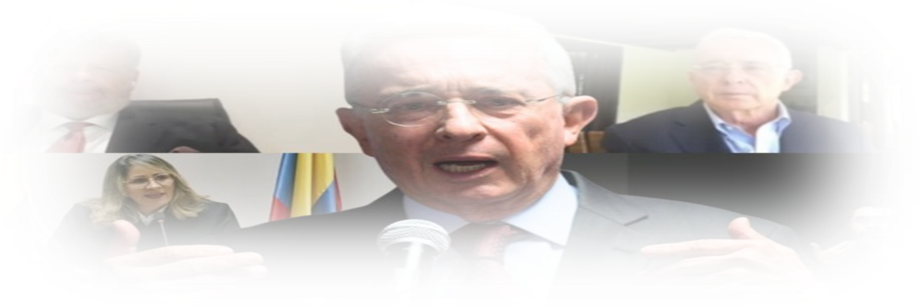
La justicia colombiana ha encontrado culpable de delitos penales a quien ha sido el hombre más poderoso del país, el ex presidente Álvaro Uribe Vélez. La decisión me sorprendió porque la justicia en Colombia tradicionalmente ha ignorado abusos del poder por parte de su clase dirigente pero, a la vez, la decisión duele porque, por correcta que sea, muy probable es que nos dividirá aún más como pueblo.
Un víctima de la injusticia tan común en Colombia, mi amigo Luis Fernando Rosas Londoño, un hombre talentoso, inteligente y honrado quien fue injustamente privado de sus derechos políticos y de su libertad, lleva tiempo rogándoles a los dirigentes políticos de nuestros partidos que para sanarnos como pueblo, para realmente lograr la paz, necesitamos una amnistía general, algo que, irónicamente, entiendo fue rechazado por el ex presidente Uribe. Luis Fernando no lo propone por su propio beneficio. Lo hace teniendo en cuenta las personas inocentes que han sido castigados en procesos jurídicos injustos y, a la vez, entendiendo que con tantos pecados por todos lados de nuestra política, se necesita “reformatear nuestro disco duro” e iniciar de nuevo.
No obstante lo anterior, reconozco que aunque el concepto de un perdon general es importante para re-direccionarnos hacia un futuro más civil y más decente, la corrupción, sea política, económica, académica o militar, etcétera, la corrupción que infecta a nuestra sociedad en forma tan profunda se tiene que minimizar, entendiéndose que acabar con ella es improbable, si no imposible; entendiendo que en un sistema político funcional, la violación de responsabilidades públicas tiene que ser el mayor delito con los castigos más serios.
Entonces, en este instante, nos encontramos en una situación, a la vez tan positiva como amarga. Una situación probablemente sin solución. No estoy feliz que el expresidente Uribe se haya encontrado culpable de violar leyes esenciales para el funcionamiento de nuestro sistema legal, pero estoy aún más triste que él nos ha puesto en la situación en la cual nos encontramos, que él ha violado sus más sagrados juramentos. Y me entristece profundamente que, en toda probabilidad, el expresidente Uribe insistirá, o en forma directa o indirecta, que sus seguidores rechacen la decisión en su contra no obstante el impacto que tenga esa reacción con respecto al bienestar popular. Espero que, en forma directa o indirecta, el expresidente Uribe insistirá en que sus seguidores organicen protestas y manifestaciones masivas en las cuales la violencia será probable.
Claro que es posible que si el expresidente es tan noble como creen sus seguidores, pondrá el bienestar de nuestro pueblo por encima de sus intereses personales. Él podría, sin admitir o negar las acusaciones en su contra (que ahora son sentencia), aceptarlas y pedirles a sus seguidores que también acepten la decisión jurídica existente. Y quizás, para minimizar la polarización, si el presidente Gustavo Petro también es tan noble como creen sus seguidores, él podría otorgarle al ex presidente Uribe clemencia en forma de un perdon ejecutivo, no en forma de algún tipo de negocio extrajudicial, pero como una ofrenda de paz para todos los colombianos en la cual, las horribles brechas entre nosotros se puedan realmente empezar a sanar y la desconfianza que nos ha dividido por tanto tiempo impidiendo las reformas esenciales en nuestras políticas públicas que urgentemente necesitamos, se pueda remplazar con un espíritu de colaboración.
No veo lo último probable pero hoy, por medio de nuestras reacciones con respecto a este juicio, se podría crear una oportunidad casi única para reconocer que los colombianos todos somos hermanos, no obstante nuestras diferencias de opinión, y que ya es tiempo que rechacemos el ejemplo mítico de Caín y Abel en favor del ejemplo de ese antiguo nazareno que tantos colombianos supuestamente aman.
Ya pronto veremos que va a ocurrir.
Temo que será lo peor pero, a la vez, aspiro que en eso yo esté equivocado. Yo salí de Colombia, como tantos otros, a los seis años, salí no en forma voluntaria pero por una decisión de mis padres basada en la violencia en la cual se encontraba nuestro país. Pero nunca olvidé que yo era y siempre seré colombiano, y que desde ese país hacia el norte que tanto daño nos ha hecho, me era muy difícil entender cómo, en un pueblo como el nuestro, un pueblo lleno de lo mejor que puede brindar la naturaleza, nos encontrábamos tan infelices el uno contra el otro. Y que muchos de los mejores ciudadanos nuestros, los más educados y los más nobles, huían en un flujo permanente hacia el norte donde eran despreciados e insultados, doctores trabajando como meseros.
Desde lejos era fácil percibir que unidos, aunque con diferencias en temas de creencias y opiniones, seriamos entre los pueblos más exitosos del mundo. En parte, para ayudar a lograr eso, fue que siempre quise volver a mi patria, algo que logré en el 2007, ese año tan especial en el cual nuestro pueblo, en masivas manifestaciones, demostró que estaba harto con nuestros eternos conflictos internos. Al volver, tuve el privilegio de trabajar por una década en la Universidad Autónoma de Manizales con estudiantes de diversas perspectivas políticas, pero unidos en el respeto por sus diferencias mientras dedicados a superarlas para lograr el bienestar común, estudiantes enamorados con su pueblo, estudiantes que ya están ascendiendo las laderas de las responsabilidades políticas y en la gran mayoría de los casos, haciéndolo en forma ética y eficiente. Esos ex estudiantes míos y otros jóvenes que he conocido me hacen pensar que la Colombia que merecemos no solo es posible sino probable, probable si evitamos seguir enmarañados en las mallas del pasado.
Hoy, haremos importantes decisiones, quizás existenciales, como individuos pero también como pueblo. El desastre del juicio en el cual se encuentra el expresidente Uribe no es ocasión para sentirnos o vencedores o vencidos, no es ocasión para ser felices o sentirnos heridos. Es una ocasión excepcional para reflexionar y mirar hacia el futuro, recordando la regla de oro: tratando a los demás como quisiéramos que otros nos trataran. Entonces, como tantas veces decimos en ocasiones más positivas, “que viva Colombia” y “que vivan los colombianos”, … todos.
Guillermo Calvo Mahé es escritor, comentarista, analista político y académico residente en la República de Colombia. Aspira ser poeta y a veces se lo cree. Hasta el 2017 coordinaba los programas de Ciencia Política, Gobierno y Relaciones Internacionales de la Universidad Autónoma de Manizales. En la actualidad, participa en entrevistas radiales y televisadas, foros, seminarios y congresos cívicos y edita y publica la revista virtual, The Inannite Review disponible en Substack.com/. Tiene títulos académicos en ciencias políticas (del Citadel, la universidad militar de la Carolina del Sur), derecho (de la St. John’s University en la ciudad de Nueva York), estudios jurídicos internacionales (de la facultad posgrado de derecho de la New York University) y estudios posgrado de lingüística y traducción (del Centro de Estudios Latinoamericanos de la Universidad de la Florida). Sin embargo, también es fascinado por la mitología, la religión, la física, la astronomía y las matemáticas, especialmente en lo relacionado con lo cuántico y la cosmogonía. Puede ser contactado en guillermo.calvo.mahe@gmail.com y gran parte de su escritura está disponible a través de su blog en https://guillermocalvo.com/.