| Abstract: A Gaelic-style satire speculating on whether President Donald J. Trump is more likely to be a reincarnation of Gaius Julius Caesar Augustus Germanicus or the Pauline antichrist or possibly both or neither, and whether quantum theories provide other possibilities. [1], [2] Key Words: “Trump”, Caligula, Antichrist, “Saul of Tarsus”, Reincarnation, “Evolutionary monist panentheism”, “Gaelic satire”, “Quantum Theories”. |
There are people today who claim to believe that Donald John Trump, the current president of the United States is the antichrist[3], the one predicted by Saul of Tarsus in his guise as Paulus, the Roman Jew who created the religions today grouped together as Christianity[4]. Only a few of those who make that claim, however, are really religious. Nonetheless, their message has resonated, albeit primarily among political opponents. I believe there may be a more likely, less supernatural possibility (or perhaps metaphor): one involving the possibility of “reincarnation”. That concept is usually relegated to metaphysics and oriental religions but it’s actually a pretty widely held, although perhaps not a firmly held, belief[5]. However, there is a tempting hypothesis that makes it sound reasonable, one involving “evolutionary monist panentheism[6]” premised on a belief that the omniverse may be sentient and that it evolves by learning through experience, experience acquired using reincarnation of its biological components as a tool. Waste not want not.
The reincarnation hypothesis is as difficult to prove as it is impossible to disprove and with reference to the scientific method the question always is, is it “testable”? It is not, not yet, perhaps never. No hypotheses concerning the “after life” are but yet, they are widely held and by some pretty smart people (as well, of course, by many people of questionable sanity). Still, the reincarnation hypothesis seems at least as possible as Paul’s beliefs concerning the antichrist. Until, of course, the antichrist shows up. If he or she does. That would tend to render the hypothesis tested.
So, let’s examine both of the foregoing hypotheses. First we’ll look at reincarnative possibilities and then we’ll delve into antichristic possibilities and finally, we’ll very briefly consider other alternatives.
Cheers!!! A nice goblet of brandy may go very well with the following.
On the Possibility that the Current President of the United States is a Reincarnation of a Late Roman Princeps[7]:
We initiate this analysis by recalling an event that occurred during October of the 37th year of the Common Era (although the timeline had yet to be designated as such). It involved a young fellow by the name of Gaius Julius Caesar Augustus Germanicus (formerly just Gaius Julius Caesar, a name he shared with his great grandfather) but better known to history as “Caligula[8]” (“little boot”, a nickname he hated)[9]. That year Caligula (I’ll use that name given that I’m not all that fond of him) came to believe that he’d undergone an apotheotic metamorphosis and had been transformed, while alive, from a mortal into a divinity. Such transformations, at that time, were not unusual but they generally occurred postmortem. Today, well, it’s been a while, but ….
At the time of his apotheotic metamorphosis, Caligula was the anointed “princeps” (first citizen) of the Roman people, a title akin to that of Führer among twentieth century Germans (which raises another possible reincarnation scenario). Caligula had many other titles though. Titles which included but were not limited to Pater Patriae, Pontifex Maximus and consul (several time). But for purposes of this speculation I especially like his title as “Optimus Maximus Caesar” (the Greatest and Best Caesar), one that would certainly appeal to Mr. Trump who would probably have added the term “Ever”. Moderns seem to believe that Caligula was referred to as “emperor” but they’re mistaken, they frequently are.
History has not treated Caligula kindly but then, history not infrequently[10] records events in a manner very different from that which an objective observer would consider accurate. History is, after all, a sort of calcified version of journalism and we know just how unreliable journalism can be. It always has been[11]. All too frequently, as is the case of journalism and journalists, historical verities are completely obfuscated and, in the case of Caligula, or Gaius Julius Caesar Augustus Germanicus if you prefer, that might well have been the case (Barrett, 2015).
Now to the crux of our speculation: i.e., events in the United States of America that took place on the weekend of April 11 through 12 of 2026 when a “president” of the United States (not quite the same as a “princeps”, at least not yet, at least not that we know of although some suspect) apparently had an experience analogous to that of young Caligula after a dispute with the now current Roman Pontiff, Robert Francis Prevost (whose papal name is Leo XIV). Interestingly, like Caligula, Pope Leo is a man of many titles, one of which is shared with Caligula, that of Pontifex Maximus. But Leo is not the object of our speculation.
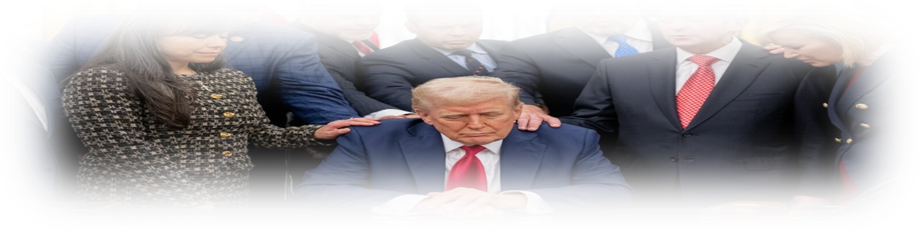
For some reason hard to decipher other than perhaps a belief that he had been, was being or would be deified while alive, Mr. Trump publicly shared artificial intelligence assisted artwork on a self-serving (some would assert, self-aggrandizing) Internet platform which he founded and ironically named “Truth Social”. The “artwork” portrayed Mr. Trump as a divinity, apparently as Yešu the Nazarene[12], the itinerant Palestinian Hebrew civic activist and healer who may have lived several millennia ago[13]. After due reflection, well after due reflection following massive public outrage, Mr. Trump removed the offending post claiming that he’d been misunderstood, as usual, and that the “artwork” merely depicted him as a “physician” curing a patient through non-traditional means. An interesting reaction.
Many people throughout the world found Mr. Trump’s post reminiscent of the ancient Roman princeps Caligula and speculation concerning similarities between Mr. Trump and Caligula became rife, although such speculation was not new[14]. In Mr. Trump’s defense, he might have referenced the fact that, unlike Caligula, he has yet to seek a seat in the Senate for a horse of which he is fond although, while Mr. Trump does not currently own horses, he famously owned a thoroughbred originally named Alibi which he renamed “D. J. Trump”, one he purchased for $500,000 in 1988, but the horse never raced due to health issues and was later retired to stud[15] before dying in 1991[16]. Hmmm, “stud”, that’s purportedly how Mr. Trump perceives of himself but, given J.D.’s demise in 1991, no equine senatorial candidate is likely to be nominated by Mr. Trump, at least for now. Still, his critics would likely have pointed out that like young Caligula, Mr. Trump also fancies himself a great artist (perhaps the greatest artist ever), or at least a great interior decorator (ditto). And a great exterior decorator as well (with ballrooms and arches of triumph a new specialty). Previously it had been hotels and golf courses. And beauty pageants! Both Caligula and the president were fond of beauty pageants although Caligula’s involved involuntary participation in erotic activities in the style of Mr. Trump’s former friend, Jeffrey Epstein, by the wives of members of the Roman Senate. That possibility has yet to occur to Mr. Trump. At least as far as we know. If ever released, the Epstein files might indicate otherwise[17].
But, superficial anecdotes and similarities aside, … About reincarnation? Is it possible that Caligula, whose career was cut short by his own Praetorians, is revisiting us?
Well, “possible” is a very open ended concept. It’s possible that the world we perceive doesn’t exist[18] and that we’re just players in a nightmare being experienced by the earliest life form, perhaps the primal prokaryote, so perhaps reincarnation is possible and, if so, perhaps an angry and vengeful Caligula has returned to correct erroneous impressions or, perhaps, to confirm them. Let’s assemble evidence so that we can make an informed guess, comparing young Gaius Julius Caesar Augustus Germanicus with the current avatar of Donald John Trump (sometimes referred to, at his suggestion, as “the Donald”). And let’s assemble it using the artificial intelligence of which the Donald seems so fond when creating images some might interpret as divine.
According to a query concerning Caligula on the Internet platform known as Chrome and a response, apparently employing artificial intelligence, here is what is popularly known about Caligula’s attributes, with my own responsive observations concerning similarities with the Donald:
- “Divine Self-Image: Caligula frequently appeared in public dressed as various gods and demigods, such as Hercules, Mercury and Venus. He was known to have the heads removed from famous statues of gods and replaced with his own, treating himself as the supreme artistic masterpiece.” Hmmm, to my knowledge, the Donald has yet to engage “publicly” in activities comparable to the foregoing (well, except with respect to planned changes in currency) but there is a sense that he just might, given time. To date, he only does that in artificially enhanced artwork that he posts on his personal social media platform, “Truth Social”. That’s something young Caligula could not match. But similarities, hmmm. Yep!
- “Oratory and Performance: Caligula was regarded as a “renowned declaimer” and enjoyed showing off his oratorical skills. He reportedly engaged in public performances and acted in various capacities, showcasing an ego that required public validation of his talents.” While cognizanti concerning rhetoric and grammar ridicule Mr. Trump’s “eloquence”, he himself revels in displaying his oratorical antics and he certainly showcases an ego that requires public validation of his talents. To his admirers and followers, he certainly seems to be a “renowned declaimer”. So, once again, yep!
- “Emulating Hellenistic Kings: Caligula admired the style of Hellenistic rulers, who were often treated as living gods and viewed themselves as patrons or creators of high art.” Hmmm, this raises interesting questions, especially in light of his latest antics. It seems clear that Mr. Trump views himself, especially with respect to real estate construction, as a “creator of high art”, witness his decoration of the Oval Office and the White House, his planned White House Ballroom and his proposed Arch of Triumph (as well as his plans for Gaza). And he also seems to see himself as a monarch (something he’s also portrayed on Truth Social with the help of artificial intelligence). So, not a perfect match but then perfection is an elusive goal. But similarities? Yep! Again.
- “Dismissal of Rivals: He was known to act with extreme arrogance, with accounts noting that “no one was allowed to outrank Caligula” in any regard”. Well, in this regard Mr. Trump clearly outdoes young Caligula and that is even without regard to his recent denigration of Catholic Pope Leo XIV. So; … absolutely!
- “Removal of Obstructions to Personal Power: During his brief reign, Caligula worked to increase the unconstrained personal power of the princeps as opposed to countervailing powers within the Principate”. That pretty definitely sounds like the Donald. Separation of powers is certainly something he ignores as he ignores concepts such as the sovereignty of independent countries, the rules of international law and anything and everything that does not coincide with his personal morality of the moment (see, e.g., Yang, 2026).
- “Military Experience”; Caligula did not lead Roman troops in a conventional battle. In the year 40 of the Common Era but he marched an army to the English Channel for a planned invasion of Britain. However, instead of fighting, he ordered the legionnaires to attack the waves with weapons and to collect seashells as “spoils of the sea” to celebrate an imagined victory over the sea god Neptune.” While Mr. Trump attended a military high school in New York, he “declined” to serve in the military given that the conflict in Vietnam was not healthy for his feet[19]. He did however order the kidnapping of the president of Venezuela and a joint attack (along with Israel) on Iran, in both cases, hoping that their oil would qualify as a trophy, and he provided Israel with all the funds and armaments necessary to engage in genocidal ethnic cleansing throughout the Middle East. That should count for something.
- “Impoverishing his subjects”: Caligula impoverished the Roman treasury by squandering 2.7 billion sesterces left by his predecessor, Tiberius, in less than a year. His lavish spending on spectacles, personal luxury and extravagant building projects led him to seize private property, raise taxes and resort to extortion to fund his reign.” Hmmm, well, Mr. Trump also spends lavishly, largely at the behest of his buddy, Benjamin Netanyahu, and, together, they increased the United States national debt from less than twenty trillion dollars at the beginning of Mr. Trump’s initial term as president to almost forty trillion by the end of his fifth year in the presidency, albeit with a little help from his friend Joey Robinette Biden. Well, not so much a friend as a bitter enemy but with shared values and goals (they both enjoyed plundering). But Joey was the friend of a friend (Bibi) and it’s the thought that counts. And Mr. Trump did raid and steal assets to help fund his extravagant ideas, especially from Venezuela. Like Caligula (and Eric Cartman of South Park fame), the Donald’s motto has been “I can do whatever I want”! And of course there’s the White House ballroom and the proposed Arc de Triomphe, etc., so, one more time, a hearty yep!
Hmm, it seems there may be disturbing trends echoing in from the past. And they continue:
A Wikipedia entry with respect to Caligula[20] asserts that he was initially perceived as a “good, generous, fair and community-spirited” sort of guy but that he promptly became “increasingly self-indulgent, cruel, sadistic, extravagant and sexually perverted”, eventually evolving into “an insane, murderous tyrant who demanded and received worship as a living god, humiliated the Senate and planned to make his horse a consul”. However, the Wikipedia article notes that, on reflection, given the fact that his history was written by Senatorial detractors long after his assassination, modern historians “dismiss many of the allegations against him as misunderstandings, exaggerations, mockery or malicious fantasies”. Well, the media, other than that controlled by pro-Israeli Zionists such as Fox News, has given Mr. Trump a pretty hard time up to now but, as a result, pro-Israeli Zionists have gone on a buying spree buying-up numerous media sources[21], especially those that have been critical of Mr. Trump, like CNN. Sounds like the future may hold further similarities. Here again echoes seem to ring loudly with reference both to the “unflattering” written conclusions concerning Mr. Trump and his defense by those inclined to view him more favorably. Sycophants I think they’re called[22].
Continuing:
With reference to the observations of more prurient similarities between Mr. Trump and the Princeps, Caligula, for many decades Mr. Trump has been viewed as a sexual addict, a sexual predator and perhaps even a sexual pervert[23] (as was Caligula), especially given his close relationship with Jeffrey Epstein but, during his first term as president it can be argued that his intentions at least were “good, generous, fair and community-spirited”. It is also clear that during that time his opponents engaged in a vicious and unfair campaign to discredit him[24]. However, apparently at least in part due to the abuse he suffered during his first term and even more, to the abuse he suffered during the Joseph Robinette Biden presidency, his second term has been very different from the positive aspects that seemed possible during his first term thus, all of the pejorative descriptions of Caligula seem to be have become germane with respect to Mr. Trump[25], except, of course, the references to equestrian matters. At least for the nonce. It seems unlikely that equines will soon obtain representation in the United States Senate; golf clubs however, may be a different matter.
Anyway:
Partially as a result of the Biden administration’s abuse of power and its own corruption following Mr. Trump’s initial term, a supportive reaction occurred among the electorate and he was elected to a non-consecutive second term, a rarity in United States political history. He was elected amid expectations that he would reverse the Biden administration’s support for Israeli military adventures, genocide and ethnic cleansing and the foreign interventionism that had characterized four of the previous United States presidencies (the Clinton, Bush, Obama and Biden presidencies), after all, that’s what he’d promised (among a plethora of other things).
So, another similarity crops up, predecessors!! Caligula’s predecessor, Tiberius Claudius Nero (then Tiberius Julius Caesar, then Tiberius Julius Caesar Augustus) had been very unpopular towards the end of his reign and it was hoped, even expected, that the abuses of Tiberius would be curbed when Caligula came to power. No such luck. Pretty much the same can be said with respect to the Donald. Almost immediately following his second inaugural however, all restraints were cast aside and delusions of grandeur comparable to those of young Caligula were made manifest. Well, at least more manifest than theretofore. Indeed, Mr. Trump specifically insisted, in response to critics, that neither the United States Constitution nor international law nor the opinions of non-aligned religious leaders nor public opinion restricted his activities in any manner, only his own “morals of the moment” being relevant[26]. As a result, Mr. Trump has quickly become (as was the case with Caligula) the least popular president in recorded United States history[27], a perception shared throughout the world with the exception of genocidal Israel and the few world leaders who find both Mr. Trump and his apparent political master, Benjamin Netanyahu, men to be admired, a view however not shared by most of their subjugated populations.
The term “least popular” is complex though, at least among the United States electorate. Mr. Trump’s most fervent followers profess to devout Christianity and continue to support him, no matter what, completely ignoring all vestiges of reality, even as his conduct becomes more and more deranged and at odds with the Christianity they claim to profess[28]. Thus this speculation (intended as a “satire” in the ancient Gaelic sense) is, in part, a reaction to the reactions of many people for whom the author cares and who he respects respects (having shared similar educational backgrounds) but whose ability to grasp reality now seems impossible for the author to understand. Well, unless he takes into account the impact of B. F. Skinner’s behaviorist psychology and modern communications theory[29] and the apparent reality that facts not only do not impact strongly-held opinions but that contradictory facts seem to reinforce them[30]. The author is specifically alluding to attitudes by Mr. Trump supporting and enabling genocidal events in the Middle East by Israel, the Pearl Harbor-like attack on Iran by the United States and Israel and ignoring the Zionist attitude towards Christians in the Middle East where spitting on Christians and desecrating Christian artifacts and destroying churches is considered a Jewish tradition[31] (something with which non-Zionist Jews do not agree). Facts with reference to the foregoing are plentiful and readily available but, as in the case of the “say no evil, see no evil and hear no evil simians”, such facts are blissfully ignored by United States citizens, many of them military veterans and religious Christians who one would think, based on heretofore shared values and shared educational experiences, would know better. But they don’t, and they don’t aggressively. They view those who believe as the author[32] does to be historically ignorant, deluded and lacking patriotism. Fair enough. Thus this “satire”.
So, enough about Mr. Trump as the incarnation of Caligula (for the moment). The evidence is strong but not conclusive. And we still have no definitive evidence that reincarnation exists at all, although it may be a possibility. But what about Mr. Trump’s potential role as the antichrist?[33]
On the Possibility that the president of the United States is the Antichrist Envisioned by Saul of Tarsus (and others):
Some of Mr. Trump’s followers, perhaps many, assert that he is the catalyst for the second coming of Yešu and that his seemingly deranged current activities in the Middle East in support of the quest for Israeli hegemony should be seen as the precursors for the great battle they anticipate at Armageddon, the herald for Yešu’s return. Of course, that would tend to support the hypotheses that Mr. Trump really is the antichrist[34] rather than merely the reincarnation of Caligula as the role of catalyst for Armageddon is usually ascribed to that entity. But what are the purported attributes of the antichrist and how do they relate to Mr. Trump? Again I’ll seek the assistance of a version of artificial intelligence as superficially provided by the Chrome Internet browser for assistance: Based on Pauline prophecies the antichrist is depicted as a charismatic, deceitful global leader and dictator who appears during the end times[35]. Among his principal characteristics are the following, which I will compare with characteristics attributable to Mr. Trump:
- “The Man of Lawlessness/Sin: He is marked by total rebellion aiming to change established times and laws”. Hmmm, pretty much on point as he has stated that he is bound neither by the Constitution or International law but only by his own “morality” of the moment (see, e.g., Yang, 2026), a morality that quickly changes as convenient.
- “Blasphemous Ruler: He speaks arrogant words, blasphemes God.” Hmm, I think Catholic Pope Leo XIV might have strong opinions on this point but, in a contrary fashion, so do his followers who equate his pronouncements with those of their god.
- “Charismatic Deceiver: He initially appears as a peaceful savior, using flattery and brilliant deception to gain power, often compared to a ‘little horn’ that grows in influence.” Hmm, well, “ain’t that the truth!
- “Global Dictator: He will gain worldwide authority over nations and religions.” Well, he certainly perceives himself in that light and is doing everything he can to make it a reality.
- “Economic Controller: He controls the global economy, forcing a mark on the right hand or forehead, forbidding anyone to buy or sell without it.” Once again, hmmmm: Donald Trump owns hundreds of trademarks and service marks globally, managed primarily through his company, DTTM Operations LLC. His portfolio includes over 800 trademarks in more than 80 countries, covering real estate, hotels, hospitality, apparel and merchandise, alongside political campaign slogans like “Make America Great Again”. Aha!!! MAGA.
- “Persecutor of Believers: He is a blood-thirsty dictator who wars against and destroys those who refuse to follow him.” Wow!!!! That pretty much describes the Donald, just ask former followers Tucker Carlson or Megyn Kelly or Candace Owens or Alex Jones or Clint Russell or Nick Fuentes, etc., and, of course, anyone who opposes him in any form. Ask Pope Leo.
Observations & Contextualization
Although I usually refrain from using pejoratives such as “ignorant” and “stupid” (this speculation notwithstanding) because I feel they would be counterproductive if I am seeking to persuade, I have to admit that such thoughts do cross my mind. And they sadden me with respect to the people who hold those beliefs who I personally know, men with whom I’ve studied or who’ve graduated from educational institutions I also attended. And they are many. Probably a majority. Which leads me to ask myself how and why my perceptions and perspectives are so different from theirs. That I may be wrong and they may be right is an essential postulate with respect to an open mind. Empathy calls and only empathy can someday resolve our differences, assuming that empathy somehow survives. Well then, a bit of personal revelation (a sort of pun) is probably in order, revelation that seems relevant in light of the nature of most current Trump supporters (other than Israelis) who believe themselves to be devout Christians (or else devout Zionists). Revelation that may help to explain the differences in our perceptions, as well as similarities that may someday provide resolution.
I’ve explored religions since I was seven years old[36] and as a young adult, taught courses on comparative religions and comparative mythologies. Based on my research and on profound reflections I’ve come to rejected most, perhaps all the religions I’ve studied, at least as postulated, although I’ve not rejected their fundamental premises[37]. I’ve studied religions primarily from historical and philosophical perspectives using historical and philosophical sources accompanied by deep personal introspection, frequently introspection facilitated as I wrote and puzzled over, … well, the myriad puzzles[38] religions present, puzzles where questions multiply as answers become more and more evasive, although answers are not required where “faith” can substitute for facts and logic. In doing so I encountered doctrines that were purportedly espoused[39] by Yešu and I found the precepts attributed directly to him with respect to interpersonal relationships both worthy and generous, with a sweet undertone, as opposed to those ascribed to the Pharisee, Saul of Tarsus so beloved of Trump supporters, whose doctrines seemed mean spirited and callous to me, all too frequently aligned with fund raising and control, almost the opposite of those attributed directly to Yešu. And, of course, Saul is the primary originator of the antichrist mythos.
The association of Pauline Christianity with Mr. Trump is certainly a point of departure from Caligula who reigned during the birth of the movement that sprung up around Yešu during his lifetime. But it’s a point of contact with respect to speculation involving the antichrist. Caligula probably reigned shortly after Yešu’s demise, his demise either through crucifixion by the Romans, as related in what has come to be referred to as the New Testament, or torture, stoning and hanging by the Jerusalem Sanhedrin, as related in diverse versions of the Jewish Toledot Yeshu[40]. Muslims reject the notion that he was put to death and insist that Yešu (Isa to them) survived and eventually ascended directly into Heaven without a sojourn in Hell. Caligula reigned from the years 37 through 41 of the Common Era and likely had no direct contact with or knowledge of early followers of Yešu (not yet Christians), who were still a small, emerging Jewish sect. Of course, Mr. Trump’s Christian followers are more correctly followers of one of the many Pauline religions premised mainly on the death of Yešu rather than on the precepts he sought to imbue. So, in matters of religion, the nexus between Mr. Trump and Caligula suffers from a temporal vacuum when it comes to how we might compare them other than the seeming fact that both appear to consider themselves divinities and that neither particularly respected religion, except in so far as it served to aggrandize them. But the differences between Yešu’s ethical and moral teachings with respect to interpersonal relations and the divergent Pauline doctrines do a lot to explain the differing perceptions among those of us who otherwise share such similarities in education and values. After all, Yešu never mentioned a “Christ” or an “antichrist”.
Far Off Hypotheses and Conclusions:
Wow, Caligula reincarnated versus the Pauline antichrist, it seems like a tie.
In neither case is there demonstrably definitive probative evidence that either concept is valid which, however, is not the same as indicating that no supporting evidence exists. “Demonstrably definitive probative evidence” is a much harder standard of proof than the “beyond a reasonable doubt standard” required for criminal conviction. But there is definitely adequate proof that a Donald J. Trump exists (unfortunately) and it is very likely that there was a Gaius Julius Caesar Augustus Germanicus and a Saul of Tarsus and even a Yešu as well.
So, where are we in this comparative speculation in the guise of a Gaelic satire? Are there any other possible conclusions we might want to consider?
Well, to be honest, farfetched though they may be, there are other alternative hypotheses concerning the possible apotheoses of Caligula and or Mr. Trump or others? Indeed, there are several to the effect that fictional characters can incarnate. One is posited by Daniil Andreev and taken seriously by some fairly intelligent people[41]. And supposedly “quantum” theories have confused everything while they have made everything possible. So let’s speculate a bit on that hypothesis as a final element worthy of a Gaelic satire. How about a presidential version of Yosemite Sam? Yosemite Sam first came to public awareness during 1945, the year prior to the Donald’s birth. While I personally don’t believe it’s likely that cartoon characters can reincarnate but the similarity is also, in some respects, uncanny. My apologies to Sam. The same holds true for Eric Cartman of South Park fame, another Donald Trump act-alike.
So, in light of the foregoing, what might we conclude, recalling that this is a speculation in the form of a Gaelic satire?
Well, it’s theoretically possible that both primary speculations concerning Mr. Trump are accurate and that he is Gaius Julius Caesar Augustus Germanicus reincarnated and that both are the antichrist anticipated by Paulus, formerly Saul of Tarsus. A sort of ribbon on this satiric package. One seemingly more reasonable than the Yosemite Sam or Eric Cartman hypotheses. Or, of course, none may be accurate and Mr. Trump may be sui generis, as he believes, although the nature of his uniqueness is certainly up for debate and may well be debated for centuries (as is the case with Caligula), assuming that the world survives Mr. Trump’s presidency. At any rate, in closing, a traditional Gaelic “aspiration” may well be appropriate with reference to Mr. Trump:
“Imeacht gan teacht ort!”
Interested readers may want to look it up. It is certainly not the worst malediction one might contrive.
I wonder if this speculation qualifies as a syllogism, albeit a sarcastic and satirical syllogism.
Bibliography & Sources
Andreev, Daniil (1957, published in English 1997): The Rose of the World (translated by Jordan Roberts); Lindisfarne Books, London.
Barrett, Anthony A. (2015): Caligula: The Abuse of Power. 2nd ed. Routledge, London.
Brooks, Bras; Coster, Helen; Ax, Joseph (2026): “Trump’s AI image of himself as Jesus-like figure follows feud with Pope Leo”; Reuters, April 13, 202611:08 a.m., updated April 14, 2026, available at https://www.reuters.com/business/media-telecom/trump-posts-ai-image-himself-jesus-like-figure-drawing-outrage-2026-04-.13/#:~:text=Trump’s%20AI%20image%20of%20himself,follows%20feud%20with%20Pope%20Leo&text=Trump’s%20post%20depicts%20him%20in,with%20hand%20on%20man’s%20head.
Brown, Mark (2016): “Donald Trump has ‘fascinating parallels’ with Caligula, says historian”; The Guardian, June 1, 2016, available at https://www.theguardian.com/books/2016/jun/01/donald-trump-has-fascinating-parallels-with-caligula-says-historian.
Calvo Mahé, Guillermo (2024): “The Life of Yešu According to Diverse Jewish Sources”; Academia.edu available at https://www.academia.edu/124579552/The_Life_of_Ye%C5%A1u_According_to_Diverse_Jewish_Sources.
Calvo Mahé, Guillermo (2025): “Panentheistic Reflections on Evolutionary Structure”; The Inannite Review, Substack, September 28, 2025 available at https://open.substack.com/pub/guillermocalvomah/p/panentheistic-reflections-on-evolutionary?r=lwzkv&utm_campaign=post&utm_medium=web.
Chalmers, D. J. (2022): Reality+: Virtual worlds and the problems of philosophy; W. W. Norton & Company, New York City.
Clayton, P. (2004): Mind and emergence: From quantum to consciousness. Oxford University Press, New York City.
Frankel, Jeffrey (2026). “Caligula Reincarnated.” Belfer Center for Science and International Affairs, February 6, 2026. Harvard Kennedy School; Cambridge, available at https://www.belfercenter.org/research-analysis/caligula-reincarnated.
Gibson, Caitlin (2017): “The Sad Saga of Thoroughbred D. J. Trump, Donald Trump’s Lone Foray into Horse Racing” Washington Post, May 19, 2017 available at https://www.washingtonpost.com/news/sports/wp/2017/05/19/the-sad-saga-of-thoroughbred-d-j-trump-donald-trumps-lone-foray-into-horse-racing/.
Hedges, Chris (2026): “Trump the God”; The Chris Hedges Report, April 20, 2026 available at https://open.substack.com/pub/chrishedges/p/trump-the-god?r=lwzkv&utm_campaign=post&utm_medium=web.
Jones, Sarah (2019): “Here’s how We’d Really Know That Trump Is the Antichrist”; Intelligencer, August 21, 2019 available at https://nymag.com/intelligencer/2019/08/heres-how-wed-really-know-that-trump-is-the-antichrist.html.
M.K., anonymity required for personal protection (2023): “Spitting on Christians by Jewish fanatics continues”, WAFA, Palestinian News & Information Agency, October 4, 2023 available at https://english.wafa.ps/Pages/Details/137914.
McGinn, Bernard (1994): Antichrist: Two Thousand Years of the Human Fascination with Evil; HarperSanFrancisco, San Francisco.
McLaughlin, Roisin (2008): “Early Irish Satire”; Journal of the Galway Archaeological and Historical Society, Volume 62, January 2010; School of Celtic Studies, Dublin Institute for Advanced Studies. Dublin.
Morris EK, Smith NG, Altus DE. B. F. (2005): “Skinner’s contributions to applied behavior analysis”; The Behavior Analyst, Volume 28 Number Two, Fall 2005, pp. 99-131, available at https://pmc.ncbi.nlm.nih.gov/articles/PMC2755377/#:~:text=Our%20paper%20reviews%20and%20analyzes%20BF%20Skinner’s,role%20as%20the%20field’s%20originator%20and%20founder.
Nyhan, B. and Reifler, J. (2010): “When corrections fail: The persistence of political misperceptions”. Political Behavior, Volume 32 Issue 2, pp. 303-330 available at https://www.jstor.org/stable/40587320.
Pauli, Adolf F. (1958): “Letters of Caesar and Cicero to Each Other”; The Classical World, Vol. 51, No. 5 (Feb., 1958), pp. 128-132. The Johns Hopkins University, Baltimore available at https://www.jstor.org/stable/4344010.
Rottinghaus, B., & Vaughn, J. S. (2024): Presidential Greatness Project Expert Survey 2024. University of Houston; Coastal Carolina University.
Shane, Leo, III (2019): “Trump made up injury to dodge Vietnam service, his former lawyer testifies”; Military Times Feb 27, 2019 available at https://www.militarytimes.com/news/pentagon-congress/2019/02/27/trumps-lawyer-no-basis-for-presidents-medical-deferment-from-vietnam/.
Sheehan, Colleen A. (2004): “Madison v. Hamilton: The Battle Over Republicanism and the Role of Public Opinion”; American Political Science Review, Volume 98, Issue 3, August 2004 pp. 405–424, available at https://www.jstor.org/stable/4145337].
Schneid, Rebecca (2025): “Inside Trump and Epstein’s Long, Complicated Relationship”; Time Magazine, Nov 12, 2025 available at https://time.com/7333365/trump-epstein-relationship-timeline/.
Stevenson, I. (1997). Reincarnation and Biology: A Contribution to the Etiology of Birthmarks and Birth Defects (Vols. 1–2). Praeger Publishers, Westport, CT.
Tabor, James D. (2013): Paul and Jesus: How the Apostle Transformed Christianity; Simon & Schuster, New York City.
Whitehead, Andrew L. and Samuel L. Perry. 2020. Taking America Back for God: Christian Nationalism in the United States. Oxford University Press, New York City.
Wikipedia contributors. (2026, April 12). Caligula. In Wikipedia, The Free Encyclopedia. Retrieved 00:42, April 20, 2026, from https://en.wikipedia.org/w/index.php?title=Caligula&oldid=1348470896.
Yang, Maya (2026): “‘I don’t need international law’: Trump says power constrained only by ‘my own morality’; The Guardian, Thursday January 8, 2026, 21.19 GMT, last modified on Sunday January 11, 2026 17.28 GMT, available at https://www.theguardian.com/us-news/2026/jan/08/trump-power-international-law.
_____
© Guillermo Calvo Mahé; Manizales, 2026; all rights reserved. Please feel free to share with appropriate attribution. This “speculation” or Gaelic satire was first published on Academia.edu.
Guillermo (“Bill”) Calvo Mahé (a sometime poet and aspiring empirical philosopher) is a writer, political commentator and academic currently residing in the Republic of Colombia (although he has primarily lived in the United States of America of which he is also a citizen). Until 2017 he chaired the political science, government and international relations programs at the Universidad Autónoma de Manizales. Previously, he chaired the social studies and foreign language departments at the Eastern Military Academy in Huntington, New York. He is currently the publisher of the Inannite Review available at Substack.com; an intermittent commentator on radio and television; and, an occasional contributor to diverse periodicals and publications. He has academic degrees in political science (BA, The Citadel, the Military College of South Carolina), law (JD, St. John’s University, School of Law), international legal studies (LL.M, the Graduate Division of the New York University School of Law) and translation and linguistic studies (GCTS, the University of Florida’s Center for Latin American Studies). However, he is also fascinated by mythology, religion, physics, astronomy and mathematics, especially with matters related to quanta, cosmology and cosmogony. He can be contacted at guillermo.calvo.mahe@gmail.com and much of his writing is available through his blog at https://guillermocalvo.com/.
[1] This piece is way too long, even as a Gaelic satire, but I just couldn’t help myself and for those with the patience to read it, I think you’ll find it at least entertaining and possibly informative. Give it a try!! I double down dare you! It’ll piss Donald Trump off no end.
Apologies: I hereby formally and sincerely apologize, beforehand and as an afterword, to Pope Leo XIV, to Yešu, to all my friends who will be offended by a Gaelic satire directed at someone they love, to fundamentalist Zionist Christians in general, to Yosemite Sam, to Eric Cartman and to Gaius Julius Caesar Augustus Germanicus. Better late than never. Finally, last but not least, should it turn out that Saul of Tarsus (a/k/a Paulus) was indeed the antichrist, my apologies for having attributed that possibility to Mr. Trump and to Mr. Germanicus (assuming that is the proper modern manner of addressing Caligula).
[2] For Gaelic satire, see generally McLaughlin, Roisin (2008): “Early Irish Satire”; Journal of the Galway Archaeological and Historical Society, Volume 62, January 2010; School of Celtic Studies, Dublin Institute for Advanced Studies. Dublin.
[3] For an academic discussion of the antichrist, see McGinn, Bernard (1994): Antichrist: Two Thousand Years of the Human Fascination with Evil; HarperSanFrancisco, San Francisco.
[4] See, e.g., Tabor, James D. (2013): Paul and Jesus: How the Apostle Transformed Christianity; Simon & Schuster, New York City.
[5] For an academic study delving into the possibility of reincarnation, see generally Stevenson, I. (1997). Reincarnation and Biology: A Contribution to the Etiology of Birthmarks and Birth Defects (Vols. 1–2). Praeger Publishers, Westport.
[6] “Evolutionary monist panentheism” is a philosophical and theological worldview that posits that all reality exists within a single, interconnected divine being that is both beyond the universe (transcendent) and immanent within it. This divine reality is not static; rather, it is constantly evolving alongside the universe, with all constituent parts striving toward greater complexity and “perfection”. See generally Clayton, P. (2004): Mind and emergence: From quantum to consciousness. Oxford University Press, New York City; see also Calvo Mahé, Guillermo (2025): “Panentheistic Reflections on Evolutionary Structure”; The Inannite Review, Substack, September 28, 2025 available at https://open.substack.com/pub/guillermocalvomah/p/panentheistic-reflections-on-evolutionary?r=lwzkv&utm_campaign=post&utm_medium=web.
[7] See, e.g., Frankel, Jeffrey (2026). “Caligula Reincarnated.” Blog Post. Belfer Center for Science and International Affairs, February 6, 2026. Harvard Kennedy School; Cambridge, available at https://www.belfercenter.org/research-analysis/caligula-reincarnated.
[8] A sort of strange confession impacting my probable lack of objectivity concerning Caligula is in order. The paternal line of my family (the Calvi) has long clung to what to me appears to be a historical delusion (a variant on an urban myth so, a family myth). Some among them claim ancestry from a certain Gaius Calvisius Sabinus who was a Roman consul in the year 26 of the Common Era. A prior Calvisius Sabinus from whom they also claim descent was co-consul with Octavian during the 4th year prior to the Common Era, the purported year of Yešu’s birth, at least according to some. The former Calvisius Sabinus (although later in time) was a Roman senator who fell out of favor during Caligula’s reign, long after he’d served as consul, because he and his wife Cornelia had been accused of conspiring against the Princeps (a point of pride among those old members of my family who cling to the myth). To avoid a certain conviction Calvisius and Cornelia both committed suicide during the year 39 of the Common Era thus avoiding the trial. Notwithstanding my certainty that the familial relationship is mythical, it did impact my earliest perceptions with respect to Caligula. On the other hand, given evolutional biological probabilities, most people with southern European roots may well be descended indirectly from most people who bore children in that region during antiquity. Just not in a direct line as my own ancestors seem to believe.
[9] For a detailed academic discussion relating to Caligula, see generally Barrett, Anthony A. (2015): Caligula: The Abuse of Power. 2nd ed. Routledge, London.
[10] A double negative, I know, I know, I claim poetic license, after all, Gaelic satires are poetic in nature.
[11] “Yellow Journalism” preceded the Pulitzer – Hearst battles of the 19th century, see for example, the vicious journalistic battles involving Founding Fathers Thomas Jefferson (with the assistance of James Madison) versus Alexander Hamilton and even Aaron Burr [see, e.g., Sheehan, Colleen A. (2004): “Madison v. Hamilton: The Battle Over Republicanism and the Role of Public Opinion”; American Political Science Review, Volume 98, Issue 3, August 2004 pp. 405–424, available at https://www.jstor.org/stable/4145337] and, even before Caligula, Marcus Tullius Cicero and Gaius Julius Caesar engaged in written rhetorical battles were truth was not infrequently victimized, see, e.g., Pauli, Adolf F. (1958): “Letters of Caesar and Cicero to Each Other”; The Classical World, Vol. 51, No. 5 (Feb., 1958), pp. 128-132. The Johns Hopkins University, Baltimore available at https://www.jstor.org/stable/4344010.
[12] Known primarily under Greek variants of the name such as Jesus (English), Jesús (Spanish), Jésus (French), Gesù (Italian), and Yesu (Swahili/Hindi).
[13] See Brooks, Bras; Coster, Helen; Ax, Joseph (2026): “Trump’s AI image of himself as Jesus-like figure follows feud with Pope Leo”; Reuters, April 13, 202611:08 a.m., updated April 14, 2026, available at https://www.reuters.com/business/media-telecom/trump-posts-ai-image-himself-jesus-like-figure-drawing-outrage-2026-04-.13/#:~:text=Trump’s%20AI%20image%20of%20himself,follows%20feud%20with%20Pope%20Leo&text=Trump’s%20post%20depicts%20him%20in,with%20hand%20on%20man’s%20head.
[14] See, e.g., Brown, Mark (2016): “Donald Trump has ‘fascinating parallels’ with Caligula, says historian”; The Guardian, June 1, 2016, available at https://www.theguardian.com/books/2016/jun/01/donald-trump-has-fascinating-parallels-with-caligula-says-historian.
[15] That was probably a better reward for a beloved horse than a seat in our contentious Senate.
[16] See Gibson, Caitlin (2017): “The Sad Saga of Thoroughbred D. J. Trump, Donald Trump’s Lone Foray into Horse Racing” Washington Post, May 19, 2017 available at https://www.washingtonpost.com/news/sports/wp/2017/05/19/the-sad-saga-of-thoroughbred-d-j-trump-donald-trumps-lone-foray-into-horse-racing/.
[17] See, e.g., Schneid, Rebecca (2025): “Inside Trump and Epstein’s Long, Complicated Relationship”; Time Magazine, Nov 12, 2025 available at https://time.com/7333365/trump-epstein-relationship-timeline/.
[18] See, e.g., Chalmers, D. J. (2022): Reality+: Virtual worlds and the problems of philosophy; W. W. Norton & Company, New York City.
[19] See, e.g., Shane, Leo, III (2019): “Trump made up injury to dodge Vietnam service, his former lawyer testifies”; Military Times Feb 27, 2019 available at https://www.militarytimes.com/news/pentagon-congress/2019/02/27/trumps-lawyer-no-basis-for-presidents-medical-deferment-from-vietnam/.
[20] Not that Wikipedia is always a reliable source, especially as to things about which exuberant contributors feel strongly. Caligula, however, for now, seems a safe topic. See Wikipedia contributors. (2026, April 12). Caligula. In Wikipedia, the Free Encyclopedia. Retrieved 00:42, April 20, 2026, from https://en.wikipedia.org/w/index.php?title=Caligula&oldid=1348470896.
[21] E.g., Paramount Global, Warner Brothers Discovery, HBO/HBO Max, CNN, DC Comics and Warner Bros. Pictures and TikTok USA, etc.
[22] Hedges, Chris (2026): “Trump the God”; The Chris Hedges Report, April 20, 2026 available at https://open.substack.com/pub/chrishedges/p/trump-the-god?r=lwzkv&utm_campaign=post&utm_medium=web.
[23] See, e.g., Padilla, Mariel (2023): “Defend and Deny: What we know about Trump and accusations of sexual misconduct”; The 19th, October 26, 2023, 11:04 updated November 14, 2025, available at https://19thnews.org/2023/10/donald-trump-associates-sexual-misconduct-allegations/#:~:text=Jill%20Harth%2C%20who%20worked%20with,according%20to%20the%20Associated%20Press.
[24] Indeed, this author frequently defended Mr. Trump in diverse published articles as well as on radio and television from a number of the unfair attacks levelled against him although always stressing that such defense did not indicate positive support for Mr. Trump or for Mr. Trump’s conduct, beliefs or proposed policies. While I profoundly regret the fact that Mr. Trump has been elected president of the United States and, as in the case of his predecessor, has been a facilitator directly responsible for genocide, ethnic cleansing and Israel’s campaign of lebensraum in the Middle East, I do not regret having defended him from unfair accusations and attacks which in fact made him more popular than ever. Such defense, I feel, provides my critiques of Mr. Trump with more credibility, at least I hope so.
[25] Hmm, that brings up another possibility, one unrelated to the antichrist or reincarnation, spiritual possession. But that’s beyond the scope of this already far too long “speculation”.
[26] See Yang, Maya (2026): “‘I don’t need international law’: Trump says power constrained only by ‘my own morality’; The Guardian, Thursday January 8, 2026, 21.19 GMT, last modified on Sunday January 11, 2026 17.28 GMT, available at https://www.theguardian.com/us-news/2026/jan/08/trump-power-international-law.
[27] See, e.g., Rottinghaus, B., & Vaughn, J. S. (2024): Presidential Greatness Project Expert Survey 2024. University of Houston; Coastal Carolina University.
[28] See, e.g., Whitehead, Andrew L. and Samuel L. Perry. 2020. Taking America Back for God: Christian Nationalism in the United States. Oxford University Press, New York City.
[29] See, e.g., Morris EK, Smith NG, Altus DE. B. F. (2005): “Skinner’s contributions to applied behavior analysis”; The Behavior Analyst, Volume 28 Number Two, Fall 2005, pp. 99-131, available at https://pmc.ncbi.nlm.nih.gov/articles/PMC2755377/#:~:text=Our%20paper%20reviews%20and%20analyzes%20BF%20Skinner’s,role%20as%20the%20field’s%20originator%20and%20founder.
[30] See, e.g., Nyhan, B. and Reifler, J. (2010): “When corrections fail: The persistence of political misperceptions”. Political Behavior, Volume 32 Issue 2, pp. 303-330 available at https://www.jstor.org/stable/40587320.
[31] See, e.g., M.K. (anonymity required for personal protection; 2023): “Spitting on Christians by Jewish fanatics continues”, WAFA, Palestinian News & Information Agency, October 4, 2023 available at https://english.wafa.ps/Pages/Details/137914.
[32] Okay, I’ll confess, “I” am the author referenced above. I was just briefly trying to maintain a more academic attitude which for some reason eschews use of the first person. But that has quickly become tedious. I will therefor return to using I, or me, or myself, etc., from here on out. I can almost sense the grammatical first person smiling while the third person frowns.
[33] As a disclaimer or better yet, an admission, I’ve always believed that if an antichrist ever existed it was the man who invented the concept, Saul of Tarsus but, for purposes of this speculation, I’ll pretend to keep an open mind. Sort of the way a journalist would.
[34] See, e.g., Jones, Sarah (2019): “Here’s how We’d Really Know That Trump Is the Antichrist”; Intelligencer, August 21, 2019 available at https://nymag.com/intelligencer/2019/08/heres-how-wed-really-know-that-trump-is-the-antichrist.html.
[35] See generally McGinn, Bernard (1994), supra.
[36] Hence my familiarity with reincarnation in the evolutional monist panentheistic sense.
[37] I confess however to being drawn to the concept of evolutional monist panentheism in an agnostic sense.
[38] As a barely relevant (perhaps irrelevant) aside, I’ve taught comparative religions in conjunction with which I’ve studied all three branches of the Abrahamic faiths as well as the Indian religions (all Indian religions revolve around a mixture of Hindu concepts sometimes mixed somehow with Islam), Buddhism, Zoroastrianism, Theosophy, primitive mythologies (which my students wisely referred to as “other peoples’ religions), etc. In trying to understand current world politics, a study of the Abrahamic religions and their interrelationship seems essential and my friends, those who were catalysts for this speculation, clearly have a poor and superficial understanding of that topic which may help explain our divergent perspectives. The Three Abrahamic religions, Judaism, Christianity and Islam are a complex mix of contradictions and their interrelationship is incoherent. Islam is the bridge between the toe polar opposites, Judaism and Christianity. It shares a very positive view of Yešu with Christianity but shares the strict monotheism of Judaism thus Islam respects both of its two related religious branches. Indeed, were it not for Islamic tolerance, Judaism might well have been successfully expunged by intolerant Christians but, as has occurred with the Persians who saved the Hebrews from their Babylonian exile, Islam is facing existentially genocidal attacks as Israel, with United States assistance, picks off one group of Muslims after another while wealthy Muslim countries watch, perhaps not realizing their turn is coming (reminiscent of the situation criticized by German pastor Martin Niemöller with reference to the cowardice and inaction of spectators during the Nazis’ rise to power, see United States Holocaust Memorial Museum. [2023, April 11] Martin Niemöller: “First they came for the Socialists…”. Holocaust Encyclopedia. Retrieved April 21, 2026, from https://encyclopedia.ushmm.org/content/en/article/martin-niemoeller-first-they-came-for-the-socialists).
[39] A sort of a digression (again), a sort of silly one this time, I’ve also studied linguistics and words tend to fascinate me. As I wrote the word “espoused” above it occurred to me to reflect on its etymology and how it is related to both marriage on the one hand (spouse) and to support for a cause. I guess both concepts involve “support” albeit in very different senses. According to Chrome, the link involves a “commitment”. Rats! Now I’ve become interested in the etymology of the term “commit” and its use with respect to dedication as opposed to a sort of imprisonment.
[40] See, e.g., Calvo Mahé, Guillermo (2024): “The Life of Yešu According to Diverse Jewish Sources”; Academia.edu available at https://www.academia.edu/124579552/The_Life_of_Ye%C5%A1u_According_to_Diverse_Jewish_Sources.
[41] Strange as it may seem, the concept of fictitious characters incarnating or “reincarnating” into reality has been explored in both esoteric writing and speculative fiction. See, e.g., Andreev, Daniil (1957, published in English 1997): The Rose of the World (translated by Jordan Roberts); Lindisfarne Books, London. In The Rose of the World (Roza Mira) Mr. Andreev posits that fictional characters are not merely products of the imagination but rather entities that exist in other planes of reality and are channeled by poets and artists. Consequently, he proposed a complex meta-geography where fictional characters can be seen as manifestations or indeed, as beings, either demonic or enlightened, that enter the human consciousness through creative inspiration. Hmmm!!! Pretty interesting.