Ever since I can remember I’ve been an admirer of Leonardo da Vinci, the bastard son of Ser Piero da Vinci d’Antonio di ser Piero di ser Guido, a successful Florentine legal notary, and Caterina di Meo Lippi. Leonardo was apparently born in either Anchiano, a country hamlet near the Florentine commune of Vinci, or in a house in Florence, part of the ancient Italian region of Tuscany, owned by his father, in either case, seeking privacy to hide the illegitimate birth. His mother may have been an Arab or Chinese slave although a book published by Martin Kemp and the archival researcher Giuseppe Pallanti claims that she was born in 1436 to a poor farmer, was orphaned at the age of fourteen and gave birth to Leonardo da Vinci at the age of sixteen, after which she purportedly had five other children with a different man, also a poor farmer. Leonardo was initially raised in relative poverty by his mother and her husband but eventually Leonardo came to enjoy a positive relationship with his father’s family, especially with his uncle and grandfather, although perhaps not with his father who was too busy with business matters. Consequently, he only received a very basic and informal education in writing, reading, and mathematics, although his artistic talents were recognized at an early age and emphasis was quickly placed on their development.
It is telling and very worth considering that from such inauspicious beginnings perhaps the world’s most universally talented man arose and to ask ourselves how many other multifaceted geniuses born under comparable circumstances never had the opportunity to attain their potential. In my own life I’ve known a number of men and women who fit that characterization. In this regard, the world owes a great debt to Andrea del Verrocchio, an Italian sculptor, painter and goldsmith who was a master of a workshop in Florence and who apparently accepted Leonardo, first as a studio boy but when he turned 17, as an apprentice, setting him on his path to greatness, first as an artist and then, … well, as a universal genius.
Leonardo di ser Piero da Vinci is one of my greatest heroes, but I admire him less for his myriad successes than because he attained them despite the humility of his origins. One thing I have always found incomprehensible however is the fame of his most famous painting, the Mona Lisa, and the worshipful claims concerning the subject’s beauty, and especially her smile. To my perhaps jaded and certainly inexpert tastes, she is not even particularly attractive and as for the “enigmatic” nature of her smile, I find nothing at all special about it, especially when compared to my wife’s. I assume many other husbands, boyfriends and fathers share my perspective and that some may also share my curiosity. What most troubles me however concerning the Mona Lisa hysteria is that it obscures Leonardo’s truly great achievement, having risen from such humble beginnings to such stunning heights without the intervention of martial opportunities and successes, the more usual route to success for those born of humble origins. One wonders how many people who might eventually have proven to be a new Leonardo we trash as we expel those desperate to become part of our society and who ask only to be permitted to work and grow among us? “… [g]ive me your tired, your poor, your huddled masses yearning to breathe free, the wretched refuse of your teeming shore …” indeed.
The foregoing frequently leads me to reflect on the reality that when people are not assisted in attaining their potential, it is not only they who suffer, but the whole world, and on the stupidity and cupidity of those who oppose state assistance to the most humble among us. We certainly desperately need a world were the most humble can attain their full potential, a concept which the Athenian philosopher Plato referred to as an essential component of “justice” and understood as essential for optimal societal development, the common welfare and attainment of the best possible world. Something which, despite the millennia since Plato, his mentor Socrates and his student Aristotle contemplated how to attain justice, we are very, very far from attaining. _____
Guillermo (“Bill”) Calvo Mahé (a sometime poet and aspiring empirical philosopher) is a writer, political commentator and academic currently residing in the Republic of Colombia (although he has primarily lived in the United States of America of which he is also a citizen). Until 2017 he chaired the political science, government and international relations programs at the Universidad Autónoma de Manizales. Previously, he chaired the social studies and foreign language departments at the Eastern Military Academy in Huntington, New York. He is currently the publisher of the Inannite Review available at Substack.com; an intermittent commentator on radio and television; and, an occasional contributor to diverse periodicals and publications. He has academic degrees in political science (BA, The Citadel, the Military College of South Carolina), law (JD, St. John’s University, School of Law), international legal studies (LL.M, the Graduate Division of the New York University School of Law) and translation and linguistic studies (GCTS, the University of Florida’s Center for Latin American Studies). However, he is also fascinated by mythology, religion, physics, astronomy and mathematics, especially with matters related to quanta, cosmology and cosmogony. He can be contacted at guillermo.calvo.mahe@gmail.com and much of his writing is available through his blog at https://guillermocalvo.com/.
It’s interesting and indeed important in this age where verity is an anachronism to reflect on the intellectual pillars on which seventeenth and eighteenth century political philosophers ruminated as they wove the fundaments on which they hoped “western” society might to be based. They were not concerned with democracy at all. Indeed, most disdained it as mob rule, but they were very concerned with avoidance of tyranny. Not “tyranny” in the classical Greek sense of attainment of power by nontraditional means, Greek tyrants were among the most effective and populist leaders, but in the sense of abuse of power by an oligarch. They realized, I believe, that rule of one man (a subject) by another (a sovereign) inevitably involves the appropriation, for benign or malign purposes, of the subject’s sovereignty (i.e., his or her autonomy) and they were most concerned with at least limiting the extent to which such bequeathed, stolen or otherwise acquired individual sovereignty would be subjugated. In this, Thomas Hobbes was more sanguine than was the kinder and more idealistic John Locke but as history has demonstrated, Hobbes was more perceptive.
In the opinion of John Locke and perhaps also Thomas Hobbes, in a primordial, perhaps metaphorical past, individuals, theretofore fully vested of their individual sovereignty, surrendered it in exchange for a social system that provided some semblance of security and predictability because in a world where everyone was sovereign, no one was secure, the concept of private property could not exist, and though the strongest might rule, the weak, collectively or while the strong slumbered, could dispose of them. Hobbes believed that individuals surrendered the totality of their individual sovereignty to a single individual, an autocrat, or to a group of individuals, an oligarchy, in exchange for promised personal safety and for “boons” from the sovereign which resembled rights, but could be modified, suspended or eliminated at the sovereign’s whim, so long as the sovereign provided security.
John Locke’s perspective was very different in that not all aspects of individual sovereignty were surrendered and the aspects retained were inviolable “rights”. Further, that the surrender of the portion of individual sovereignty not retained was based on a social contract and thus, the surrender was conditioned on the sovereign’s compliance with the terms pursuant to which it had attained its authority, which included guarantees of security, but much more, especially respect for the aspects of sovereignty not surrendered.
Because “rights” were the purported residue of individual sovereignty, not granted but retained, they could not be conditioned, even when the conditions were benign, made sense and were necessary. Consequently, if what seems a right is subject to any condition, it is no longer a right but a boon granted by one who has attained sovereignty over another or others, and the best that might be hoped for is a quasicontractual arrangement where the sovereign agrees to be bound by rules giving the subject limited means to enforce the boon granted. Limited means because, as we see today in the United States, sovereigns tend to avoid or ignore the promises made to their subjects whenever the whim strikes them. Thomas Hobbes did not believe in the concept of rights (other than as a primordial myth). Because he believed that the totality of individual sovereignty had been surrendered to a central authority in exchange for security and for the grant of boons that sort of smelled like rights, he believed that mankind’s hope lay in enlightened sovereigns.
Today, “rights” appear everywhere, enumerated in countless constitutions and referenced constantly in treaties, legislation and political debates, indeed, they have morphed into diverse purported generations each expanding their purported scope. But no so-called-right is unconditional and despite constant references to guarantees, no such right is consistently enforced. Given that rights are purportedly self-enforcing, not having been granted but retained, it seems clear, at least to the author, that in reality, no rights, as understood by John Locke exist. Rather, there are aspirational concepts towards which decent governments should seek to evolve, and what exists currently is solely the conception described by David Hume in his criticism of Locke as conventional, utility-based, and established human conditional agreements meant to maintain social order and property, essential, artificial rules that allow people to coexist peacefully, which may or may not be honored..
John Locke naively believed in rights and argued articulately in their favor albeit, as David Hume eventually pointed out, his logic was premise free, i.e., rather than articulated, his premises were purportedly self-evident. However, clever politicians including those who betrayed their oaths of loyalty to the British monarchy in the latter half of the eighteenth century in order to appropriate the British monarch’s sovereignty for themselves, found Locke’s arguments useful, if perhaps not quite credible. They were, after all, pragmatically practical men interested in practical results rather than the idealists that history portrays. Indeed, their actions (think of Thomas Jefferson, the Declaration of Independence and slavery) with respect to their purported reformulation of John Locke’s conclusions were laced with hypocrisy. That always has been the case and not just among the so-called Founding Fathers nor limited to the republic they founded.
Still, the Founding Fathers, like the political philosophers who preceded and followed them, were concerned with the issue of tyranny, at least with tyranny that impacted them directly and, in order to minimize tyranny, the founders of the United Colonies’ eventual republic sought to constitutionally disperse sovereignty in two ways: first by placing temporal limits on the human beings who might be charged with its employment and second, by fragmenting sovereignty into separate groupings of political power, thus avoiding “dictatorship” [1]. In this regard it is worth noting that the concept of dictatorship ought not to be considered a pejorative but rather, merely the result of un-fragmented sovereignty, i.e., when all political power was concentrated in one person or institution (the traditional segmentation of political power being, legislative, executive and judicial, to which should have been added a fourth, supervision and control over the other three to avoid usurpation[2]).
That democracy was not important at to the Founding Fathers seems obvious in the institutional structures they established through the Constitution promulgated in 1787 and set into full force in 1788:
The Senate was selected, not by the People but by the States.
The membership of the House of Representatives was not based on population but on a complex system comprised in part of population, in another part based on equal numerical representation of the states, and in a third part by treating persons locked into involuntary servitude (slavery) as 3/5ths of a person, however, the right to vote was restricted in such manner as the states might determine so that, as in ancient Athens, less than ten percent of the population originally enjoyed the “franchise” (right to vote).
The President was to be elected by designees of the states selected as they saw fit to serve in an organization that never actually met, the Electoral College. And the federal Judiciary was to be selected for life by agreement between the president and the Senate.
No trace of democracy anywhere.
That system has somewhat morphed into a semblance of democracy by expansion of the right to vote, usurping functions originally assigned to the states, but not on a one person one vote basis as residents in smaller states exercise disproportional electoral power in the Senate, the House of Representatives and the Electoral College.
Democracy should however be a majoritarian concept and that requires popular participation. Unfortunately, unlike the ancient Athenians and Romans where political participation (at least by those eligible to participate) was deemed a duty, in the United States participation in the political process is deemed a sort of right and, consequently, rarely if ever do enough eligible voters participate in the electoral process to make attainment of a real majority (more than 50% of the eligible electorate) possible. Hence electoral decisions are made by relatively small pluralities, usually less than 30% of the eligible electorate and that 30% is comprised of or controlled by elites with little or no interest in the common welfare (as opposed to their own privileges).
Perhaps more relevant is the reality that while the illusion of democracy seems to have evolved over time, the reality has not. Elected officials for the most part (with fairly are exceptions) answer not to their constituents but to those who fund their political campaigns. Institutionally, political power is purportedly concentrated in two privileged political parties supposedly in a relationship of collaborative opposition but today and for the past half century at least, both of those groupings are economically dominated by a purportedly private organization dedicated to imposing the will of a foreign country on the citizenry[3]. As a result, the residents of that foreign country, well, at least the residents who are members of that country’s official religion, obtain, at the expense of United States tax payers, massive social programs unavailable in the United States (e.g., subsidized housing, free healthcare and education, etc.), massive funding for its armed forces, the use of the armed forces of the United States for its own quest for lebensraum and, use of the veto power of the United States in the United Nations (as directed by that foreign government). In addition to the foregoing, the purported rights constitutionally guaranteed to the citizens of the United States are quickly becoming inapplicable if they are detrimental to the goals, aspirations or interests of that foreign state. Consequently, a foreign state, without temporal limitations such as are involved in terms of political office or limitations based on fragmentation of sovereignty has imposed a de facto tyrannical dictatorship over the United States, which it uses to impose its will over the Middle East. Its ambitions however may well spread to other regions in the not too distant future.
Ironic but perhaps, something that was predictable as far back as 1787. Indeed, George Washington, the first president of the United States under the Constitution of 1787 seems to have foreseen the possibility now existent in his farewell address. The address was in the form of a letter entitled “The Address of General Washington to the People of America on His Declining the Presidency of the United States” published in Claypoole’s American Daily Advertiser on September 19, 1796, about ten weeks before the newly appointed members of the Electoral College were to cast their votes in 1796. In that address he sternly warned against the situation which the country finds itself in today, one that has been continually evolving since at least 1916. Wikipedia, not the most reliable source but a useful one from time to time, describes the segment of George Washington’s Farewell Address dedicated to foreign sovereigns as follows (footnotes omitted)[4]:
Washington dedicates a large part of his farewell address to discussing foreign relations and the dangers of permanent alliances between the United States and foreign nations, which he views as foreign entanglements. He advocates a policy of good faith and justice towards all nations, again making reference to proper behavior based upon religious doctrine and morality. He urges the American people to avoid long-term friendly relations or rivalries with any nation, arguing that attachments with or animosity toward other nations will only cloud the government’s judgment in its foreign policy. He argues that longstanding poor relations will only lead to unnecessary wars due to a tendency to blow minor offenses out of proportion when committed by nations viewed as enemies of the United States. He continues this argument by claiming that alliances are likely to draw the United States into wars that have no justification and no benefit to the country beyond simply defending the favored nation. Alliances, he warns, often lead to poor relations with nations who feel that they are not being treated as well as America’s allies, and threaten to influence the American government into making decisions based upon the will of their allies instead of the will of the American people.
….
Washington makes an extended reference to the dangers of foreign nations who will seek to influence the American people and government; nations who may be considered friendly as well as nations considered enemies will equally try to influence the government to do their will. “Real patriots”, he warns, who “resist the intrigues” of foreign nations may find themselves “suspected and odious” in the eyes of others, yet he urges the people to stand firm against such influences all the same. He portrays those who attempt to further such foreign interests as becoming the “tools and dupes” of those nations, stealing the applause and praise of their country away from the “real patriots” while actually working to “surrender” American interests to foreign nations.
Washington goes on to urge the American people to take advantage of their isolated position in the world, and to avoid attachments and entanglements in foreign affairs, especially those of Europe, which he argues have little or nothing to do with the interests of America. He argues that it makes no sense for the American people to become embroiled in European affairs when their isolated position and unity allow them to remain neutral and focus on their own affairs. He argues that the country should avoid permanent alliances with all foreign nations, although temporary alliances during times of extreme danger may be necessary. He states that current treaties should be honored but not extended.
Washington wraps up his foreign policy stance by advocating free trade with all nations, arguing that trade links should be established naturally and the role of the government should be limited to ensuring stable trade, defending the rights of American merchants and any provisions necessary to ensure the conventional rules of trade.
Obviously, as in the case of President Dwight David Eisenhower’s farewell address, President Washington’s foresight has been utterly ignored. Thus, while the postulations of the sixteenth and seventeenth century philosophers who sought to provide future generations with guidance with respect to the avoidance of tyranny to some extent impacted the Founding Fathers in the formulation of the Constitution of 1787, the results have proven singularly unsuccessful and have instead, resulted in the domination of three hundred and fifty million residents of the United States by ten million European Immigrants to the Middle East who have managed to leverage widespread control over economics, communication, entertainment and finance into total control over the … well, … seemingly everything. Pretty much the definition of tyranny.
So, … In retrospect, reflecting on tyranny, democracy, rights and sovereignty, we have never had democracy or rights although for a while, to an extent, we managed to minimize tyranny, but whatever sovereignty we once had, or though we had, is now illusory as well. Ironically, the efforts of the Founding Fathers to sunder Britain’s American colonies from British sovereignty in a manner minimizing the risks of tyranny have only resulted in subjugation to the tyranny of another foreign sovereign.
Guillermo (“Bill”) Calvo Mahé (a sometime poet and aspiring empirical philosopher) is a writer, political commentator and academic currently residing in the Republic of Colombia (although he has primarily lived in the United States of America of which he is also a citizen). Until 2017 he chaired the political science, government and international relations programs at the Universidad Autónoma de Manizales. Previously, he chaired the social studies and foreign language departments at the Eastern Military Academy in Huntington, New York. He is currently the publisher of the Inannite Review available at Substack.com; an intermittent commentator on radio and television; and, an occasional contributor to diverse periodicals and publications. He has academic degrees in political science (BA, The Citadel, the Military College of South Carolina), law (JD, St. John’s University, School of Law), international legal studies (LL.M, the Graduate Division of the New York University School of Law) and translation and linguistic studies (GCTS, the University of Florida’s Center for Latin American Studies). However, he is also fascinated by mythology, religion, physics, astronomy and mathematics, especially with matters related to quanta, cosmology and cosmogony. He can be contacted at guillermo.calvo.mahe@gmail.com and much of his writing is available through his blog at https://guillermocalvo.com/
[1] A dictatorship is the most efficient form of government but more likely to lead to tyranny than fragmented sovereignty although, as can be seen today, the scheme of governance the Founding Fathers established on their second attempt, in 1787, can fairly easily be converted into a dictatorship when all elements of such fragmentation are reunited under one person, or one political group, as frequently occurs and as is the case in the United States today.
[2] Unfortunately, the Founding Fathers did not provide for an arbiter between the three traditional powers, although the concept was considered at the Constitutional Convention, and several proposed solutions rejected. Instead, they appeared to assume that such function could be attained through granting the executive a power to veto legislation, for whatever reason, subject to override, and also the power to pardon. They were, unfortunately mistaken as that power was quickly usurped by the Judiciary in a decision worthy of Machiavelli, the case of Marbury v. Madison (1803) where John Marshall, the recently appointed n Chief Justice of the United States provided his detested cousin, President Thomas Jefferson with a pyrrhic victory by deciding in his favor, but based on the dubious theory that the Judiciary was the arbiter of constitutional authority. Theretofore, that function had been assumed to lie in the legislative branch (as it did in the United Kingdom) or in the executive as implied at the Constitutional Convention, although a number of colonies in their own systems of governance had been drifting towards the concept of judicial review under their own constitutions. See generally, Calvo Mahé, Guillermo et. al. (Jiménez Ramírez, Milton Cesar, editor, 2020): “Capítulo I. Evolución del control de constitucionalidad en los estados unidos.”; El control de la constitucionalidad en episodios: acerca del control constitucional como límite al poder; Universidad de Caldas, Facultad de ciencias jurídicas y sociales; Bogotá.
[3] The American Israeli Public Affairs Committee (AIPAC).
Murphy’s Law and the purported Law of Unintended Consequences sometimes coincide and they may have done so when the United States and Israel bombed Iranian petroleum facilities creating a toxic chemical rain that seems to have violated the Convention on the Prohibition of the Development, Production, Stockpiling and Use of Chemical Weapons and on their Destruction which purportedly entered into force on 29 April 1997. Israel has signed the treaty but has not ratified it (although it has, as it does with the Nuclear Non-Proliferation Treaty, accused others of its abuse and with the help of its proxy, the United States, has sought to have other countries punished for its purported violation).
The foregoing is not surprising as both Israel and the United States now feel that they have the right to violate International Law at all levels with impunity. But, in this instance, they may have bitten off more than they expected. Chemical weapons (and biological weapons as well) are not difficult to manufacture or to put into play and having opened Pandora’s Box (figuratively, it was an amphora, not a box) it may be that other states or even non-state actors will also decide that International Law is not a norm binding on them, certainly not on them but not on their adversaries, and may decide that when treaties are not honored, they certainly do not apply with respect to protecting the violators.
Until now both Israel and the United States have enjoyed absolute impunity in their violations of international law assassinating and kidnapping foreign heads of state, blatantly stealing other countries national resources, imposing illegal blockades and embargoes, attacking, invading and destroying foreign cities and towns, even engaging in blatant genocide and ethnic cleansing but, until now, there seemed now viable means for the victims to strike back. Strike back at the United States and Israeli homelands, not just defensively. But when you place an adversary in a position where it has nothing to lose, the consequences can be terrible. That has not been the case in modern history, until now. There have always been the protections provided to the vanquished under International Humanitarian Law and International Law, but those concepts have proven to be delusory illusions. Even the Nazis refused to violate very international norm.
So what now?
Chemical weapons, mass poisoning, etc., are seemingly on the table but the real horror, the one likely to wipe us out, is the one apparently recently experimented with under the guise of the Covid 19 pandemic, something many feel was a trial run by the United States, Israel and their allies. And that is biological warfare. And biological warfare can quickly spin out of human control.
The sixteenth century English political philosopher, Thomas Hobbes, used the concept of a primordial State of Nature as an illustration of a lawless society, one without any rules other than strength, the kind of society to which both Benjamin Netanyahu and Donald Trump allude from time to time and one which their ministers and followers seem to fully embrace. The State of Nature was a metaphor for a time where only the strongest ruled and ruled with impunity, but Hobbes noted that even the strongest had vulnerabilities, they had to sleep, and thus a rules based society emerged. That society has now, in large part, broken down.
Both the United States and Israel act as though they can engage in any kind of conduct, regardless of how depraved. And in that they, especially the Israelis, enjoy widespread domestic support. But cheap and easily deployed biological and chemical weapons may change that equation leaving us to wonder what species will replace us after our extinction and whether, eventually, some successor species will evolve with the ethical and moral instincts necessary to assure their survival. Something we, or at least enough of us, seemingly lack.
The Armageddon that Christian Zionist pray for may be on the brink of arrival, albeit not quite in the manner they expect. If Jesus does return, he may well return to find nobody home. _____
Guillermo (“Bill”) Calvo Mahé (a sometime poet and aspiring empirical philosopher) is a writer, political commentator and academic currently residing in the Republic of Colombia (although he has primarily lived in the United States of America of which he is also a citizen). Until 2017 he chaired the political science, government and international relations programs at the Universidad Autónoma de Manizales. Previously, he chaired the social studies and foreign language departments at the Eastern Military Academy in Huntington, New York. He is currently the publisher of the Inannite Review available at Substack.com; an intermittent commentator on radio and television; and, an occasional contributor to diverse periodicals and publications. He has academic degrees in political science (BA, The Citadel, the Military College of South Carolina), law (JD, St. John’s University, School of Law), international legal studies (LL.M, the Graduate Division of the New York University School of Law) and translation and linguistic studies (GCTS, the University of Florida’s Center for Latin American Studies). However, he is also fascinated by mythology, religion, physics, astronomy and mathematics, especially with matters related to quanta, cosmology and cosmogony. He can be contacted at guillermo.calvo.mahe@gmail.com and much of his writing is available through his blog at https://guillermocalvo.com/.
Today, March 8, 2026 is an interesting day because of the confluence of diverse factors. It is “Women’s Day” in many places, originally “Working Women’s Day” but the concept has been expanded internationally as it has become recognized that unpaid domestic labor is as worthy of recognition as any other kind of labor. But today is also Daylight Savings Time Day, at least in the United States of America where millions of people woke to find that they’re bodies believe that it is an hour later than everything around them seems to be occurring. Finally, it is the first in a series of election days in the Republic of Colombia this year. Today the members of Congress are elected and primaries are held for contested presidential candidacies. Which brings me, admittedly in a roundabout way, to the continuing debate in the United States concerning who should be permitted to vote and how.
In Colombia, voting requires photo identification via a national identity card updated constantly to electronically indicate not only citizenship, but voting residency. At the designated polls (voting is in person), one is also fingerprinted and required to provide a signature. The individual voting locations are maintained electronically in the National Registry and one can find one’s polling place and room through the Internet. The identity cards, denominated “cedulas”, are easily available to everyone, in fact, they’re required and used for commercial transactions, transport, etc. They are issued by the National Registry which verifies citizenship as well as basic personal data including height and blood type. Elections are easy, quick, and with results posted the same day. All of the foregoing is very different than the incoherently complex, inefficient and insecure system in the United States where the concept of a national identification card has been anathema to conservatives and libertarians in the past but, ironically, at present, it is liberals who seem to oppose required voting identification while conservatives insist on photo identification that includes proof of citizenship and support federal legislation denominated the “Save Act” to make such requirements applicable nationally.
The Save Act sounds logical but has a major problem. Because the United States is a federation, elections occur at the state, county and special district rather than national level, even in elections for Congress and the Presidential Electoral College (there are no real presidential elections) thus, appropriate identification would require supplemental systems that verify not only national citizenship, but state and local domicile. No current form of identification meets those requirements which would require a constantly updated national citizen database similar to what exists in Colombia and most other countries, a database heretofore opposed by the conservatives who now insist on what, without it, would be a dysfunctional Save Act. So, unlike most of the world, the United States is engaged in an easily resolvable but transcendentally important ludicrous political debate, politicized in order to polarize the electorate. Perhaps instead of Make America Great Again, the United States electorate needs to concentrate on just Make America Functional.
While the electoral process in the Republic of Colombia is fair, efficient and relatively secure, there are significant issues that render it deficient in terms of democracy, a universal problem. Most of all, the electoral system is geared to empower political parties instead of voters, hence, it is political parties rather than the citizenry that is the subject of political rights and related political power. As in most of the non-English speaking world, Colombian legislative elections are proportional so that the legislature more or less represents most of the political forces in the country. If, for example, a political party only receives ten percent of the vote, it still receives ten percent of the membership in the legislature, unlike the English speaking world (the United States, the United Kingdom, Canada, Australia and New Zealand) where it would be completely frozen out. This is accomplished in Colombia and elsewhere because instead of using individual electoral districts where only one legislator is chosen, a system of multi-legislator districts is used. The most efficient such system is the one used in the Republic of Ireland for elections to the lower house of Parliament where the voter places all of the candidates in the district in order of preference allocating to each a voting value. Thus, the individual voter’s personal list can be comprised of candidates from diverse political parties. For example, if the district were to have ten candidates, the one listed first would receive a voting value of ten and the one listed tenth would receive a voting value of one. If a candidate is not listed, the voting value would be zero. The candidates elected in that ten legislator district would be the ten who accumulated the most voting value points and might well include candidates who received no first or second place votes.
In Colombia and other places, the list system is perverted because the lists are predetermined by the political parties and in many instances, the order of candidates, which determines who will be elected, is frozen. In other hybrid systems voters get to either vote for the whole list or to indicate a preference for a single candidate, with the order of candidates in the list reprioritized based on the number of votes received by individual candidates. In the Republic of Colombia, the political parties determine whether the lists will be closed, the former option, or open, the latter. Closed lists are sometimes justified as necessary in order to assure gender balance in the results with candidates listed in alternating gender.
The principal practical problem with the legislative electoral system in the Republic of Colombia in the open system is that the names of candidates do not appear on the ballot, rather, only the names of the political parties or movements sponsoring the list and a series of numbers representing the individual candidates, thus, voters have to arrive at the polls with the number of the candidate they favor memorized. Because voters frequently forget the specific numbers, they instead opt to vote only for the party. This issue is easily resolvable by either placing the names of candidates on the ballot or providing a guide at the polling station that voters can consult to find the number allocated to their preferred candidate but as usually occurs, solutions are plentiful but the will to implement them, for manipulative reasons, is absent. The other major problem is that although the electoral districts are multi legislator districts, voters can only vote for one candidate thus, for example, the Department of Caldas is entitled to five members in the House of Representatives, voters can only vote for one and in doing so, automatically vote for that candidates sponsoring political party or political movement.
Another practical problem in Colombia is that the political party system is in great incoherent ideologically. With political parties forming local electoral alliances of convenience. Thus, in one Department a list may be jointly sponsored by the Liberal Party, Conservative Party, the Party of National Unity and the Radical Change Party, in another Department the party configuration may be very different, excluding some of the members or replacing or supplementing them with others, or even, presenting a unique list without alliances with other parties. The consequence is that the policies advocated by different parties can be inconsistent in different parts of the country but, since promised policies are, as in most parts of the world, rarely honored, the impact is more theoretical than practical.
Legislative electoral systems in the English speaking world, the first past the post systems as they are commonly known, are the least democratic, i.e., candidates receiving less than half of the vote are elected based on a plurality, and a plurality means that the candidate was opposed by most of the voters who fragmented their votes. Such issue could be tempered, if not resolved, through required runoff systems, but that would still disenfranchise a majority of the electorate. Smaller political parties have no legislative representation at all, and hence, are not likely to ever evolve into major parties, especially as voters are urged by the media not to waste their votes on smaller political parties.
The proportional list systems have their own problems except, perhaps, in systems such as exist in the Republic of Ireland, but given the political power provided to political parties by systemic deficiencies, the likelihood of change to improve the functionality of legislative democracy, other than through constitutional reform directly through the electorate, is unlikely. Democracy is thus, unfortunately, more of a useful illusion than a realistic system of governance, almost everywhere. Of course, that leaves open for future analysis the value of an effective democratic electoral system given the laziness, ignorance, emotionality, prejudices and naiveté of so many voters.
Further exponent sayeth naught other than: Happy Women’s Day and Happy Daylight Savings Day!
Guillermo (“Bill”) Calvo Mahé (a sometime poet and aspiring empirical philosopher) is a writer, political commentator and academic currently residing in the Republic of Colombia (although he has primarily lived in the United States of America of which he is also a citizen). Until 2017 he chaired the political science, government and international relations programs at the Universidad Autónoma de Manizales. Previously, he chaired the social studies and foreign language departments at the Eastern Military Academy in Huntington, New York. He is currently the publisher of the Inannite Review available at Substack.com; an intermittent commentator on radio and television; and, an occasional contributor to diverse periodicals and publications. He has academic degrees in political science (BA, The Citadel, the Military College of South Carolina), law (JD, St. John’s University, School of Law), international legal studies (LL.M, the Graduate Division of the New York University School of Law) and translation and linguistic studies (GCTS, the University of Florida’s Center for Latin American Studies). However, he is also fascinated by mythology, religion, physics, astronomy and mathematics, especially with matters related to quanta, cosmology and cosmogony. He can be contacted at guillermo.calvo.mahe@gmail.com and much of his writing is available through his blog at https://guillermocalvo.com/.
“Ignorance is bliss” is a saying truer than we care to admit. And orchestrated ignorance is perhaps the most reliable tool for controlling slaves, especially when they are unaware of their status and are treated just well enough to keep them from rebelling. Especially when they can be kept divided and polarized, fooled into thinking they have a meaningful voice in their own lives. Especially when they can be turned against those who seek to free them.
During the academic year that started in the fall of 1976 and ended as summer approached in 1977 I was a student at the graduate division of New York University’s school of law working on my LL.M in international legal studies. My classmates in that endeavor included students from all over the world. The best and the brightest. One was a member of an African country’s supreme court, two were Lebanese legal scholars and several were Iranian jurists. There were others but those were the ones I most remember; my apologies to the rest. The academic aspects of that experience were very important, especially those that dealt with comparative constitutional law, but much more important were the eye opening experiences shared with me by my classmates. Real people who introduced me to the real world rather than the one to which I’d been exposed as a student and then replicated as a lecturer in history. History as to which I had been abysmally misled, especially with reference to Iran and Islam, topics now all too relevant.
During my time at my alma mater, the Citadel, the Military College of South Carolina, and for the bulk of the decade that followed my graduation in June of 1968 while I was an instructor at the Eastern Military Academy in Huntington, New York, I was a devout supporter of Israel. Israel, the purported David amidst a sea of Goliaths. And I was also an admirer of the Shah of Iran, Israel’s greatest and perhaps only ally in the Middle East. Islam, I had been taught, was the greatest threat to world peace and Zionism the savior not only of Judaism but of Christianity as well (I had never heard of the Toledot Yeshu or of the Zionist tradition of spitting on Christians). The world was purportedly evolving following the defeat of evil in World War II, the second war to end all wars, and international law was to be the norm that made Kant’s aspirations for perpetual peace possible. And that was what I was specializing in.
As reality demonstrates, I could not have been more wrong. False narratives impact us more than anything else, they always have, and false narratives were what I’d been fed. What we’d all been fed and what most of us continue to be fed. We were taught that we were a benign force seeking to share freedom and prosperity and democracy with our less enlightened neighbors, not that we were rapacious looters of their natural resources. Or at least that some among us were, most of us were merely useful tools.
In our high school and undergraduate studies as they touched on modern Persia, on Iran, we were not taught about the coup on the 19th of August in 1953 when democratically elected Prime Minister Mohammad Mosaddegh was overthrown because he’d dared to place the interests of his people over those of British and United States oil interests, an industry he’d nationalized after the Anglo-Iranian Oil Company had refused to account for the income it had consistently looted. That coup against democracy, decency and the right to national self-determination was not unusual. It was what the United Kingdom and the United States had always done and still do when faced with the desire of any people to control their own destinies threatens to become a reality. In hindsight it’s become clear that World War II was not about preventing genocide or saving the world for democracy, the German genocide could not compare in breadth or scope to that engaged in for a century by the United Kingdom and the United States and Belgium and the Netherlands and France, etc. It was about preserving the right to loot and enslave of the billionaire class which ruled us all as though possessed of Tolkien’s One Ring. And International Law? A useful delusion for a while.
The CIA and MI6 and Mossad orchestrated Iranian coup of 1953 restored the power of Shah Mohammad Reza Pahlavi, the monarch without a monarchical background who had ruled and would again rule Iran with an iron fist under the direction of the United States CIA, the British MI6 but, most of all, the Israeli Mossad. The Shah who, as the figurehead for United Kingdom, United States and Israeli interests, brutally ruled the Iranian people through the Bureau for Intelligence and Security of the State (the Savak), an agency modelled on the German Gestapo and the Soviet KGB but under the ironic tutelage of the French intelligence service and, according to a declassified CIA memo, run by the CIA which provided the Savak with both funding and training, albeit on behalf of the Israeli Mossad.
Unlike all too many of my contemporaries, my blissful ignorance was not destined to last forever. My new acquaintances at the International Legal Studies program at NYU (doctoral students or post-doctoral students all), especially the Iranian jurists (who were actually part of the Shah’s regime), provided me with a narrative completely at odds with everything I’d been taught and which I’d been parroting to my own students for almost a decade. I listened to them during our conversations, listened uncomfortably but politely, but refused to believe what they were telling me (the way my contemporaries refuse to believe the truths I seek to share with them now). I refused to believe them at least until the fall of 1979, two years after I’d earned my LL.M and was no longer in contact with any of those who’d sought to open my eyes to uncomfortable realities. Until the Iran I thought I knew, a Muslim anomaly purportedly peopled by a happy and grateful populace, exploded and seemingly from one day to the next turned into a mass of seemingly ungrateful monsters who hated the hand that had “fed them” for so long. Until the Shah I’d been taught to admire was cast out without a shot being fired and a religious theocracy was established under a long exiled religious cleric, the Ayatollah Ruhollah Khomeini, something seemingly out of Frank Herbert’s imagination on the Planet Dune
It was only at that point that I decided that perhaps I should do my own research given that the Iran in which I’d believed seemed to have been replaced by the Iran about which I’d been warned, and my own research confirmed the worst that I’d been told about the Iran I thought I knew, the Iran that sent its purported best and brightest to study in the United States, including at the Citadel. Research was more onerous back in the late 1970s and early 1980s than it is today but it was possible. Today, despite increasing censorship of information by Zionist ownership over most means of communication, it is still possible for those who care about truth to engage in adequate personal research, even if only on Wikipedia which is not the most reliable of sources but is frequently adequately accurate. I found several relevant articles there just now and it took less than ten minutes. As of today they can be found at the following links: the 1953 coup d’état: https://en.wikipedia.org/wiki/1953_Iranian_coup_d%27%C3%A9tat#:~:text=On%2019%20August%201953%2C%20Prime,AJAX%20Project%20or%20Operation%20Ajax.;
As in the case of the myriad Middle East monarchical dictatorships that exist today as vassals of Israel and the United States, or the myriad dictatorships imposed by the United States in Latin America during the past century, the common people in Iran during the fall of 1979 had no reason to love the United States and certainly not Israel, something that became evident when, in an orgy of rage, Iranian students seized control of the United States embassy in Tehran and held United States personnel there hostage until after the United States presidential election of 1980. Ironic given current United States and Israeli organized student demonstrations against the government their parents and grandparents founded. But as to Iran, history for most of the current generation in the United States only started when that embassy takeover occurred, just as the history of the Palestinian conflict only purportedly started on October 7, 2023 (rather than in 1948 when Israel initiated its campaign of genocide and ethnic cleansing).
It comforts the current successors of the United States’ mid-nineteenth century American Party (self-described for non-pejorative reasons as the “Know Nothings”) to study history in that manner, or rather, to be taught history in that manner. The exclusion of inconvenient truths, like the genocide of indigenous Americans, or slavery, or child labor, or orchestrated mass pedophilia makes looking in the mirror much easier and facilitates cheering for the Star Spangled Banner and God Bless America at ball games followed by the honoring of heroes who kept and keep us free and safe. And it certainly makes it much easier for us to sanctimoniously attend Sunday religious services where we can repeat memorized prayers and hymns while ignoring the real messages that underlie them. We are taught to fear Iran because it purportedly seeks to join the nuclear armed club of which the United States and Israel are members and would then be in a position to not only defend itself, but also to defend all the Muslim countries in the Middle East whose lands Israel covets and intends to incorporate into a Greater Israel. The fact that Iran, unlike Israel, has under both international and Islamic law renounced such ambitions is ignored. As is the fact that the prophecy that Iran is within several weeks of acquiring nuclear weapons and must thus be destroyed now before it destroys us, destroys us because it hates our freedom not because of anything we’ve done, is an utter fallacy, one personally spread by Israel’s genocidal prime Minister, Benjamin Netanyahu, during over two decades (making obvious its deceptive nature). But perhaps now that the author of that prohibition, Iranian Supreme Leader Ali Khamenei, has been assassinated by the United States and Israel that false prophecy may become a self-fulfilling reality. His Fatwa, an edict prohibiting the development of nuclear weapons, may have died with him as more realistic Iranian leaders may decide that in a world bereft of law, nuclear weapons may provide the only source of national security, something North Korea has apparently demonstrated. And if it does, nuclear proliferation is likely to spread, and if it does, a nuclear holocaust may well become a reality.
My ignorance certainly comforted me during most of the first half of my life. It comforted me as I self-righteously engaged in all of the fascist nationalist tapestry so comforting for my contemporaries, hymns and parades and demonization and dehumanization of opponents all in the name of liberty and democracy, and especially of war in the name of peace. As I engaged in activities the way most of those with whom I attended school still do. Unfortunately, my eyes were forced open and I chose to keep them that way. I was educated under an honor code that I took seriously but that perhaps should have included another vow, one not to engage in gratifying self-delusion.
There is a joke popular in the areas surrounding retirement communities in South Florida about the “driving dead”. Old people who continue driving, albeit at a snail’s pace, unaware that they’ve passed away. A similar joke may, in a sense, apply to neoliberal citizens in the United States, the United Kingdom and Western Europe who are blissfully unaware that they’ve already been conquered, politically, economically and intellectually, not by the hordes of Muslim immigrants fleeing the countries they, at the behest of Israel, have gleefully bombed into oblivion, Iraq, Libya, Syria, Lebanon, the Sudan and now Iran, but by the Zionist billionaire class who have seemingly acquired the One Ring of which Tolkien once wrote.
Unfortunately, the reign of Sauron, or perhaps of the anti-Christ, is upon us and we have no Bilbo Baggins or Samwise to bail us out as we pontificate with our eyes wide shut.
Guillermo (“Bill”) Calvo Mahé (a sometime poet and aspiring empirical philosopher) is a writer, political commentator and academic currently residing in the Republic of Colombia (although he has primarily lived in the United States of America of which he is also a citizen). Until 2017 he chaired the political science, government and international relations programs at the Universidad Autónoma de Manizales. Previously, he chaired the social studies and foreign language departments at the Eastern Military Academy in Huntington, New York. He is currently the publisher of the Inannite Review available at Substack.com; an intermittent commentator on radio and television; and, an occasional contributor to diverse periodicals and publications. He has academic degrees in political science (BA, The Citadel, the Military College of South Carolina), law (JD, St. John’s University, School of Law), international legal studies (LL.M, the Graduate Division of the New York University School of Law) and translation and linguistic studies (GCTS, the University of Florida’s Center for Latin American Studies). However, he is also fascinated by mythology, religion, physics, astronomy and mathematics, especially with matters related to quanta, cosmology and cosmogony. He can be contacted at guillermo.calvo.mahe@gmail.com and much of his writing is available through his blog at https://guillermocalvo.com/.
Shades of December 7, 1941, but in reverse. And again, of the Nazi Holocaust, but in reverse. This time it’s the United States that is the villain, as are Zionists and as is Israel. Indeed, a more objective historical analysis of the causes of the Second World War and of the history of its protagonists would call into question just who the historical purveyors of genocide were. Think of the indigenous population of the United States, think of the genocide against Africans and East Indians perpetrated by the British and the French and the Belgians, or more historically, of the genocide perpetrated on the Canaanites, and on Jericho, and on so many other peoples as reflected in the Tanakh. Perhaps reality has just become a bit more clear, a bit more focused. And reality is not all that pretty.
It’s difficult to put into words the infamy involved in the latest United States’ collaboration with the pedophilic, genocidal regime which has obviously taken control over politics, governance and communications throughout the so called Western World. The actions undertaken by the United States and Israel on that infamous day at the end of February in 2026.
On December 7, 1941, less perfidious actions by the Empire of Japan against the United States naval base at Pearl Harbor were labelled “a day that would live in infamy” by then president Franklin Delano Roosevelt. But sneak attacks during negotiations have become the norm for the United States, in each instance, based on obvious lies, but not involving United States’ interests nor United States territorial expansion, just the sacrifice of the lives of United States citizens and of millions of innocent victims to further the ethnic cleansing, genocidal and expansionist goals of the worst people in modern history, worse even that the Nazis whom they emulate.
That all of the foregoing is applauded and facilitated by Christian fundamentalists mainly in the United States, Israeli firster despite Zionist disdain for Christians (who Zionists loathe and as to whom they claim a god given right to expectorate) is not just sickening but amazing. However, Christianity, at least in its Pauline version, has always been hypocritical, but rarely has it been so self-delusional, subordinating its interests to those of the people who most despise them, those who claim that Yešu was the black magician bastard child of a prostitute (see, Toledot Yeshu).
It all once again proves the accuracy of the Orwellian premises published in 1948. All of them. Self-delusion is as prevalent as the delusion imposed by the Zionists who have attained control over virtually the entirety of United States and Western media, both official and social, just as they acquired, or at least rented, both major United States political parties in the United States through AIPAC and in the United Kingdom through the Conservative Friends of Israel (CFI), the Labour Friends of Israel (LFI), the Zionist Federation of Great Britain and Ireland (ZF), and the Britain Israel Communications and Research Centre (BICOM). That more and more United States citizens and citizens of countries in Western Europe are awakening to the foregoing, especially among the young (including young Jews who ought never to be confused with Zionists), may not be enough and certainly will not be timely.
A large segment of the population in the United States, including people I’ve loved and admired and with whom I was educated, people with whom I once felt I shared values of decency and morality and equity and justice, are delusionally applauding the actions of the United States and Israel, having somehow, despite all the evidence to the contrary, become convinced that Iran was the power mad international villain set on conquest. It makes me understand, at long last, how the peaceful and socially aware German people became Nazi supporters, able to look in their mirrors and admire what they saw. But that understanding brings no solace.
The sins of the Clinton, Bush, Obama, Biden and Trump administrations against even the semblance of human decency and especially of the values the United States purports to represent, are eradicable and if history is a guide, may all too soon come home to roost. Certainly the reputation, even if illusory, of which former president Ronald Reagan once spoke, the metaphorical “shining city on a hill”, has been utterly destroyed, at least among the people of the world, if not among their leaders.
February 28, 2026, a day that will live in infamy indeed.
Guillermo (“Bill”) Calvo Mahé (a sometime poet and aspiring empirical philosopher) is a writer, political commentator and academic currently residing in the Republic of Colombia (although he has primarily lived in the United States of America of which he is also a citizen). Until 2017 he chaired the political science, government and international relations programs at the Universidad Autónoma de Manizales. Previously, he chaired the social studies and foreign language departments at the Eastern Military Academy in Huntington, New York. He is currently the publisher of the Inannite Review available at Substack.com; an intermittent commentator on radio and television; and, an occasional contributor to diverse periodicals and publications. He has academic degrees in political science (BA, The Citadel, the Military College of South Carolina), law (JD, St. John’s University, School of Law), international legal studies (LL.M, the Graduate Division of the New York University School of Law) and translation and linguistic studies (GCTS, the University of Florida’s Center for Latin American Studies). However, he is also fascinated by mythology, religion, physics, astronomy and mathematics, especially with matters related to quanta, cosmology and cosmogony. He can be contacted at guillermo.calvo.mahe@gmail.com and much of his writing is available through his blog at https://guillermocalvo.com/.
No matter how frequently stakes are driven into the heart of the claim that all Jews are part of a sinister plot to enslave all non-Jews, a plot intricately woven into the fraudulent “Protocols of the Elders of Zion” which seemingly refuse to die[1], related suspicions and rumors resurface. It is worth analyzing why. Most recently they are resurfacing on a worldwide basis as a result of the impunity with which Israel has conducted a campaign of land theft, ethnic cleansing and genocide in Palestine as well as throughout the Middle East, a campaign that has lasted, not since October 7, 2023 but during the past three quarters of a century; but now, even more given the ghastly revelations concerning the depredations of Jeffrey Epstein and his accomplices, almost all of whom were devout Zionists. Recent related events have exacerbated the problem due to the facility with which Israel has manipulated the United States, and indeed, most of Western Europe since the end of the Second World War to engage in a series of armed conflicts in the Middle East on Israel’s behalf[2]. Indeed, the roots of that issue precede the First World War, you know, the one that was originally referred to as the War to End All Wars, and the role in all of the foregoing of a small group of Jewish atheists (sort of an oxymoron) and Christian adventists (with a small “a” to distinguish them from the denomination of that name), both identifying as “Zionists”.
The so-called “Protocols of the Elders of Zion” have been characterized as fraudulent for over a century. They were likely initially written by Russian anti-Semites to slander Jews. Ironically however it seems that Zionists[3] may have used at least some of the suggestions contained therein as mechanisms to become the world’s most powerful group, one reveling in related impunity. Disturbingly, Zionists actions now reflect some of the most horrific calumnies attributed to Jews during past millennia because Zionists in Israel engage, not only in genocide and ethnic cleansing, but apparently in the ghoulish harvesting of human organs from involuntary “donors”, in the wholesale murder of women and children and have praised rape as a legitimate instrument of social control. An indicia that not all Jews are Zionists and indeed, that many strongly oppose Zionist atrocities was recently illustrated when the Israeli army’s chief legal officer, Major General Yifat Tomer-Yerushalmi, resigned and was subsequently arrested (earlier this month for leaking a surveillance video that evinced the brutal rape of a Palestinian detainee at the Sde Teiman military detention facility during 2024.
What an irony.
Unfortunately for non-Zionist Jews who reflect real traditional Jewish values, while the Elders of Zion, at least as reflected in the purported Protocols, may well have been fictional, the American Israel Public Affairs Committee (AIPAC) certainly is not nor are the numerous Zionist billionaires whose atrocities are reflected in the so called Epstein files. Nor are AIPAC’s Zionist counterparts in the United Kingdom which destroyed the political career of statesman Jeremy Corbin, replacing him with Keith Stammer, and in France, gave us Rothschild protégé Emmanuel Macron and, in Germany, Joachim-Friedrich Martin Josef Merz as well as German Ursula Gertrud von der Leyen in the European Union.
In the United States, AIPAC exercises de facto veto power over all the presidential and most of the Congressional candidates in both the Democratic and Republican parties, choices most voters would rather not support, but the AIPAC controlled portion of the national media constantly convinces us that there are no other choices and manages to keep us too divided and polarized to do anything but accept AIPAC’s dictates, no matter the cost to us in taxes diverted for Israel’s benefit, or the cost in human lives lost or destroyed, both here and abroad in senseless military adventures and interventions. Zionist media control is growing as illustrated by the recent acquisitions by Larry Ellison and his son David, two of the world’s wealthiest billionaires[4] and passionate supporters of Zionism, of Israel and of AIPAC who have recently consolidated their media influence through a series of strategic moves, most notably through the Paramount-Skydance merger which provided them with control over the Warner Bros. Discovery and its CNN news network and a significant portion of TikTok’s U.S. operations, one of the few social media platforms that have previously permitted broad uncensored criticism of Israel. Furthermore, the accelerating evolution of artificial intelligence, especially as used in Internet browsers and search engines now also “coincidentally” censors comments deemed “unfairly” critical of Israel, AIPAC or Zionism in general, an area in which the Ellisons have also recently invested heavily.
Given the Jeffrey Epstein related horrors being revealed daily which include not only pedophilia but unimaginable vampiric blood drinking rituals and cannibalism by world economic and political leaders, it seems to many people all over the world that we are in a hopeless downward ethical and moral spiral and that instead of the perpetual peace envisioned by German philosopher Immanuel Kant, we are trapped in perpetual war engaged in primarily to generate profits and that, to a great extent, that downward spiral is led by Zionists. And that such downward spiral continues with circuses, if not bread, keeping us carefully anesthetized, circuses like sports and television programs and cinema and concerts, and fake news. Arenas where we can futilely rail against each other, wasting our energy but somehow feeling as though we’ve won something, perhaps even as if someone had heard us and acted.
And “someones” have seemingly heard us, and they have acted, just not who we think or in the manner we hoped, and certainly not in the manner we need. But the foregoing does not mean that terrible the status quo will continue without meaningful opposition. Increasingly, younger people all over the world, the United States and Western Europe, many of them Jewish, are protesting against the perpetual war we have been involved in seemingly forever, including against the genocide, ethnic cleansing and massive violations of human rights being orchestrated by the government of Israel, supported by the United States, the United Kingdom, Australia and Germany. A number of countries have taken affirmative actions to minimize the new holocaust taking place by filing complaints with the International Criminal Court in Rome and with the International Court of Justice, as well as by formally recognizing the existence of a Palestinian State and by restricting or even breaking off relationships with Israel. While such opposition, to date, has been no match for the political, financial and cultural power amassed by Zionists, both Jewish and Christian[5], and by the billionaire class in general, perhaps the all-pro consummate politician, Abraham Lincoln, had a point when he asserted that “you can fool all the people some of the time, and some of the people all of the time, but you can’t fool all of the people all of the time”, and to an extent, that hypothesis may be proving at least partially accurate. However, the growing reaction to Zionist atrocities and abuses is not without significant danger of its own. It may well lead to abuses as malign as those it is initially seeking to eliminate. Rather than a temporary moral and ethical awakening, it appears that a reactive increase in the age old immorality of antisemitism is also occurring. And that solves nothing. It never has.
It is essential therefore to forcefully acknowledge that neither AIPAC nor Zionism in general represent all Jews and indeed, to note that Zionism was founded by atheists rather than religious Jews, and that Zionists, rather than being descendants of the ancient Hebrews, or even of the Jews who inhabited Palestine at the dawn of the Common Era, are, for the most part, descendants of Turkish, Kazhar and Russian converts to Judaism who today primarily comprise only one segment of Judaism, the Ashkenazi. And it is also essential, notwithstanding the insistence by Zionists that they represent all Jews and notwithstanding the reality that the creation of Israel in Palestine against the wishes of those who had inhabited those lands for millennia was a travesty, especially in light of the judgments of the Nuremburg Tribunals, it is critical to acknowledge that Jews and Judaism have been a force for decency and tolerance for millennia and have positively contributed a great deal towards Western civilizations.
As an aside, it is incredibly frustrating and sad that the three branches of the Abrahamic faiths have proven so internecinely fratricidal and that, rather than sharing Abram of the Sumerians as their founder, they all seem to be offspring of the mythical Cain.
Guillermo (“Bill”) Calvo Mahé (a sometime poet and aspiring empirical philosopher) is a writer, political commentator and academic currently residing in the Republic of Colombia (although he has primarily lived in the United States of America of which he is also a citizen). Until 2017 he chaired the political science, government and international relations programs at the Universidad Autónoma de Manizales. Previously, he chaired the social studies and foreign language departments at the Eastern Military Academy in Huntington, New York. He is currently the publisher of the Inannite Review available at Substack.com; an intermittent commentator on radio and television; and, an occasional contributor to diverse periodicals and publications. He has academic degrees in political science (BA, The Citadel, the Military College of South Carolina), law (JD, St. John’s University, School of Law), international legal studies (LL.M, the Graduate Division of the New York University School of Law) and translation and linguistic studies (GCTS, the University of Florida’s Center for Latin American Studies). However, he is also fascinated by mythology, religion, physics, astronomy and mathematics, especially with matters related to quanta, cosmology and cosmogony. He can be contacted at guillermo.calvo.mahe@gmail.com and much of his writing is available through his blog at https://guillermocalvo.com/.
[2] Recent revelations, although circulation has been limited due to de facto media self-censorship, indicate that a great deal of Zionist power may be the result of blackmail and extortion activities targeting political, military and business leaders such as those which have been attributed to the abuse of underage girls and boys orchestrated by Jeffery Epstein, possibly acting on behalf of the Israeli Mossad and perhaps even United States, British and French intelligence agencies.
[3] Note, it is essential to emphasize that not all Jews are Zionists nor, as described above, are all Zionists Jews.
[4] Studies indicate that while the Jewish population in the United States is approximately 3%, Zionists represent 40% of its billionaires.
[5] There may well be more Christian than Jewish Zionists, especially among “fundamentalist” Christians in the United States.
Opposition to the so called Save Act (H.R.22 – 119th Congress, 2025-2026) by Democrats based on their current arguments concerning threats to democracy seems stupid, nonsensical and counterproductive (to the glee of the GOP). The requirement for photo identification verifying citizenship and right to vote as a prerequisite to voting is something common all over the world, something usually accompanied by required signature and fingerprint verification. In the United States the issue is a bit more complicated because of states’ rights under our federal system and the historical aversion to a national identification card and because of the transient nature of United States society with voting at federal, state and local levels predicated not only on citizenship but on residency. Thus it would seem that appropriately reliable verification documentation would be required at each such level depending on the election involved. A problem, true, but not an irresolvable problem given available technology. However, it could well require implementation of a national identification smart card, centrally updated; not an insurmountable obstacle as credit card companies make clear on a quotidian basis. Mail in voting, the other serious wedge issue, clearly facilitates electoral fraud and just as clearly, makes voting easier. But safeguards can be added to minimize its deficiencies. In addition to the danger of facilitating electoral fraud, mail in voting has been abused in order to “lock in” votes before relevant issues come to light by providing for early voting, but that too can be regulated in order to minimize its abuse, rather than eliminated. Wise Democrats would be much better off electorally by resolving the deficiencies noted rather than by focusing on hyperbolic platitudes.
Still, constitutional arguments based on federalism and states’ rights do have merit. The Constitution vests decisions concerning electoral qualifications and related issues in the states but provides Congress a role should it elect to exercise it, something which Congress has done from time to time albeit not coherently, that is because Congress has limited its role to issues involving “federal elections” and the only real federal election is that “virtual” election taken when state departments of state submit the results of state level elections for electors to the Electoral College (which never, in fact, meets) to the United States Congress for tabulation and consideration. All other elections involving the national government are taken at the state level. The House of Representatives is elected through state district elections in districts established and supervised by the states, the same being true with respect to the Electoral College and, of course, despite the ill-considered and antidemocratic 17th Amendment to the Constitution, election of Senators is also done on a state basis. The members of the Supreme Court are not elected at all but rather appointed through agreement between the Senate and the president. The issue however is, or ought to be, more complex. The truth is that a constitutional amendment related to a number of electoral issues is desperately required.
Issues that need to be dealt with constitutionally include:
Financing of electoral campaigns which should, in all probability, be limited to eligible voters in the electoral districts involved, excluding thereby corporate and related entities (e.g., unions, political action committees, etc.). The Supreme Court’s abhorrent Citizens United decision also needs to be obliterated.
The use of the national census for purposes of determining state representation in the House of Representatives and the Electoral College needs to be clarified so that for those purposes, only citizens are counted. Not even permanent residents should be counted although for other purposes the census should include everyone resident in a state, regardless of their nationality or electoral status.
The issue of birthright citizenship, poorly dealt with in the 14th amendment, should be clarified. As interpreted by the Supreme Court, it has been seriously abused and is a goad to illegal immigration. Mr. Trump is not always wrong.
The status of undocumented immigrants for diverse purposes should also be dealt with, perhaps creating national standards in order to avoid forum shopping.
Those issues each require serious consideration involving a much more fundamental issue as well. The United States Constitution adopted in 1789 and implemented in 1791 envisioned a federal state comprised of purportedly sovereign states. Really, a fragmentation of sovereignty predicated on the concept of enumerated powers dealt with both in Article I, Section 8 of the Constitution and in its 9th and 10th amendments. However, as I noted quite a while ago in an article entitled Motley Constitutionalism: a Labyrinthine Aphorism, the concept of federalism has been drastically and negatively impacted since shortly after adoption of the Constitution; first, by John Marshall’s usurpation of constitutional control in the case of Marbury v. Madison, then by the usurpation of issues involving secession, supremacy of legislation and related factors by the federal government as a result of the Civil War of 1861-65 and through the 13th, 14th and 15th amendments imposed following the Civil War (justifiable though they were), then, in the series of Wilson administration constitutional amendments that shattered state power, especially the 16th (taxation), 17th (representation through the Senate), 18th (state police power) and 19th (state control of the right to vote) and finally, by Supreme Court decisions ostensibly based on the Commerce Clause of the Constitution during the middle of the 20th century. The foregoing constitutional proposals would further the trend away from federalism and towards a unitary state, as would consistent proposals to do away with the Electoral College in favor of direct, popular election of the president.
Those damned two sides to every issue can be utterly frustrating. However, there is also a third side. The truth is that a broad and serious discussion concerning the federal nature of the Republic is very much past due, a nature that has become largely illusory as chip by chip its federal foundation has become eroded. The reality is that the original concept, first of a confederation of independent states, sort of like the United Nations, and then of a hybrid between a confederation and a unitary state (a federation) has in practice perhaps become obsolete as the United States has “sort of” become one nation rather than a conglomeration of regions, although, politically, it has become divided between urban and rural areas with totally different voting perspectives and an utterly polarized citizenry. That discussion should have been undertaken before each and every decision impacting federalism but apparently the topic and its strategic aspects were ignored in favor of the interests of the moment, pretty much in the same manner as the Save Act is being currently considered: ironically, a legislative act proposed by traditional proponents of states’ rights and opposed by traditional proponents of a powerful central government.
Perhaps it’s way past time for a profound discussion concerning the nature and deficiencies of the Constitution adopted in 1789, two-hundred-and-thirty-seven years ago, and so patched up that it resembles the “motley of ill-matched patches” worn by ancient court jesters. Like the Bible and other sacred treatises, the current Constitution is honored and revered, oaths taken to preserve and defend it, but not really followed.
Perhaps it’s time for a new constitutional convention, one led by serious technocrats and academics rather than politicians, a constitution to then be presented directly for approval or rejection, in whole or in part, by the citizenry it will be meant to govern. A constitution to effectively, efficiently and equitable harmonize our society in order to really attain the common welfare. But the sad truth is that neither major political party is interested in the foregoing as it would eliminate too many of the useful wedge issues through which we are each manipulated, divided and controlled. _____
Guillermo (“Bill”) Calvo Mahé (a sometime poet and aspiring empirical philosopher) is a writer, political commentator and academic currently residing in the Republic of Colombia (although he has primarily lived in the United States of America of which he is also a citizen). Until 2017 he chaired the political science, government and international relations programs at the Universidad Autónoma de Manizales. Previously, he chaired the social studies and foreign language departments at the Eastern Military Academy in Huntington, New York. He is currently the publisher of the Inannite Review available at Substack.com; an intermittent commentator on radio and television; and, an occasional contributor to diverse periodicals and publications. He has academic degrees in political science (BA, The Citadel, the Military College of South Carolina), law (JD, St. John’s University, School of Law), international legal studies (LL.M, the Graduate Division of the New York University School of Law) and translation and linguistic studies (GCTS, the University of Florida’s Center for Latin American Studies). However, he is also fascinated by mythology, religion, physics, astronomy and mathematics, especially with matters related to quanta, cosmology and cosmogony. He can be contacted at guillermo.calvo.mahe@gmail.com and much of his writing is available through his blog at https://guillermocalvo.com/.
There has been a great outcry recently by those who despise Mr. Trump, no matter what, but also by some among those who admire him without reserve, over the post that involved the Obamas with their faces superimposed on the bodies of chimpanzees. The criticism had been hyperbolically focused on perceived racism. I do not support Mr. Trump and have admittedly grown to despise him but I try to maintain a sense of objectivity without which discernment of truth is impossible (absent fortuitous coincidence). So, while I was initially dumfounded and outraged; I watched the video to see for myself what I would be criticizing. I doubt many others have done the same. And I was surprised. Rather than racist, I found the video idiotically juvenile. It was by no means limited to the Obamas, although that has been the focus of the criticism, but involved numerous political figures both opposed to and supportive of Mr. Trump, all represented with animal bodies, and that included Mr. Trump himself.
It was obvious to me that in the associational choice of animals Mr. Trump sought to insult his opponents and glamorize himself. His was the body of a lion. But my conclusion was that the video demonstrated not Mr. Trump’s racism but his ignorance concerning biology and evolution. For example, chimpanzees are extremely intelligent and in their bonobo variant, the biological species closest to humans while male lions, such as the one selected by Mr. Trump to represent himself, are lazy and indolent, albeit strong and fierce, but dominated by the females of the species who do most of the work.
Thus, the video was childish and idiotic but instructive as well, and perhaps unintentionally, the portrayal may have been all too accurate.
Perhaps someone pointed that out to Mr. Trump who has removed the video from his social platforms. _____
Guillermo (“Bill”) Calvo Mahé (a sometime poet and aspiring empirical philosopher) is a writer, political commentator and academic currently residing in the Republic of Colombia (although he has primarily lived in the United States of America of which he is also a citizen). Until 2017 he chaired the political science, government and international relations programs at the Universidad Autónoma de Manizales. Previously, he chaired the social studies and foreign language departments at the Eastern Military Academy in Huntington, New York. He is currently the publisher of the Inannite Review available at Substack.com; an intermittent commentator on radio and television; and, an occasional contributor to diverse periodicals and publications. He has academic degrees in political science (BA, The Citadel, the Military College of South Carolina), law (JD, St. John’s University, School of Law), international legal studies (LL.M, the Graduate Division of the New York University School of Law) and translation and linguistic studies (GCTS, the University of Florida’s Center for Latin American Studies). However, he is also fascinated by mythology, religion, physics, astronomy and mathematics, especially with matters related to quanta, cosmology and cosmogony. He can be contacted at guillermo.calvo.mahe@gmail.com and much of his writing is available through his blog at https://guillermocalvo.com/.
The “Make America Great Again” (MAGA) Trumpian political movement[1] within the United States Republican Party, is hardly original. It is merely a reflection of the profound xenophobia that has characterized the United States since well before its founding; at least since descendants of English invaders[2] deemed new German immigrants during the colonial era unworthy of sharing the colonial society the English were in the process of founding. But MAGA has a more direct historical ancestor: the mid-nineteenth century “American Party” (better known as the Know-Nothing Party). The latter was a name it proudly applied to itself based on a pledge required of its members to preserve secrecy concerning party activities by answering all queries with the phrase “I know nothing”, a phrase ironically adopted by a comic character in a sitcom set in a German prisoner of war camp over a century later[3], rather than in praise of ignorance (although a pretty good case might be made for the latter).
The American Party was an outgrowth of secretive groups like the Order of the Star-Spangled Banner[4] (which somewhat explains its paranoiac tendencies) and became a major third party political movement during the 1850s (interestingly, a time as polarized as our own) rivaling not only the traditional parties at the time (the Democratic and Whig parties) but also the emerging abolitionist (and industrialist[5]) Republican Party. It was ideologically characterized by nativist Protestant supremacism and anti-immigrant sentiment particularly targeting Irish and German immigrants and, like MAGA today, advocated for stricter naturalization laws (proposing to extend the residency requirement for citizenship from five to twenty-one years) and seeking to keep the foreign-born, even if they had attained United States citizenship, from voting or holding public office. They did not address the “birthright” citizenship issue as the 14th amendment to the constitution on which it is based had yet to be adopted, but they would assuredly have agreed with MAGA on that issue as well. The party gained significant power during the 1854 – 1855 electoral period, capturing several state governments and sending numerous representatives to Congress. Former President Millard Fillmore was their 1856 candidate securing 21% of the popular vote but winning only Maryland. However, the party quickly fragmented into northern and southern factions leading to its collapse by the time of the Civil War.
While similar to MAGA in ideology, the American Party was a bit more coherent than MAGA in its xenophobia given the control exerted over MAGA by Israel through its American Israeli Public Affairs Committee (AIPAC). AIPAC finances the political campaigns of all MAGA affiliated members of Congress who are then required to place Israeli interests over those of the United States (which would have been anathema to the American Party); however, that subservience is not limited to MAGA or the GOP given that such phenomenon equally impacts the Democratic Party. Indeed, using the “wag the dog” analogy, there are international analysts who view the United States as a mercantilist Israeli colony, regardless of which domestic political party attains political power, a hypothesis supported by the immense transfer of United States tax revenue directly to Israel for both domestic and military purposes.
So, not much new with MAGA, just a rehash of old prejudices but this time, ironically, in the service of a foreign, non-Protestant power.
When trumpets were mellow and every gal only had one fellow, no need to remember when because everything old is new again. Dancing at church, Long Island jazzy parties; waiter bring us some more Bacardi. We’ll order now what they ordered then because everything old is new again.
Get out your white suit, your tap shoes and tails; let’s go backwards when forward fails and movie stars you thought were alone then are now framed beside your bed. Don’t throw the past away, you might need it some rainy day; dreams can come true again when everything old is new again
Get out your white suit, your tap shoes and tails; put it on backwards when forward fails. Better leave Greta Garbo alone, be a movie star on your own and don’t throw the past away; you might need it some other rainy day. Dreams can come true again when everything old is new again.
When everything old is new again, I might fall in love with you again
Well, at least sort of new. Perhaps, with an innovation or two.
Guillermo (“Bill”) Calvo Mahé (a sometime poet and aspiring empirical philosopher) is a writer, political commentator and academic currently residing in the Republic of Colombia (although he has primarily lived in the United States of America of which he is also a citizen). Until 2017 he chaired the political science, government and international relations programs at the Universidad Autónoma de Manizales. Previously, he chaired the social studies and foreign language departments at the Eastern Military Academy in Huntington, New York. He is currently the publisher of the Inannite Review available at Substack.com; an intermittent commentator on radio and television; and, an occasional contributor to diverse periodicals and publications. He has academic degrees in political science (BA, The Citadel, the Military College of South Carolina), law (JD, St. John’s University, School of Law), international legal studies (LL.M, the Graduate Division of the New York University School of Law) and translation and linguistic studies (GCTS, the University of Florida’s Center for Latin American Studies). However, he is also fascinated by mythology, religion, physics, astronomy and mathematics, especially with matters related to quanta, cosmology and cosmogony. He can be contacted at guillermo.calvo.mahe@gmail.com and much of his writing is available through his blog at https://guillermocalvo.com/.
[1] One wonders whether Donald John Trump (or, “The Donald” as he styles himself) has registered intellectual property rights to the “MAGA” name? I wouldn’t be surprised; indeed, I’d be surprised if he hasn’t.
[2] They called themselves colonists but the indigenous population of the continent saw them somewhat differently, actually, saw them pretty much in the same way as the invaders saw all subsequent undocumented “immigrants”.
[4] A nativist, anti-Catholic and anti-immigrant secret society founded in New York City in 1849 by Charles B. Allen.
[5] Indeed, despite its abolitionist veneer, the emerging Republican Party was largely a pro-industrial revolution, pro-capitalist political movement that sought to centralize the government in order to facilitate the consolidation of the North American continent and the imperialistic expansion of the United States.



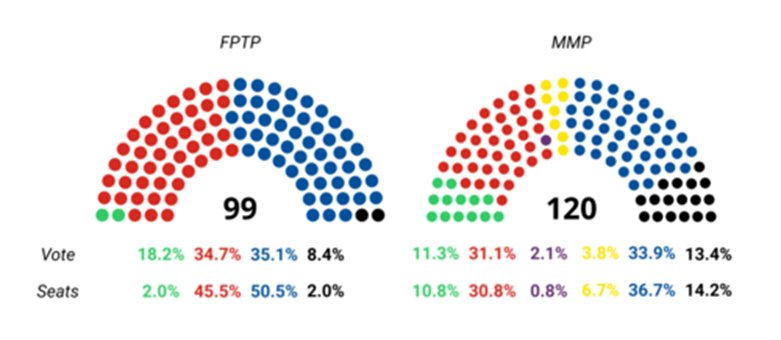





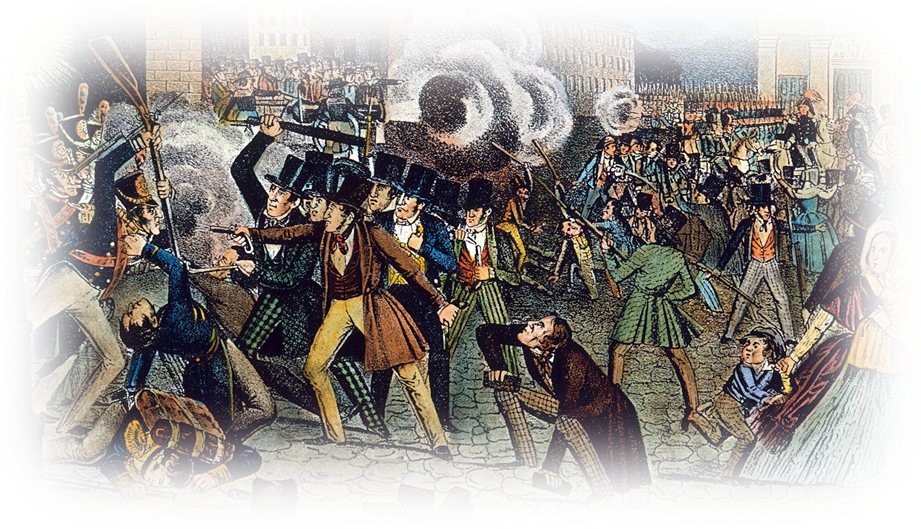
 Guillermo Calvo Mahé