How do my nostalgia and melancholy relate to bitterness? Or are they more associated with boredom? Or a combination of both?
Actually, I’d guess, they’re related to the full panoply of emotions I’ve felt and to the spectrum of my personal experiences. To all of my regrets and joys; a distillation of sorts, one perhaps diluted in the process, but perhaps, synergistically enhanced instead.
A strange sort of brandy, part biological, part cognitive, part emotional and part spiritual.
And what of that brandy’s residue? The things seemingly forgotten but perhaps just hiding. Hiding from me and from anyone and everyone, but perhaps, like a neurosis, rather than hiding are only in stasis, preparing to pounce unexpectedly, and to create an alternative version of the person I perceive as me.
Brandy, distilled wine, sometimes disguised as cognacs and armagnacs, but only when blended in France, albeit from grapes whose ancestors were once migrants in Chile. Strange. Sort of like my nostalgia and melancholy, all of them filtered through traces of bitterness, but spiced with joys and regrets. _______
Guillermo (“Bill”) Calvo Mahé (a sometime poet) is a writer, political commentator and academic currently residing in the Republic of Colombia (although he has primarily lived in the United States of America of which he is also a citizen). Until 2017 he chaired the political science, government and international relations programs at the Universidad Autónoma de Manizales. He is currently the publisher of the Inannite Review, available at Substack.com, a commentator on Radio Guasca FM, and an occasional contributor to the regional magazine, el Observador. He has academic degrees in political science (the Citadel), law (St. John’s University), international legal studies (New York University) and translation and linguistic studies (the University of Florida’s Center for Latin American Studies). However, he is also fascinated by mythology, religion, physics, astronomy and mathematics, especially with matters related to quanta and cosmogony. He can be contacted at guillermo.calvo.mahe@gmail.com and much of his writing is available through his blog at https://guillermocalvo.com/.
Nirvana doesn’t appeal to me. Nor frankly do Heaven, Hell, Purgatory, etc., although heaven is such an amorphous concept it can encompass anything.
Abrahamic heaven is certainly not my thing. At best, horribly boring with perpetual psalms, harping and sycophancy.
But an afterlife with everyone I’ve cared for would be interesting even if complex given competing and inconsistent relationships; at least in my case.
Hell is apparently were all the fun people go so a hell without the torment would be pretty awesome. I wonder if Jimmy Buffet is there, and the Beatles who’ve passed on, and Elvis, and Mickey Mantle and Joe DiMaggio. Awesome artists of course, Vincent van Gogh and Picasso, Rembrandt and da Vinci, Raphael and el Greco, Michelangelo too. And actors and actresses and writers, and of course, poets. Of course, a lot of unpleasant characters would be there as well, loads of politicians and lawyers and pseudo journalists, pederasts and rapists and reams upon reams of religious leaders, popes, cardinals, bishops, priests, rabbis, pastors. And a lot of military officers, especially generals and field marshals and such. And monarchs and judges and jurists who made mistaken decisions.
So Hell, … interesting but not really for me. Too much like the current world.
Purgatory. Hmmm, probably pretty cool, maybe the best of Hell without its downside. But Limbo? Well, sort of vacuous with a lot of babies wailing wondering just what the heck they were doing there, and who they were, and why they’d been abandoned.
What kind of deity creates the foregoing and where ought he, she, it or they be reigning, if anywhere at all.
But Nirvana.
I guess I’m not yet evolved enough to yearn for the absence of everything and anything, everyone and anyone. As though I’d never been, which I find philosophically confusing. Why all the effort, all the incarnations and suffering and, well, pleasure too, if the goal is to return to what I was before I was. Unless, of course, it’s just an exercise for the education, training and evolution of the omnidivine.
But what happens when the omnidivine attains Nirvana?
Guillermo (“Bill”) Calvo Mahé (a sometime poet) is a writer, political commentator and academic currently residing in the Republic of Colombia (although he has primarily lived in the United States of America of which he is also a citizen). Until 2017 he chaired the political science, government and international relations programs at the Universidad Autónoma de Manizales. He is currently the publisher of the Inannite Review, available at Substack.com, a commentator on Radio Guasca FM, and an occasional contributor to the regional magazine, el Observador. He has academic degrees in political science (the Citadel), law (St. John’s University), international legal studies (New York University) and translation and linguistic studies (the University of Florida’s Center for Latin American Studies). However, he is also fascinated by mythology, religion, physics, astronomy and mathematics, especially with matters related to quanta and cosmogony. He can be contacted at guillermo.calvo.mahe@gmail.com and much of his writing is available through his blog at https://guillermocalvo.com/.
Reflection and introspection at times clarified things for him. His life had not been bad but it had been confusing, and despite its complexities and diversity, he was unfulfilled. Fulfillment, he realized, at least in his case, had to come from within, and his attempts to obtain it through his diverse relationships had always been a mistake, a detour at best, a deliberate misdirection at worst. But misdirection by whom, and for what purpose? That seemed incomprehensible. He was not usually prone to delusions of grandeur, or to despair. He was just not important enough to merit that kind of attention, unless each and every one of us was.
We humans are gregarious he thought to himself, seeking to contradict instincts that hinted that introversion was not synonymous with temerity, and that at least in his case, accurate answers were more likely to be derived from inner reflection than from outward associations. His truths lay within, something he’d always sensed, and perhaps it was boredom more than anything else that misled him. Alleviation of boredom through intimacy with others was not love, although it often seemed that way, and when the boredom dissipated somewhat, what passed for love was gone as well. Residues remained, affection, respect, gratitude, but nothing of the synergistic mutual resonance that he felt love should have involved, and those residues were always tinged with regret and self-recrimination because the residues included consequences to others, as if, vampire-like, he’d left the objects of his affection drained.
It was not love that he sought, although that’s what he frequently thought, but fulfillment of a very different kind, fulfillment that had no fear of loneliness nor need of external resources. A sort of fulfillment crafted from inner echoes and infinite reflections in perfectly juxtaposed interior mirrors where, perhaps, his soul communed with his heart and with his mind seeking to grasp the eternal within and without. And in that context, others would always be a distraction when the mists of passion lifted. As they always did.
He was, he felt, a sort of tempest, a cyclone, a hurricane whose vortex needed to keep ascending fighting against emotional gravity wells lest he crash to earth and lose himself in drifts and eddies of rootless emotions, then be crushed in the grasp of history’s relentlessly chaotic tides. But he’d always been drawn to chaos in whose inchoate depths everything remained possible and from whence he suspected he’d been cast adrift eons ago, before there existed time or space. Cast adrift to find something, perhaps an antidote to relentless order, or perhaps something altogether intangible, perhaps an antidote to a divine inchoatesy, perhaps a counter balance to divinity itself, if divinity in fact existed.
What would that make him he wondered, as images of Hêlēl and Samael and Shaitan churned in his version of Jung’s universal unconscious, or was that subconscious, and any way, was there a difference there, or any relevance? Did relevance in fact exist? Was he utterly lost or on the verge of enlightenment, perhaps sitting in a lotus-like position, meditating under an immense primordial tree, perhaps somewhere near the intersection of Ragnarok and Eden, futilely seeking enlightenment?
Guillermo (“Bill”) Calvo Mahé (a sometime poet) is a writer, political commentator and academic currently residing in the Republic of Colombia (although he has primarily lived in the United States of America of which he is also a citizen). Until 2017 he chaired the political science, government and international relations programs at the Universidad Autónoma de Manizales. He is currently the publisher of the Inannite Review, available at Substack.com, a commentator on Radio Guasca FM, and an occasional contributor to the regional magazine, el Observador. He has academic degrees in political science (the Citadel), law (St. John’s University), international legal studies (New York University) and translation and linguistic studies (the University of Florida’s Center for Latin American Studies). However, he is also fascinated by mythology, religion, physics, astronomy and mathematics, especially with matters related to quanta and cosmogony. He can be contacted at guillermo.calvo.mahe@gmail.com and much of his writing is available through his blog at https://guillermocalvo.com/.
The lava was dazzlingly bright and malodorous, viscous and horribly searing. He could feel the ring formerly called by some Isildur’s Bane, the One Ring, the one still on Frodo’s finger but both now both ensconced in his belly, both stirring and rumbling, as if fighting or perhaps mating. Somehow the One Ring and Frodo’s finger formed a strange amalgam protecting him from the elements in which he found himself immersed, albeit changing him. He was actually breathing the molten blend of minerals in the core of Mt. Doom, becoming one with them and gaining insights. Everything that had once been vague, confusing and occluded was becoming crystal clear. Well, actually, had become crystal clear. His metamorphosis, if not complete, was well on the road to completion. For some reason he thought of two thespians, one a crooner and the other a comic, and strangely, at the same time, visa versa. They’d someday be famous for something called “road movies”, at least for a while, but their time would be followed by one where the past was something to be quickly discarded and replaced with nary a trace. Strange sort of prescient instant but not one involving the Middle Earth he’d always thought of as home.
His Gollum aspects had been purified and distilled somehow, and become integrated with the Sméagol from whom they’d once escaped, the Sméagol who had once been and would be again, albeit in a drastically changed form, all occurring concurrently. Everything, he realized, was both concurrent and complimentary, especially those things that most seemed at odds. Oxymoronism was the rule rather than an exception as the power of the One Ring and the one finger were integrated into his being. As had been the case with that damned Gandalf the Grey, when he’d been had been transformed into Gandalf the White, his essence seared and melded in the comparatively minor fires in the depths of Khazad-Dûm, so Sméagol was being transformed, was transformed in the infinitely more powerful and hellishly hot timeless fires of Mount Doom. Yes, Sméagol too had emerged transformed, transformed into the all-powerful being he’d aspired to, but not quite. The metamorphosis apparently involved a complex blend of good and evil, and the Gollum he’d been ironically found himself transformed into Sméagol the White, Sméagol of the many colors, Sméagol the-all-colored-and-none. But what had he been before? Gollum the Black perhaps, or Sméagol the sort of dingy grey.
Anyway, “it”, whatever “it was”, was not what he’d imagined. His final triumph over the burglar had not turned out as he’d hoped. He was encumbered rather than liberated, chained to responsibilities in every direction. He was chained in chains more biting and bitter than those in Barad-dûr, although as ethereal as they were ephemeral. He was as imprisoned as he’d ever been, although now in a prison of his own devise where “duty”, rather than feckless free will and whimsical follies and grandeur, seemed to be what divinity entailed.
He was not quite omniscient, although he now knew almost everything that had ever happened and had a fair inkling of what was to come, and if he was omnipotent, his use of power was severely constrained through limits that may or may not have been self-imposed. And omnipresence was very overblown as it stretched him so thinly over time and space as to make him virtually non-existent. As to omnibenevolence, well that was only possible if he froze everything and failed to permit any action at all, and apparently, his possibly self-imposed limits rendered that as improbable as it was impractical. The closest that could be attained in that regard was a sort of perpetual balance between the light and the dark, between absolute silence and the eternally unwinding song of the orbs. Damned stifling he thought.
Sméagol was disappointed. And he had a bit of indigestion as his body tried to assimilate both Frodo’s finger and the One Ring, and despite the hellish heat in the nethermost pits of Mount Doom, he felt bitterly cold. And the massive constant input of information made him dizzy. And he was lonely and alone, now the only being of his kind. Worse, the former occupant of his current post had evaporated as Sméagol’s metamorphosis took hold, changing into a joyful mist from whence was shouted: “free at last, free at last, thank Me all-mighty I’m free at last”, … or some such thing.
Sméagol remembered Bilbo and Frodo and Hobbits and fishies and his cavern and his lake and his little boat, and he remembered the stages through which he’d passed to become what he now was, some phases when he’d been relatively happy, albeit mainly as a baby, then increasingly less so as he’d grown into a young lad of a species now extinct (having been assimilated into various other species, Hobbits among them). He remembered how tasty orcs and goblins could be, especially when seasoned with a bit of garlic, which was hellishly hard to come by given the absence of Italians in the Middle Earth of his time. But now all times were his to play with, albeit passively, but what fun was there in passivity he thought to himself, there being no one around with whom to chat, or with whom to share riddles.
He speculated on how Italians might fit into “his” Middle Earth. Perhaps medieval Italians. But had they already invented the cuisine for which future Italians would become famous and with which he, free of temporal constraints, was already somehow familiar? And what about the famous “Mafia”, which was apparently not an acronym for the Mothers and Fathers Italian Association? He wondered why Italy had come to mind, rather than say, South Africa, or England, now that he had the omniverse in which to play, although, he recalled, only in a passive sense. Then he wondered why South Africa and England felt more relevant. And Iceland, something about its sagas seemed important.
Perhaps, thought Sméagol the White (or whatever, the colors issue had become confusing), this was all a dream, perhaps everything was a dream and only dreams existed, and perhaps he was the only dreamer. Perhaps he’d always been the only dreamer in a dream from which there could be no escape, notwithstanding omniscience and omnipotence and all the other omnis, all of them being somehow passive in the end, each one cancelling out the others.
Then gratefully, if not blissfully, everything became dark, if not quite silent. That damned infernal music of the orbs was incessant as was the somewhat painful rumbling in his stomach, but Sméagol the White, Sméagol of the many colors, Sméagol the-all-colored-and-none slept; hopefully dreamlessly and forever if not quite peacefully.
Sigh!!!!!
In a corner somewhere else in time and space, a place but not a place, someone chuckled, and a string of multicolored rings made from some sort of smoke played at tag. _______
Guillermo (“Bill”) Calvo Mahé (a sometime poet) is a writer, political commentator and academic currently residing in the Republic of Colombia (although he has primarily lived in the United States of America of which he is also a citizen). Until 2017 he chaired the political science, government and international relations programs at the Universidad Autónoma de Manizales. He is currently the publisher of the Inannite Review, available at Substack.com, a commentator on Radio Guasca FM, and an occasional contributor to the regional magazine, el Observador. He has academic degrees in political science (the Citadel), law (St. John’s University), international legal studies (New York University) and translation and linguistic studies (the University of Florida’s Center for Latin American Studies). However, he is also fascinated by mythology, religion, physics, astronomy and mathematics, especially with matters related to quanta and cosmogony. He can be contacted at guillermo.calvo.mahe@gmail.com and much of his writing is available through his blog at https://guillermocalvo.com/.
Sequentially serial monogamy. Or polygamy, or polyandry, or polyamory, or what have you.
Are those among the paths nature expected us to tread? Paths that would separate and segment child bearing, child rearing, sexual intimacy, economic collaboration and companionship into different functions, each potentially involving differing relationships over time, but relationships tied together through decency and harmonious post relationship continuity? Something I think Robert Heinlein seemed to espouse and which makes a great deal of sense, but with which, emotionally, most of us are not prepared to cope, that inability being primarily attributable to hypocritical Abrahamic strictures which insist that jealousy and possession ought to be our prime motivators. Motivators that rule our personal lives as well as our lives as members of collectives, collectives from dysfunctional nuclear families to contending nations bent on mutual annihilation.
The concepts work well in Heinlein’s novels but not that well in real life, although perhaps they should.
Guillermo (“Bill”) Calvo Mahé (a sometime poet) is a writer, political commentator and academic currently residing in the Republic of Colombia (although he has primarily lived in the United States of America of which he is also a citizen). Until 2017 he chaired the political science, government and international relations programs at the Universidad Autónoma de Manizales. He is currently the publisher of the Inannite Review, available at Substack.com, a commentator on Radio Guasca FM, and an occasional contributor to the regional magazine, el Observador. He has academic degrees in political science (the Citadel), law (St. John’s University), international legal studies (New York University) and translation and linguistic studies (the University of Florida’s Center for Latin American Studies). However, he is also fascinated by mythology, religion, physics, astronomy and mathematics, especially with matters related to quanta and cosmogony. He can be contacted at guillermo.calvo.mahe@gmail.com and much of his writing is available through his blog at https://guillermocalvo.com/.
Guillermo (“Bill”) Calvo Mahé (a sometime poet) is a writer, political commentator and academic currently residing in the Republic of Colombia (although he has primarily lived in the United States of America of which he is also a citizen). Until 2017 he chaired the political science, government and international relations programs at the Universidad Autónoma de Manizales. He is currently the publisher of the Inannite Review, available at Substack.com, a commentator on Radio Guasca FM, and an occasional contributor to the regional magazine, el Observador. He has academic degrees in political science (the Citadel), law (St. John’s University), international legal studies (New York University) and translation and linguistic studies (the University of Florida’s Center for Latin American Studies). However, he is also fascinated by mythology, religion, physics, astronomy and mathematics, especially with matters related to quanta and cosmogony. He can be contacted at guillermo.calvo.mahe@gmail.com and much of his writing is available through his blog at https://guillermocalvo.com/.
Did the Magdalene and the Nazarene, either together or alone, ever touch the waters that bathe Northern Africa, Southern Europe and Southwestern Asia, the sea purportedly in the middle of the world, at least as perceived by them? Perhaps on a soft and balmy midsummer’s eve?
Probably not, but given the millennia that separate us from them, who can tell.
Immersion in that central sea would have been both pleasant and mystically sacred. Especially on such a day. At least it would seem so to me, notwithstanding that so many millions have been so privileged.
A wandering thought on a midsummer’s morning. _______
Guillermo (“Bill”) Calvo Mahé (a sometime poet) is a writer, political commentator and academic currently residing in the Republic of Colombia (although he has primarily lived in the United States of America of which he is also a citizen). Until 2017 he chaired the political science, government and international relations programs at the Universidad Autónoma de Manizales. He is currently the publisher of the Inannite Review, available at Substack.com, a commentator on Radio Guasca FM, and an occasional contributor to the regional magazine, el Observador. He has academic degrees in political science (the Citadel), law (St. John’s University), international legal studies (New York University) and translation and linguistic studies (the University of Florida’s Center for Latin American Studies). However, he is also fascinated by mythology, religion, physics, astronomy and mathematics, especially with matters related to quanta and cosmogony. He can be contacted at guillermo.calvo.mahe@gmail.com and much of his writing is available through his blog at https://guillermocalvo.com/.
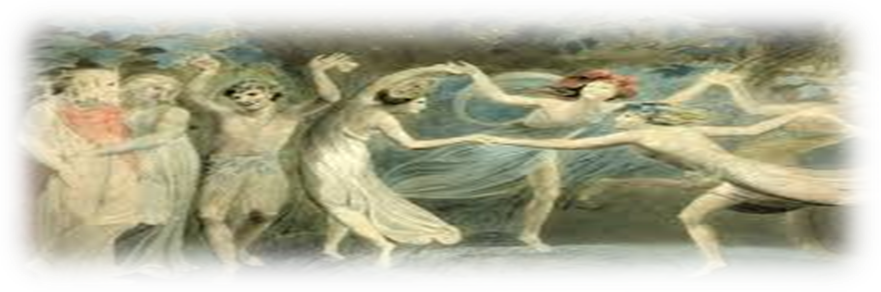
Midsummer’s eve was probably yesterday, but it could have been “the evening of the day before”, a good title for a book perhaps. Perhaps a book by Umberto Eco or a play by Will-o’-the-wisp Shakespeare.
I wonder if Titania and Oberon and Puck were out cavorting. I certainly hope so, but, if so, “wherefore were they and why”?
Wandering thoughts on an early summer’s day in a sort of late Juniper’s June. _______
Guillermo (“Bill”) Calvo Mahé (a sometime poet) is a writer, political commentator and academic currently residing in the Republic of Colombia (although he has primarily lived in the United States of America of which he is also a citizen). Until 2017 he chaired the political science, government and international relations programs at the Universidad Autónoma de Manizales. He is currently the publisher of the Inannite Review, available at Substack.com, a commentator on Radio Guasca FM, and an occasional contributor to the regional magazine, el Observador. He has academic degrees in political science (the Citadel), law (St. John’s University), international legal studies (New York University) and translation and linguistic studies (the University of Florida’s Center for Latin American Studies). However, he is also fascinated by mythology, religion, physics, astronomy and mathematics, especially with matters related to quanta and cosmogony. He can be contacted at guillermo.calvo.mahe@gmail.com and much of his writing is available through his blog at https://guillermocalvo.com/.
Today, May 8, 2023, is an important day to me because two very important people were born on that day, long ago. Vicki Meryl Forest (now Baker) and Michael Harris Jordan. Two very different people important for very different reasons.
Vicki is 70 today. She and her delightful family were wonderful to me during very difficult times. Unfortunately, in the end, I couldn’t bring myself to culminate the wonderful relationship we shared because of the trauma of the one that preceded it. Vicki deserved everything I could have given, she was an amazing woman, a delight in every sense. I know that whoever she’s with today is a happy man, and I’m certain she made a wonderful mother. I often recall her father Irvin and mother Lucie, her sister Elise and nieces Jennifer and Melissa, and her brother-in-law Saul Sklar, with whom I still correspond from time to time. I recall them all with a great deal of love. Vicki was sunshine crystalized, I’m pretty sure she still is.
Coincidently, Michael would also have been 70 today. He was a fascinating person, the son of my friend and sometimes client, David E. Jordan, a financier of sorts, as was his son. He was short and stocky and funny and creative and bright, a great chef and a very decent man. He experimented with all kinds of things during his life, which unfortunately, ended much too soon. Not that everything in our relationship was rosy and bright from a professional aspect, but that was more due to his dad’s misadventures and to one of his brother’s machinations. But in sum, it was a privilege and a joy to have been a part of Michael’s life.
It’s a pretty day high in the central range of the Colombian Andes where I now live, close by to a volcano seemingly stirring by the side of a tall former glacier, far from the Islands in New York where I met them both, and the Florida peninsula where I last interacted with them. But they’re comfortably ensconced in my memories and in my heart.
And they always make the eighth day of May very special. _______
Guillermo (“Bill”) Calvo Mahé (a sometime poet) is a writer, political commentator and academic currently residing in the Republic of Colombia (although he has primarily lived in the United States of America of which he is also a citizen). Until 2017 he chaired the political science, government and international relations programs at the Universidad Autónoma de Manizales. He is currently the publisher of the Inannite Review, available at Substack.com. He has academic degrees in political science (the Citadel), law (St. John’s University), international legal studies (New York University) and translation and linguistic studies (the University of Florida’s Center for Latin American Studies). However, he is also fascinated by mythology, religion, physics, astronomy and mathematics, especially with matters related to quanta and cosmogony. He can be contacted at guillermo.calvo.mahe@gmail.com and much of his writing is available through his blog at https://guillermocalvo.com/.