Reflections on Tyranny, Democracy, Rights and Sovereignty

It’s interesting and indeed important in this age where verity is an anachronism to reflect on the intellectual pillars on which seventeenth and eighteenth century political philosophers ruminated as they wove the fundaments on which they hoped “western” society might to be based.  They were not concerned with democracy at all.  Indeed, most disdained it as mob rule, but they were very concerned with avoidance of tyranny.  Not “tyranny” in the classical Greek sense of attainment of power by nontraditional means, Greek tyrants were among the most effective and populist leaders, but in the sense of abuse of power by an oligarch.  They realized, I believe, that rule of one man (a subject) by another (a sovereign) inevitably involves the appropriation, for benign or malign purposes, of the subject’s sovereignty (i.e., his or her autonomy) and they were most concerned with at least limiting the extent to which such bequeathed, stolen or otherwise acquired individual sovereignty would be subjugated.  In this, Thomas Hobbes was more sanguine than was the kinder and more idealistic John Locke but as history has demonstrated, Hobbes was more perceptive.

In the opinion of John Locke and perhaps also Thomas Hobbes, in a primordial, perhaps metaphorical past, individuals, theretofore fully vested of their individual sovereignty, surrendered it in exchange for a social system that provided some semblance of security and predictability because in a world where everyone was sovereign, no one was secure, the concept of private property could not exist, and though the strongest might rule, the weak, collectively or while the strong slumbered, could dispose of them.  Hobbes believed that individuals surrendered the totality of their individual sovereignty to a single individual, an autocrat, or to a group of individuals, an oligarchy, in exchange for promised personal safety and for “boons” from the sovereign which resembled rights, but could be modified, suspended or eliminated at the sovereign’s whim, so long as the sovereign provided security.

John Locke’s perspective was very different in that not all aspects of individual sovereignty were surrendered and the aspects retained were inviolable “rights”.  Further, that the surrender of the portion of individual sovereignty not retained was based on a social contract and thus, the surrender was conditioned on the sovereign’s compliance with the terms pursuant to which it had attained its authority, which included guarantees of security, but much more, especially respect for the aspects of sovereignty not surrendered.

Because “rights” were the purported residue of individual sovereignty, not granted but retained, they could not be conditioned, even when the conditions were benign, made sense and were necessary.  Consequently, if what seems a right is subject to any condition, it is no longer a right but a boon granted by one who has attained sovereignty over another or others, and the best that might be hoped for is a quasicontractual arrangement where the sovereign agrees to be bound by rules giving the subject limited means to enforce the boon granted.  Limited means because, as we see today in the United States, sovereigns tend to avoid or ignore the promises made to their subjects whenever the whim strikes them.  Thomas Hobbes did not believe in the concept of rights (other than as a primordial myth).  Because he believed that the totality of individual sovereignty had been surrendered to a central authority in exchange for security and for the grant of boons that sort of smelled like rights, he believed that mankind’s hope lay in enlightened sovereigns.

Today, “rights” appear everywhere, enumerated in countless constitutions and referenced constantly in treaties, legislation and political debates, indeed, they have morphed into diverse purported generations each expanding their purported scope.  But no so-called-right is unconditional and despite constant references to guarantees, no such right is consistently enforced.  Given that rights are purportedly self-enforcing, not having been granted but retained, it seems clear, at least to the author, that in reality, no rights, as understood by John Locke exist.  Rather, there are aspirational concepts towards which decent governments should seek to evolve, and what exists currently is solely the conception described by David Hume in his criticism of Locke as conventional, utility-based, and established human conditional agreements meant to maintain social order and property, essential, artificial rules that allow people to coexist peacefully, which may or may not be honored..

John Locke naively believed in rights and argued articulately in their favor albeit, as David Hume eventually pointed out, his logic was premise free, i.e., rather than articulated, his premises were purportedly self-evident.  However, clever politicians including those who betrayed their oaths of loyalty to the British monarchy in the latter half of the eighteenth century in order to appropriate the British monarch’s sovereignty for themselves, found Locke’s arguments useful, if perhaps not quite credible.  They were, after all, pragmatically practical men interested in practical results rather than the idealists that history portrays.  Indeed, their actions (think of Thomas Jefferson, the Declaration of Independence and slavery) with respect to their purported reformulation of John Locke’s conclusions were laced with hypocrisy.  That always has been the case and not just among the so-called Founding Fathers nor limited to the republic they founded.

Still, the Founding Fathers, like the political philosophers who preceded and followed them, were concerned with the issue of tyranny, at least with tyranny that impacted them directly and, in order to minimize tyranny, the founders of the United Colonies’ eventual republic sought to constitutionally disperse sovereignty in two ways: first by placing temporal limits on the human beings who might be charged with its employment and second, by fragmenting sovereignty into separate groupings of political power, thus avoiding “dictatorship” [1].  In this regard it is worth noting that the concept of dictatorship ought not to be considered a pejorative but rather, merely the result of un-fragmented sovereignty, i.e., when all political power was concentrated in one person or institution (the traditional segmentation of political power being, legislative, executive and judicial, to which should have been added a fourth, supervision and control over the other three to avoid usurpation[2]).

That democracy was not important at to the Founding Fathers seems obvious in the institutional structures they established through the Constitution promulgated in 1787 and set into full force in 1788:

  • The Senate was selected, not by the People but by the States. 
  • The membership of the House of Representatives was not based on population but on a complex system comprised in part of population, in another part based on equal numerical representation of the states, and in a third part by treating persons locked into involuntary servitude (slavery) as 3/5ths of a person, however, the right to vote was restricted in such manner as the states might determine so that, as in ancient Athens, less than ten percent of the population originally enjoyed the “franchise” (right to vote). 
  • The President was to be elected by designees of the states selected as they saw fit to serve in an organization that never actually met, the Electoral College.  And the federal Judiciary was to be selected for life by agreement between the president and the Senate. 

No trace of democracy anywhere. 

That system has somewhat morphed into a semblance of democracy by expansion of the right to vote, usurping functions originally assigned to the states, but not on a one person one vote basis as residents in smaller states exercise disproportional electoral power in the Senate, the House of Representatives and the Electoral College. 

Democracy should however be a majoritarian concept and that requires popular participation.  Unfortunately, unlike the ancient Athenians and Romans where political participation (at least by those eligible to participate) was deemed a duty, in the United States participation in the political process is deemed a sort of right and, consequently, rarely if ever do enough eligible voters participate in the electoral process to make attainment of a real majority (more than 50% of the eligible electorate) possible.  Hence electoral decisions are made by relatively small pluralities, usually less than 30% of the eligible electorate and that 30% is comprised of or controlled by elites with little or no interest in the common welfare (as opposed to their own privileges).

Perhaps more relevant is the reality that while the illusion of democracy seems to have evolved over time, the reality has not.  Elected officials for the most part (with fairly are exceptions) answer not to their constituents but to those who fund their political campaigns.  Institutionally, political power is purportedly concentrated in two privileged political parties supposedly in a relationship of collaborative opposition but today and for the past half century at least, both of those groupings are economically dominated by a purportedly private organization dedicated to imposing the will of a foreign country on the citizenry[3].  As a result, the residents of that foreign country, well, at least the residents who are members of that country’s official religion, obtain, at the expense of United States tax payers, massive social programs  unavailable in the United States (e.g., subsidized housing, free healthcare and education, etc.), massive funding for its armed forces, the use of the armed forces of the United States for its own quest for lebensraum and, use of the veto power of the United States in the United Nations (as directed by that foreign government).  In addition to the foregoing, the purported rights constitutionally guaranteed to the citizens of the United States are quickly becoming inapplicable if they are detrimental to the goals, aspirations or interests of that foreign state. Consequently, a foreign state, without temporal limitations such as are involved in terms of political office or limitations based on fragmentation of sovereignty has imposed a de facto tyrannical dictatorship over the United States, which it uses to impose its will over the Middle East.  Its ambitions however may well spread to other regions in the not too distant future.

Ironic but perhaps, something that was predictable as far back as 1787.  Indeed, George Washington, the first president of the United States under the Constitution of 1787 seems to have foreseen the possibility now existent in his farewell address.  The address was in the form of a letter entitled “The Address of General Washington to the People of America on His Declining the Presidency of the United States” published in Claypoole’s American Daily Advertiser on September 19, 1796, about ten weeks before the newly appointed members of the Electoral College were to cast their votes in 1796.  In that address he sternly warned against the situation which the country finds itself in today, one that has been continually evolving since at least 1916.  Wikipedia, not the most reliable source but a useful one from time to time, describes the segment of George Washington’s Farewell Address dedicated to foreign sovereigns as follows (footnotes omitted)[4]:

Washington dedicates a large part of his farewell address to discussing foreign relations and the dangers of permanent alliances between the United States and foreign nations, which he views as foreign entanglements. He advocates a policy of good faith and justice towards all nations, again making reference to proper behavior based upon religious doctrine and morality. He urges the American people to avoid long-term friendly relations or rivalries with any nation, arguing that attachments with or animosity toward other nations will only cloud the government’s judgment in its foreign policy. He argues that longstanding poor relations will only lead to unnecessary wars due to a tendency to blow minor offenses out of proportion when committed by nations viewed as enemies of the United States. He continues this argument by claiming that alliances are likely to draw the United States into wars that have no justification and no benefit to the country beyond simply defending the favored nation. Alliances, he warns, often lead to poor relations with nations who feel that they are not being treated as well as America’s allies, and threaten to influence the American government into making decisions based upon the will of their allies instead of the will of the American people.

….

Washington makes an extended reference to the dangers of foreign nations who will seek to influence the American people and government; nations who may be considered friendly as well as nations considered enemies will equally try to influence the government to do their will. “Real patriots”, he warns, who “resist the intrigues” of foreign nations may find themselves “suspected and odious” in the eyes of others, yet he urges the people to stand firm against such influences all the same. He portrays those who attempt to further such foreign interests as becoming the “tools and dupes” of those nations, stealing the applause and praise of their country away from the “real patriots” while actually working to “surrender” American interests to foreign nations.

Washington goes on to urge the American people to take advantage of their isolated position in the world, and to avoid attachments and entanglements in foreign affairs, especially those of Europe, which he argues have little or nothing to do with the interests of America. He argues that it makes no sense for the American people to become embroiled in European affairs when their isolated position and unity allow them to remain neutral and focus on their own affairs. He argues that the country should avoid permanent alliances with all foreign nations, although temporary alliances during times of extreme danger may be necessary. He states that current treaties should be honored but not extended.

Washington wraps up his foreign policy stance by advocating free trade with all nations, arguing that trade links should be established naturally and the role of the government should be limited to ensuring stable trade, defending the rights of American merchants and any provisions necessary to ensure the conventional rules of trade.

Obviously, as in the case of President Dwight David Eisenhower’s farewell address, President Washington’s foresight has been utterly ignored.  Thus, while the postulations of the sixteenth and seventeenth century philosophers who sought to provide future generations with guidance with respect to the avoidance of tyranny to some extent impacted the Founding Fathers in the formulation of the Constitution of 1787, the results have proven singularly unsuccessful and have instead, resulted in the domination of three hundred and fifty million residents of the United States by ten million European Immigrants to the Middle East who have managed to leverage widespread control over economics, communication, entertainment and finance into total control over the … well, … seemingly everything.  Pretty much the definition of tyranny.

So, … In retrospect, reflecting on tyranny, democracy, rights and sovereignty, we have never had democracy or rights although for a while, to an extent, we managed to minimize tyranny, but whatever sovereignty we once had, or though we had, is now illusory as well.  Ironically, the efforts of the Founding Fathers to sunder Britain’s American colonies from British sovereignty in a manner minimizing the risks of tyranny have only resulted in subjugation to the tyranny of another foreign sovereign.

At least for now.
_____

© Guillermo Calvo Mahé; Manizales, 2026; all rights reserved.  Please feel free to share with appropriate attribution.

Guillermo (“Bill”) Calvo Mahé (a sometime poet and aspiring empirical philosopher) is a writer, political commentator and academic currently residing in the Republic of Colombia (although he has primarily lived in the United States of America of which he is also a citizen). Until 2017 he chaired the political science, government and international relations programs at the Universidad Autónoma de Manizales. Previously, he chaired the social studies and foreign language departments at the Eastern Military Academy in Huntington, New York. He is currently the publisher of the Inannite Review available at Substack.com; an intermittent commentator on radio and television; and, an occasional contributor to diverse periodicals and publications. He has academic degrees in political science (BA, The Citadel, the Military College of South Carolina), law (JD, St. John’s University, School of Law), international legal studies (LL.M, the Graduate Division of the New York University School of Law) and translation and linguistic studies (GCTS, the University of Florida’s Center for Latin American Studies). However, he is also fascinated by mythology, religion, physics, astronomy and mathematics, especially with matters related to quanta, cosmology and cosmogony. He can be contacted at guillermo.calvo.mahe@gmail.com and much of his writing is available through his blog at https://guillermocalvo.com/


[1] A dictatorship is the most efficient form of government but more likely to lead to tyranny than fragmented sovereignty although, as can be seen today, the scheme of governance the Founding Fathers established on their second attempt, in 1787, can fairly easily be converted into a dictatorship when all elements of such fragmentation are reunited under one person, or one political group, as frequently occurs and as is the case in the United States today.

[2] Unfortunately, the Founding Fathers did not provide for an arbiter between the three traditional powers, although the concept was considered at the Constitutional Convention, and several proposed solutions rejected.  Instead, they appeared to assume that such function could be attained through granting the executive a power to veto legislation, for whatever reason, subject to override, and also the power to pardon.  They were, unfortunately mistaken as that power was quickly usurped by the Judiciary in a decision worthy of Machiavelli, the case of Marbury v. Madison (1803) where John Marshall, the recently appointed n Chief Justice of the United States provided his detested cousin, President Thomas Jefferson with a pyrrhic victory by deciding in his favor, but based on the dubious theory that the Judiciary was the arbiter of constitutional authority.  Theretofore, that function had been assumed to lie in the legislative branch (as it did in the United Kingdom) or in the executive as implied at the Constitutional Convention, although a number of colonies in their own systems of governance had been drifting towards the concept of judicial review under their own constitutions.  See generally, Calvo Mahé, Guillermo et. al. (Jiménez Ramírez, Milton Cesar, editor, 2020): “Capítulo I. Evolución del control de constitucionalidad en los estados unidos.”; El control de la constitucionalidad en episodios: acerca del control constitucional como límite al poder; Universidad de Caldas, Facultad de ciencias jurídicas y sociales; Bogotá.

[3] The American Israeli Public Affairs Committee (AIPAC).

[4] George Washington’s Farewell Address; Wikipedia, the free encyclopedia at https://en.wikipedia.org/wiki/George_Washington’s_Farewell_Address.  Last edited on 23 February 2026, at 19:06 (UTC), accessed, March 10, 2026.
Democracy and Comparative Electoral Systems

Today, March 8, 2026 is an interesting day because of the confluence of diverse factors.  It is “Women’s Day” in many places, originally “Working Women’s Day” but the concept has been expanded internationally as it has become recognized that unpaid domestic labor is as worthy of recognition as any other kind of labor.  But today is also Daylight Savings Time Day, at least in the United States of America where millions of people woke to find that they’re bodies believe that it is an hour later than everything around them seems to be occurring.  Finally, it is the first in a series of election days in the Republic of Colombia this year.  Today the members of Congress are elected and primaries are held for contested presidential candidacies.  Which brings me, admittedly in a roundabout way, to the continuing debate in the United States concerning who should be permitted to vote and how.

In Colombia, voting requires photo identification via a national identity card updated constantly to electronically indicate not only citizenship, but voting residency.  At the designated polls (voting is in person), one is also fingerprinted and required to provide a signature.  The individual voting locations are maintained electronically in the National Registry and one can find one’s polling place and room through the Internet.  The identity cards, denominated “cedulas”, are easily available to everyone, in fact, they’re required and used for commercial transactions, transport, etc.  They are issued by the National Registry which verifies citizenship as well as basic personal data including height and blood type.  Elections are easy, quick, and with results posted the same day.  All of the foregoing is very different than the incoherently complex, inefficient and insecure system in the United States where the concept of a national identification card has been anathema to conservatives and libertarians in the past but, ironically, at present, it is liberals who seem to oppose required voting identification while conservatives insist on photo identification that includes proof of citizenship and support federal legislation denominated the “Save Act” to make such requirements applicable nationally. 

The Save Act sounds logical but has a major problem.  Because the United States is a federation, elections occur at the state, county and special district rather than national level, even in elections for Congress and the Presidential Electoral College (there are no real presidential elections) thus, appropriate identification would require supplemental systems that verify not only national citizenship, but state and local domicile.  No current form of identification meets those requirements which would require a constantly updated national citizen database similar to what exists in Colombia and most other countries, a database heretofore opposed by the conservatives who now insist on what, without it, would be a dysfunctional Save Act.  So, unlike most of the world, the United States is engaged in an easily resolvable but transcendentally important ludicrous political debate, politicized in order to polarize the electorate.  Perhaps instead of Make America Great Again, the United States electorate needs to concentrate on just Make America Functional.

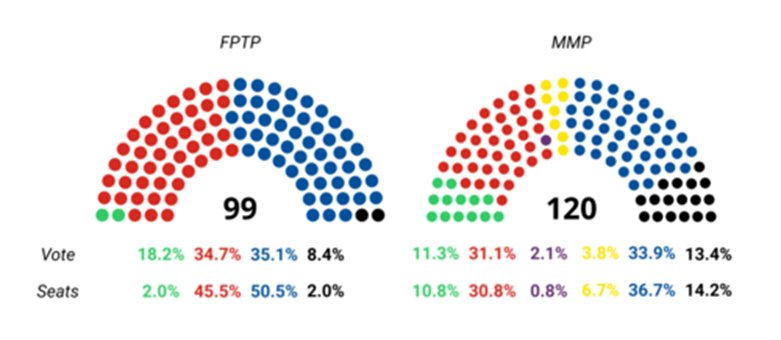
While the electoral process in the Republic of Colombia is fair, efficient and relatively secure, there are significant issues that render it deficient in terms of democracy, a universal problem.  Most of all, the electoral system is geared to empower political parties instead of voters, hence, it is political parties rather than the citizenry that is the subject of political rights and related political power.  As in most of the non-English speaking world, Colombian legislative elections are proportional so that the legislature more or less represents most of the political forces in the country.  If, for example, a political party only receives ten percent of the vote, it still receives ten percent of the membership in the legislature, unlike the English speaking world (the United States, the United Kingdom, Canada, Australia and New Zealand) where it would be completely frozen out.  This is accomplished in Colombia and elsewhere because instead of using individual electoral districts where only one legislator is chosen, a system of multi-legislator districts is used.  The most efficient such system is the one used in the Republic of Ireland for elections to the lower house of Parliament where the voter places all of the candidates in the district in order of preference allocating to each a voting value.  Thus, the individual voter’s personal list can be comprised of candidates from diverse political parties.  For example, if the district were to have ten candidates, the one listed first would receive a voting value of ten and the one listed tenth would receive a voting value of one.  If a candidate is not listed, the voting value would be zero.  The candidates elected in that ten legislator district would be the ten who accumulated the most voting value points and might well include candidates who received no first or second place votes.

In Colombia and other places, the list system is perverted because the lists are predetermined by the political parties and in many instances, the order of candidates, which determines who will be elected, is frozen.  In other hybrid systems voters get to either vote for the whole list or to indicate a preference for a single candidate, with the order of candidates in the list reprioritized based on the number of votes received by individual candidates.  In the Republic of Colombia, the political parties determine whether the lists will be closed, the former option, or open, the latter.  Closed lists are sometimes justified as necessary in order to assure gender balance in the results with candidates listed in alternating gender.

The principal practical problem with the legislative electoral system in the Republic of Colombia in the open system is that the names of candidates do not appear on the ballot, rather, only the names of the political parties or movements sponsoring the list and a series of numbers representing the individual candidates, thus, voters have to arrive at the polls with the number of the candidate they favor memorized.  Because voters frequently forget the specific numbers, they instead opt to vote only for the party.  This issue is easily resolvable by either placing the names of candidates on the ballot or providing a guide at the polling station that voters can consult to find the number allocated to their preferred candidate but as usually occurs, solutions are plentiful but the will to implement them, for manipulative reasons, is absent.  The other major problem is that although the electoral districts are multi legislator districts, voters can only vote for one candidate thus, for example, the Department of Caldas is entitled to five members in the House of Representatives, voters can only vote for one and in doing so, automatically vote for that candidates sponsoring political party or political movement.

Another practical problem in Colombia is that the political party system is in great incoherent ideologically. With political parties forming local electoral alliances of convenience.  Thus, in one Department a list may be jointly sponsored by the Liberal Party, Conservative Party, the Party of National Unity and the Radical Change Party, in another Department the party configuration may be very different, excluding some of the members or replacing or supplementing them with others, or even, presenting a unique list without alliances with other parties.  The consequence is that the policies advocated by different parties can be inconsistent in different parts of the country but, since promised policies are, as in most parts of the world, rarely honored, the impact is more theoretical than practical.

Legislative electoral systems in the English speaking world, the first past the post systems as they are commonly known, are the least democratic, i.e., candidates receiving less than half of the vote are elected based on a plurality, and a plurality means that the candidate was opposed by most of the voters who fragmented their votes.  Such issue could be tempered, if not resolved, through required runoff systems, but that would still disenfranchise a majority of the electorate.  Smaller political parties have no legislative representation at all, and hence, are not likely to ever evolve into major parties, especially as voters are urged by the media not to waste their votes on smaller political parties.

The proportional list systems have their own problems except, perhaps, in systems such as exist in the Republic of Ireland, but given the political power provided to political parties by systemic deficiencies, the likelihood of change to improve the functionality of legislative democracy, other than through constitutional reform directly through the electorate, is unlikely.  Democracy is thus, unfortunately, more of a useful illusion than a realistic system of governance, almost everywhere.  Of course, that leaves open for future analysis the value of an effective democratic electoral system given the laziness, ignorance, emotionality, prejudices and naiveté of so many voters.

Further exponent sayeth naught other than: Happy Women’s Day and Happy Daylight Savings Day!

_____

© Guillermo Calvo Mahé; Manizales, 2026; all rights reserved.  Please feel free to share with appropriate attribution.

Guillermo (“Bill”) Calvo Mahé (a sometime poet and aspiring empirical philosopher) is a writer, political commentator and academic currently residing in the Republic of Colombia (although he has primarily lived in the United States of America of which he is also a citizen). Until 2017 he chaired the political science, government and international relations programs at the Universidad Autónoma de Manizales. Previously, he chaired the social studies and foreign language departments at the Eastern Military Academy in Huntington, New York. He is currently the publisher of the Inannite Review available at Substack.com; an intermittent commentator on radio and television; and, an occasional contributor to diverse periodicals and publications. He has academic degrees in political science (BA, The Citadel, the Military College of South Carolina), law (JD, St. John’s University, School of Law), international legal studies (LL.M, the Graduate Division of the New York University School of Law) and translation and linguistic studies (GCTS, the University of Florida’s Center for Latin American Studies). However, he is also fascinated by mythology, religion, physics, astronomy and mathematics, especially with matters related to quanta, cosmology and cosmogony. He can be contacted at guillermo.calvo.mahe@gmail.com and much of his writing is available through his blog at https://guillermocalvo.com/.

On the Reality of Donald Trump’s Recent Animal-Human Hybrid Video

There has been a great outcry recently by those who despise Mr. Trump, no matter what, but also by some among those who admire him without reserve, over the post that involved the Obamas with their faces superimposed on the bodies of chimpanzees.  The criticism had been hyperbolically focused on perceived racism.  I do not support Mr. Trump and have admittedly grown to despise him but I try to maintain a sense of objectivity without which discernment of truth is impossible (absent fortuitous coincidence).  So, while I was initially dumfounded and outraged; I watched the video to see for myself what I would be criticizing.  I doubt many others have done the same.  And I was surprised.  Rather than racist, I found the video idiotically juvenile.  It was by no means limited to the Obamas, although that has been the focus of the criticism, but involved numerous political figures both opposed to and supportive of Mr. Trump, all represented with animal bodies, and that included Mr. Trump himself. 

It was obvious to me that in the associational choice of animals Mr. Trump sought to insult his opponents and glamorize himself.  His was the body of a lion.  But my conclusion was that the video demonstrated not Mr. Trump’s racism but his ignorance concerning biology and evolution.  For example, chimpanzees are extremely intelligent and in their bonobo variant, the biological species closest to humans while male lions, such as the one selected by Mr. Trump to represent himself, are lazy and indolent, albeit strong and fierce, but dominated by the females of the species who do most of the work.

Thus, the video was childish and idiotic but instructive as well, and perhaps unintentionally, the portrayal may have been all too accurate. 

Perhaps someone pointed that out to Mr. Trump who has removed the video from his social platforms.
_____

© Guillermo Calvo Mahé; Manizales, 2026; all rights reserved.  Please feel free to share with appropriate attribution.

Guillermo (“Bill”) Calvo Mahé (a sometime poet and aspiring empirical philosopher) is a writer, political commentator and academic currently residing in the Republic of Colombia (although he has primarily lived in the United States of America of which he is also a citizen). Until 2017 he chaired the political science, government and international relations programs at the Universidad Autónoma de Manizales. Previously, he chaired the social studies and foreign language departments at the Eastern Military Academy in Huntington, New York. He is currently the publisher of the Inannite Review available at Substack.com; an intermittent commentator on radio and television; and, an occasional contributor to diverse periodicals and publications. He has academic degrees in political science (BA, The Citadel, the Military College of South Carolina), law (JD, St. John’s University, School of Law), international legal studies (LL.M, the Graduate Division of the New York University School of Law) and translation and linguistic studies (GCTS, the University of Florida’s Center for Latin American Studies). However, he is also fascinated by mythology, religion, physics, astronomy and mathematics, especially with matters related to quanta, cosmology and cosmogony. He can be contacted at guillermo.calvo.mahe@gmail.com and much of his writing is available through his blog at https://guillermocalvo.com/.

Paradoxical Reflections as 2025 Morphs into 2026

Dateline, January 4, 2026

For many historians the assassinations of Roman reformers Tiberius Gracchus in 133 BCE and of his brother, Gaius Gracchus, in 121 BCE, both tribunes of the plebs who pushed for agrarian and social reforms against powerful Senate opposition, marked the end of the Roman Republic, at least in constitutional terms.  The rational system of governance represented by the Republic broke down after that with the dictatorships of Marius and Sulla, and then the triumvirates of Julius Caesar, Gnaeus Pompeius (self-denominated Magnus), and Marcus Licinius Crassus until Octavian Caesar initiated the Imperium a century later. 

In the case of the United States of North America (a more accurate name than the United States or the United States of America), constitutional order, at least involving the constitution usurpatively adopted in 1789, first broke down in 1861 with the war between the states (now usually referred to as the Civil War except among conservative Caucasians in the South where it is known as the War of Northern Aggression), being thereafter replaced by a militarily imposed new constitutional order which was, in turn, more legally replaced during the presidency of Woodrow Wilson by a new antifederalist centrist variant through adoption of the 16th, 17th, 18th and 19th amendments, amendments which, because they virtually destroyed the Constitution’s federalist premises, could well be considered unconstitutional constitutional amendments as described by Professor Richard Albert of the University of Texas’ School of Law.  But the end of any semblance of constitutionalism in the United States entered its death throes, as did the concept of international law, during the presidency of William Jefferson Clinton in 1992, culminating in their absolute demise during the second term of the presidency of Donald John Trump.  By that time, most of those who, upon assuming office in the United States, whether civil or military, took an oath to “defend and protect the Constitution of the United States” in truth were dedicated to serving the dictates of the de facto Führer, a more accurate term for the dictatorial presidents of the United States that started with Mr. Clinton and reached a high point (so far) with the presidency of Donald Trump.  They (the de facto führers), in turn, along with most of the bureaucracy and the members of the United States Congress, owed their loyalty to the unelected, secretive, American Israel Public Affairs Committee (AIPAC) which bought most of them with monetary contributions and “favors” and which in turn owed its fealty to the Hobbesian Zionist Israeli government.

The result, both domestically and internationally, was a return to what philosopher Thomas Hobbes had once described as “the State of Nature”, not a benevolent environmentally friendly status but one where brute power was the only reality that mattered.  In both cases, the Roman and that of the United States, indeed, in that of the entire global state system, the demise of constitutional government, in each case based on superficial principles of liberty and democracy, experienced a gradual, unperceived death which, by the time it had become permanent, was virtually ignored, unmourned by the vast majority of the populations they were meant to serve. 

Unbidden, the ancient Trojan prophetess Cassandra comes to mind as I write this, and the political prophets Aldous Huxley and his former student, Eric Arthur Blair (writing as George Orwell) as well, as do the warnings in the farewell addresses of presidents George Washington and Dwight David Eisenhower.  But all to no avail. 

In this world, evil, greed, impunity and hypocrisy seemingly always triumph.  At least where collectives are involved.  It turns out that collectives, meant to foster collaboration in the quest for mutual benefit instead serve as means for the most ruthless and selfish among us to concentrate power, facilitated by our fatal individual naiveté and immense capacity for self-deception.

As I all too frequently end my reflections nowadays, I again see Elphaba Thropp (albeit in her earlier 1930s incarnation in the film, “The Wizard of Oz”) slowly melting after having been inadvertently doused with water by the ingénue, Dorothy, with Elphaba desperately declaiming: “what a world, what a world”!

Welcome to 2026!

_____

© Guillermo Calvo Mahé; Manizales, 2026; all rights reserved.  Please feel free to share with appropriate attribution.

Guillermo (“Bill”) Calvo Mahé (a sometime poet and aspiring empirical philosopher) is a writer, political commentator and academic currently residing in the Republic of Colombia (although he has primarily lived in the United States of America of which he is also a citizen). Until 2017 he chaired the political science, government and international relations programs at the Universidad Autónoma de Manizales. Previously, he chaired the social studies and foreign language departments at the Eastern Military Academy in Huntington, New York. He is currently the publisher of the Inannite Review available at Substack.com; an intermittent commentator on radio and television; and, an occasional contributor to diverse periodicals and publications. He has academic degrees in political science (BA, The Citadel, the Military College of South Carolina), law (JD, St. John’s University, School of Law), international legal studies (LL.M, the Graduate Division of the New York University School of Law) and translation and linguistic studies (GCTS, the University of Florida’s Center for Latin American Studies). However, he is also fascinated by mythology, religion, physics, astronomy and mathematics, especially with matters related to quanta, cosmology and cosmogony. He can be contacted at guillermo.calvo.mahe@gmail.com and much of his writing is available through his blog at https://guillermocalvo.com/.

Reflections on the New York City Electorate and, Secondarily, on the Mayoral Candidacy of Zohran Mamdani

Like Zohran Mamdani, but more like Albert Einstein, Noam Chomsky, Martin Luther King, Jr., Nelson Mandela, Pepe Mujica and many others, I define myself as a democratic socialist.  That is very different from authoritarian socialists, “social democrats” and very, very different from a supporters of the ill-named Democratic Party or of the GOP although, with respect to the latter two, I find the Democratic Party much more hypocritical, despicable and dangerous.  I am not a Trump or MAGA supporter, far from it, but nor am I afflicted with Trump Derangement Syndrome.  Trump has many faults but all are shared by the most prominent Democrats, Democrats like war mongers Hillary Clinton, Barack Obama and Joe Biden to name just a few, especially with respect to their primary allegiance to Israel, allegiance bought and paid for by AIPAC.  My primary regret with reference to Mr. Mamdani’s candidacy is that it is Messrs. Cuomo and Adams who are running as independents and Mr. Mamdani will be the candidate of the utterly corrupt Democratic Party, although its leadership has not only rejected him but is actively opposing him.  More than anything, New York City, New York State and the United States need new political alternatives whose loyalty is to the United States and its citizenry rather than to a foreign government (Israel) or to the billionaire caste (it’s more a caste than a class).  But no such luck.  At least not yet.

I find the article entitled “Debunking the Myths about Mamdani’s Candidacy” written by Stewart Lawrence and published on August 13, 2025 in Counterpunch (available at https://www.counterpunch.org/2025/08/13/debunking-the-myths-about-mamdanis-candidacy/) not only interesting, but reflective of a hopeful sign, i.e.,  that the young may prove significantly less naïve and less subject to media manipulation and much more cognitively competent and ethical than most of their elders, a bit strange given that my generation, the Baby Boomers, shared many of their values when we were their age. When purportedly, “the Times they were a ‘Changing”.  That is a double edged sword, though, as my generation permitted its idealism to be corrupted in a quest for financial security as soon as we became parents.  One wonders if that same affliction will also contaminate the best of Generation X and Generation Z, etc.

While I share some, perhaps many, perhaps even most of Mr. Mamdani’s values and beliefs, there are postures I feel are simplistically addressed by him.  For example, those dealing with issues like immigration and law enforcement which, while very important, are more complex than what he perceives.  And, I’m concerned that beneath it all, he’s a partisan Democrat who suffers from the obligatory Trump Derangement Syndrome and who, like Bernie Sanders and Alexandria Ocasio-Cortez (“AOC”, a moniker I find presumptive) will, if he is elected (a near certainty, sell out his values in exchange for acceptance by the same old power brokers who have always controlled everything and that he will all too soon permit himself to serve as little more than a deceptive token.  A cynical view, I know, but one well earned.

Still, for now, Mr. Mamdani is a breath of fresh air and much more importantly, those who are drawn to him, especially those among the young and among most of New York City’s Jewish population seem to have had the cobwebs removed from their eyes and their ears and their mouths reflecting a political awakening that may help lead us away from the Deep State’s perpetual wars and thus from the edge of the apocalyptic abyss. It may center us on the importance of spending our hard earned tax revenue on positive things, items like free universal health care, like free education for all at all levels, like affordable housing for all, like adequate nutrition for all, like all of the things, including the foregoing, available to Israeli and European citizens, who our government subsidizes. 

Wouldn’t that be something? 

Especially if the New York City electorate has really woken to the realities facing us, especially if they reflect not just a New York City phenomenon.  Especially if they can reject “woke” triumphalism and virtue shaming which, rather than draw others to their idealistic goals, just turns them off.
_____

© Guillermo Calvo Mahé; Manizales, 2025; all rights reserved.  Please feel free to share with appropriate attribution.

Guillermo (“Bill”) Calvo Mahé (a sometime poet) is a writer, political commentator and academic currently residing in the Republic of Colombia (although he has primarily lived in the United States of America of which he is also a citizen). Until 2017 he chaired the political science, government and international relations programs at the Universidad Autónoma de Manizales. Previously, he chaired the social studies and foreign language departments at the Eastern Military Academy in Huntington, New York. He is currently the publisher of the Inannite Review available at Substack.com; an intermittent commentator on radio and television; and, an occasional contributor to diverse periodicals and publications. He has academic degrees in political science (BA, The Citadel, The Military College of South Carolina), law (JD, St. John’s University, School of Law), international legal studies (LL.M, the Graduate Division of the New York University School of Law) and translation and linguistic studies (GCTS, the University of Florida’s Center for Latin American Studies). However, he is also fascinated by mythology, religion, physics, astronomy and mathematics, especially with matters related to quanta, cosmology and cosmogony. He can be contacted at guillermo.calvo.mahe@gmail.com and much of his writing is available through his blog at https://guillermocalvo.com/.

If Only “the Times Were Really A’ Changing”

On June 28, 2025, Christian Paz published an article on Vox.com entitled “The Democratic Party is ripe for a takeover”.  Apparently, the primary victory of Zohran Mamdani is the catalyst, or the symptom, or something.  Except for the author’s apparent Trump derangement syndrome in which the Democratic Party’s sole goal should be to confront Mr. Trump, a situation historically reminiscent of the old Whig party’s focus on opposing Andrew Jackson, the article posits interesting possibilities, although possibilities in which I don’t believe or rather, possibilities I don’t believe are likely.

It is a positive that at least in the city of New York so many voters are apparently rejecting the calcified and corrupt leadership of the Democratic Party, a leadership without real ideals other than the attainment and maintenance of power in order to syphon off the country’s wealth to fund perpetual wars in a quest for hegemony, albeit under the control of the American Israel Public Affairs Committee (AIPAC).  But the Democratic Party is so tainted by historical sins and so cancer ridden with corruption that a Tea Party-like revolution ought not to save it, even if it could.  The dust bins of history have been all too empty for too much time.  Rather, as an apparent majority of the United States electorate frequently acknowledges (although it never does anything about it), what real liberals and real progressives and real leftists trapped in the quicksand that characterizes the Democratic Party need is a new political party of their own, one independent from AIPAC, the Deep State, the billionaire class and the forever war quest for hegemony that characterizes both the Democratic Party and most of the GOP.  A political party that really prioritizes the needs and aspirations of its members, the reality being that the United States political system is a factionalist collective rather than a grouping of altruistic political movements concerned with the common good and the general welfare.

The current Democratic Party, at least since 1992, has been reactive rather than proactive, with faux political goals and slogans echoed by a captive corporate press successfully enough to delude the more noble elements of its membership.  It went from GOP lite in the Clinton era, to a political hodgepodge during the Obama era more thoroughly controlled by the Deep State (an informal coalition comprised of unelected bureaucrats and judges) than is the GOP, amazing as that may seem.  And today, its principle goal is to oppose Donald Trump, no matter what he does, unless it aligns with AIPAC goals, but then again, AIPAC virtually owns both the Democratic and Republican parties.  And if opposition to Mr. Trump by any means, legal or not, has become the Democratic Party’s fixation, it is failing in that goal.  Failing dismally, and floundering.

That echoes what happened to the Whigs with respect to their hatred of Andrew Jackson during the mid-nineteenth century, when irate voters with specifically defined goals and ideals abandoned both the Whigs and the Democrats to found the Republican Party, although it too was eventually taken over by the values it was created to reject. 

The GOP too, like the Andrew Jackson controlled Democratic Party of the same mid-nineteenth century, has shifted its axis and threatens to splinter into various segments: one deemed traditionalist which tends to echo the current Democratic Party’s devotion to the Deep State and opposition to Mr. Trump;  a wing that seems to worship President Trump the way Democrats once worshipped President Jackson; and a libertarian wing that rejects forever wars, foreign intervention and the abandonment of the liberty purportedly guaranteed by the Bill of Rights.  That libertarian wing would also do well to strike out on its own as an independent political party guided by real ideals and real goals, while the traditionalist wing should just meld with the current leadership of the Democratic Party, a leadership seemingly in conflict with a substantial number of younger Democrats who, according to Mr. Paz (cool name, it means peace in Spanish) seem to be rebelling.

The electorate in general appears to be angry and dissatisfied but has been manipulated and confused by false news and the false narrative that masquerades as history so that its ability to make electoral decisions has become nonexistent.  We have been led to confuse the essential political concepts of democracy, liberty and pluralism because confusing them was essential for the small elite who rule us to attain and maintain political and economic power, not quite bleeding us dry, rather, like intelligent vampires, they understand that their victims, those who provide their sustenance, must be maintained at least barely alive.  Barely alive but without realizing their condition or who is to blame, being led to believe that they actually have a voice in their own affairs through a system that sort of smells like a meld of the adversative concepts of democracy, liberty and pluralism, a useful illusion.  A system that argues that peace can only be attained through perpetual war and prosperity through the diversion of taxpayers assets to defense contractors and their cronies.  That Christian values are now premised on acceptance of genocide and ethnic cleansing as well as capital punishment.  Somewhere, George Orwell weeps.

Democracy is the rule of a majority (more than 50%), not a plurality, and it does not guarantee that decisions will be correct, or just or equitable.  Liberty is a diametrically opposed concept that insists that no matter what a majority decides, or even what everybody else decides, every individual has sovereign and autonomous inherent rights that cannot be curtailed.  And pluralism?  That too is an antidemocratic concept but one involving the right of collectives to be different and to have a say in their affairs notwithstanding majoritarian opinions.  All three of those contradictory concepts are desirable so constitutions, in part, or at least in theory, exist to reconcile and prioritize them into some sort of workable political and legal system.  Unfortunately, like the quest for a unified field theory in physics, it has always been a utopian ideal distorted and manipulated by elites, except that physicists by and large tend to acknowledge that their goal has not been attained, while most of the electorate everywhere in our planet believes that the particular political systems through which they are ruled are really theirs and that their leaders have their best interests at heart, after all, in most countries, it was purportedly that electorate who selected them.

That is certainly true in the United States and has been true for most of its history.  For most of its history, the United States political system has seemed like a duopoly (a two party dictatorship) but rather, has always been a vehicle for the concentration of wealth and power by an elite few, today, not even an elite few in the United States but sixteen families that effectively rule the world and are responsible for almost all of the world’s poverty and for all of the world’s war and for all of the world’s disparity.

With reference to the surprise victory of Assemblyman Zohran Mamdani in the Democratic Party’s recent New York City mayoral primary, many Democratic Party leaders as well as most people who identify with the GOP are suffering AIPAC sponsored apoplexy because Mr. Mamdani is a Muslim with parental roots in Africa and opposes Zionism and genocide and ethnic cleansing and champions the working class and the downtrodden masses described in Emma Lazarus’ poem inscribed on the Statue of Liberty and thus, he must be a godless communist, although he identifies as a democratic socialist as did Albert Einstein and Martin Luther King, Jr., and Nelson Mandela, and as does Noam Chomsky today.  And the opposition of the moneyed classes to Mr. Mamdani led by AIPAC may well result in his defeat in the general election, whether by the opponents he just defeated running as independents or even by a Republican if the GOP proves Machiavellian enough to select a moderate candidate.  And perhaps the politics as usual crowd in both the Democratic Party and the GOP who Mr. Mamdani’s success has mortified have “nothing to fear but fear itself”.  But it seems to me a positive sign that in the city that boasts the largest Jewish population of any city in the world, a significant portion of that religious group (it’s not really an ethnicity and certainly not a race) may have taken up the antizionist slogan “not in our names” and rejected the distortion of Judaism marketed by AIPAC and its Israeli masters and voted their consciences and in favor of real classical Judaic values and traditions which, perhaps ironically, it is Mr. Mamdani who represents.  Or perhaps it’s not ironic.  The reality is that no religion is closer to real classical Judaism in all respects (except perhaps in the respect that it renders to that certain Jewish Nazarene), than is Islam.

Because of the foregoing, according to Mr. Paz and other optimists, it sort of smells a bit like the “times may be a’ changing”, at least in the desperate Democratic Party, but I wouldn’t hold my breath.
_____

© Guillermo Calvo Mahé; Manizales, 2025; all rights reserved.  Please feel free to share with appropriate attribution.

Guillermo (“Bill”) Calvo Mahé (a sometime poet) is a writer, political commentator and academic currently residing in the Republic of Colombia (although he has primarily lived in the United States of America of which he is also a citizen). Until 2017 he chaired the political science, government and international relations programs at the Universidad Autónoma de Manizales. Previously, he chaired the social studies and foreign language departments at the Eastern Military Academy in Huntington, New York. He is currently the publisher of the Inannite Review available at Substack.com; an intermittent commentator on radio and television; and, an occasional contributor to diverse periodicals and publications. He has academic degrees in political science (BA, The Citadel, The Military College of South Carolina), law (JD, St. John’s University, School of Law), international legal studies (LL.M, the Graduate Division of the New York University School of Law) and translation and linguistic studies (GCTS, the University of Florida’s Center for Latin American Studies). However, he is also fascinated by mythology, religion, physics, astronomy and mathematics, especially with matters related to quanta, cosmology and cosmogony. He can be contacted at guillermo.calvo.mahe@gmail.com and much of his writing is available through his blog at https://guillermocalvo.com/.

Dreams of Freedom on an Early Winter’s Day

I’ve been listening to the beautiful Scottish Anthem, Highland Cathedral lately.  Almost compulsively so.  I’m very supportive of the rights of subjugated peoples, rights to the independence purportedly guaranteed as a result of the first war to end all wars, the one we now know, after its abject failure as World War I and, to me, the Scotts are an enigma.  Brutally subjugated by the English, they morphed into English tools for the subjugation of others including the attempted subjugations of residents of thirteen of England’s North American colonists, whole peoples throughout the world including the Indian subcontinent, Asia and Africa.  As an aside, I wonder why India is a subcontinent while Europe is a continent when, in reality, both are parts of Asia. 

Still, many Scotts are awakening and discarding the hypocrisy inherent in their subjugation.  Bagpipe hymns like Highland Cathedral and Scotland the Brave bring to mind the aspiration for freedom, independence and self-expression of legendary Scottish folk heroes like Robert the Bruce, John Balliol, David II and even he who was referred to as Bonny Prince Charley, the original Charles III.  Today, of course, they would be joined by numerous Palestinian martyrs.

Perhaps many of today’s Scotts are being shamed by the courage of the Palestinian people in the face of genocide, ethnic cleansing and the theft of their country by European invaders.  Scottish independence.  Now wouldn’t that be something.  And perhaps a United Ireland.  And, maybe even a free Wales.  And, of course, a Free Palestine. 

Highland Cathedral, perhaps an anthem for the subjugated everywhere. 

No wonder it resonates so in my soul.
_____

© Guillermo Calvo Mahé; Manizales, 2025; all rights reserved.  Please feel free to share with appropriate attribution.

Guillermo (“Bill”) Calvo Mahé (a sometime poet) is a writer, political commentator and academic currently residing in the Republic of Colombia (although he has primarily lived in the United States of America of which he is also a citizen). Until 2017 he chaired the political science, government and international relations programs at the Universidad Autónoma de Manizales. Previously, he chaired the social studies and foreign language departments at the Eastern Military Academy in Huntington, New York. He is currently the publisher of the Inannite Review available at Substack.com; an intermittent commentator on radio and television; and, an occasional contributor to diverse periodicals and publications. He has academic degrees in political science (BA, The Citadel, The Military College of South Carolina), law (JD, St. John’s University, School of Law), international legal studies (LL.M, the Graduate Division of the New York University School of Law) and translation and linguistic studies (GCTS, the University of Florida’s Center for Latin American Studies). However, he is also fascinated by mythology, religion, physics, astronomy and mathematics, especially with matters related to quanta, cosmology and cosmogony. He can be contacted at guillermo.calvo.mahe@gmail.com and much of his writing is available through his blog at https://guillermocalvo.com/.

A Satirical Trumpian Fairy Tale, Twice Removed

Trumpets please!!!!

Ladies and gentlemen, we present this sort of satirically sordid tale for your amusement and entertainment.  It may or may not be based on fact, that’s a matter of perspective, and the names may or may not have been changed to protect the innocent.  Or the guilty.  Once again, a matter of perspective.

Let’s begin:

Deius Clandestinius Amorphus, the eighty seventh of that designation in his dynasty, glanced languidly at his twenty seventh consort, soon to be his eighth wife, junior grade, at least for the time being.  Time would tell how high she rose or how far she fell.  Hard to predict at the moment as she had just turned twelve (or so she claimed, she looked much closer to fifty) and he was just short of eighty-three.  He was not an emperor, or a king, or a prince, or even a duke.  Rather, he was an ascendant file clerk at the small law firm of Blathers & Associates.  Small but successful, a boutique firm specializing in electoral manipulation.  Sly, as he preferred to be called given all the syllables and numbers in his name, was the eighth cousin, thrice removed, of Yackoff Stanton, the senior associate in the firm to whom he owed his position with its attendant salary and more importantly, its fringe benefits.  Yackoff, in turn, was aspiring and constantly plotting to ascend to the position of most junior partner, a position long unfilled as the firm was bereft of any partners at all, Mrs. Blather not being keen on having to share her authority with anyone else, not since she had attained her current position upon the death of her husband, Slayton Armington Blathers, the great grandson thrice removed of the firm’s founder. 

Like Kamala (that was the impending bride’s name), Mrs. Blathers had once also been a consort but had ascended to the role of junior wife from which she had clawed and seduced her way to senior wife-once-removed, further ascending to senior wife when her predecessor succumbed to a strange and inexplicable stomached ailment after tea and crumpets or some such dainty brought to her by her ladies in waiting, the current Mrs. Blathers among them, … perhaps fortuitously.  The current widow Blathers did not care for tea or crumpets or for any other such dainties, perhaps because her own husband had suffered a fate similar to that suffered by her own predecessor soon after the dowager Blathers had become senior wife.  Some considered it interesting that the latest Mrs. Blathers first name was Lucretia, … but that’s another story.

Sly was a diligent and dedicated employee whose principle responsibility involved the destruction of electoral records (or what for a brief instant in time had passed as electoral records), before their authenticity could be verified, which he did in coordination with numerous county clerks’ and electoral supervisors’ offices in what had once been the State of California (in what had once been a federal republic of sorts).  That’s what made him such a catch and explained his numerous concubines and wives, that and the fact that he was the youngest elder in the Reformed Orthodox California Church of All Saints and Assorted Personages, Nancy Pelosi chapter.  Nancy Pelosi had long been Lucretia’s favorite saint. 

Because of the sinecure involved, Sly had never aspired to become even the most junior deputy associate twice removed, much less a partner.  He not only knew on which side his bread was buttered, but also where the jam and honey and peanut butter and cream cheese were hidden.  Sly had no children, none at all, but he did have quite a few cousins in varying degrees of consanguinity.  Nor did he plan on ever having any children if he could help it.  He did, however, have one cat, a very old and very cranky cat, one who mainly slept and ate nowadays, or perhaps, she always had.  And snarled, snarled a lot, definitely snarled.  He had, for reasons unknown or at least never admitted, named her Hillary.

Lucretia liked neither Hillary nor Kamala, being, for some reason, of a very suspicious nature, nor did she like Yackoff although he was her stepsister’s great grandson, nor did she like Sly but Sly managed to remain largely unnoticed.  Truth be told, except for her admiration for St. Nancy, Lucretia did not seem to like anyone, anyone at all.  And Lucretia kept no pets, she was suspicious of animals as well.  She just sort of kept to herself, counting her ever increasing virtual mountains of bitcoins, a sort of female Scrooge McDuck but without that billionaire avian’s sense of adventure.  She had once been eerily beautiful but now, despite numerous facelifts and other aesthetic procedures, people who somehow or other managed to navigate the complex labyrinth of security in which she was ensconced all too frequently mistook her for a rare pallid walking and talking prune (although the talking was mainly limited to “who the Hell are you and how did you get in here!!!”).  Still, she was a competent albeit not a creative administrator and the firm prospered, although there were those who nervously whispered, mainly to themselves, that the firm ran itself.  That, of course, was not true, it was run by a virtual artificial intelligence project, a joint project really, one referred to as “AG Holder” by those who knew of it.  A joint project devised by a cabal of former intelligence agency leaders and former presidents of what had once been a federal republic.

It was ironic that given the reality that with the demise of that once-upon-a-time federal republic, elections had no meaning and thus, there was really no need to manipulate them, but the firm’s success had been deemed a work of art and a natural treasure (in California), and thus, elections continued to be held and, as sure as the fact that the sun was likely to both rise and set, even though it could rarely be seen through the California smog, electoral results were artfully delayed for longer and longer periods of time, time during which Sly and his coterie of county clerks and electoral “supervisors” danced their dance of many veils.

As the nuptials for Sly and Kamala approached, Oprah, Sly’s current senior wife fretted.  She always fretted concerning her weight which seemed involved in a mysterious game of give and take, but now she fretted about Kamala, until recently her latest “bestest” friend.  A “bestest” friend who certainly paid well for being befriended. 

What if for some reason or other the wedding was called off”?  How, wondered Oprah, would that affect their blossoming relationship?  

Elsewhere, similar thoughts were occurring to Kamala.

_____

© Guillermo Calvo Mahé; Manizales, 2024; all rights reserved.  Please feel free to share with appropriate attribution.

Guillermo (“Bill”) Calvo Mahé (a sometime poet) is a writer, political commentator and academic currently residing in the Republic of Colombia (although he has primarily lived in the United States of America of which he is also a citizen). Until 2017 he chaired the political science, government and international relations programs at the Universidad Autónoma de Manizales. Previously, he chaired the social studies and foreign language departments at the Eastern Military Academy in Huntington, New York. He is currently the publisher of the Inannite Review available at Substack.com; an intermittent commentator on radio and television; and, an occasional contributor to diverse periodicals and publications. He has academic degrees in political science (BA, The Citadel, The Military College of South Carolina), law (JD, St. John’s University, School of Law), international legal studies (LL.M, the Graduate Division of the New York University School of Law) and translation and linguistic studies (GCTS, the University of Florida’s Center for Latin American Studies). However, he is also fascinated by mythology, religion, physics, astronomy and mathematics, especially with matters related to quanta, cosmology and cosmogony. He can be contacted at guillermo.calvo.mahe@gmail.com and much of his writing is available through his blog at https://guillermocalvo.com/.

“And Perhaps” …. An Exercise in Positive Wishful Thinking

Dateline, November 6, 2014

I did not support Mr. Trump’s aspirations to return to the house from which he was evicted four years ago, perhaps improperly so, we’re not likely to ever know.  But I certainly did not support the continuation of the tyranny under which so many in the United States and abroad have been forced to live during the past four years.  I am and have been a political independent for many decades although I have supported third party candidates, including candidates from political parties with very differing philosophies, political parties like the Libertarian Party and the Green Party and various socialist movements.  In truth, like Albert Einstein and Noam Chomsky and Nelson Mandela, etc., I consider myself a democratic socialist philosophically.  Thus on the day after the presidential electoral victory of Donald J. Trump, I watch public reactions with interest and, I confess, a bit of ambivalence.  I especially note with a bit of sardonic humor how, furious, president-elect Trump’s Deep State critics in the media and the Democratic Party seek to sow panic and more discord, whining that he will now seek revenge for all of the trauma they sought to cause him and many other opponents through abuse of the legal and penal systems during the past four years.  Hell, during the past eight years. 

Their fear is understandable, a rapist fears angry parents, angry siblings, angry spouses and police and prosecutors too.  And that fear is well earned.  And perhaps it’s justified if not justifiable.  Perhaps those who have abused the justice and penal system so flagrantly during the past four years are in for a taste of their own medicine.  But perhaps not.  During his first term in office Mr. Trump, after all, did not seek to prosecute the Clintons or their allies, even after the Steele Dossier affair.

There are other possibilities. 

Having been the victim of tyranny in action and abuse of power by the Biden administration, not only against him but against thousands and thousands of ordinary citizens, against Jill Stein, Cornell West and Robert F. Kennedy, against thousands of patriotic Americans who protested on January 6, 2021 in a manner much less flagrant than did American “heroes” in Boston Harbor centuries ago or opponents of police brutality against African Americans just five years ago, perhaps his attitude will surprise even those quacking in their boots in fear of chickens coming home to roost. 

Perhaps his administration will focus on critical issues such as sane electoral safeguards, safeguards like easy to obtain voter identification with photographs, fingerprints and other verifiable forms of minimizing fraud while concurrently seeking to assure that participation in electoral processes by all eligible voters is facilitated.  And perhaps he will recommend legislation to Congress outlawing censorship and other means of threatening the exercise of freedom of opinion and freedom of expression, whether by public authorities or by the monopolistic private entities that have gained control over the infrastructure most of us now use to communicate.  And perhaps he will propose additional legislation to Congress and state legislatures that will outlaw and severely penalize the abuse of the penal and judicial systems for partisan political purposes, eliminating related immunity which leads to impunity.  And perhaps his solicitor general can convince the Supreme Court to overturn the egregious decision in Sullivan v NY Times which has facilitated the death of objective journalism in the United States and facilitated the character assassination of so many, including Mr. Trump.  And perhaps Mr. Trump will propose a constitutional amendment that will outlaw legalized bribery through political contributions and generous fringe benefits such as free travel, etc., and seriously regulate the utterly corrupt lobbying industry.

Perhaps Mr. Trump will avoid the meddling in the affairs of other countries, including the imposition and maintenance of ludicrous punitive economic sanctions and economic blockades that destroy their economies and create a crescendo of illegal immigration seeking solace in the land that made them all kinds of promises if they’d only turn against their brethren, and, then, perhaps he and his political allies will support meaningful and fair immigration reform that will encourage compliance with applicable laws, not only by depriving violators of all related benefits and building walls, but by providing for prompt, fair and equitable procedures for immigration by foreigners who have a legitimate basis to seek permanent residency and then citizenship the way the ancestors of most current citizens of the United States once obtained it.

Perhaps Mr. Trump and other members of his administration and others who have been victims of the autocracy and tyranny rampant during the Biden administration, instead of seeking revenge and becoming mirror images of their adversaries, will do the foregoing, not in a mean spirited manner but in a manner that will heal wounds, minimize polarization and really “Make America Great Again”, but internally, not in an adversarial manner against the world.  That may not be likely but Mr. Trump is rarely predictable, and he is not always wrong.  And only someone who has been made to suffer what Mr. Trump was made to suffer during the past eight years can really understand why the foregoing changes are so essential for America’s quest to someday attain the promises laid out in the Declaration of Independence, hypocritical though they were, and the premises set forth in the Preamble to the Constitution. 

Like many Americans, I have lost faith in both major political parties and in the institutions of government, at least at the federal level, but if Mr. Trump would follow the path described above (unlikely, I know), he would earn a place on Mount Rushmore even higher than that occupied by the four deeply flawed former presidents enshrined there, all men who, notwithstanding their shortcomings, nevertheless seem to have made a positive lasting impression.

Perhaps an exercise in wishful thinking but “if our reach does not exceed our grasp, then what’s a heaven for”?
_____

© Guillermo Calvo Mahé; Manizales, 2024; all rights reserved.  Please feel free to share with appropriate attribution.

Guillermo (“Bill”) Calvo Mahé (a sometime poet) is a writer, political commentator and academic currently residing in the Republic of Colombia (although he has primarily lived in the United States of America of which he is also a citizen). Until 2017 he chaired the political science, government and international relations programs at the Universidad Autónoma de Manizales. Previously, he chaired the social studies and foreign language departments at the Eastern Military Academy in Huntington, New York. He is currently the publisher of the Inannite Review available at Substack.com; an intermittent commentator on radio and television; and, an occasional contributor to diverse periodicals and publications. He has academic degrees in political science (BA, The Citadel, The Military College of South Carolina), law (JD, St. John’s University, School of Law), international legal studies (LL.M, the Graduate Division of the New York University School of Law) and translation and linguistic studies (GCTS, the University of Florida’s Center for Latin American Studies). However, he is also fascinated by mythology, religion, physics, astronomy and mathematics, especially with matters related to quanta, cosmology and cosmogony. He can be contacted at guillermo.calvo.mahe@gmail.com and much of his writing is available through his blog at https://guillermocalvo.com/.

Reflections and Prognostications with respect to a First Tuesday Following a First Monday in November

Dateline: October 3, 2024

Faith in electoral processes all over the world seems to be at all-time lows, largely because, for so long, elections in most places have been manipulated, either through distortion of information presenting false scenarios and expectations or, because of threats of economic or military castigation should voters fail to follow electoral scripts designed by their self-perceived “betters”.  As last resorts, until fairly recently, orchestrated coups d’état and even direct military intervention from abroad were popular; however, new technologies, especially with respect to communications and hackable electronic voting have reintroduced a strain of subtlety.  The British and the French were the past masters of such manipulation but for a century at least, it has been the United States that has taken over that function, initially through the State Department but now through intelligence agencies; and intelligence agencies acting more and more on their own.  Power, of course, is the ultimate prize, economic power derived through theft of natural resources but more and more, through organized war profiteering of the kind Ike warned against as he left office. 

Until recently, the foregoing did not bother United States citizens very much, even when it involved domestic electoral fraud.  We were aware that domestic electoral fraud was not unusual.  Bribery was a tradition as was vote buying and, when all else failed, destruction of ballots with replacements stuffed into ballot boxes.  Nor unusual were the super patriotic voting dead.  In any case, electoral promises were always illusory, few felt they would be kept and fewer seemed to care that they’d been deceived.  Elections were a sort of game, like baseball perhaps, but of the Black Sox variant.  Now, however, chickens seem to have come home to roost.  Of a sudden, the United States electorate really seems to care about the results, albeit futilely so. 

One cannot tell if the United States federal elections of 2020 (both presidential and for the Senate, i.e., in Georgia) were “stolen”, something a substantial portion of the United States electorate believes.  We will probably never find out.  But groundwork for electoral fraud in 2020 was facilitated by the orchestrated response to the Covid 19 pandemic, with electoral safeguards demolished both bureaucratically and judicially, purportedly in the name of democracy.  During the past decade electoral safeguards have been minimized in the United States in a manner not seen anywhere else in the world.  Almost everywhere else, at least the illusion of ballot security is maintained with voters required to establish who they are through picture identification, signatures and finger prints before being permitted to exercise their so-called “sacred franchise”.  Additionally, ballots are strictly restricted to voting booths, with their collection strictly controlled.  Those are the norms except in a number of states in the purportedly United States. 

Electoral manipulation in the United States would seem difficult on a national scale given the nature of federalism, with important electoral functions vested at the county level, but in a society so polarized, electoral fraud need not be widespread but rather, concentrated at the points most equally divided in the states with the most electoral votes, and with efforts coordinated at the national level through sources of logistical and legal support. 

Electoral orchestration has evolved from an art form to a science.  Of course, implementing the groundwork for successful electoral manipulation is not enough, it must at least be flavored with plausible deniability.  Thus, the same bureaucracy and judiciary that facilitates electoral creativity shields electoral fraud from being proven by refusing to seriously investigate allegations of electoral improprieties, usually dismissing most such allegations on technicalities after which, the corporate media that supported the electoral misconduct in the first place, loudly proclaims that the allegations were bogus and that those alleging the existence of electoral fraud are evil, seditious “election deniers”.  That is the world in which the citizenry of the United States now lives, the same world the United States has forced on so many other countries whenever it suited the interests of those who controlled it.

Democracy, in the sense of majority rule, does not exist anywhere and never has, even absent electoral shenanigans.  It doesn’t exist because most people are not interested enough in electoral participation, either because it bores them or because they believe it is futile, thus, because of inadequate participation, majorities are rarely possible.  Instead, the majoritarian concept is replaced by mere plurality, i.e., were usually more votes are collectively cast against a specific candidate or proposal, or not at all, than in favor.  However, for some strange psychosocial reason, both the victims and the victimizers of political fraud feel that a semblance of popular government is essential, something we perhaps inherited from the Greeks and the Romans.

In a few days the people of the United States, both citizens and in all probability a number of non-citizens as well, will again earnestly participate in an electoral charade, a futile exercise by a populace utterly polarized by a corrupt corporate media, a corrupt entertainment industry and a corrupt bureaucracy, all making us relatively easy to manipulate, although we seem to be tottering closer than ever to a breaking point as more and more people have somehow gotten the impression that their votes can make a difference.  Indeed, we may be approaching a possibly violent breaking point such as has not been seen in the United States in over a century and a half, and that, despite the best efforts of the powers-that-be to create the impression that, as the Borg may someday become fond of saying, “resistance is futile”.  During the past four years it has become clear that, under Democratic Party rule, protest will not be tolerated unless it is orchestrated by the right people (e.g., the “woke”), that has been made more than abundantly clear through prosecution and persecution of those who dared to express their refusal to accept what they honestly believed was a stolen election in 2020.  A reality which many, too many, discovered on and after January 6, 2021. It is worth noting how different the attitude towards rejection of electoral results deemed fraudulent is when the protestors are political allies of the United States, as in the recent cases of Venezuela and Georgia (the country, not the state), as opposed to our opponents.  Evidently protest abroad is patriotic when in support of United States puppets but involves terrorism when challenging those the United States places and maintains in power.  At home, it’s even more hypocritical.  Electoral protest in the United States against results orchestrated by those who really rule us is anathema, it is seditious and treasonous, notwithstanding the platitudes redolent in our Declaration of Independence.

As an aside, I wonder what vice president Kamala Harris will do in the unlikely event that her opponent prevails when it comes time for her to exercise her constitutional function and certify the result.  An unlikely situation given my pessimistic analysis of probabilities but, wouldn’t that be interesting?  The Chinese have a curse that sounds a bit like a proverb “may you live in interesting times”.  It certainly seems to apply to us.  To many of us, the results of the proximate elections have already been written and, unlike 2016, that script will, in all likelihood, not be subject to evasion, not even temporarily. And even if it were, as Mr. Trump found out during his term in office, the federal bureaucracy and judiciary are so riddled with moles that governance contrary to the interest of the tiny group of powerful elites who rule us as if they possessed Sauron’s ring of power, is virtually impossible.  The reality is probably that, even if the election were not rigged by misinformation and electoral fraud, our future would remain bleak as we will, in all probability, continue to be led towards the Armageddon too many see as an essential way-stop on the road to paradise.  Tipping points are all but impossible to reverse and we seem to have reached ours as both major presidential campaigns applaud genocide, ethnic cleansing and apartheid and most of the United States electorate, as German citizens once did, looks the other way; and as antagonizing powers that share our capacity to destroy everything has become a bipartisan ideal.

As a supporter of third party and independent candidates for many decades, no candidate likely to win ever enjoys my support, but that is not as negative as it sounds.  Those of us who find ourselves perpetually outside-looking-in tend to attain a clearer vision of political realities, one free of the emotional price associated with passionate advocacy and of a hope to share in the spoils.  Thus, from the sidelines, what most matters to me and others like me is to share perspectives concerning the greatest threats to whatever remnants of liberty remain, not many as during the past four years censorship and castigation of deviation from opinions deemed acceptable has become the norm, and of course, it is important to those of us with strong civic consciousness to share information concerning how electoral processes are safeguarded in diverse parts of the world, contrasting such safeguards with trends in the ever more autocratic United States, a country whose people, if not its governments, I love profoundly.

From the fringes, the more decent among the political class, a tiny group led by aspirants to political power like Jill Stein, Cornell West and Dennis Kucinech, look on horrified, desperately fighting against the fatal entropy that has us firmly in its grasp, while the universe, disinterested, spins on its merry way.  So, don’t be surprised when this November 6, 2024, at the end of a long evening, the elections of 2020 are once more repeated, their format now become the template with which our subjugation will be made ever more clear.  Perhaps, in the future, rather than bother to deceive us, the charade will end and we’ll just assume the posture and accept the inevitable, hoping for the best, knowing that as has almost always been the case: in our own destiny we have little if any say.

So sayeth the realist (that’s what pessimists always call themselves), as from the Global South, where hope still somehow survives, an expat in exile looks North.
_____

© Guillermo Calvo Mahé; Manizales, 2024; all rights reserved.  Please feel free to share with appropriate attribution.

Guillermo (“Bill”) Calvo Mahé (a sometime poet) is a writer, political commentator and academic currently residing in the Republic of Colombia (although he has primarily lived in the United States of America of which he is also a citizen). Until 2017 he chaired the political science, government and international relations programs at the Universidad Autónoma de Manizales. Previously, he chaired the social studies and foreign language departments at the Eastern Military Academy in Huntington, New York. He is currently the publisher of the Inannite Review available at Substack.com; an intermittent commentator on radio and television; and, an occasional contributor to diverse periodicals and publications. He has academic degrees in political science (BA, The Citadel, The Military College of South Carolina), law (JD, St. John’s University, School of Law), international legal studies (LL.M, the Graduate Division of the New York University School of Law) and translation and linguistic studies (GCTS, the University of Florida’s Center for Latin American Studies). However, he is also fascinated by mythology, religion, physics, astronomy and mathematics, especially with matters related to quanta, cosmology and cosmogony. He can be contacted at guillermo.calvo.mahe@gmail.com and much of his writing is available through his blog at https://guillermocalvo.com/.