On the Confusing Nature of Contextualized Instants and Other Anomalies

According to one system used to measure the passage of “time” (whatever that is) and to identify events that occurred during that particular stream, one among many events once stood out.  Well in truth almost an infinity of events stood out at least with respect to the entities with which this reflection deals but, for the nonce (another sort of vaguely defined unit of “time”) we intend to deal with some specific events that they somehow deemed crystalized.  The author uses the plural first person pronoun, not in the royal sense, but rather, as a means of including both the author and the readers in the assertion.  Anyway, we will attempt to reflect on an undefined, perhaps undefinable specific series of related events, albeit only after we engage in an effort to place them in a somewhat coherent temporal context (again, a concept related to “time”) albeit using the limited form of communication available to our protagonists.

Diverse series of somewhat related events have seemed interesting to the strange carbon based biological composites which, at the “time” about which we are reflecting, inhabited a satellite revolving around another satellite and with a satellite of its own (as will be explained below) who considered themselves the pinnacle of natural evolution as well as the beneficiaries of particular attention from beings ironically superior to themselves, or at least of one such being which some among them believe to be a deity.  They believe themselves to be sentient and, not just sentient, but special, although, to be honest, they subdivide themselves into a myriad of subgroups and each subgroup considers that only it is special and that all the other virtually identical subgroups, at least with respect to their biological composition, are inferior.  Incoherent, we agree, but we are just doing our best to describe related contextualizing phenomena.  

One of the units of “time” (a concept they cannot quite define but which they use all of the, well, time), is a period they refer to as a year; i.e., the “time” it takes the satellite of a “star” (a “star” being a very large spherical continuous nuclear explosion) inhabited by them (the satellite), the “star being known to them as “Sol”, among other names, and the satellite they inhabit being referred to by many of them as “Terra”, among other names, “among other names” because they have apparently (despite ancient legends concerning a time prior to the destruction of a great tower) never been quite been able to agree on appropriate nomenclature …. 

Oh my, we’ve digressed so much in an effort at contextualization that we’ve assuredly confused the reader’s train of thought, so, we’ll sort of “reboot”: … “a year” is the term they use to refer to the approximate amount of “time” it takes their Terra to complete one circumnavigation of their Sol.

These peculiar and extremely conceited beings further subdivide the “year” into days, the time it took Terra, the satellite they inhabit, to complete one revolution around its axis, and then further subdivide their perception of times into units smaller than days known to them as hours and seconds and milliseconds and nanoseconds, etc., as well as into units larger than days which they refer to as weeks and months and seasons.  Months and seasons are related to the orbits of a satellite of Terra, which these entities, who believe themselves to be sentient, sometimes refer to as Luna (among other names).  Weeks?  Well, they really have no logical basis (but they could if the “year” were divided into thirteen, rather than twelve months, and each month further divided into four, seven day weeks instead of into a variable number of days ranging from twenty-eight to thirty-one). In that case, a day or two would be left over and would be deemed outside of the normal calendar designations of months and weeks, perhaps being designated holidays, for example, New Year’s Day and, every four years, Leap Day. Why months are arranged as they currently are is difficult to say which is not the same as saying that such somewhat irrational albeit purportedly sentient beings do not have myriads of rationalizations to explain their incoherence.  Oh my, a double negative, … confusing.

At this point, it probably makes sense to identify the author of this reflection.  Not exactly an easy thing to do but essential if we’re ever to get to the point.

The author is a confused member of the protagonists in this reflection but knows that “he” is confused.  What, the reader may now wonder is a “he”?  Well, these entities subdivide themselves into two major biological categories, male and female, although lately (another concept related to time involving proximity, “proximity” being a concept related to something referred to as “space” but which could, by analogy, also refer to “time”), a number of these entities have been refusing to acknowledge such categories and refer to themselves as, among other things, non-binary, or else, just somewhat arbitrarily switch their biological characterization to a variant of the other category to which they refer as “their culturally perceived gender”.

Perhaps the foregoing will lead the reader to understand why the author perceives of himself as confused.  So confused in fact that he has completely lost track of the nature of this reflection and as to why he has been writing it and as to just what series of events he had hoped to memorialize when he started writing this reflection.

Contextualization can be so confusing!  It seems that the author has lost himself amidst shifting eddies of time and space flowing somewhere hidden deep within what passes for his mind.

Ahhh, fortunately, perhaps, or perhaps not, clarity, or something akin to clarity seems to engulf him and he recalls that when he started writing this reflection he had been speculating on the nature of what some among his contemporaries referred to as divinity, and on how different perspectives were with respect to that strange but seemingly transcendental concept, and then, that he had been wondering about the nature of “surety”, not in the sense of one who stands for the obligations of another, but in the sense of certainty, acknowledging that his interpretation of that term was based on linguistic analysis rather than custom and that language was utterly inefficient in that respect, as opposed, perhaps, to numbers.  And that as he started writing, he had started to reflect on the nature of “knowledge” which, in terms of absolute accuracy, seemed as unattainable as infinity, and he considered the probability that all we had, really, were opinions, some of which we held very strongly, and then he had recalled a philosopher, David Hume, who had wrestled with related speculations and had concluded that absolute truths might or might not exist, and that as humans we could at best approximate the practical semblance of truths by developing what he called “conventions”, useful vehicles which we could, for a time, treat as “truths” but knowing that at some point, their seeming verity might well prove an illusion but how, over time, “conventions” became calcified so that, to most people, they became unassailable truths for which they were prepared to fight and to kill and to die, although “to kill for” was certainly favored over “to die over”.  And then, he had become distracted with the concept of prepositions, wondering how a “convention” had evolved in the English language, really a hodgepodge combination of diverse linguistic traditions, to the effect that it was improper to end a sentence with a preposition.  Certainly a much safer “convention” than the diverse religious “conventions” among the fratricidal Abrahamic religions which declared any failure to firmly consider related “conventions” absolute truths were what they referred to as “heresies”, and that heretics had to be eliminated, justifying genocide regardless of commandments that abjured homicide.  And then he recalled how, as a very young teacher, he had taught a course on comparative religions which he had expanded to include comparative mythologies as neither he nor his students could establish clear boundaries between the two concepts and how, after decades of research, he had come to perceive all organized religions, especially the Abrahamic variants, as more mythic than those belief systems that he and his students had once considered ancient superstitions.  Not a comforting thought, so he had returned to speculating on the nature of time and space which had doubled back to the concept of “conventions” and thence, to this strange reflection.

And the author wonders, first, whether anyone will ever read this reflection and, if so, what the reader or readers will make of it.  And what they will make of him.  And whether or not he will be embarrassed if anyone who knows him will attribute it to him.

Then he decides that perhaps it’s “time” to end this strange reflection.

“Time” he wonders, just what is it?  Not just how it’s measured.  And then he speculates on whether time can exist without motion and then, finally (another concept related to time), while wondering whether syllogisms had anything to do with silliness, he seemingly stops writing ….

At least for the nonce.
_____

© Guillermo Calvo Mahé; Manizales, 2025; all rights reserved.  Please feel free to share with appropriate attribution.

Guillermo (“Bill”) Calvo Mahé (a sometime poet and aspiring empirical philosopher) is a writer, political commentator and academic currently residing in the Republic of Colombia (although he has primarily lived in the United States of America of which he is also a citizen). Until 2017 he chaired the political science, government and international relations programs at the Universidad Autónoma de Manizales. Previously, he chaired the social studies and foreign language departments at the Eastern Military Academy in Huntington, New York. He is currently the publisher of the Inannite Review available at Substack.com; an intermittent commentator on radio and television; and, an occasional contributor to diverse periodicals and publications. He has academic degrees in political science (BA, The Citadel, the Military College of South Carolina), law (JD, St. John’s University, School of Law), international legal studies (LL.M, the Graduate Division of the New York University School of Law) and translation and linguistic studies (GCTS, the University of Florida’s Center for Latin American Studies). However, he is also fascinated by mythology, religion, physics, astronomy and mathematics, especially with matters related to quanta, cosmology and cosmogony. He can be contacted at guillermo.calvo.mahe@gmail.com and much of his writing is available through his blog at https://guillermocalvo.com/.

If Only “the Times Were Really A’ Changing”

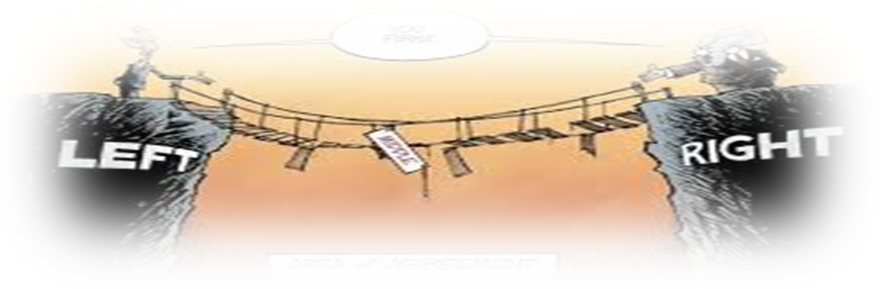
On June 28, 2025, Christian Paz published an article on Vox.com entitled “The Democratic Party is ripe for a takeover”.  Apparently, the primary victory of Zohran Mamdani is the catalyst, or the symptom, or something.  Except for the author’s apparent Trump derangement syndrome in which the Democratic Party’s sole goal should be to confront Mr. Trump, a situation historically reminiscent of the old Whig party’s focus on opposing Andrew Jackson, the article posits interesting possibilities, although possibilities in which I don’t believe or rather, possibilities I don’t believe are likely.

It is a positive that at least in the city of New York so many voters are apparently rejecting the calcified and corrupt leadership of the Democratic Party, a leadership without real ideals other than the attainment and maintenance of power in order to syphon off the country’s wealth to fund perpetual wars in a quest for hegemony, albeit under the control of the American Israel Public Affairs Committee (AIPAC).  But the Democratic Party is so tainted by historical sins and so cancer ridden with corruption that a Tea Party-like revolution ought not to save it, even if it could.  The dust bins of history have been all too empty for too much time.  Rather, as an apparent majority of the United States electorate frequently acknowledges (although it never does anything about it), what real liberals and real progressives and real leftists trapped in the quicksand that characterizes the Democratic Party need is a new political party of their own, one independent from AIPAC, the Deep State, the billionaire class and the forever war quest for hegemony that characterizes both the Democratic Party and most of the GOP.  A political party that really prioritizes the needs and aspirations of its members, the reality being that the United States political system is a factionalist collective rather than a grouping of altruistic political movements concerned with the common good and the general welfare.

The current Democratic Party, at least since 1992, has been reactive rather than proactive, with faux political goals and slogans echoed by a captive corporate press successfully enough to delude the more noble elements of its membership.  It went from GOP lite in the Clinton era, to a political hodgepodge during the Obama era more thoroughly controlled by the Deep State (an informal coalition comprised of unelected bureaucrats and judges) than is the GOP, amazing as that may seem.  And today, its principle goal is to oppose Donald Trump, no matter what he does, unless it aligns with AIPAC goals, but then again, AIPAC virtually owns both the Democratic and Republican parties.  And if opposition to Mr. Trump by any means, legal or not, has become the Democratic Party’s fixation, it is failing in that goal.  Failing dismally, and floundering.

That echoes what happened to the Whigs with respect to their hatred of Andrew Jackson during the mid-nineteenth century, when irate voters with specifically defined goals and ideals abandoned both the Whigs and the Democrats to found the Republican Party, although it too was eventually taken over by the values it was created to reject. 

The GOP too, like the Andrew Jackson controlled Democratic Party of the same mid-nineteenth century, has shifted its axis and threatens to splinter into various segments: one deemed traditionalist which tends to echo the current Democratic Party’s devotion to the Deep State and opposition to Mr. Trump;  a wing that seems to worship President Trump the way Democrats once worshipped President Jackson; and a libertarian wing that rejects forever wars, foreign intervention and the abandonment of the liberty purportedly guaranteed by the Bill of Rights.  That libertarian wing would also do well to strike out on its own as an independent political party guided by real ideals and real goals, while the traditionalist wing should just meld with the current leadership of the Democratic Party, a leadership seemingly in conflict with a substantial number of younger Democrats who, according to Mr. Paz (cool name, it means peace in Spanish) seem to be rebelling.

The electorate in general appears to be angry and dissatisfied but has been manipulated and confused by false news and the false narrative that masquerades as history so that its ability to make electoral decisions has become nonexistent.  We have been led to confuse the essential political concepts of democracy, liberty and pluralism because confusing them was essential for the small elite who rule us to attain and maintain political and economic power, not quite bleeding us dry, rather, like intelligent vampires, they understand that their victims, those who provide their sustenance, must be maintained at least barely alive.  Barely alive but without realizing their condition or who is to blame, being led to believe that they actually have a voice in their own affairs through a system that sort of smells like a meld of the adversative concepts of democracy, liberty and pluralism, a useful illusion.  A system that argues that peace can only be attained through perpetual war and prosperity through the diversion of taxpayers assets to defense contractors and their cronies.  That Christian values are now premised on acceptance of genocide and ethnic cleansing as well as capital punishment.  Somewhere, George Orwell weeps.

Democracy is the rule of a majority (more than 50%), not a plurality, and it does not guarantee that decisions will be correct, or just or equitable.  Liberty is a diametrically opposed concept that insists that no matter what a majority decides, or even what everybody else decides, every individual has sovereign and autonomous inherent rights that cannot be curtailed.  And pluralism?  That too is an antidemocratic concept but one involving the right of collectives to be different and to have a say in their affairs notwithstanding majoritarian opinions.  All three of those contradictory concepts are desirable so constitutions, in part, or at least in theory, exist to reconcile and prioritize them into some sort of workable political and legal system.  Unfortunately, like the quest for a unified field theory in physics, it has always been a utopian ideal distorted and manipulated by elites, except that physicists by and large tend to acknowledge that their goal has not been attained, while most of the electorate everywhere in our planet believes that the particular political systems through which they are ruled are really theirs and that their leaders have their best interests at heart, after all, in most countries, it was purportedly that electorate who selected them.

That is certainly true in the United States and has been true for most of its history.  For most of its history, the United States political system has seemed like a duopoly (a two party dictatorship) but rather, has always been a vehicle for the concentration of wealth and power by an elite few, today, not even an elite few in the United States but sixteen families that effectively rule the world and are responsible for almost all of the world’s poverty and for all of the world’s war and for all of the world’s disparity.

With reference to the surprise victory of Assemblyman Zohran Mamdani in the Democratic Party’s recent New York City mayoral primary, many Democratic Party leaders as well as most people who identify with the GOP are suffering AIPAC sponsored apoplexy because Mr. Mamdani is a Muslim with parental roots in Africa and opposes Zionism and genocide and ethnic cleansing and champions the working class and the downtrodden masses described in Emma Lazarus’ poem inscribed on the Statue of Liberty and thus, he must be a godless communist, although he identifies as a democratic socialist as did Albert Einstein and Martin Luther King, Jr., and Nelson Mandela, and as does Noam Chomsky today.  And the opposition of the moneyed classes to Mr. Mamdani led by AIPAC may well result in his defeat in the general election, whether by the opponents he just defeated running as independents or even by a Republican if the GOP proves Machiavellian enough to select a moderate candidate.  And perhaps the politics as usual crowd in both the Democratic Party and the GOP who Mr. Mamdani’s success has mortified have “nothing to fear but fear itself”.  But it seems to me a positive sign that in the city that boasts the largest Jewish population of any city in the world, a significant portion of that religious group (it’s not really an ethnicity and certainly not a race) may have taken up the antizionist slogan “not in our names” and rejected the distortion of Judaism marketed by AIPAC and its Israeli masters and voted their consciences and in favor of real classical Judaic values and traditions which, perhaps ironically, it is Mr. Mamdani who represents.  Or perhaps it’s not ironic.  The reality is that no religion is closer to real classical Judaism in all respects (except perhaps in the respect that it renders to that certain Jewish Nazarene), than is Islam.

Because of the foregoing, according to Mr. Paz and other optimists, it sort of smells a bit like the “times may be a’ changing”, at least in the desperate Democratic Party, but I wouldn’t hold my breath.
_____

© Guillermo Calvo Mahé; Manizales, 2025; all rights reserved.  Please feel free to share with appropriate attribution.

Guillermo (“Bill”) Calvo Mahé (a sometime poet) is a writer, political commentator and academic currently residing in the Republic of Colombia (although he has primarily lived in the United States of America of which he is also a citizen). Until 2017 he chaired the political science, government and international relations programs at the Universidad Autónoma de Manizales. Previously, he chaired the social studies and foreign language departments at the Eastern Military Academy in Huntington, New York. He is currently the publisher of the Inannite Review available at Substack.com; an intermittent commentator on radio and television; and, an occasional contributor to diverse periodicals and publications. He has academic degrees in political science (BA, The Citadel, The Military College of South Carolina), law (JD, St. John’s University, School of Law), international legal studies (LL.M, the Graduate Division of the New York University School of Law) and translation and linguistic studies (GCTS, the University of Florida’s Center for Latin American Studies). However, he is also fascinated by mythology, religion, physics, astronomy and mathematics, especially with matters related to quanta, cosmology and cosmogony. He can be contacted at guillermo.calvo.mahe@gmail.com and much of his writing is available through his blog at https://guillermocalvo.com/.

Initial Reflections on Pope Leo XIV

Raining on parades is not something of which I’m fond, especially given how many parades I participated in during my youth while a cadet, first at the Eastern Military Academy in Huntington, New York, and then at the Citadel, the Military College of South Carolina, which is not to say that I and my fellow cadets were not, at times, very grateful for rain that resulted in cancellation of weekly parades permitting us to enjoy additional leave time.  Today, however, as I reflect on the passing of Jorge Mario Bergoglio, Pope Francis I, and of Jose Mujica several weeks later, I find myself doing just that, although perhaps it’s just tears cascading I hear.  That we were privileged to share this world with two souls as purely beneficent as theirs has been an amazing blessing.

Following Francis I will not be an easy task, it may well prove extremely challenging as there is little hope of equaling his charismatic humility and the aura of human decency he generated.  It is unlikely that Robert Francis Prevost will follow the examples of humility and personal frugality that Jorge Mario Bergoglio set, both before and after he attained the papacy.  It is interesting, in a very sad manner, to note with profound regret that we lost both Pope Francis and his political homolog, Jose Mujica, the late, former president of Uruguay, within several weeks of each other.  That is an immense degree of decency lost in a very brief period, especially when human decency and humility among those who currently lead us is in such short supply.

My first impression of the new Pope was not positive but I admit that after Francis probably no one would have seemed comparatively positive to me, at least at first blush.  However, I fear that my unfair initial reaction may unfortunately have been instinctively and cognitively perceptive, especially after rumors that pressure to select Cardinal Prevost were exerted, who knows how, by the American Israel Public Affairs Committee and by neoliberal and neoconservative elements in a number of governments, especially that of the United States.  But I guess it would be extremely naïve in a professional political analyst to believe that the election of a new pope would be free of geopolitical pressure from many sides.  Especially if one has studied papal history.

Cardinal Prevost, now Pope Leo XIV, has aspects that should appeal to me emotionally.  He is a Peruvian as well as a United States citizen, the son of Louis Marius Prevost of French and Italian descent and of Mildred Martínez of Spanish descent and it appears that his maternal grandparents, Joseph Martinez, born in Haiti, and Louise Baquié, a Creole a native of New Orleans, were partially of African descent.  Like the new Pope, I’m also a dual national, having been born a citizen of the Republic of Colombia and naturalized many decades ago as a citizen of the United States of America.  And I share at least the Pope’s Spanish and French roots.  But for some reason, the ethnicity and dual citizenship that we share did not impact me in the way that Pope Francis’ Argentinian birth did.  It should have.  Instead, the fact that he is a United States native seems a double edged sword.  He is viewed with pride by United States’ citizens as the first United States born Pope but with suspicion by many throughout the world, fearful, as noted above, that his election was impacted by United States and especially, Israeli pressure.  Something that is given at least some credence if one reads between the lines of some of his public statements involving international affairs, both before and after he became Pontiff.

Still, he is unlikely to be as Deep State oriented as were his predecessors, John Paul or Benedict XVI, but he is also unlikely to be as progressive or humble as Francis, something his decision to reside in the Papal Palace at Castle Gandolfo eschewed by Francis makes clear.  However, as in the case of Supreme Court justices in the United States, the office frequently changes the holder and perhaps, rather than a disappointment (to me) he will prove to be an inspiration.

Only time will tell. 

The only certainty is that my perceptions are emotional, intuitive and not factually based although, like billions of others, I’ve sought for whatever facts I can find but, other than glowingly positive reports concerning his priesthood in Peru, reports of the kind frequently generated by public relations specialists rather than by historians, not much that rings true to me seems available.  Perhaps as I’ve matured, I’ve become a bit too cynical.

I certainly hope so.
_____

© Guillermo Calvo Mahé; Manizales, 2025; all rights reserved.  Please feel free to share with appropriate attribution.

Guillermo (“Bill”) Calvo Mahé (a sometime poet) is a writer, political commentator and academic currently residing in the Republic of Colombia (although he has primarily lived in the United States of America of which he is also a citizen). Until 2017 he chaired the political science, government and international relations programs at the Universidad Autónoma de Manizales. Previously, he chaired the social studies and foreign language departments at the Eastern Military Academy in Huntington, New York. He is currently the publisher of the Inannite Review available at Substack.com; an intermittent commentator on radio and television; and, an occasional contributor to diverse periodicals and publications. He has academic degrees in political science (BA, The Citadel, The Military College of South Carolina), law (JD, St. John’s University, School of Law), international legal studies (LL.M, the Graduate Division of the New York University School of Law) and translation and linguistic studies (GCTS, the University of Florida’s Center for Latin American Studies). However, he is also fascinated by mythology, religion, physics, astronomy and mathematics, especially with matters related to quanta, cosmology and cosmogony. He can be contacted at guillermo.calvo.mahe@gmail.com and much of his writing is available through his blog at https://guillermocalvo.com/.

Perniciously Concupiscent Parodies, Volume One

Biggus Dickus, a character eventually revealed (albeit tangentially) in Monty Python’s documentary on the Life of Brian (which dealt with purported events during the first century of the Common Era), may or may not have involved a parody of the infamous Roman Casanova-wanna-be, Primus Phalux Maximus Quintus (who may or may not have actually existed), and who if he did exist (improbable but one never knows), but for temporal improbabilities, may or may not have been the secret hidden triplet of Publius Clodius Pulcher, the third member of which was the audaciously beautiful, sensuous and libidinous Clodia Metelli, sometimes known as Quadrantaria, of whom the Roman eroticist poet Gaius Valerius Catullus longingly wrote dramatically ambivalent vignettes comprised in equal parts of love, despair and deprecation.  At least that might have been the lead story in the media in the late Roman Republic, circa sixty years before the Common Era, had its journalistic ethics born a resemblance to that of today’s maliciously creative corporate media, which, come to think of it, it may well have, both having prioritized creative writing.
_____

© Guillermo Calvo Mahé; Manizales, 2025; all rights reserved.  Please feel free to share with appropriate attribution.

Guillermo (“Bill”) Calvo Mahé (a sometime poet) is a writer, political commentator and academic currently residing in the Republic of Colombia (although he has primarily lived in the United States of America of which he is also a citizen). Until 2017 he chaired the political science, government and international relations programs at the Universidad Autónoma de Manizales. Previously, he chaired the social studies and foreign language departments at the Eastern Military Academy in Huntington, New York. He is currently the publisher of the Inannite Review available at Substack.com; an intermittent commentator on radio and television; and, an occasional contributor to diverse periodicals and publications. He has academic degrees in political science (BA, The Citadel, The Military College of South Carolina), law (JD, St. John’s University, School of Law), international legal studies (LL.M, the Graduate Division of the New York University School of Law) and translation and linguistic studies (GCTS, the University of Florida’s Center for Latin American Studies). However, he is also fascinated by mythology, religion, physics, astronomy and mathematics, especially with matters related to quanta, cosmology and cosmogony. He can be contacted at guillermo.calvo.mahe@gmail.com and much of his writing is available through his blog at https://guillermocalvo.com/.

Dreams of Freedom on an Early Winter’s Day

I’ve been listening to the beautiful Scottish Anthem, Highland Cathedral lately.  Almost compulsively so.  I’m very supportive of the rights of subjugated peoples, rights to the independence purportedly guaranteed as a result of the first war to end all wars, the one we now know, after its abject failure as World War I and, to me, the Scotts are an enigma.  Brutally subjugated by the English, they morphed into English tools for the subjugation of others including the attempted subjugations of residents of thirteen of England’s North American colonists, whole peoples throughout the world including the Indian subcontinent, Asia and Africa.  As an aside, I wonder why India is a subcontinent while Europe is a continent when, in reality, both are parts of Asia. 

Still, many Scotts are awakening and discarding the hypocrisy inherent in their subjugation.  Bagpipe hymns like Highland Cathedral and Scotland the Brave bring to mind the aspiration for freedom, independence and self-expression of legendary Scottish folk heroes like Robert the Bruce, John Balliol, David II and even he who was referred to as Bonny Prince Charley, the original Charles III.  Today, of course, they would be joined by numerous Palestinian martyrs.

Perhaps many of today’s Scotts are being shamed by the courage of the Palestinian people in the face of genocide, ethnic cleansing and the theft of their country by European invaders.  Scottish independence.  Now wouldn’t that be something.  And perhaps a United Ireland.  And, maybe even a free Wales.  And, of course, a Free Palestine. 

Highland Cathedral, perhaps an anthem for the subjugated everywhere. 

No wonder it resonates so in my soul.
_____

© Guillermo Calvo Mahé; Manizales, 2025; all rights reserved.  Please feel free to share with appropriate attribution.

Guillermo (“Bill”) Calvo Mahé (a sometime poet) is a writer, political commentator and academic currently residing in the Republic of Colombia (although he has primarily lived in the United States of America of which he is also a citizen). Until 2017 he chaired the political science, government and international relations programs at the Universidad Autónoma de Manizales. Previously, he chaired the social studies and foreign language departments at the Eastern Military Academy in Huntington, New York. He is currently the publisher of the Inannite Review available at Substack.com; an intermittent commentator on radio and television; and, an occasional contributor to diverse periodicals and publications. He has academic degrees in political science (BA, The Citadel, The Military College of South Carolina), law (JD, St. John’s University, School of Law), international legal studies (LL.M, the Graduate Division of the New York University School of Law) and translation and linguistic studies (GCTS, the University of Florida’s Center for Latin American Studies). However, he is also fascinated by mythology, religion, physics, astronomy and mathematics, especially with matters related to quanta, cosmology and cosmogony. He can be contacted at guillermo.calvo.mahe@gmail.com and much of his writing is available through his blog at https://guillermocalvo.com/.

On the Nature of Modern History

The recording of history seems to have always belonged to the literary genres of creative writing and fiction.  It has seemingly always been, at least in its popular and official versions, more of a creative than an objective process.  It frequently has some links to actual events but its role seems to have almost always been to distort whatever is reported in order to protect the most guilty and nefarious among us.  Consider for example Abrahamic sacred scriptures including their Jewish originals and their Christian and Islamic incarnations (e.g., the Tanakh, the Bible and the Koran): slavery was just, human sacrifice appropriate, genocide a good thing (as was the death penalty for minor transgressions), animal sacrifice was required, women were inherently inferior, etc.  Amazingly, we continue to consider such “historical” (some would call them hysterical) sources as sacred and worthy of adoration while, incoherently, we consider those who actually follow such canonical laws (mainly fundamentalist Muslims) as savages.

The trend towards massive distortion of history and journalism has become exceedingly obvious during the past two centuries and, at this juncture, has gone wild as purported journalism has become a primary source for historians.  To mangle and distort a quote made famous in the fictional Star Trek universe: journalism “is not and never has been a historian’s friend”.  There is a related saying with some truth in it to the effect that “history is written by the victors” but of course, the word “history” in that phrase must be modified with the adjective “purported”.

Recent events have made the foregoing more clear than ever.  Take the recent situation in Syria for example.  The “western” press (whatever that is) is gleefully proclaiming that Bashar al-Assad was a ruthless and vicious dictator whose overthrow must be seen as a wonderful event for justice, decency and democracy, while the same “western” press promotes Zionist genocide throughout the Middle East with the full support of “western democracies” and also support murderous dictatorships all over the world, Saudi Arabia and Israel being interesting examples.  That Ahmed al-Sharaa (also known as Abu Mohammed al-Jolani), Mr. Assad’s conqueror is a former leader of ISIS and Al-Qaida seems beside the point to such western democracies and to the journalists who help keep them and their pet dictators in power.  That Mr. Assad’s conqueror was backed by, hmmm, genocidal Israel in its quest to conquer the Middle East is also beside the point, or that the new regime is already imposing a Taliban style regime in Syria, something criticized severely by western democracies and journalists with respect to Afghanistan.  That Israel seems to be surreptitiously behind these recent events raises questions (at least to the bravest or most reckless among us) concerning the reality of the events in lower Manhattan on the morning of September 11, 2001.  And, of course, we also have the situation in what was once the Ukraine (who knows what it is now).  Apparently impoverished Ukraine was directly involved in helping arm the victorious rebellion and some wonder how that was possible or what it portends.  Questions, questions, questions.  Answers will of course be soon forthcoming and had best be accepted, … unquestioned.

Today, seemingly a majority of the United States electorate as well as majorities of the electorates in diverse European countries are aware that they are being deceived and manipulated by what passes for journalism and historiography and, at least recently, many voters have been turning to populist candidates, populist in the sense of reliance on a more accurate version of democracy, one freed from the purportedly democratic institutions that are really no more than manipulative weaves designed to fleece us as surely as victims are fleeced in a traditional shell game.  Nonetheless, knowing that one is being deceived is not synonymous with discerning the truth and that is where we find ourselves: effectively manipulated by persons we know are deceiving us but who manage to impact our perceptions just the same.  Had William Shakespeare been more discerning, perhaps he would have added journalists and historians to lawyers in the famous line from his play Henry VI, Part 2: “The first thing we do, let’s kill all the lawyers”.  As both a lawyer (non-practicing though) and a historian (among other things), that thought, while perhaps somewhat meritorious, does not appeal to me.

The foregoing admissions concerning the nature of the history most of us are taught (and teach), raise (for the relatively few of us who aspire to retain open minds and who value truth) serious and important questions about the real history of our planet, especially during the past two centuries.  For example, about the real causes of the American Revolution and the United States “Civil” War (some refer to it as the war of Northern Aggression while the more objective refer to it as the War Between the States), or more recently and perhaps more to the point today, about the causes of the Second World War and what actually took place in the countries involved during that cataclysmic epoch, an epoch whose echoes still seem to buffet us all too regularly.  We’ve been taught that fascists under the leadership of Adolf Hitler and Benito Mussolini (and to some extent, Hideki Tōjō) were bloodthirsty, racist tyrants who embodied everything evil while the leaders of the United States and the United Kingdom were benign defenders of liberty, democracy, justice and tolerance, this despite the fact that the latter, like the Axis powers, maintained concentration camps: the United States in California to imprison people of Japanese descent and in Panama, for general purposes, and the British, in South Africa and elsewhere.  Indeed, the British invented the concept.  And, of course, the history we are taught presents the victors in the Second World War as benign saviors of humanity notwithstanding the fact that both the United Kingdom and the United States engaged in mass murder during that conflict as assuredly as did their enemies, albeit more efficiently, ; i.e., mass extermination not through a morbid form of euthanasia but by burning and blowing up massive numbers of human beings through firebombing of civilian population centers in Europe and Japan and, of course, in the nuclear attacks on Hiroshima and Nagasaki.

Interestingly, notwithstanding the purported importance of verity to the just, it is illegal in many countries to question what happened during the Second World War and why, at least if questioning raises questions whose answers deviate from official narratives imposed by the victors.  It is illegal to question official narratives even though common sense seems to squeal as if it were being tortured when such narratives are even superficially examined, and, especially, when we witness how journalism and history are tortured today by the descendants of the sources that have forced their narratives for over three quarters of a century on a weary postwar world (well, “postwar” may be a distortion given the never ending nature of armed encounters involving the victors in that conflict).  Interesting that the Zionist ethnic cleansing and genocide of Palestinians began concurrently with the fabrication of such narratives, narratives which were relied on by Zionists to justify their theft of Palestine as compensation for the atrocities that Jews suffered during the Second World War, purportedly at the hands of the Germans (rather than, as one might have supposed, the Palestinians).  An alien ethnologist not bound by Terran penal codes might someday dare to ask: “Why weren’t the Jews given Bavaria as a homeland?

Other questions that such daring alien ethnologist might ask but which are illegal for us to consider involve, for example, some observations that arise from admitted facts, for example, that the “Allies” (history’s good guys in that conflict) had imposed a total economic blockade and embargo over continental Europe which prevented the countries under the control of the “Axis Powers” (history’s bad guys in that conflict) from obtaining food, medicine, fuel, etc., from noncombatants and neutral states, and the observation that because of that, the populations in such countries faced starvation and their leaders were forced to make desperate decisions as to allocation of resources, including the establishment of priorities with respect to what segments of their populations were to be fed and cared for.  Were one to make such illegal observations instead of the alien ethnologist (heaven forbid), then one might follow them up wondering how many of the casualties of what has become pejoratively referred to as the Holocaust were attributable to decisions relating to the consequences of such successful total economic blockade and embargo.

Another illegal perspective to consider with respect to the Second World War is how the overwhelmingly pro-German worldwide Jewish population during the First World War subsequently came to be despised by their formerly benign non-Jewish German neighbors.  After all, the German Empire and its predecessor, the Kingdom of Prussia, had been, for centuries, the parts of Europe most welcoming to Jews, the places where they were treated most equitably and most permitted to thrive.  There are source materials that point rather specifically at a deliberate effort by a segment of Jews in the United Kingdom and the United States to accomplish exactly that in order to promote a secular political goal known as Zionism, and that the success of their efforts, directed at colonizing and acquiring the segment of the Ottoman Empire known geographically, culturally and historically as Palestine, required the sundering of German Jews from their historical loyalty to their adopted homeland by turning their neighbors against them based on the assertion that “it was Jews who were responsible for the German Empire’s defeat in the First World War”, a feat accomplished by manipulating the United States into entering that war on the side of the Triple Entente (history’s good guys in that war).  That is a distorted assertion as it was only the small minority of Jews who had adopted Zionism who had offered to betray their brethren in exchange for the promise by the members of the Triple Entente to turn Palestine over to them following successful conclusion of that war and dismemberment of the Ottoman Empire (the Balfour Declaration), but, repeated frequently and boastfully enough by Zionists, it seems that it had the desired impact, consequences be damned.

Since the foregoing considerations are illegal, they must be false and thus, no efforts may be permitted to research them and to come to contrarian conclusions and to share such conclusions.  That would obviously involve fascism, hatred for liberty and democracy and justice and equity, and of course, racism, antisemitism and white supremacy.  Anyone making related observations would justifiably be labeled a Holocaust denier!!! 

Such is the current interpretation of historical objectivity and it echoes attempts to minimize analysis in real time, with our own eyes and ears, of just what is happening in the Middle East today as hundreds of thousands of people, mainly women, children and the elderly are mysteriously “dying”, dismembered.  Misguided college students, academics, researchers and non-traditional journalists who raise related questions, come to related conclusions and engage in related protests, all misguided of course, are, fortunately, being censored into more constructive reflections concerning things such as their future, their scholarships, their institutional standing, their tenure, their job prospects, all considerations certain to guide them toward the light.

After all, genocide is relative. 

When good guys engage in mass murder, such as in the case of:

  • the murder of the first born males of ancient Egypt, or
  • of all the men, women, children and frequently, even livestock in ancient Canaan (Jericho for example), or
  • of the Christians in Jerusalem during the year 614 of the Common Era; or, of course,
  • the massacre of the indigenous populations of the Americas by Europeans,

then, even though it walks, talks, sounds and feels like genocide, it is something else.  Or, in each such case, genocide is actually a positive cleansing tool designed to promote the delights of ethnic purity and to meet the “white man’s burden”.  Not so much when the former orchestrators of genocide become the victims (or represent themselves as victims), at least not until they can once more become the victimizers.  At any rate, purported victims of genocide are generally characterized by history as “terrorists” or “savages”, except, of course, if they are presented as having been victims of “the” Holocaust.

It’s a mystery, I know, kind of like the nature of the Christian “trinity”, or how there can be a square root for minus one, or how observation can impact quantic phenomena.  But that’s history for you, at least in its “official” versions.

So, how sick is our world today? 

Perhaps a more relevant question might be, where it legal to ask: “How much different is our world today than it would have been had the Central Powers (the German Empire, the Austria-Hungarian Empire and the Ottoman Empire) emerged victorious in the First World War?”  One answer is: there might well never have been a second world war.  But then, things having happened as they did, so perhaps there are other areas in which we can more profitably sort of speculate.  So we might ask, were it legal: “How much different would our world be today had the Nazis won World War Two?”  We’ll never know and that may be a good thing.  Then again, given the reality that the only thing we know is that everything we’ve been taught is at best highly distorted and likely very inaccurate (didn’t want to say false, that would be too broad a generality), perhaps the world would be all too similar to our own with just the lead characters having changed roles: our historical heroes, especially Winston Churchill and Harry Truman being perceived as horrendous villains (which they were) and our arch villains, Adolf Hitler, Benito Mussolini and Hideki Tōjō perceived as courageous visionaries and mankind’s saviors (which they, in all likelihood, were not and would not have been).  And what about Stalin in that scenario? 

Wow!  The tune played by the defeated English armies at Yorktown in October of 1771 after their defeat at the Battle of Saratoga comes to mind.
_____

© Guillermo Calvo Mahé; Manizales, 2024; all rights reserved.  Please feel free to share with appropriate attribution.

Guillermo (“Bill”) Calvo Mahé (a sometime poet) is a writer, political commentator and academic currently residing in the Republic of Colombia (although he has primarily lived in the United States of America of which he is also a citizen). Until 2017 he chaired the political science, government and international relations programs at the Universidad Autónoma de Manizales. Previously, he chaired the social studies and foreign language departments at the Eastern Military Academy in Huntington, New York. He is currently the publisher of the Inannite Review available at Substack.com; an intermittent commentator on radio and television; and, an occasional contributor to diverse periodicals and publications. He has academic degrees in political science (BA, The Citadel, The Military College of South Carolina), law (JD, St. John’s University, School of Law), international legal studies (LL.M, the Graduate Division of the New York University School of Law) and translation and linguistic studies (GCTS, the University of Florida’s Center for Latin American Studies). However, he is also fascinated by mythology, religion, physics, astronomy and mathematics, especially with matters related to quanta, cosmology and cosmogony. He can be contacted at guillermo.calvo.mahe@gmail.com and much of his writing is available through his blog at https://guillermocalvo.com/.

A Wakeup Call for Black Voters

African Americans were brought in chains to the Americas where for centuries they were forced to serve as slaves and, in a political sense that has not changed. After the purported emancipation of American slaves they’ve permitted themselves to remain in political slavery, first to the Grand Old Party and now, for almost a century, to the party that sought to keep them enslaved, the Democratic Party. In part that’s because American slaves, unlike the slaves in Haiti, did not free themselves. Haiti can hardly be qualified as a success but it’s version of Simon Bolívar and José Francisco de San Martín y Matorras and yes, George Washington, Toussaint Louverture should be an inspiration to all descendants of Africans stolen from their own lands and forced into slavery. Abraham Lincoln should not.

American slaves were emancipated only through a cynical ploy by Abraham Lincoln, a racist who believed African Americans could never coexist with whites and should all be expelled from the Union he loved. A cynical racist who believed that African Americans should never have political rights in the United States of America. American slaves were emancipated, not to enjoy the fruits of freedom and the ability to attain their highest potential, as individuals and as a race, but rather, to preserve the Union and to lower the cost of labor for Northern factory owners thriving as the industrial revolution permitted the evolution of what became known as the “gilded age” in the United States.

Slaves in the United States were emancipated, not because slavery was considered an intolerable evil, but because victory in the Civil War was essential for Northern industrialists to realize their dream of an American Empire. They were emancipated only to dissuade the United Kingdom and France from supporting the Confederacy’s aspirations for independence. In fact, when they were initially purportedly emancipated during the Civil War, they were emancipated only in the Confederacy over which the Union lacked legal jurisdiction but remained enslaved in the Union itself. That seems ironic based on how history has been taught in the United States for the past century but anyone can read Lincoln’s initial inaugural address where he said (and anyone can verify it on Google): “I have no purpose, directly or indirectly, to interfere with the institution of slavery in the States where it exists. I believe I have no lawful right to do so, and I have no inclination to do so.

The fact that Americans of African descent were emancipated by cynical whites by no means implies that there have not been brilliant, ethical and visionary leaders of African descent in the United States, leaders, for example, like Frederick Douglas or Marcus Garvey or Malcolm Little (later known as el-Hajj Malik el-Shabazz and finally as Malcolm X) or Martin Luther King, Jr., leaders who believed that Americans of African descent should break the bonds of political slavery that prevented them from attaining the role in American society to which their numbers and their talents should have entitled them.  Indeed, as of 2019, there were a total of 255 different African American led groups in the United States that avocated for African American political independence. But the old overseer system that controlled African Americans during their days as slaves, the system of treacherous African American overseers who betrayed their brothers and sisters, never ended. It just morphed into a system controlled and funded by people of all races that sees African Americans as a commodity to be controlled and used, especially in the political arena where African Americans can be herded into a monolithic voting bloc that serves its masters rather than its members just as slaves enriched plantation owners while they were maintained at barely subsistence levels. A system run by modern overseers like Barack Obama and Kamala Harris and Hakeem Sekou Jeffries and Charles Diggs and Charley Rangel and Kweisi Mfume and Shirley Chisholm and Louis Stokes and William L. Clay. Heroes to African Americans because some among them participated in apparently successful battles for desegregation and civil rights but whose principal loyalties were and are to the white led, power mad, ill-named Democratic Party.

The Democratic Party is a strange amalgam of disenfranchised minorities and fringe groups without common bonds other than their deluded acquiescence in their own continuous betrayal, especially since the ascension of the Clintons to political power in 1992. The party’s principal strategy is the use of polarization to goad their betrayed supporters to maintain them in power so that the party can, in turn, serve its real masters: the billionaire class, Wall Street, trial lawyers, but most of all, the military industrial complex. It seems amazing, especially with reference to African Americans, how successful condescending platitudes, backslapping and utter hypocrisy have been in keeping their voters in line even when, as in case of the Clintons, they are devastatingly betrayed. Witness the Clintons (two for the price of one) deformations of the criminal justice and welfare systems that devastated the African American community. But that’s exactly what overseers are for. What they’ve always been for.

The reality is that Black Power is an inchoate reality, as is the power of each and every component of the incoherent alliance that conforms the modern Democratic Party, but a reality that will only be realized when such groups are emancipated from political slavery and attain their own political power through their own political parties under leaders loyal to their constituencies rather than to the hidden leaders of what has come to be known as the Deep State. Shifting from one component of the political duopoly that has ruled the United States since the Civil War to the other is meaningless. Only a multiparty system embracing real democracy rather than its verisimilitude can bring about a real American Dream, a society where every American citizen can attain his or her own greatest personal potential, for their own benefit, and where overseers are consigned to the Hell they deserve.

Of course, the United States constitutional system at all levels, as implemented by legislation, regulations, rules, ordinances, decree and judicial decisions, poses a huge impediment to political emancipation and democracy. It was designed by slaveholders precisely for such purpose, with the seductive illusions of democracy, liberty and opportunity for all held out like a carrot, but the carrot has always been a mere mirage and only the stick has been real.

It’s not as though African American political parties don’t exist. Cornell West, PhD, a brilliant American philosopher of African descent is running for president during this electoral cycle, although the Democratic Party is doing all it can to keep him off the ballot in November, and the following are an illustrative listing of current African American political parties in the United States: the African People’s Socialist Party, the All-African People’s Revolutionary Party, the Black Hammer Party, the Black Panther Party, the Black Riders Liberation Party, the Freedom Now Party, the Harold Washington Party, the New Afrikan Black Panther Party, the New Black Panther Party, the Progressive Democratic Party, the Revolutionary Action Movement, the Revolutionary Black Panther Party, the Umoja Party and the United Citizens Party. However, they are singularly unsuccessful because the overseers appointed by the Democratic Party (and its allies in the corporate media) keep them virtually unknown.

African American voters bear a terrible stigma as a result of the homogeneous manner in which a majority have voted over the decades. They tend to be the balance of power in American politics and have been so since they were formally granted the rights of citizens pursuant to the thirteenth fourteenth and fifteen amendments to the United States Constitution following the Civil War. In reality, although they’ve derived few tangible benefits as a result of their political subservience, they’ve been responsible for the election of the administrations responsible for World War II, the Korean War, the Vietnam War, the wars on Serbia and Kosovo, the destruction of Libya (Africa’s most economically successful state), the promotion of civil war in Syria, the Ukrainian conflict, and, for Israeli genocide, ethnic cleansing and Apartheid in Palestine.  Those are intolerable moral burdens for a people to bear. For any people. But especially for a people who have been so utterly abused for over half a millennium.

What Americans of African descent really need if real freedom and real independence and real emancipation and real personal realization are their goals, rather than fourth class illusory citizenship, is their very own “Toussaint Louverture”.

If you’re an American of African descent and don’t know who he is, look him up. 

You may be glad you did.

______

© Guillermo Calvo Mahé; Manizales, 2024; all rights reserved.  Please feel free to share with appropriate attribution.

Guillermo (“Bill”) Calvo Mahé (a sometime poet) is a writer, political commentator and academic currently residing in the Republic of Colombia (although he has primarily lived in the United States of America of which he is also a citizen). Until 2017 he chaired the political science, government and international relations programs at the Universidad Autónoma de Manizales. Previously, he chaired the social studies and foreign language departments at the Eastern Military Academy in Huntington, New York. He is currently the publisher of the Inannite Review available at Substack.com; an intermittent commentator on radio and television; and, an occasional contributor to diverse periodicals and publications. He has academic degrees in political science (BA, the Citadel, the Military College of South Carolina), law (JD, St. John’s University, School of Law), international legal studies (LL.M, the Graduate Division of the New York University School of Law) and translation and linguistic studies (GCTS, the University of Florida’s Center for Latin American Studies). However, he is also fascinated by mythology, religion, physics, astronomy and mathematics, especially with matters related to quanta, cosmology and cosmogony. He can be contacted at guillermo.calvo.mahe@gmail.com and much of his writing is available through his blog at https://guillermocalvo.com/.

The Ides of March, 2024

Once more, the ides of March approach, or really, a date in the modern calendar associated with the Roman concepts of ides, calends and nones (the Romans having had no concept of a seven day week until well after the start of the imperial period).  And with the approach of the somewhat imprecise ides in the month of March, Martius to the Romans (originally the first month of the Roman year, later relegated to the third month, as it is now for us), one special ides in March comes to mind.  The ides of March which since 44 b.c.e., has been associated with the assassination of Gaius Iulius Caesar by a group of Roman senators, to most of whom he had been both kind and forgiving, and which was led by Marcus Junius Brutus, possibly his illegitimate son.  

Caesar, as he has become known to history, was never a Roman emperor in the sense we’ve come to associate with that title.  At that time, the title was a battlefield honorific granted by Roman soldiers to outstanding military leaders in a given battle and represented by the award of a crown of woven grass.  Caesar had indeed been granted such an honor, but at the time of his murder, his title was “dictator”, an honorable elected position rather than the pejorative term it has become in modernity.  It was a title originally granted for a brief period during times of existential crisis and combined all aspects of governmental power in one person, but following expiration of that term, the former dictator was held to account for his actions and might well be condemned for them.  The Romans had no use for official impunity, as we do today with our various forms of “immunity” for official acts by government officials in the executive, judicial and legislative branches.  Unlike prior dictators, which had become more and more common and included older contemporaries of Caesar, including his uncle-in-law Gaius Marius, and Marius’ mortal enemy, Lucius Cornelius Sulla Felix, Caesar had been named dictator for life after having rejected the title of Rex (king).

Caesar was a complex and enigmatic figure, a genius on many levels and with respect to a broad range of talents, among them of course, politics and military matters, but also many areas involving non martial pursuits, and he was a populist like Marius, rather than a member of the aristocratic elite of the time, who referred to themselves as the “boni” (the good), much as they do today notwithstanding the reality that they disdained the populace, much as do today’s elites.  But born relatively poor, he did not hesitate to abuse his military commands to generate profits through the sale of captured populations into slavery, not an uncommon pursuit in antiquity (and his legal right as a proconsul).  Slavery then had nothing to do with one’s race.  His charisma was legendary, on a scale with that of Alexander the Great, or of Napoleon, or Charlemagne, and his success was translated, after a series of civil wars, into an empire by his grandnephew Octavius, whom he had adopted as his heir, and whom we know as Augustus.  Gaius Octavius Thurinus is considered the first emperor of Rome.  His official title, however, was “princeps civitatis and subsequently, prínceps senatus”, meaning first citizen and first senator respectively.  And of course, later, by his own request, “augustus”.

Gaius Iulius Caesar, whose father bore the same name, has been gone for 2,068 years.  I always wonder on the ides of March what the world might have been like, had he not been murdered by a crowd of cowardly (dozens attacked one man, alone and unarmed) and jealous political adversaries who Caesar had pardoned, jackals who considered themselves (or at least claimed to be) patriots. 

My apologies to jackals everywhere.
_______

© Guillermo Calvo Mahé; Manizales, 2024; all rights reserved.  Please feel free to share with appropriate attribution.

Guillermo (“Bill”) Calvo Mahé (a sometime poet) is a writer, political commentator and academic currently residing in the Republic of Colombia (although he has primarily lived in the United States of America of which he is also a citizen).  Until 2017 he chaired the political science, government and international relations programs at the Universidad Autónoma de Manizales.  He is currently the publisher of the Inannite Review, available at Substack.com, a commentator on Radio Guasca FM, and an occasional contributor to the regional magazine, el Observador.  He has academic degrees in political science (the Citadel), law (St. John’s University), international legal studies (New York University) and translation and linguistic studies (the University of Florida’s Center for Latin American Studies).  However, he is also fascinated by mythology, religion, physics, astronomy and mathematics, especially with matters related to quanta and cosmogony.  He can be contacted at guillermo.calvo.mahe@gmail.com and much of his writing is available through his blog at https://guillermocalvo.com/.