
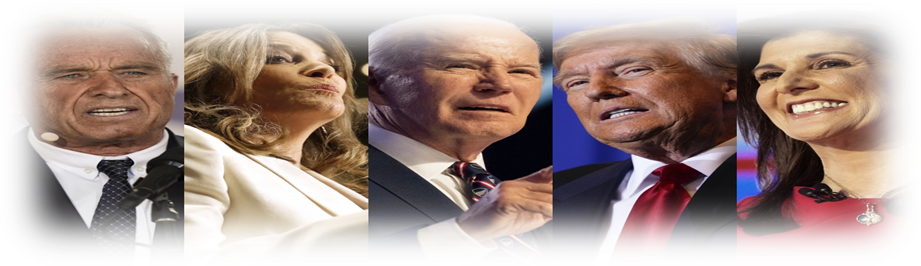
As an independent academic, researcher, political analyst and commentator, I have several observations concerning candidates for the 2024 presidential nomination.
First, as to the GOP, albeit only two of the four mentioned remain, I would rank candidates as follows on the basis of danger to humanity and world peace: most dangerous, Nicky Haley (a Biden clone and Deep State shill); then, Ron DeSantis, Donald Trump and Vivek Ramaswamy. Ramaswamy seemed the most interesting, notwithstanding his Hindu inspired Islamophobia and reminded me of Tulsi Gabbard in some respects, but, as in the case of DeSantis, he has acknowledged the inevitable and dropped out. There were other GOP candidates but they really had nothing to offer, indeed, as in the case of Haley, most were sponsored and paid for by pro-Biden, Deep State loyal Democratic Party related donors. Of course, ranked on the basis of lousy personality, pomposity, apparent ego and childishness, no one can touch “the” Donald. Haley refuses to abandon her quest but that may be a preplanned Deep State strategy to cause Mr. Trump to expend resources ahead of the real contest in November. Ms. Haley and the Deep State are as friendly as is Mr. Biden and the Deep State. Cozier than that one cannot get.
On the Democratic Party side, well, there is no side although two candidates Dean Phillips, a Biden clone who feels Biden is just too old and infirm, and Marianne Williamson, a talanted and interesting non-politician, are running. However, the ill named Democratic Party has refused to organize debates and the corporate media is doing all it can to cooperate by rendering everyone but Mr. Biden invisible. Still, Ms. Williamson bears consideration. On the worst to best basis therefore, Ms. Williamson seems best, followed by Mr. Phillips (as neutral, or neutered, as one can get), and then, in last place, the worst candidate from any party, movement, etc., perhaps ever, the eternal warmonger and merchant of personal greed and corruption, “Genocide Joe”, aka, Mr. Joseph Robinette Biden.
Independents and third party candidates are very interesting and provide the most intelligent, competent and honest candidates so, of course, they are carefully facing assassination by silence. For the record, and in their case, in no particular order given that they are all pretty good, I would rank the top three as follows: Cornel West, an Afro-American philosopher, academic, civil rights leader, political activist and pacifist as the best, although his campaign seems terminally hokey; then, his former running mate (she was at the top of the ticket, he was in the second spot), perpetual Green Party candidate, Jill Stein, who shares most of Mr. West’s political perspectives but is a Jewish woman, rather than an Afro-American male; and, perhaps most interesting but with a fatal flaw, the most recognized candidate among the independents (largely because of his family name), Robert F. Kennedy, Jr. He is, of course, the son of the late senator, attorney general and assassinated presidential candidate whose name he bears, and the nephew of the late, assassinated president, John F. Kennedy. Mr. Kennedy shares many of Dr. West’s and Ms. Stein’s progressive perspectives but is apparently owned, lock, stock and barrel, by the American Israel Public Affairs Committee (AIPAC), not unexpected given the reality that his father was assassinated by a Palestinian, but still, his tolerance for Israeli genocide and ethnic cleansing pretty much neutralizes his many positive qualities for most people who might otherwise have been inclined to support him.
The real question is, of course, given realities associated with the United States electoral system as impacted by lax voting standards and requirements; interference by the legal and penal system as well as the intelligence agencies; interference by most of the owners of major Internet platforms; and, the utter lack of objectivity by the corporate press (most in favor of Democrats, no matter what, but one in favor of Republicans on the same basis), what difference do candidates make, or the will of the electorate for that matter???
Of course, as in 2016, all of us but especially the Deep State may be surprised. But I doubt it. They’ve learned their lesson. The one sure thing is that the best person running, the most ethical, most experienced, with the best judgment, hasn’t a chance.
Good (and bad news) from another source concerning this year’s federal election, the person who would have been the best presidential candidate (he once was, but was trounced), Dennis Kucinich, is running for the House of Representatives again, albeit this time, wisely, as an independent. Goooo Dennis!!! Gooo independents!!!! The bad news is that he is not running for president. The corporate press, of course, is doing all it can (again) to make him invisible so any help readers can provide to overcome that tactic would, I’m sure, be greatly appreciated. He was Robert F. Kennedy, Jr.’s campaign manager but resigned when Mr. Kennedy’s anti-Palestinian bias led him to support Israeli atrocities. Good for him (Dennis, not Robert), his integrity, unlike that of most politicians, is neither for sale nor for lease.
_______
© Guillermo Calvo Mahé; Manizales, 2024; all rights reserved. Please feel free to share with appropriate attribution.
Guillermo (“Bill”) Calvo Mahé (a sometime poet) is a writer, political commentator and academic currently residing in the Republic of Colombia (although he has primarily lived in the United States of America of which he is also a citizen). Until 2017 he chaired the political science, government and international relations programs at the Universidad Autónoma de Manizales. He is currently the publisher of the Inannite Review, available at Substack.com, a commentator on Radio Guasca FM, and an occasional contributor to the regional magazine, el Observador. He has academic degrees in political science (the Citadel), law (St. John’s University), international legal studies (New York University) and translation and linguistic studies (the University of Florida’s Center for Latin American Studies). However, he is also fascinated by mythology, religion, physics, astronomy and mathematics, especially with matters related to quanta and cosmogony. He can be contacted at guillermo.calvo.mahe@gmail.com and much of his writing is available through his blog at https://guillermocalvo.com/.


