
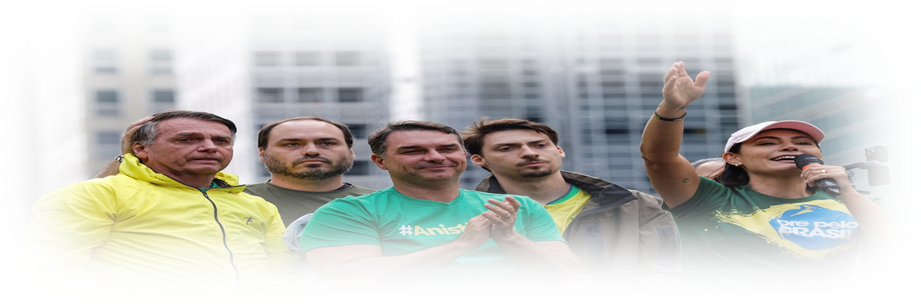
The following is the transcript for the segment by Guillermo Calvo Mahé in a special report by India’s NewsX World with respect to the Bolsonaro Dynasty in Brazil, a reality regardless of the final results of the 2026 Brazilian Elections. It has been slightly edited to correct grammatical issues and provide context and updating information has been added:
_______
On Sunday October 4, the Brazilian electorate followed the path of most recent Latin American elections, at least as far as the Congress is concerned, rejecting the progressive left and embracing the conservative right. In that context, a question arises as to whether Brazil’s turn to the right is a reaction against what the public perceives of as a moribund and corrupt economy (notwithstanding significant progress in minimizing poverty during the current administration) or whether it reflects the crystallization of a Bolsonaro family dynasty (given the fact that so many members of the Bolsonaro family are now in elected positions of power). Jahir Bolsonaro, the family’s patriarch, was 38th president of Brazil, having served in that role from 2019 to 2023 and as a member of the Chamber of Deputies from 1991 to 2019. Previously, he served as a captain in the Brazilian army. However, he has been in prison serving a twenty-seven year sentence for organizing an attempted coup against his successor, the current president of Brazil, Luiz Inácio Lula da Silva, who is currently running for reelection against Jahir Bolsonaro’s son, Flavio.
One answer to the unexpected results of the initial round of the Brazilian elections which involved not only the presidency but the Chamber of Deputies, a significant part of the Senate and the powerful state governors seems to be that, come what may during the final round of presidential voting on October 31, Jahir Bolsonaro has managed to install his family firmly in control of the Congress and in likely control of the presidency. If so, that would quickly lead to his from imprisonment and expand Bolsonaro family control of the federal judiciary as well.
So, who are the members of the evolving Bolsonaro family dynasty? Let’s start with Flavio.
Flavio is not his father’s clone nor a mere figurehead. He has his own 23 year political career including eight years as a senator and, although his father is certainly Flavio’s political mentor, they have differing styles and different focuses, something Flavio emphasizes:
- Flavio’s presidential campaign stressed down to earth economic issues and concerns rather than abstract ideological issues and Flavio used a more restrained personal style, reaching out to centrist voters as well as focusing on conservative themes. Still, like his father, he also stressed his relationships with the United States and Israel would be much more positive, his relations with China more limited and that his interests in the BRICS coalition would be secondary at best.
- As in all recent elections in Latin America, Flavio’s stressed the problem of allegedly rampant crime and a decline in morals urging a return to traditional Christian values and was highly critical of the threats of an emerging socialist state.
- Flavio’s campaign focused on sophisticated use of targeted and tightly focused social media rather than on the mass, amateur WhatsApp forwarding networks used by his father and, perhaps thanks to his brother Eduardo’s US contacts, his use of the Internet was extremely well financed by, among others, the Rockbridge Network, a group co-founded by U.S. Vice President JD Vance and backed by prominent right-wing donors and Silicon Valley investors such as Peter Thiel and Rebekah Mercer, and supporters of Israel.
Of course, a political dynasty such as that established in India by the Nehru–Gandhi family, in the United States by the Kennedy and Bush families or as is common in many Latin American countries, is a complex concept, but it is one that the family’s patriarch, Jahir Bolsonaro, has apparently mastered.
The second round of the presidential election is not clear cut as most believe given that 40 million voters either did not participate (notwithstanding Brazil’s mandatory voting requirements) or cast null or none of the above ballots in the first round of voting and, as October 25 approaches, polls indicated that it is tightening, although Flavio remains in the lead, but, even if enough voters who failed to participate in the initial round were pulled into the Lula camp to overcome Flavio’s initial two million plus lead and a Lula comeback took place, a Bolsonaro political dynastic structure seems firmly in place, one that, given the age of its diverse members, could last for decades.
For example, in addition to Flavio, Jahir Bolsonaro’s current wife, Michelle, Jahir’s third wife and Flavio’s second step mother, is virtually the same age as Flavio and an ambitious political power on her own, especially among evangelical Christians and among conservative women, two constituencies largely responsible for Flavio’s success in the first round. She is also extremely powerful in the Liberal Party, the political party that sponsors the Bolsonaro family, even more so than Flavio. In the recent elections she attained the highest vote ever for the Brazilian Senate. But Flavio and his brothers have had serious conflicts with Michelle and their goals and ambitions are not always compatible.
In addition to Michelle, the Bolsonaro clan now boasts a number of other members of Congress with current and future electoral aspirations. Flavio’s brother Carlos (age 43), the family’s social media and digital genius, is now in the Senate; 28 year old Jair Renan, Flavio’s half-brother, is now a deputy in the Chamber of Deputies; Flavio’s brother Eduardo, age 43, is a former Deputy who fled to the United States when threatened with possible prosecution for lobbying foreign powers to intervene in his father’s trial (he was convicted in absentia) but used his exile very successfully to cultivate strong ties with members of the Trump administration and is likely to return and resume his political career; and, Jahir’s brother, the uncle of the clan, Renato Bolsonaro, age 62, also won a seat in the incoming Congress. There are also Michelle’s two daughters waiting on the sidelines (one in her teens and the other in her twenties), the eldest from a previous relationship.
So yes, Flavio Bolsonaro successfully used economic discontent to pull ahead of Luiz Inácio Lula da Silva in the initial round of voting but a Bolsonaro political dynasty definitely seems to be coalescing in Brazil although perhaps, who will lead it, is not always clear.
_____
As an update with respect to the election itself, it appears that foreign interference in the second round of Brazil’s presidential elections has significantly intensified, including alleged intervention by Meta in favor of Flavio Bolsonaro. The Lula campaign has formally accused Meta’s platforms (Instagram, Facebook, and WhatsApp) of having utilized biased algorithms, restricted content distribution, and disabled advertising capabilities to systematically disadvantage Lula and favor Flavio.
The core allegations against Meta have involved accusations that the Meta AI engine is intrinsically biased. For instance, the AI system reportedly refused to generate campaign images or content when using the prompt “Lula 13” but readily generated them for “Flávio 22”. The Lula campaign specifically claimed that Instagram restricted Lula’s official profile from promoting feed posts, froze or interrupted video view counts and temporarily caused his profile and other left-wing leaders to disappear from search results prior to the first round of voting. The allegations have neutral support; for example, the non-profit group Ekō alleged that Meta broke Brazilian electoral laws by approving foreign-funded, AI-generated ads that spread disinformation and hate speech. A separate study from the Federal University of Rio de Janeiro found over 1,600 irregular political advertisements on Meta platforms funded primarily from the United States and Israel which violates Brazil’s ban on foreign electoral spending.
In mid-October 2026, Justice Marco Aurélio Bellizze of Brazil’s Superior Electoral Court ordered Meta to take immediate action to guarantee equal treatment for both candidates. The court mandated that Meta apply identical criteria for its AI tools and barred the company from suppressing political content or search results to cause a campaign imbalance. Meta was also issued a tight deadline to submit granular, profile-by-profile explanations of any restrictions applied to Lula’s accounts.
As expected, Meta denied any political bias rejecting all claims of “deliberate” bias or political engineering, stating that its systems do not distribute content based on ideology and are applied equally worldwide. In its defense, Meta cited widespread, unrelated global technical issues. The company stated that a freeze on Instagram Reels view counts impacted creators across more than 100 countries and was not isolated to Lula’s account. Similarly, a brief disruption to ad-creation tools affected users globally rather than targeting specific campaigns.
Notwithstanding the abovementioned, given time constraints, none of the foregoing is anticipated to have a significant impact on the highly polarized electorate. Indeed electoral violence and threats of violence, primarily from supporters of the Bolsonaro which have sought to intimidate the electorate may be more important. For example, on October 7, 2026, a major fire devastated UFPE’s Innovation Directorate building in Recife, destroying pharmaceutical, computer science, and genetics laboratories. This incident followed two other fires at the institution within an eight-day span, causing an estimated R$100 million in damages and obliterating two decades of scientific research. The fires broke out immediately after students held protests on campus supporting President Luiz Inácio Lula da Silva and opposing Flavio Bolsonaro ahead of the October 25 presidential runoff election. Because the fires occurred hours after students received explicit bomb threats attributed to Bolsonaro supporters, Brazil’s Federal Police and the Federal Prosecutor’s Office opened a criminal investigation into the matter.
_______
© NewsX World and Guillermo Calvo Mahé; Manizales, 2026; all rights reserved. Please feel free to share with appropriate attribution.
Guillermo (“Bill”) Calvo Mahé (a sometime poet and aspiring empirical philosopher) is a writer, political commentator and academic currently residing in the Republic of Colombia (although he has primarily lived in the United States of America of which he is also a citizen). Until 2017 he chaired the political science, government and international relations programs at the Universidad Autónoma de Manizales. Previously, he chaired the social studies and foreign language departments at the Eastern Military Academy in Huntington, New York. He is currently the publisher of the Inannite Review available at Substack.com; an intermittent commentator on radio and television in both Colombia and abroad; and, an occasional contributor to diverse periodicals and publications. He has academic degrees in political science (BA, The Citadel, the Military College of South Carolina), law (JD, St. John’s University, School of Law), international legal studies (LL.M, the Graduate Division of the New York University School of Law) and translation and linguistic studies (GCTS, the University of Florida’s Center for Latin American Studies). However, he is also fascinated by mythology, religion, physics, astronomy and mathematics, especially with matters related to quanta, cosmology and cosmogony. He can be contacted at guillermo.calvo.mahe@gmail.com and much of his writing is available through his blog at https://guillermocalvo.com/.

